April 15, 2025
Releases
Import and Export Prices
March 2025: Import Prices Decreased 0.1 Percent, Driven By A Decrease In The Price Of Imported Fuel Which More Than Made Up For The Increase In The Price Of Non-Fuel Imports. According to the Bureau of Labor Statistics, “U.S. import prices decreased 0.1 percent in March following a 0.2-percent increase in February, the U.S. Bureau of Labor Statistics reported today. Lower prices for fuel imports more than offset higher prices for nonfuel imports in March. Prices for U.S. exports were unchanged in March, after rising 0.5 percent the previous month. U.S. import prices decreased 0.1 percent in March following an increase of 0.2 percent in February. The March decline was the first monthly drop since the index decreased 0.4 percent in September 2024. Prices for U.S. imports increased 0.9 percent from March 2024 to March 2025.” [Bureau of Labor Statistics, 2025-04-15]
- March 2025: Import Prices For Fuel Decreased 2.3 Percent Month Over Month, And 5.2 Percent Year Over Year. According to the Bureau of Labor Statistics, “Import fuel prices decreased 2.3 percent in March following increases of 1.6 percent in February and 2.7 percent in January. The March decline was the largest monthly drop since the index decreased 7.2 percent in September 2024. Lower prices for petroleum and natural gas drove the overall decline in import fuel prices in March. Fuel import prices decreased 5.2 percent from March 2024 to March 2025. Prices for import petroleum declined 1.5 percent in March, the first monthly decrease since October 2024. The price index for petroleum imports fell 6.7 percent over the past 12 months. Import natural gas prices decreased 19.8 percent in March, the largest monthly decline since March 2024. Natural gas prices rose 88.5 percent for the year ended in March.” [Bureau of Labor Statistics, 2025-04-15]
March 2025: Non-Fuel Industrial Supplies And Materials Import Prices Increased 0.4 Percent Month Over Month, And 6.7 Percent Year Over Year. According to the Bureau of Labor Statistics, “The price index for nonfuel industrial supplies and materials rose 0.4 percent in March, after a 1.2-percent increase in February. Higher prices for major nonferrous metals drove the increase in nonfuel industrial supplies and materials prices in March. Nonfuel industrial supplies and materials prices advanced 6.7 percent from March 2024 to March 2025.” [Bureau of Labor Statistics, 2025-04-15]
March 2025: Export Prices For Finished Goods Rose In Every Category. According to the Bureau of Labor Statistics, “Prices for each of the major finished goods export categories rose in March. Capital goods prices increased 0.5 percent, after ticking up 0.1 percent in February. Higher prices for oil drilling, mining, and construction machinery, and equipment; industrial and service machinery; and computers, peripherals, and semiconductors drove the monthly increase. Automotive vehicles prices rose 0.2 percent in March for the second consecutive month. Consumer goods prices increased 0.3 percent for the third consecutive month in March, which was led by higher prices for coins, gems, jewelry, and collectibles.” [Bureau of Labor Statistics, 2025-04-15]
Context
The headline number for import prices is quite good, however, much of that was driven by a decline in imported fuel prices. Fuel prices are volatile, but generally follow the overall health of the global economy, so a decline in fuel prices is not a great sign. This is further compounded by the fact that the United States is a net exporter of oil and gas, and that our production is generally more expensive than in places like MENA, meaning that a decline in those prices will hit our industry harder.
Furthermore, higher prices for imported intermediate goods makes production here much harder. That shows up in the fact that the prices for exports of finished goods, goods produced here and sold abroad are rising, and becoming less competitive abroad.
All of these changes happened before the massive tariff increases announced on April 2, 2025, and so these trends are likely to continue.
Empire Manufacturing Survey
April 2025: New York Firms’ Outlooks Turned Negative For The First Time Since 2022. [New York Federal Reserve, 2025-04-15]
April 2025: Business Activity Declined Moderately In New York State For The Second Month In A Row. According to the New York Federal Reserve, “Business activity declined modestly in New York State in April, according to firms responding to the Empire State Manufacturing survey. After dropping steeply last month, the headline general business conditions index rose twelve points but remained below zero at -8.1.” [New York Federal Reserve, 2025-04-15]
April 2025: While Employment Declined Slightly, The Average Workweek Fell Dramatically. According to the New York Federal Reserve, “The index for the number of employees cam in at -2.6, while the average workweek index fell to -9.1, pointing to little change in employment levels but a decline in hours worked.” [New York Federal Reserve, 2025-04-15]
April 2025: Prices Rose For Inputs And Outputs, With Price Increases At Their Highest Rates In Two Years. According to the New York Federal Reserve, “Both price indexes climbed for a fourth consecutive month to their highest levels in more than two years: the prices paid index rose six points to 50.8, and the prices received index rose six points to 28.7.” [New York Federal Reserve, 2025-04-15]
April 2025: The Index Of Firm Outlooks Tumbled To “A Level Of Pessimism That Has Only Occured A Handful Of Times In The History Of The Survey.” According to the New York Federal Reserve, “Firms expect conditions to worsen in the months ahead, a level of pessimism that has only occurred a handful of times in the history of the survey. The index for future general business conditions fell twenty points to -7.4; the index has fallen a cumulative forty-four points over the past three months. New orders and shipments are expected to fall slightly in the months ahead. Capital spending plans were flat. Input and selling price increases are expected to pick up, and supply availability is expected to worsen over the next six months.” [New York Federal Reserve, 2025-04-15]
April 2025: New York Firms’ Outlook On New Orders In Six Months Dropped To An All-Time Low. 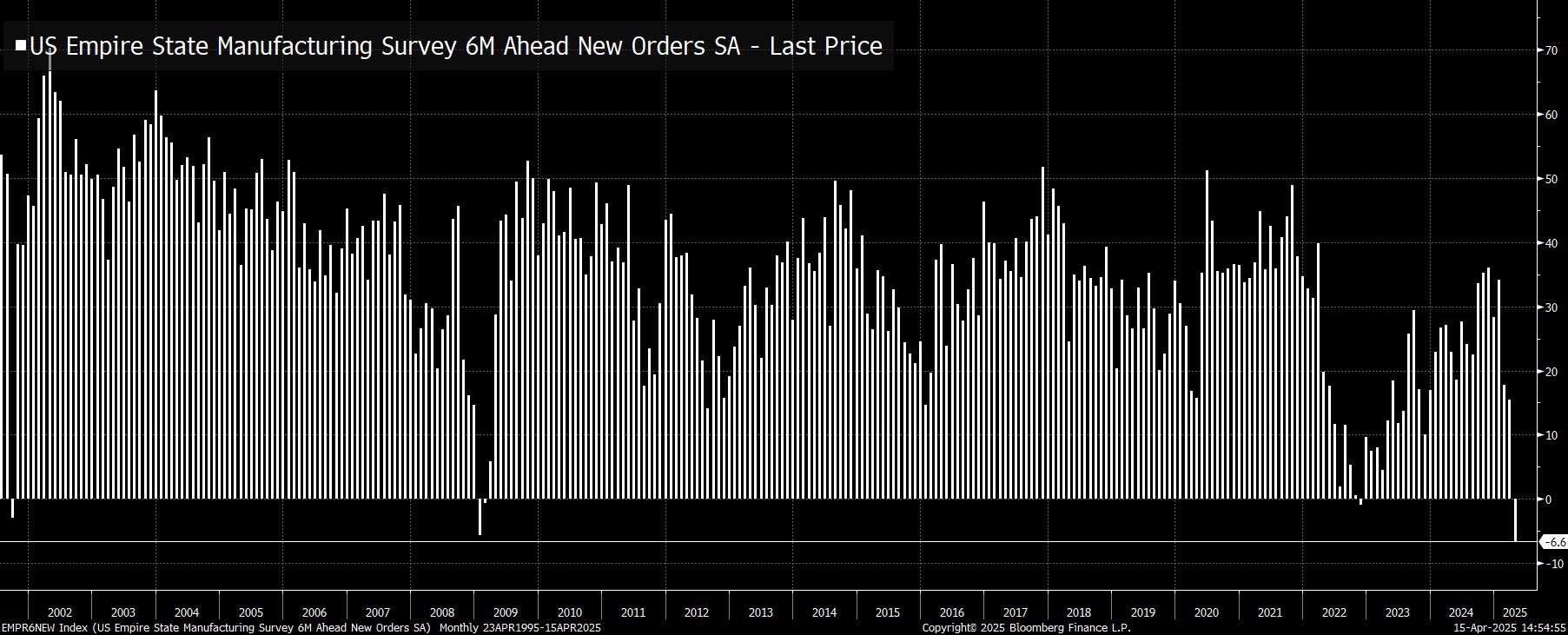 [New York Federal Reserve, 2025-04-15]
Context
This is some of the first data available for the period following Trump’s massive tariff announcements on April 2, 2025. They paint the picture of businesses deeply concerned about a stagflationary environment. It should be cautioned that New York state is has not been a great place to do business for some period of years, so the results for the rest of the country may not be as dire, but as a leading indicator it is worrying.
Tariff Fallout
Goldman Sachs Almost Doubled Their Forecasted Defaults For High-Yield And Leveraged Loan Borrowers. According to the Financial Times, “Goldman Sachs last week raised its forecast for defaults by high-yield and leveraged loan borrowers this year to 5 per cent and 8 per cent respectively, up from 3 per cent and 3.5 per cent. ‘While lower than typical recession levels, these forecasts are well above the long-term averages and reflect multiple simultaneous headwinds to leveraged finance markets,’ said Lotfi Karoui, chief credit strategist at Goldman.” [Financial Times, 2025-04-14]
The Chinese Government Ordered Airlines Not To Take Any Further Delivery Of American Aircraft, Related Equipment, And Parts. According to Bloomberg, “China has ordered its airlines not to take any further deliveries of Boeing Co. jets as part of the tit-for-tat trade war that’s seen US President Donald Trump levy tariffs of as high as 145% on Chinese goods, according to people familiar with the matter. Beijing has also requested that Chinese carriers halt any purchases of aircraft-related equipment and parts from US companies, the people said, asking not to be identified discussing matters that are private.” [Bloomberg, 2025-04-15]
- About 10 Boeing 737 Max Aircraft Were Preparing To Enter Chinese Airline Fleets Before The Order. According to Bloomberg, “About 10 Boeing 737 Max aircraft are preparing to enter Chinese airline fleets, including two each for China Southern Airlines Co., Air China Ltd. and Xiamen Airlines Co., based on data from Aviation Flights Group. Some of the jets are parked near Boeing’s factory base in Seattle while others are at a finishing center in Zhoushan in eastern China, according to the production-tracking firm’s website.” [Bloomberg, 2025-04-15]
April 2025: “Flexport Ocean Freight Bookings From Vietnam Passed Bookings From China For The First Time[.]” According to Ryan Petersen, “Flexport ocean freight bookings from Vietnam passed bookings from China for the first time last week.” [Ryan Petersen, 2025-04-14]
Frozen Bond Market
In The Two Weeks Since Trump Announced His Tariffs, No Debt Has Been Sold In The $1.4 Trillion High-Yield Bond Market. According to the Financial Times, “America’s risky corporate borrowers have been shut out of the bond market since Donald Trump’s tariff blitz, in a freeze that is reverberating across Wall Street and which threatens a tentative rebound in dealmaking. Lowly rated companies have failed to sell any debt in the $1.4tn US high-yield bond market since the president unleashed market turmoil and raised fears of a US recession with the wave of tariffs he announced earlier this month.” [Financial Times, 2025-04-14]
April 2025: Off-The-Run Credit Spreads In Investment Grade Bonds Approached Pandemic Levels. 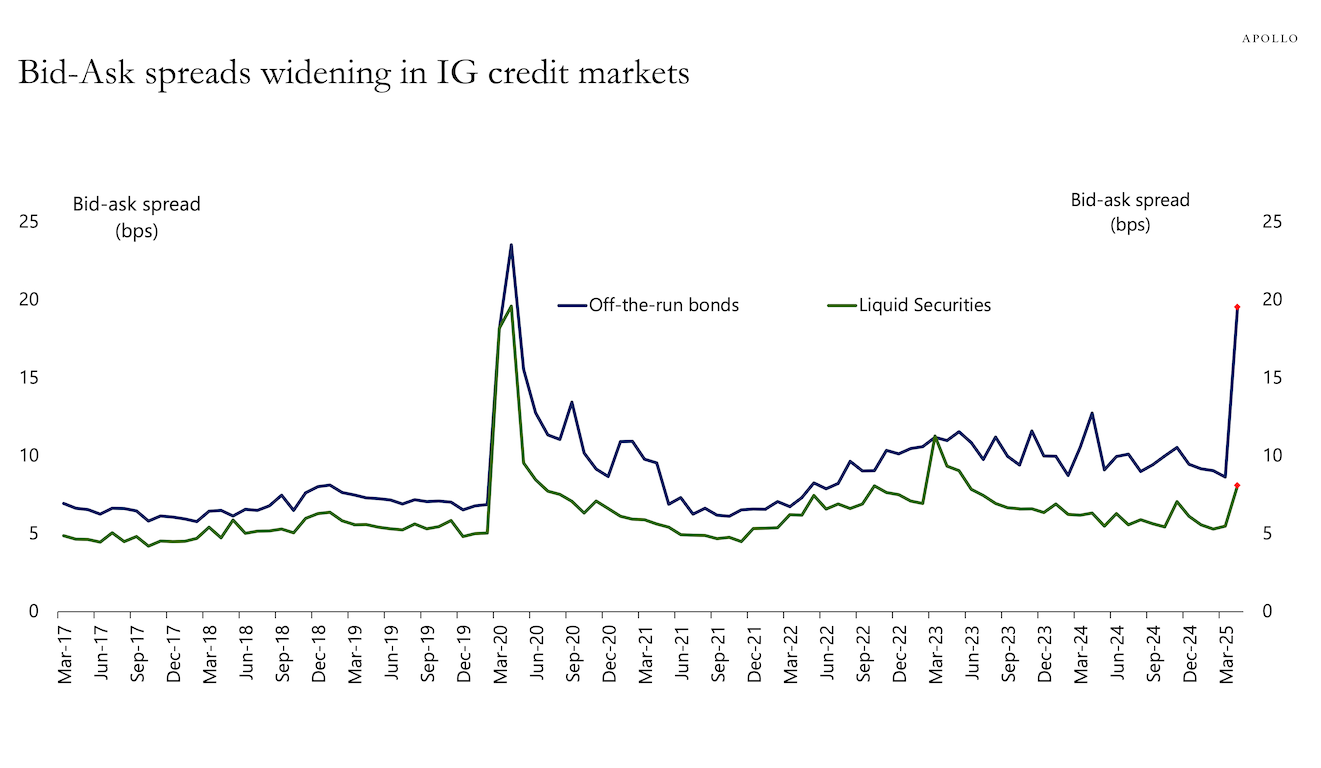 [Financial Times, 2025-04-15]
- Apollo Chief Economist Torsten Sløk: Off-The-Run Bonds Have Become “Virtually Untradeable[.]” According to the Financial Times, “Here’s Sløk’s non-answer. ‘The gap between liquid and illiquid bonds is particularly noteworthy. In 2020, the bid-ask spread widened across the whole market. But this time around, transaction costs have increased materially more for off-the-run paper. This highlights the growing liquidity divide in the public IG market. Liquidity in on-the-run bonds has improved, but off-the-run paper has become virtually untradeable and effectively a buy-and-hold investment.’” [Financial Times, 2025-04-15]
Context: Off-The-Run Bonds
The way the bond market typically works is that when a company issues a bond, there is a lot of trading in it as market participants decide how much they want at which prices, but, gradually, as newer bonds are issued and the right price seems to have been set, bonds will make their way to the long-term portfolios of entities looking to hold them to maturity. As a result, older bonds typically trade less frequently, and so market makers will often impose a higher bid-ask spread on them to compensate for the increased complexity of facilitating trades in them.
For the chart above, Apollo defined “Liquid Securities” as corporate bonds with a nominal value of at least $1 billion issued in the past year, while “Off-The-Run Bonds” are defined as bonds issued more than two years ago for less than $900 billion. Those bonds make up about half of the notional investment-grade corporate bond market, so their being “virtually untradeable” is a big deal.
It means that their holders could have a very hard time offloading them, which means that if financial conditions deteriorate further, and their holders are faced with redemption requests, the mark-to-market value of their assets could fall very fast.
Oil And Gas Industry Suffering
Lower Oil Prices And Higher Input Prices Have Impriled The Oil And Gas Industry. According to Politico, “The U.S. oil industry is suffering from the lowest crude prices in years, surging costs for steel and an economic downturn that could send consumer demand for its products plummeting. Oil prices have tumbled nearly 15 percent since April 2 to their lowest level since April 2021, a drop that is testing oil executives” patience. And it’s prompting some in the industry to warn the White House that Trump’s trade policy risks killing his plan for ‘energy dominance.’” [Politico, 2025-04-14]
Market Analysts Projected A Potential Decline In American Oil Production. According to Politico, “Market analysts are now forecasting that oil production growth in the United States will slow considerably, and could actually decline from the record levels seen last year. If $60 per barrel oil remains the norm through this autumn, U.S. drillers may produce only 200,000 barrels a day more than they had in 2024, reducing the appeal of buying their stocks, said Simon Wong, portfolio manager at investment firm Gabelli Funds.” [Politico, 2025-04-14]
Energy Information Administration: Oil Demand Growth Forecast Declined By 400,000 Barrels Per Day. According to Politico, “The U.S. Energy Information Administration on Thursday cut its oil demand growth forecast by 400,000 barrels a day. Investment bank Macquaire last week said it would likely reduce its previous forecast for U.S. oil production growth to 350,000 barrels a day — a drop of 200,000 barrels from its previous forecast.” [Politico, 2025-04-14]
Consumers Stocking Up
Earnest Analytics: Consumer Spending Spiked On Brands Exposed To Tariffs In The Days After The Announcement. According to the Wall Street Journal, “Data from Earnest Analytics, which tracked anonymous card data of millions of Americans, showed consumer spending rose 33% at Apple, 26% at Restoration Hardware and 10% at Home Depot this past Saturday compared with the average of the previous four Saturdays.” [Wall Street Journal, 2025-04-10]
Q1 2025: Amid Tariff Fears, Credit And Debit Card Spending Increased. According to the Wall Street Journal, “Bank of America increase; green up pointing triangle and Citigroup increase; green up pointing triangle said Tuesday consumer spending ticked higher in the first quarter when concerns about tariffs and the economy began to bubble up. JPMorgan Chase said last week that credit- and debit-card spending rose. Executives also said spending has largely held up in the weeks after the quarter ended, even after President Trump sharply escalated his tariff threats on ‘Liberation Day.’ JPMorgan noted some of that may have been people making purchases in advance of price increases from tariffs.” [Wall Street Journal, 2025-04-15]
Slashing Funding To Grow The Economy
IRA Recessions Could Slow The Market For Electric Trucks
2024: Chinese Shippers Purchased 55 Times As Many Electric Trucks As Their American Counterparts, While Europeans Purchased More Than Twice As Many. According to E&E News, “The hesitance to embrace heavy-duty electric trucks makes American an outlier among its global economic peers. The Chinese bought 82,277 heavy-duty electric trucks last year, according to data compiled by the International Council on Clean Transportation (ICCT), a nonprofit research group. Europe added 3,400. The United States? 1,476.” [E&E News, 2025-04-15]
Trump Administration Sought To Rescind 2022 Climate Law Incentives For Electric Trucks. According to E&E News, “His administration has asked Congress to rescind the 2022 climate law’s financial incentives for factories and tax credits for truck buyers, frozen some of that grant money unilaterally and promised to undo regulations that promote electric trucks.” [E&E News, 2025-04-15]
Despite Offering No Evidence Of Wrongdoing, Trump’s EPA Administrator Lee Zeldin Has Claimed Fraud To Cut Off More Than $7 Billion In Grants Aimed At Supporting A Market Structure In Electric Trucks. According to E&E News, “At the federal level, the Republican-controlled Congress is planning to roll back the tax credits for emissions-free trucks that were created by the 2022 Inflation Reduction Act. The law sparked a boom in battery production and truck building across the country, much of it in Republican-led states. More than 20 Republicans in the House have said they oppose eliminating the tax credit, and its fate is unclear. But the Trump administration is trying to claw back other IRA programs without waiting for Congress — an effort that has sparked numerous legal challenges. EPA Administrator Lee Zeldin’s attempt to cancel $20 billion in climate grants is already affecting the electric truck industry by delaying the market from learning an important number: the price of a used electric truck. Climate United, which was awarded a nearly $7 billion grant by Biden’s EPA to set up a ‘green bank,’ planned to use $250 million to buy 500 new electric trucks to help jump-start a used-truck market. ‘Climate United is taking this issue head-on in a way no one else is doing it,’ said Ray Minjares, the director of heavy-duty vehicle programs at ICCT. Since a new truck is so expensive, most smaller operators buy their trucks from larger operators after a few years of use. That’s what makes knowing the used price essential. With it, new-truck buyers know what they”ll make, and used-truck buyers know what they”ll pay. Price transparency also enables the used-truck buyer to get a loan, since the loaning bank needs to know the price too. But Climate United and other green bank loan recipients have seen their funds frozen. Zeldin has said the program is fraudulent but has offered no proof of wrongdoing. Meanwhile, Climate United is facing insolvency.” [E&E News, 2025-04-15]
Cancellation Of Funding For Texas High Speed Rail
April 2025: Trump’s Secretary Of Transportation Announced A Cancellation Of $63.6 Million In Grants To Support A Texas High-Speed Rail Corridor. According to the Department of Transportation, “U.S. Department of Transportation Secretary Sean P. Duffy today announced an agreement between the Federal Railroad Administration (FRA) and Amtrak to terminate the $63.9 million grant awarded to Amtrak under the Corridor Identification and Development (CID) Program for the Amtrak Texas High-Speed Rail Corridor previously known as the Texas Central Railway project. This project was originally announced as a purely private venture, but as the cost estimates dramatically ballooned, the Texas Central Railway proposal became dependent on Amtrak and federal dollars for development work. The project capital cost is now believed to be over $40 billion – making construction unrealistic and a risky venture for the taxpayer.” [Department of Transportation, 2025-04-14]