April 18, 2025
Macrofinancial Outlook for the Day
Market Gyrations
April 2025: The S&P 500 Moved By More Than 2 Percent For The Most Consecutive Days Since March 2020. 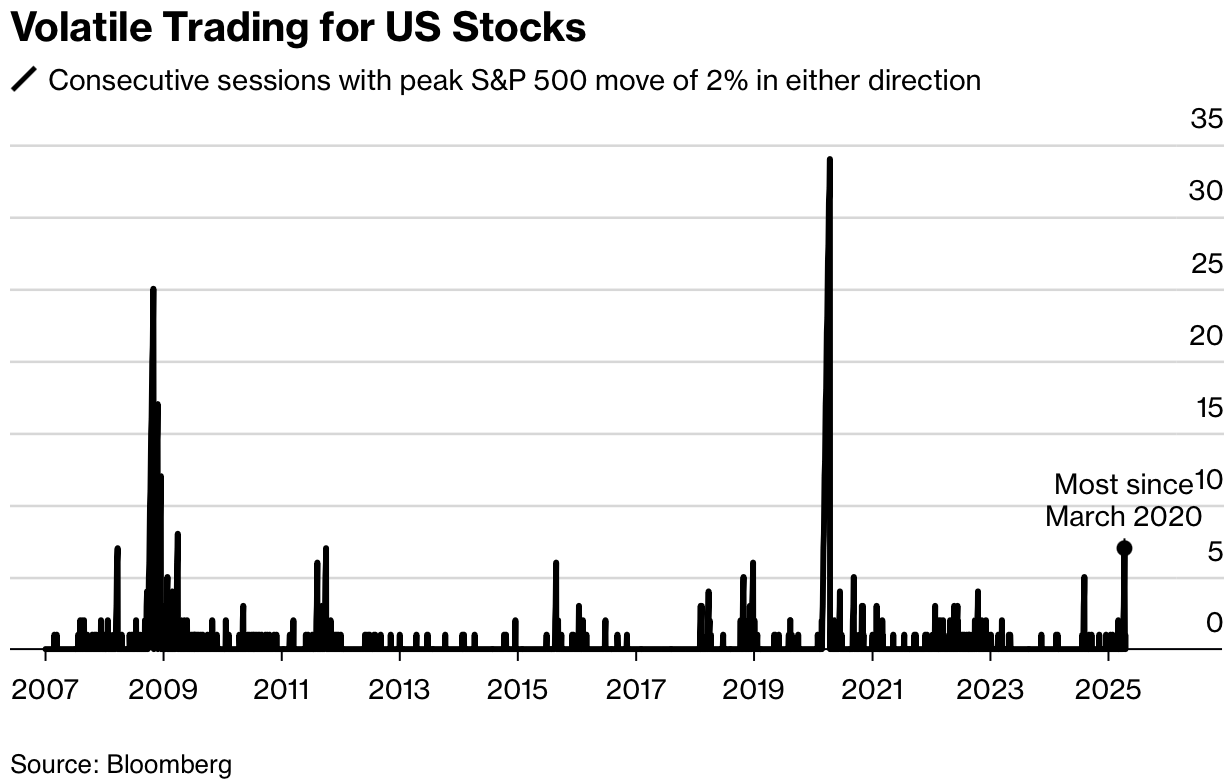 [Bloomberg, 2025-04-17]
 [Financial Times, 2025-04-17]
Goldman Sachs: After Being Previously Bullish On The Dollar, “Negative Governance Trends” Pushed Forecasts To A 6 Percent Drop Over The Next 12 Months. According to the Financial Times, “For example, Goldman Sachs — previously optimistic on the dollar — now predicts the US currency will fall to $1.20 against the euro and ¥135 against the Japanese yen over the next 12 months, equivalent to another 6 per cent weakening from the current levels. “The negative trends in US governance and institutions are eroding the exorbitant privilege long enjoyed by US assets, and that is weighing on US asset returns and the dollar, and may continue to do so in the future unless reversed,” Goldman’s foreign exchange analysts warned.” [the Financial Times, 2025-04-17]
Context
While financial markets seemed to somewhat normalize this week, the fall of the dollar signaled the continued leaching of capital out of American financial markets. Notably, even on a day where the European Central Bank cut interest rates, the dollar fell.
Going back to what I said yesterday about allocation rules and financial contagion, this means that foreign asset managers with a target exposure to American equities will have to sell off other parts of their portfolios to rebalance.
Protectionism
American Manufacturing On Edge
Wisconsin-Based Toolmaker Snap-On Suffered A Market Drawdown After It Reported A “Tariff-Driven” Sales Slump. According to Bloomberg, “Toolmaker Snap-on Inc. fell the most in more than a year after its made-in-America messaging was overshadowed by a tariff-driven sales slump, illustrating how even firms with diversified supply chains are being hurt by proposed levies. The Kenosha, Wisconsin-based firm’s shares dropped 8% on Thursday after it reported its worst quarterly organic sales and profit since 2020. Big-ticket orders were hardest hit, with originations in its financial services unit down 10.9%.” [Bloomberg, 2025-04-17]
- While Overall Sales Dropped 8 Percent, Big-Ticket Orders Dropped 10.9 Percent. According to Bloomberg, “The Kenosha, Wisconsin-based firm’s shares dropped 8% on Thursday after it reported its worst quarterly organic sales and profit since 2020. Big-ticket orders were hardest hit, with originations in its financial services unit down 10.9%.” [Bloomberg, 2025-04-17]
April 2025: In Response To Trump’s Tariffs And The Uncertainty They Have Caused, Mack Trucks Announced They Were Laying Off Between 20 And 30 Percent Of The 1200 Workers At Their Lehigh Valley Operations Center Outside Of Allentown Pennsylvania. According to PennLive, “Mack Trucks will lay off between 250 and 350 workers at its Lehigh Valley Operations center outside Allentown over the next three months, due to economic uncertainty caused by U.S. tariffs, a company spokesperson said Thursday. ‘Heavy-duty truck orders continue to be negatively affected by market uncertainty about freight rates and demand, possible regulatory changes, and the impact of tariffs,’ spokesperson Kimberly Pupillo said. ‘Today we informed our employees that this unfortunately means we”ll have to lay off 250-350 people at LVO over the next 90 days,’ Pupillo said. ‘We regret having to take this action, but we need to align production with reduced demand for our vehicles.’ Union leaders announced the company had confirmed layoffs Thursday afternoon. The plant in Macungie employs around 1,200 workers. ‘Due to the market being in decline, there will be a rate and line reduction. I have heard all the same rumors you guys have heard. This is the first time I have an official word from the company that there will be a layoff,’ United Auto Workers Local 677 shop chair Tim Hertzog said in a letter posted on the union’s Facebook page Thursday.” [PennLive, 2025-04-17]
Corporate Debt Tightening
Some Staples Debt Dropped To A Price Of 60 Cents On The Dollar. According to the Wall Street Journal, “Office-supply chain Staples, which Sycamore Partners bought for $7 billion in 2017, imports much of its inventory from Asia. Prices of some of the company’s bonds dropped to below 60 cents on the dollar in recent weeks. The firm has already returned some money to investors through dividends.” [Wall Street Journal, 2025-04-17]
Fees On Chinese Ships
After Consulting With Shipping Trade Groups, The Trump Administration Is Moving Forward With A Fee Of On Average $4 Million On Each Chinese Ship Sailing To An American Port. According to the Wall Street Journal, “The U.S. is moving forward with a plan to impose fees on Chinese ships calling at American ports. The fees will be charged for each U.S. voyage rather than each call at an American port, the U.S. trade representative’s office said Thursday, a change from the original plan announced in February to charge ships at each port they visited. The USTR said the fees will be only imposed on any given ship up to five times a year. The trade representative’s office said in six months it will begin charging Chinese vessel owners and operators $50 a net ton on each U.S. voyage. The fee will increase by $30 a net ton a year for the next three years. Non-Chinese operators of Chinese-built ships will be charged based on net tonnage or by container, starting at $18 a net ton or $120 a container in six months and increasing by $5 a net ton or the proportional amount for containers each year over the next three years. Ships that travel from China to the U.S. typically move an average of around 12,000 40-foot containers.” [Wall Street Journal, 2025-04-17]
- After Being Warned That The Earlier Plan To Charge The Fee Per Port Of Call Would Be Economically Damaging To Smaller Ports, The Trump Administration Changed The Structure To Per Trip. According to the Wall Street Journal, “A typical sailing from Asia involves an average of four U.S. port calls. Shipping companies and trade groups had warned that fees charged at each port call would result in higher costs for American consumers, hurt U.S. farm exports and threaten dockworker jobs. Container operators had said they would cut their calls to U.S. ports by half. The port-fee plan is part of an effort by the Trump administration to revive shipbuilding in the U.S. The plan is in response to a U.S. probe that began under President Joe Biden in March 2024. The USTR determined in January that China was involved in unfair trade practices in the maritime, logistics and shipbuilding sectors.” [Wall Street Journal, 2025-04-17]
The Restrictions Would Go Into Effect By October 2025, And The Fees Would Go To Subsidize Domestic Ship Builders. According to Bloomberg, “The so-called 301 petition ordered the fee to go into effect in six months, with another phase restricting foreign-built liquefied natural gas vessels to begin in three years. Funds from the docking fees would be used to revitalize the US’ waning shipbuilding industry, which long ago pivoted from building commercial ships to focusing on naval contracts.” [Bloomberg, 2025-04-17]
A Threat To LNG Exports?
2028: Limits Would Be Placed On What Types Of Ships Could Carry Exported LNG, Which The United States Is Currently The World’s Top Exporter Of. According to Bloomberg, “A second phase beginning in three years would limit liquefied natural gas shipments on foreign vessels, with restrictions increasing incrementally over 22 years. The US is the world’s biggest exporter of LNG.” [Bloomberg, 2025-04-17]
Oil Exports
As Chinese Purchases Of American Oil Have Dropped By 90 percent, Canadian Sellers Have Been Able To Sell Into That Market. According to Bloomberg, “Chinese refiners are importing record amounts of Canadian crude after slashing purchases of US oil by roughly 90% amid escalating trade tensions. A pipeline expansion in Western Canada that opened less than a year ago has presented China and other East Asian oil importers with expanded access to the vast crude reserves in Alberta’s oilsands region. Chinese crude imports from the port at the pipeline terminus near Vancouver soared to an unprecedented 7.3 million barrels in March and are on pace to exceed that figure this month, according to data from Vortexa Ltd., which tracks waterborne oil and natural-gas shipments. Meanwhile, Chinese imports of US oil have collapsed to 3 million barrels a month from a peak of 29 million in June.” [Bloomberg, 2025-04-16]
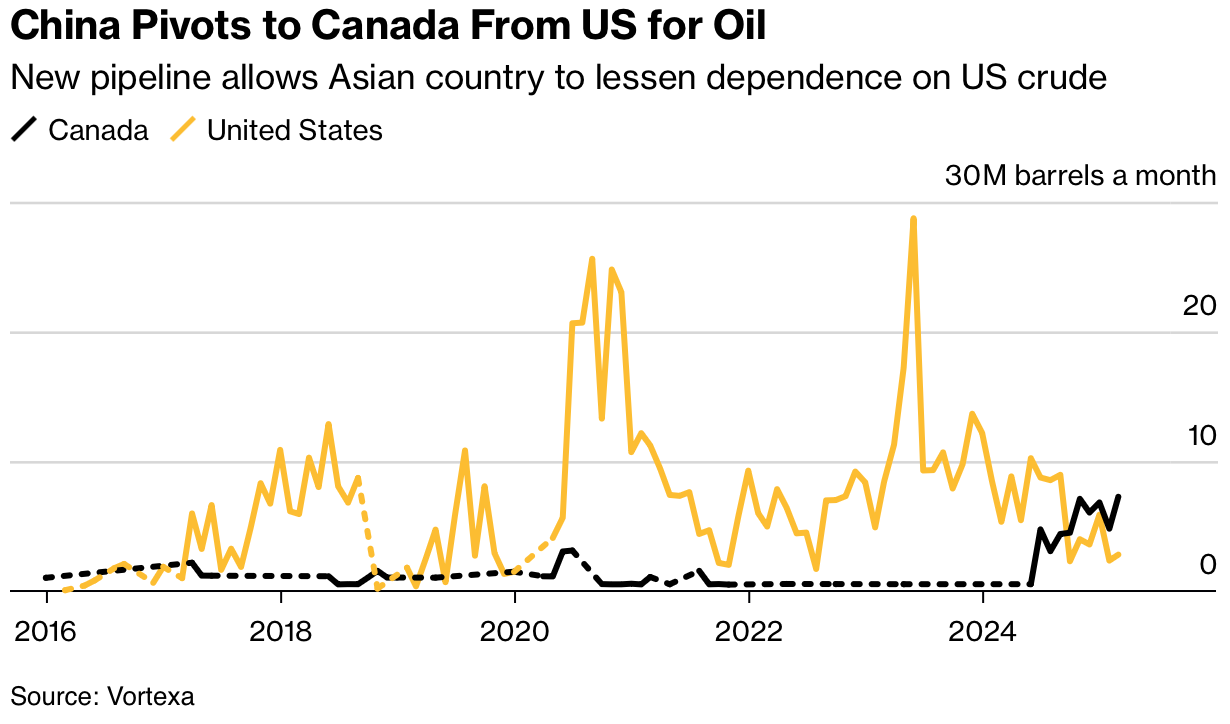 [Bloomberg, 2025-04-16]
Perception
March 2025: Americans Saw Tariffs As Bad For The Country And Likley Worse For Themselves. 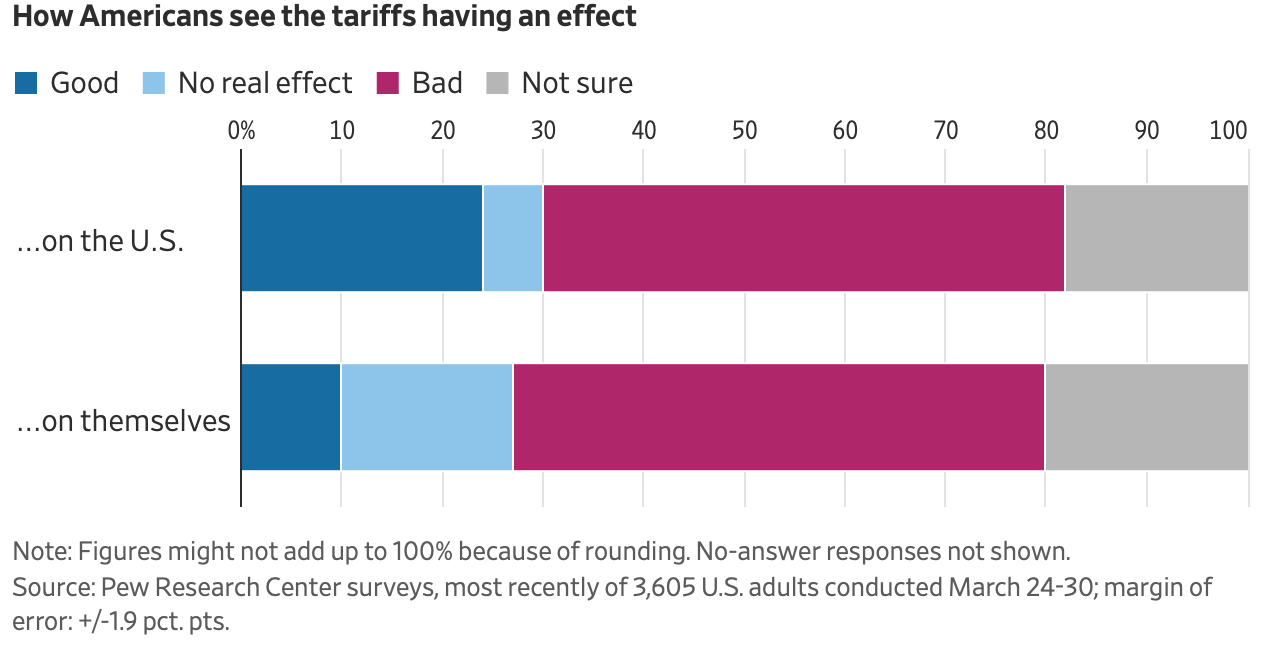 [Wall Street Journal, 2025-04-17
Private Equity
WSJ Headline: Private Equity World Engulfed By Perfect Storm. [Wall Street Journal, 2025-04-17]
“We Aren’t Even In A Recession Now, And We’re Already At A Point Where Things Are Increadibly Challenging.” According to the Wall Street Journal, “Even before President Trump’s tariff chaos, buyout firms had been struggling to sell their portfolio companies and return money to anxious investors. Now recession fears and market turmoil have brought dealmaking to a near standstill. Shares of Apollo Global Management, Blackstone, KKR and other private-equity fund managers are down 20% or more this year, far worse than the S&P 500’s sharp losses. The longer the deal logjam lasts, the harder it will be for firms to hand money back to clients such as pensions and endowments. The amount of unrealized value the funds owe their investors has hit record levels, according to an analysis by credit-ratings firm Moody’s Ratings. That makes it tougher for the firms to raise new funds. “We aren’t even in a recession now, and we’re already at a point where things are incredibly challenging,” said Hugh MacArthur, chairman for private equity at Bain & Co. ” [Wall Street Journal, 2025-04-17]
April 2025: Private Equity Firms Were Sitting On 29,000 Companies Worth $3.6 Trillion, Half Of Which Had Been Owned For More Than Five Years. According to the Wall Street Journal, “Firms are sitting on a record 29,000 companies worth $3.6 trillion, half of which they have owned for five years or more, he said. Clients are becoming less willing to make new investments and buyout fundraising dropped by almost 25% last year, he said.” [Wall Street Journal, 2025-04-17]
Trade-Exposed Companies Like Staples, Which Had Increased Leverage Due To A Dividend Recapitalization, Saw Its Debt Tank. According to the Wall Street Journal, “Office-supply chain Staples, which Sycamore Partners bought for $7 billion in 2017, imports much of its inventory from Asia. Prices of some of the company’s bonds dropped to below 60 cents on the dollar in recent weeks. The firm has already returned some money to investors through dividends.” [Wall Street Journal, 2025-04-17]
Moodys: Private Equity Firms Have A More Than Two Decade Low In “Dry Powder” Relative To Assets Locked Up In Companies. According to the Wall Street Journal, “The amount of money firms have on hand, or “dry powder,” relative to the amount they have locked up in unsold companies is at a record low, according to Moody’s.” [Wall Street Journal, 2025-04-17]
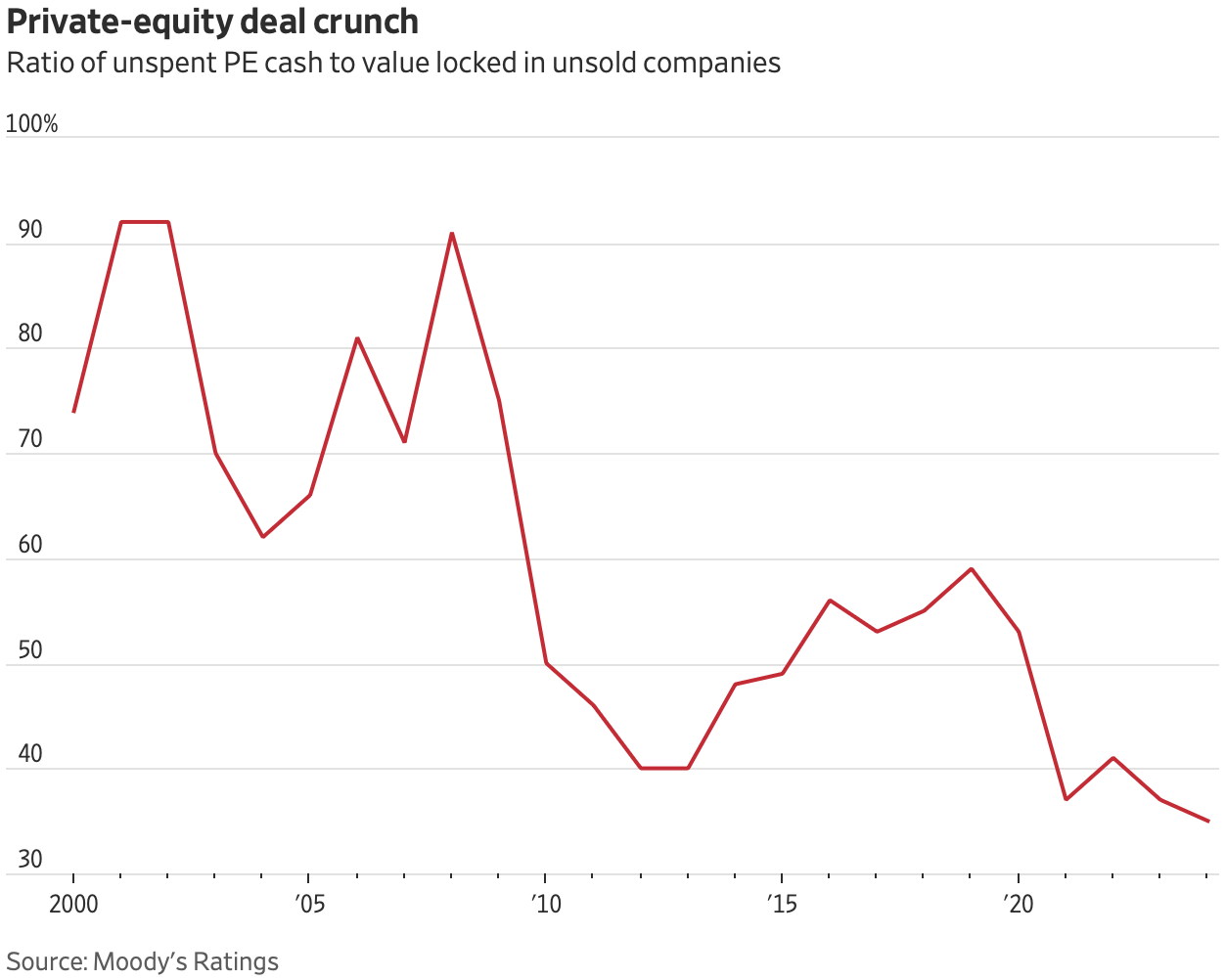 [Wall Street Journal, 2025-04-17]
Economic Destruction
April 2025: Weather Analysis Tools Provided By The Government For 27 States Went Dark. According to Bloomberg, “Weather analysis tools used by a wide array of businesses and government entities across the US have gone dark after funding for long-running regional climate hubs lapsed. The websites for four US National Oceanic and Atmospheric Administration regional centers serving 27 states across the central and southern US — including Texas, Florida, Ohio, the Dakotas and the Carolinas — are no longer accessible, according to service notifications posted on the centers’ home pages.” [Bloomberg, 2025-04-17]
- Just One Of The Weather Centers Had Logged More Than 190 Weather Disasters That Had Cost $1 Billion Or More. According to Bloomberg, “Texas, where the Southern Regional Climate Center is based, has been the US epicenter of extreme weather for decades and in recent years has been battered by a long string of events that included hurricanes, a deadly freeze that killed more than 200 people in 2021 and the state’s largest fire in early 2024. From 1980 to 2025, it logged 190 weather disasters costing $1 billion or more, according to the US National Centers for Environmental Information.” [Bloomberg, 2025-04-17]
New Economy
DOGE Has Prepared Cuts To The Energy Department That Could Hit $10 Billion In Federal Funding For Energy Development Projects Being Built Out By Major American Corporations. According to the Wall Street Journal, “The Energy Department is preparing dramatic cuts that could halt nearly $10 billion in federal funding for clean-energy projects—and some of its highest profile partnerships with Exxon Mobil and Occidental Petroleum are at stake. The proposed cuts would upend government contracts with energy companies working on hydrogen, carbon capture, long-duration energy storage and other technologies, according to department memos reviewed by The Wall Street Journal. Thousands of DOE jobs are expected to be eliminated. The cuts are part of a broad campaign by President Trump’s Department of Government Efficiency to shrink the scale of the government and its spending. DOGE efforts, led by Trump adviser Elon Musk, have slashed contracts and resulted in thousands of job cuts across the federal workforce so far. The $10 billion sum reflects potential funding cuts in two DOE offices and likely a slice of the DOGE-driven cancellations under consideration across the Energy Department, according to current and former officials. Trump has made no secret of his disdain for clean energy. On Inauguration Day, he told supporters: “Big ugly windmills, they ruin your neighborhood.” His “energy dominance” plan includes unleashing American oil and gas on the world stage and reviving the dwindling coal industry. Among the partnerships at risk of losing DOE funding are those with Exxon to use hydrogen for fuel at a large ethylene plant, NextEra Energy for long-duration storage and Occidental Petroleum for carbon capture in South Texas. The companies declined to comment.” [Wall Street Journal, 2025-04-17]
- While Four Hydrogen Hubs In Democratic Leaning Areas Have Been Had A Withdrawl Of Funding Considered, The Three Hubs In Republican Leaning Areas Seem Safe. According to the Wall Street Journal, “It is also considering withdrawing funding from four regional hydrogen hubs, largely in Democratic-leaning regions, while continuing to help fund three hydrogen hubs in largely Republican areas. The regional hubs are meant to accelerate the commercial use of hydrogen, which doesn’t produce carbon emissions when burned.” [Wall Street Journal, 2025-04-17]
Jigar Shah, Who Ran The DOE Loan Program During The Biden Administration Said There Was A Risk Of The Technologies Moving Abroad, Like They Did With Solar Panels, Batteries, And EVs. According to the Wall Street Journal, “Jigar Shah, who ran the office during the Biden administration, said the risk is companies will take their technologies, manufacturing and projects to other countries. The U.S. has a long history of making key advancements in technologies—including solar, battery storage and EVs—but letting China dominate their development and commercialization. ‘That just makes me so sad that we had convinced all of these investors that this time was different and that we really wanted people to look to the United States to commercialize their technology, and now they”re receiving the opposite message,’ Shah said.” [Wall Street Journal, 2025-04-17]
Bloomberg Headline: Trump’s Offshore-Wind Halt Risks $28 Billion Of Investment. [Bloomberg, 2025-04-17]
- Following Trump’s Order, Equinor Suspended Construction Of Its Empire Wind Project, Leaving The $1.5 Billion In Work To Wait. According to Bloomberg, “Equinor ASA suspended construction of its Empire Wind project off New York, complying with an order from US President Donald Trump. ‘Immediate steps were taken by Empire and its contractors to initiate suspension,’ Equinor said Thursday in a statement. The company is ‘considering its legal remedies, including appealing the order.’ While Trump, a longtime critic of wind turbines, had made clear that early-stage developments would be slowed or thwarted, it has come as a shock to the industry that the president would stop a project in full swing. Empire Wind, which was slated to start commercial operation in 2027, has a gross book value of about $2.5 billion, including the South Brooklyn Marine Terminal, according to the statement. Equinor said about $1.5 billion had been drawn under the project finance loan as of the end of March. ‘Equinor US Holdings Inc. has provided guarantees for the equity commitment,’ it said. ‘In a full stop scenario, the $1.5 billion will be repaid from the equity commitment to the project finance lenders and Empire Offshore Wind LLC will be exposed to termination fees towards its suppliers.’” [Bloomberg, 2025-04-17]
Housing
April 2025: The Entire Staff Of The White House Agency In Charge Of Coordinating The Anti-Homelessness Was Placed On Leave. According to Bloomberg, “The entire staff of the White House agency tasked with coordinating the federal government’s efforts to combat homelessness was placed on leave on April 15. All 13 employees of the US Interagency Council on Homelessness, or USICH, received notice from the agency’s acting director on Tuesday informing them that they were being put on administrative leave, starting immediately, according to three people familiar with the matter.” [Bloomberg, 2025-04-16]
- Despite Legal Requirements That The Agency Have At Least Six Employees, The Directive Pushed Through By A DOGE Official Seems To Have Gone Into Effect. According to Bloomberg, “Trump’s order called for the staffing and functions of these agencies to be reduced to the minimum required by law. But the actions by USICH acting director Kenneth Jackson, an official with Elon Musk’s Department of Government Efficiency, appear to violate the statutory guidelines that established the agency. USICH is required by federal law to develop a comprehensive strategic plan to address homelessness and deliver an annual report to Congress on its implementation. The council was established by the McKinney-Vento Homeless Assistance Act of 1987, the Reagan-era bill that first authorized federal funding for homeless shelters, and further clarified by Congress in 2009. It comprises the secretaries and directors of 19 different federal agencies, among them the Departments of Health and Human Services, Housing and Urban Development and Veterans Affairs. Four times a year, the leaders of those agencies convene to coordinate the government’s work on homelessness. The law requires the heads of USICH’s constituent agencies to hire an executive director. It also stipulates that USICH must employ at least five regional field advisors.” [Bloomberg, 2025-04-16]
The Primary Purpose Of USICH Has Been To Help Local Governments Navigate Federal Bureaucracy. According to Bloomberg, “While the council is tiny — with an appropriation for 18 full-time staffers and a FY 2024 budget of $4 million — it plays an important role in coordinating the efforts of cabinet-level agencies. But its greater mission, according to former staffers, is helping local governments navigate federal bureaucracy. Cities and counties receive housing and homelessness funds from a variety of sources, including the VA, HUD, HHS and the US Department of Agriculture. To sort through how those dollars can be used, especially in combination toward novel solutions, local governments often turn to USICH for guidance.” [Bloomberg, 2025-04-16]
- USICH Was Credited With Helping To Reduce Veteran Homelessness. According to Bloomberg, “A 2016 report by researchers at the nonprofit Urban Institute credited USICH with reducing veteran homelessness, which has dropped dramatically since 2010. USICH staff facilitated data sharing between the Department of Defense, the VA and HUD to implement housing vouchers for veterans. The agency has compiled numerous case studies on housing for veterans, starting in 2015 with New Orleans, the first major city to end veteran homelessness. At the local level, the agency’s staffers helped government leaders determine the appropriate uses of funds as varied as Social Security Disability Insurance, Temporary Assistance for Needy Families and Medicaid to help people struggling with housing, according to the researchers.” [Bloomberg, 2025-04-16]
Financial (De)Regulation
Stress Tests
The Fed Delayed The Effective Date Of Stress-Test Capital Buffer Requirements By One Quarter. According to Bloomberg, “The US Federal Reserve launched a potential overhaul of stress tests for big banks that would average the results over two years and give extra time to adjust to new capital requirements. The Fed said Thursday that it intends to delay the effective date of the annual stress-capital buffer requirement from Oct. 1 to Jan. 1 of the next year. Its proposal will also make ‘targeted changes’ to streamline stress test-related data collection, the central bank said in a statement.” [Bloomberg, 2025-04-17]
Following A Lawsuit From Banks And Business Groups, Newer Stress Test Models Will Be More Public. According to Bloomberg, “Later this year, the Fed is set to propose more changes to improve the transparency of stress tests, the annual health check-ups that seek to gauge how lenders would fare during a hypothetical recession. ‘Those changes include disclosing and seeking public comment on the models that determine the hypothetical losses and revenue of banks under stress, and ensuring that the public can comment on the hypothetical scenarios used for the annual stress test before the scenarios are finalized,’ the Fed said. Banking and business groups sued the Fed last year over the tests, contending that the Fed’s criteria for the tests are designed in secret and lead to ‘vacillating and unexplained requirements and restrictions on bank capital.’” [Bloomberg, 2025-04-17]
- **Former Fed Vice Chair Of Supervision And Current Governor Barr: Banks Could “Game The Capital Requirements Once They Know The Details Of The Stress Test.** According to Bloomberg,”The Fed proposal drew sharp criticism from Governor Michael Barr, until recently the vice chair for supervision. ‘These changes risk turning stress testing into an ossified exercise that will provide false comfort in the resilience of the system,’ he said in a separate statement. Barr also said banks are ‘likely to game the capital requirements once they know the details of the stress test.’” [Bloomberg, 2025-04-17]
CFPB
The Trump Administration Announced Plans For CFPB To Cut Supervision By Half. According to Bloomberg, “America’s top consumer financial watchdog has spelled out its priorities under the Donald Trump era, including a dramatic cut to supervision and a shift away from financial technology firm oversight. The Consumer Financial Protection Bureau said it will curb the number of supervision ‘events’ by 50% and leave other enforcement actions to states, according to an email to staff seen by Bloomberg News. The move will ‘avoid the ever-increasing number of supervisory exams, which are multiplying the cost of running businesses and raising consumer prices,’ it said.” [Bloomberg, 2025-04-17]
Trump’s CFPB Will Deprioritize Anti-Consumer Behavior In “Areas Such As Medical Debt, Student Loans, Consumer Data And Digital Payments.” According to Bloomberg, “In its email, the agency said its focus will be fraud against consumers, with mortgages the highest priority as well as targeting fraudulent overcharges and fees. It will deprioritize areas such as medical debt, student loans, consumer data and digital payments, it said.” [Bloomberg, 2025-04-17]
Trump’s CFPB Claimed It Would Not Facilitate Discrimination, But Would Not Use Quantitative Or Qualitative Evidence In Building Those Cases. According to Bloomberg, “The CFPB will also not facilitate “unconstitutional racial classification or discrimination in its enforcement,” according to the email. It specified that it would not bring cases on redlining solely based on statistical evidence or “stray remarks that may be susceptible to adverse inferences.”” [Bloomberg, 2025-04-17]
Elizabeth Warren: “Almost All” CFPB Staff Recieved Layoff Notices. According to Bloomberg, “The Consumer Financial Protection Bureau issued another round of termination notices to staff on Thursday, the latest effort to dismantle a regulatory agency that has long been a target of Republicans. ‘This RIF action is necessary to restructure the Bureau’s operations to better reflect the agency’s priorities and mission,’ Acting CFPB Director Russ Vought said in reduction-in-force notices sent to employees and seen by Bloomberg News. Some employees were notified they would lose access to their accounts by Friday evening. They were also warned not to send any agency information or data to personal email addresses or risk facing disciplinary action, according to a message from the agency’s Office of Human Capital that was reviewed by Bloomberg. Official termination from work duties may not occur for several weeks, according to the documents. Spokespeople for the CFPB did not immediately respond to requests for comment and to provide information on how many employees received the notices. US Senator Elizabeth Warren of Massachusetts — the ranking Democrat on the Senate Banking Committee — said in a statement that the CFPB had sent the notices to ‘almost all’ staff. The agency had more than 1,700 employees as of earlier this year.” [Bloomberg, 2025-04-17]
The Trump CFPB Will Move Away From Supervision Of Nonbank Companies, With Supervision Of Those Companies Expected To Fall By 75 Percent. According to Bloomberg, “The Consumer Financial Protection Bureau said it will curb the number of supervision ‘events’ by 50% and leave other enforcement actions to states, according to an email to staff seen by Bloomberg News. The move will ‘avoid the ever-increasing number of supervisory exams, which are multiplying the cost of running businesses and raising consumer prices,’ it said. The agency will also shift its attention back to banks rather than non-deposit taking firms like fintechs and digital payment companies, according to the email sent by Chief Legal Officer Mark Paoletta, a Trump appointee. The goal is for 70% of the bureau’s supervision to focus on banks and other deposit-taking firms — which was the status in 2012 — compared to less than 40% now, it said.” [Bloomberg, 2025-04-17]
- Bloomberg Headline: How Virtual Banking Made Saving Risky Again. According to Bloomberg, “” [Bloomberg, 2025-04-10]