April 2025: Trade-Driven Uncertainty Was Pervasive Across The National Economy. According to the Federal Reserve, “Economic activity was little changed since the previous report, but uncertainty around international trade policy was pervasive across reports. Just five Districts saw slight growth, three Districts noted activity was relatively unchanged, and the remaining four Districts reported slight to modest declines. Non-auto consumer spending was lower overall; however, most Districts saw moderate to robust sales of vehicles and of some nondurables, generally attributed to a rush to purchase ahead of tariff-related price increases. Both leisure and business travel were down, on balance, and several Districts noted a decline in international visitors. Home sales rose somewhat, and many Districts continued to note low inventory levels. Commercial real estate (CRE) activity expanded slightly as multifamily propped up the industrial and office sectors. Loan demand was flat to modestly higher, on net. Several Districts saw a deterioration in demand for non-financial services. Transportation activity expanded modestly, on balance. Manufacturing was mixed, but two-thirds of Districts said activity was little changed or had declined. The energy sector experienced modest growth. Agricultural conditions were fairly stable across multiple Districts. Cuts to federal grants and subsidies along with declines in philanthropic donations caused gaps in services provided by many community organizations. The outlook in several Districts worsened considerably as economic uncertainty, particularly surrounding tariffs, rose.” [Federal Reserve, 2025-04-23]
In A Majority Of The Fed’s Districts, The Economic Outlook Worsened, Driven By Tariff-Led Uncertainty. According to the Federal Reserve, “The outlook in several Districts worsened consid erably as economic uncertainty, particularly surrounding tariffs, rose.” [Federal Reserve, 2025-04-223]
Nationwide, Firms Noted Higher Input Prices, Portending Higher Consumer Prices And/Or Tighter Margins Going Forward. According to the Federal Reserve, “Prices increased across Districts, with six characterizing price growth as modest and six characterizing it as moderate, similar to the previous report. Most Districts noted that firms expected elevated input cost growth resulting from tariffs. Many firms have already received notices from suppliers that costs would be increasing. Firms reported adding tariff surcharges or shortening pricing horizons to account for uncertain trade policy. Most businesses expected to pass through additional costs to customers. However, there were reports about margin compression amid increased costs, as demand remained tepid in some sectors, especially for consumer-facing firms.” [Federal Reserve, 2025-04-23]
Business Trends and Outlook Survey
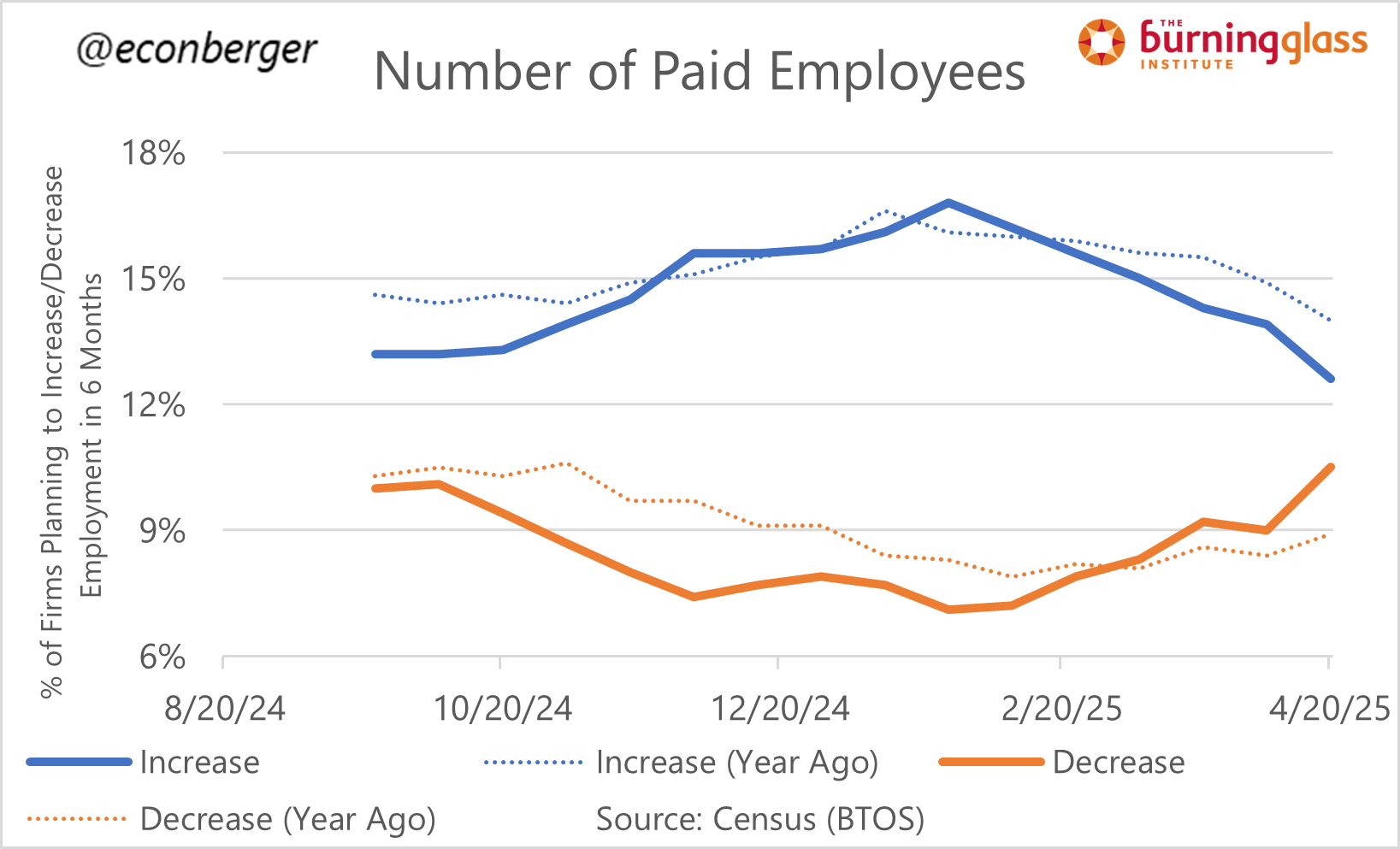
April 2025: Census Survey Of Business Trends And Outlook Showed Declines In Figure Demand And Employment, With An Increase In Future Prices. [Census Bureau, 2025-04-24]
Guy Berger of Burning Glass Institute: The Share Of Firms Planning To Expand Employment Has Declined While The Share Of Firms Planning To Increase Output Has Increased. According to Guy Berger, [Guy Berger, 2025-04-24]
Trade War
Consequences
The “Sell America Trade” Has Wiped Out Necessary Savings, Including For Things Like 529 Plans. According to Bloomberg, “Lisa Seibold, who works for JPMorgan Chase & Co. in New York, has a junior and senior in high school. She and her husband have been contributing to their tax-advantaged 529 plans since they were five days old, putting about $400 a month into each account. When she checked after Trump sent markets spiraling with new tariff announcements on April 2, she was down almost $50,000 — roughly what they have to pay in tuition at the University of Delaware, where her older son will be attending in the fall. ‘We”ve sacrificed — we don’t splurge, we do the right thing, and now here we are in this totally screwed up situation,’ she said. ‘It’s beyond aggravating.’ Seibold said her 529 plans were diversified across fixed income, large- and small-cap US equities and some international exposure. Now, she’s allocating future contributions into fixed income. If the market keeps falling, the family might have to tap into their home equity line of credit to pay for tuition for the first semester, which is due around August. The S&P 500 has fallen about 12% so far this year, walloped by a slew of new tariffs that is fueling a sell-America trade. The stock plunge came as colleges across the US released their updated sticker prices for the 2025-26 school year, with a handful now in the six-figure range.” [Bloomberg, 2025-04-22]
Empty Shelves
April 2025: Senior Executives At American Retailers Told Trump His Tariffs Could Raise Prices For Consumers. Afterwards, Trump Said His Tariffs Would “Come Down Substantially.” According to the Wall Street Journal, “On Monday, Trump met at the White House with senior executives from the country’s biggest retailers, including Target, Walmart and Home Depot. They told the president that his tariffs, particularly the duties he placed on China, could raise prices for consumers, a person familiar with the conversation said. A day later, Trump told reporters that the 145% tariffs on Chinese imports were ‘very high’ and would ‘come down substantially.’ Administration officials are discussing how much lower the tariffs should be, according to people familiar with the matter.” [Wall Street Journal, 2025-04-23]
April 2025: The CEOs Of Those Retailers Told Trump “Shelves Will Be Empty” If He Kept His Tariffs Going At The Pace He Announced Them. According to Axios, “President Trump got a scare from CEOs and markets on Monday. On Tuesday, he blunted some of his sharpest threats — signaling a softer stance on China and retreating from fiery rhetoric targeting the Fed. Why it matters: The president is resolute in his goal of reshaping the economy. But he’s sensitive to the movement of the markets and the pleas of powerful corporate leaders and investors who fear the worst from his sweeping efforts. Zoom in: Monday was a tough day for Trump’s goal of reshaping the global economy. The CEOs of three of the nation’s biggest retailers — Walmart, Target and Home Depot — privately warned him that his tariff and trade policy could disrupt supply chains, raise prices and empty shelves, according to sources familiar with the meeting.”The big box CEOs flat out told him [Trump] the prices aren’t going up, they’re steady right now, but they will go up. And this wasn’t about food. But he was told that shelves will be empty,’ an administration official familiar with the meeting told Axios.” [Axios, 2025-04-23]
Port Of Los Angeles: From April 20 To May 10, Weekly Import Volumes Will Decrease By Almost 40 Percent. [Port of Los Angeles, accessed 2025-04-24]
Code
include("../scripts/oxocarbon-plot.jl")theme(:oxocarbon)usingDatesweek_start = [Date(2025,4,20), Date(2025,4,27), Date(2025,5,4)]volume = [119_784, 85_486, 74_925]bar(week_start, volume ./1_000, title="Port of Los Angeles Import Volumes", xlabel="Week Starting", ylabel="Volume ('000 TEU)", legend=false)
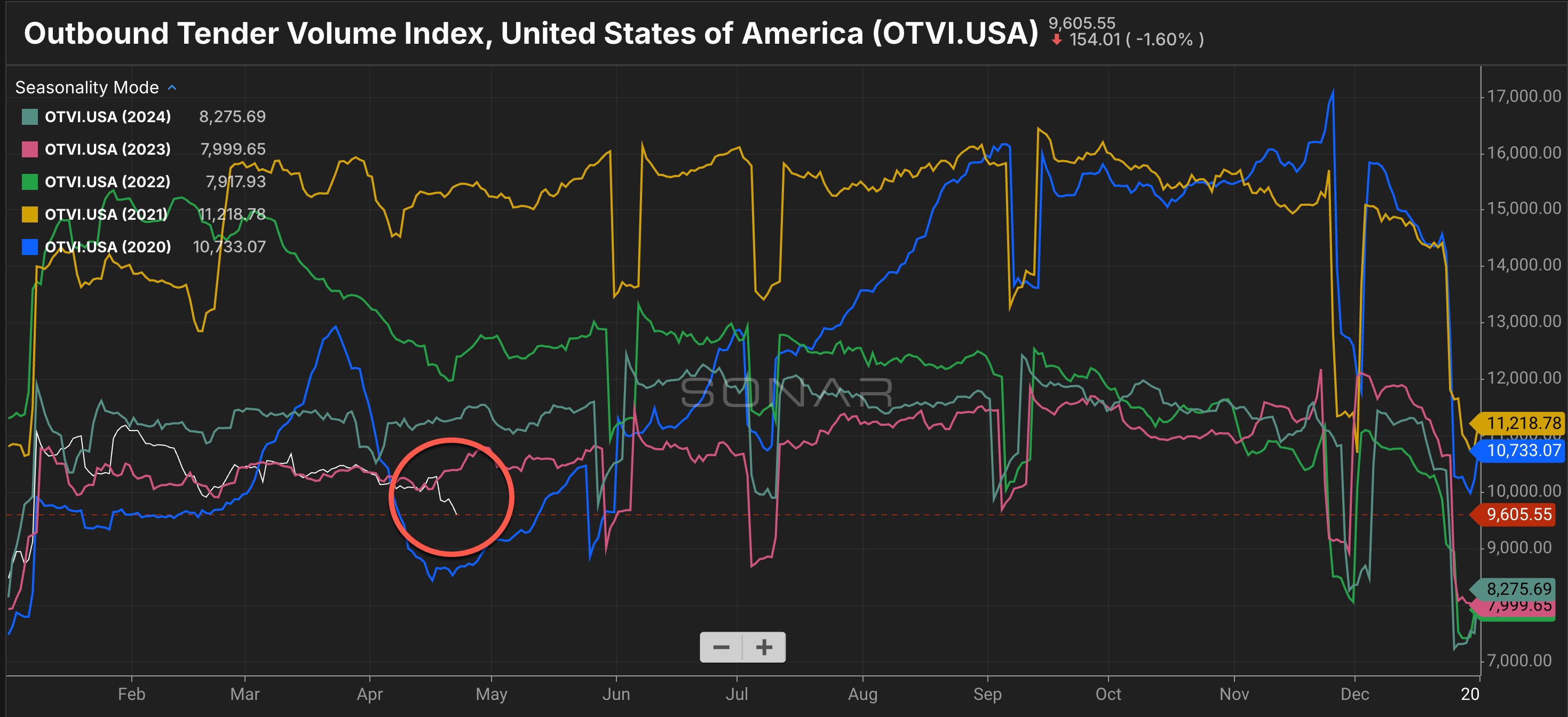
April 2025: Trucking Volume Dropped Below Every Year Since 2020. According to Craig Fuller, [Craig Fuller, 2025-04-23]
Ryan Petersen: Since Trump’s Tariffs Were Announced, Ocean Bookings From China Dropped 60 Percent. According to Ryan Petersen, “In the 3 weeks since the tariffs took effect, ocean container bookings from China to the United States are down over 60% industry wide.” [Ryan Petersen, 2025-04-23]
Petersen: “We Will Also Have Mass Shortages This Summer As The Goods Don’t Show Up.” According to Ryan Petersen, “We will also have mass shortages this summer as the goods don’t show up. The first ships carrying goods paying the duties arrived on Monday. And the decline in freight arrivals will hit in the coming weeks.” [Ryan Petersen, 2025-04-23]
Petersen: A “Bullwhip Scenario” Is Possible. According to Ryan Petersen, “Soon we may find ourselves in a bullwhip scenario where Trump relaxes the tariffs, all those cancelled orders get rebooked creating a huge surge. And with all the cancelled services and repositioned vessels, there won’t be enough throughput in the ocean network to keep up. The result will be surge pricing on ocean, perhaps higher than we saw in 2024 with the Red Sea being cut off, and approaching levels from 2021-22 when container rates from China to the U.S. hit $20k.” [Ryan Petersen, 2025-04-23]
Bullwhip Scenario
The Bullwhip effect is what happens when disruption in supplies causes firms to sell out of inventory in a way that reduces inventory. When that disruption ends, therefore, demand surges, as firms need to build their inventory up in addition to meeting current demand. The logistics industry is built to accommodate normal consumer demand plus a bit of redundancy, but these types of surges are beyond its capability.
That happened in the aftermath of COVID, where China’s continued lockdowns and the end of ours led to a situation in which there was an imbalance between consumer demand and the capacity to transport those goods through places like the ports of Los Angeles and Long beach. That forced prices up, and the result was a massive increase in shipping costs, which in turn were passed on to consumers through higher prices.
Market Volatility Has Been A Boon For The Finance Industry
Q1 2025: The Market Volatility Driven By Trump Has Allowed Jane Street’s Expected Net Trading Revenues To Jump 60 Percent From A Year Earlier. According to the Financial Times, “Trading levels at Jane Street surged further in the first quarter, as US President Donald Trump’s tariff proposals unleashed chaos in markets. The results come as Jane Street looks to bolster its balance sheet by borrowing $1.35bn through high-yield debt markets on Wednesday, according to people familiar with the matter. The firm’s ability to thrive during market turbulence is helping its debt gain traction with investors. ‘With Trump in office, they’re going to benefit from his policy volatility,’ said one investor who planned to participate in the deal. Jane Street expects to report net trading revenues of about $7.2bn in the first quarter, up more than 60 per cent from the same period a year ago.” [Financial Times, 2025-04-23]
Corruption
April 2025: The Issuer Of Trump’s Memecoin Announced That The Top 220 Holders Would Be Invited To An “Intimate Private Dinner.” According to Bloomberg, “President Donald Trump will have dinner with the top 220 holders of the Trump memecoin, the issuers of the cryptocurrency announced on Wednesday. At the ‘intimate private dinner’ on May 22 at Trump National Golf Club near Washington, Trump will talk about the future of crypto, according to the organizers. People who want to participate have to register, and a leader board of the top Trump coin holders will be kept to determine attendees. The top 25 Trump coin holders will also be invited to a reception before the dinner with the president, and will be given a tour of the White House. ‘From April 23 to May 12, your average $TRUMP balance determines your spot,’ according to the Website advertising the dinner. ‘Get $Trump Memes and climb the ranks.’” [Bloomberg, 2025-04-23]
April 2025: The Entities Controlling Trump’s Cryptocurrency Were Allowed To Sell 40 Million More Coins. According to Bloomberg, “Last week, crypto traders braced for the start of what are known as unlocks, or releases of a large swathes of the memecoin to its investors and insiders. Some 200 million Trump memecoins became available at launch on Jan. 17, and another 40 million were unlocked last week. CIC Digital LLC, an affiliate of the Trump Organization, and Fight Fight Fight LLC collectively own 80% of the coins that are subject to the unlock schedule, according to the coin’s website.” [Bloomberg, 2025-04-23]
 [Guy Berger,
  [Craig Fuller,