Dallas Fed: Texas Manufactuers’ Perception Of Broader Economy Fell To Its Lowest Level Since May 2020. According to the Dallas Federal Reserve, “Perceptions of broader business conditions continued to worsen notably in April. The general business activity index fell 20 points to -35.8, its lowest reading since May 2020. The company outlook index also retreated to a postpandemic low of -28.3. The outlook uncertainty index pushed up 11 points to 47.1.” [Dallas Federal Reserve, 2025-04-28]
Dallas Fed: Indirect Measures Of Manufacturing Output Slipped, With New Orders, Capacity Utilization, And Shipments All Falling. According to the Dallas Federal Reserve, “Texas factory activity continued to rise in April, according to business executives responding to the Texas Manufacturing Outlook Survey. The production index, a key measure of state manufacturing conditions, was largely unchanged at 5.1, a reading indicative of modest growth. Other measures of manufacturing activity signaled contraction, however. The new orders index plummeted 20 points to -20.0. The capacity utilization index edged down to -3.8, and the shipments index fell into negative territory for the first time this year, slipping to -5.5 from 6.1.” [Dallas Federal Reserve, 2025-04-28]
Dallas Fed: Price Pressure On Texas Manufacturers Increased In April. According to the Dallas Federal Reserve, “Price pressures accelerated in April, while wage growth remained fairly stable. The raw materials prices index jumped 11 points to 48.4, its highest reading since mid-2022. The finished goods prices index rose nine points to 14.9, a reading well above average. Meanwhile, the wages and benefits index held mostly steady at 14.3, below its average reading.” [Dallas Federal Reserve, 2025-04-28]
Schwab Senior Investment Strategist Kevin Gordon: Tariff-Related Terms Mentioned Often In The Report. According to Kevin Gordon, “‘Tariff’ or ‘tariffs’ mentioned 33 times in the April edition of the Dallas Fed’s Manufacturing survey” [Kevin Gordon, 2025-04-28]
Context: Stagflationary Pressures
While Texas manufacturers are not representative of the nation as a whole, they are a big enough subset to have a report like this one concern policymakers. With business activity and outlook at post-pandemic lows, and input prices rising to levels they have not shown since the period preceding the post-pandemic inflation, this report could signal that even as these businesses cut back production, anything they produce will be more expensive.
Trade War
Shortages
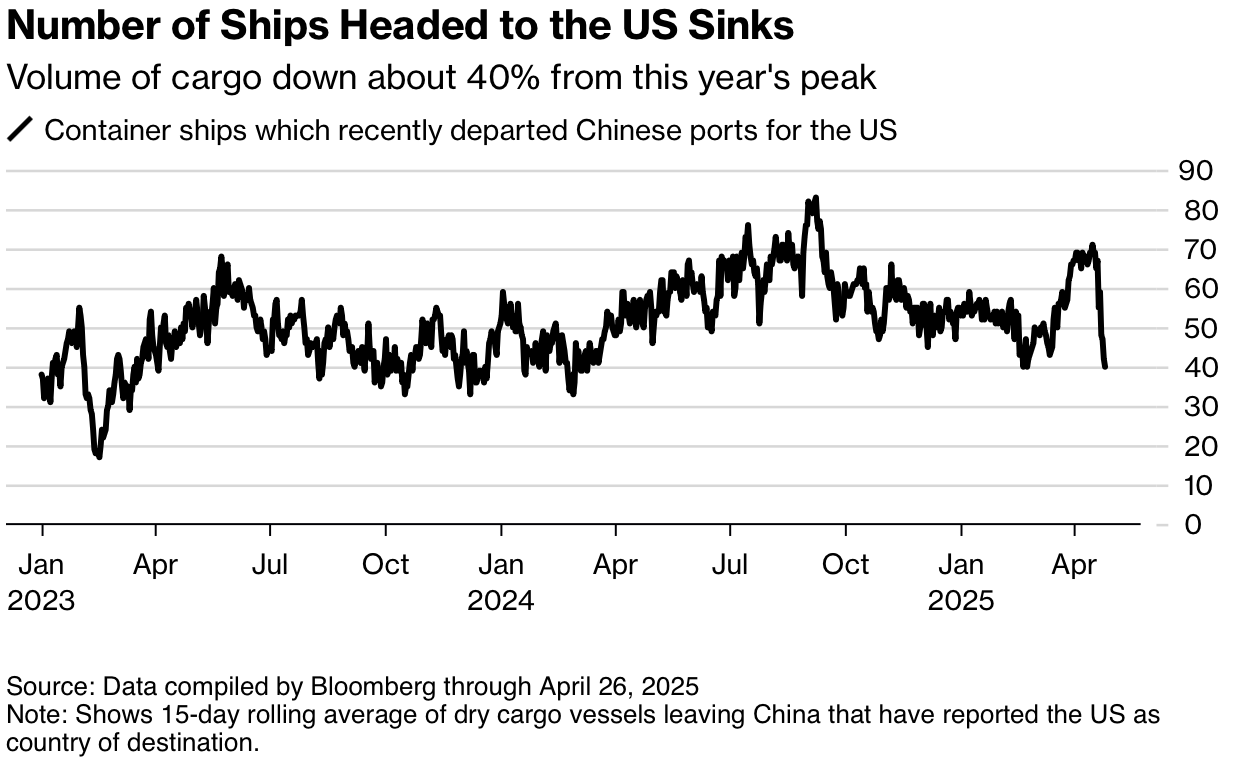
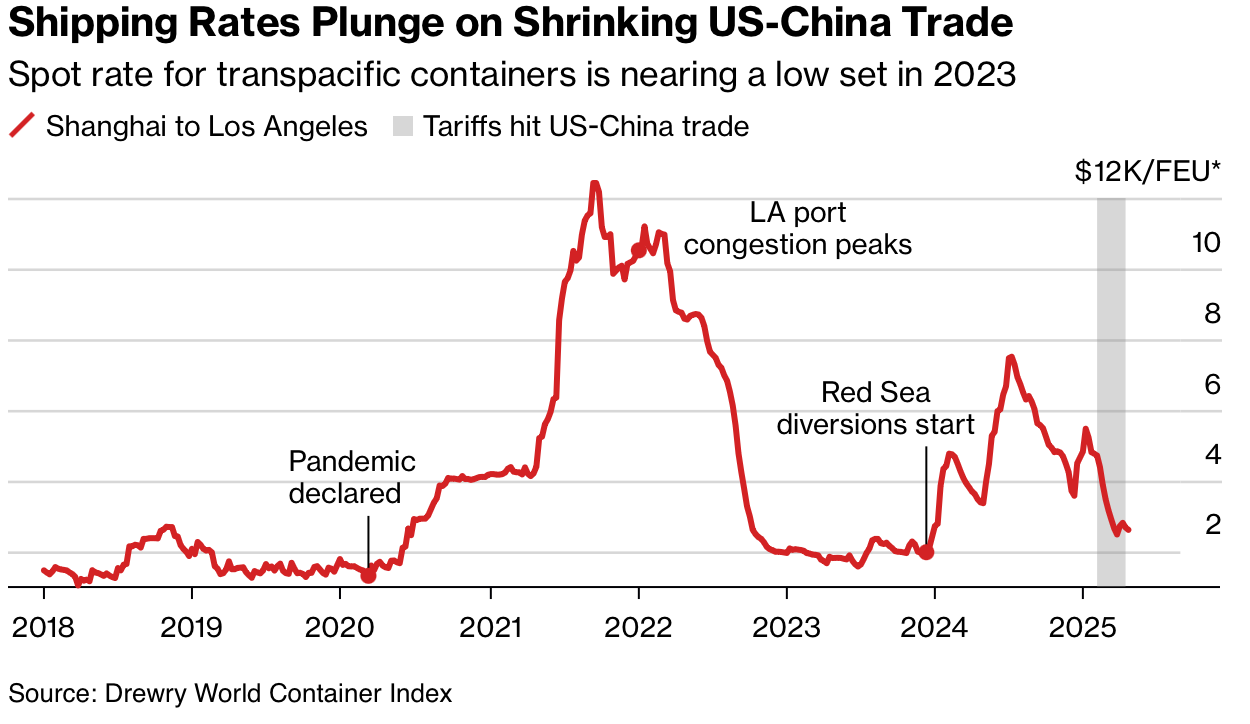
Since “Liberation Day,” Cargo Shipments Including The U.S. Have Dropped By As Much As 60 Percent. According to Bloomberg, “President Donald Trump’s tariff onslaught has roiled Washington and Wall Street for nearly a month. If the trade war persists, the next upheaval will hit much closer to home. Since the US raised levies on China to 145% in early April, cargo shipments have plummeted, perhaps by as much as 60%, according to one estimate. That drastic reduction in goods from one of the largest US trading partners hasn’t been felt by many Americans yet, but that’s about to change.” [Bloomberg, 2025-04-28]
April 2025: Container Traffic At The Ports Of Seattle And Tacoma Dropped Double Digit Percentages On Year Over Year And Month Over Month Bases. According to the Seattle Times, “Others are seeing a decline. Data from the Marine Exchange of Puget Sound, an industry association, shows the number of arriving container ships berthing at Seattle and Tacoma terminals from April 1 to April 24 was down 12% compared with the same period in 2024. Arrivals of ships carrying automobiles in April was down 36%. Similarly, the number of container vessels arriving or departing from Seattle and Tacoma between April 1 and April 15 was down around 27% compared with the first half of March and by around 24% from April 1-15, 2024, according to a Seattle-area marine services industry insider, who asked to remain anonymous because they weren’t authorized to speak for the company.” [Seattle Times, 2025-04-25]
“Ports Are Designed For Stable Flows, Not Off-Again, On-Again Volume Shifts.” Volatility Around Shipments Could Lead To Overwhelmed Infrastructure Like That In 2021. According to Bloomberg, “Even when hostilities ease, restarting transpacific trade will bring additional risks. The freight industry has reduced capacity to match weaker demand. That means a surge of orders sparked by a detente between the superpowers will likely overwhelm the network, causing delays and boosting costs. A similar scenario unfolded during the pandemic when container prices quadrupled and a glut of cargo ships jammed up ports. ‘There will be a surge in ports and consequently for trucks and rail creating delays and bottlenecks,’ said Lars Jensen, chief executive officer of shipping consultant Vespucci Maritime. ‘Ports are designed for stable flows, not the off-again, on-again volume shifts.’” [Bloomberg, 2025-04-28]
The Cyclical Nature Of Importing Could Compound Shortages
March And April Are The Times When Retailers Place Orders For Back-To-School And Christmas Shopping. According to Bloomberg, “The US tariffs on China came at a critical time for the retail industry. March and April is when suppliers start ramping up inventory for the second half of the year to fill orders for back-to-school shopping and Christmas. For many firms, the first holiday goods should be hitting the water bound for the US in roughly two weeks. ‘We are paralyzed,’ said Jay Foreman, CEO of toymaker Basic Fun in Boca Raton, Florida, which supplies big retail customers such as Amazon.com Inc. and Walmart. He called the tariffs a ‘de facto embargo’ and said customers have been pausing orders so far, but he expects them to start canceling them if the China tariffs stay at this level for much longer. ‘There’s a couple weeks, then it really starts to hurt,’ said Foreman, whose company generates about $200 million in sales a year and sources roughly 90% of products from China. ‘We”re in a period where the damage is manageable, but every week the damage level is going to increase.’” [Bloomberg, 2025-04-28]
“Every Week The Damage Level Is Going To Increase.” CEO Of $200 Million A Year Toymaker Called Trump’s Tariffs A “De Facto Embargo.” According to Bloomberg, “The US tariffs on China came at a critical time for the retail industry. March and April is when suppliers start ramping up inventory for the second half of the year to fill orders for back-to-school shopping and Christmas. For many firms, the first holiday goods should be hitting the water bound for the US in roughly two weeks. ‘We are paralyzed,’ said Jay Foreman, CEO of toymaker Basic Fun in Boca Raton, Florida, which supplies big retail customers such as Amazon.com Inc. and Walmart. He called the tariffs a ‘de facto embargo’ and said customers have been pausing orders so far, but he expects them to start canceling them if the China tariffs stay at this level for much longer. ‘There’s a couple weeks, then it really starts to hurt,’ said Foreman, whose company generates about $200 million in sales a year and sources roughly 90% of products from China. ‘We”re in a period where the damage is manageable, but every week the damage level is going to increase.’” [Bloomberg, 2025-04-28]
The Pause In Shipments, Even If Addressed Quickly, Could Lead To Supply Shocks That Could “Stretch All The Way TO Christmas.” According to Bloomberg, “By the middle of May, thousands of companies — big and small — will be needing to replenish inventories. Giant retailers such as Walmart Inc. and Target Corp. told Trump in a meeting last week that shoppers are likely to see empty shelves and higher prices. Torsten Slok, Apollo Management’s chief economist, recently warned of looming ‘Covid-like’ shortages and significant layoffs in industries spanning trucking, logistics and retail. While Trump has shown signs in recent days that he’s willing to be flexible on the import taxes imposed on China and others, it may be too late to stop a supply shock from reverberating across the US economy that could stretch all the way to Christmas.” [Bloomberg, 2025-04-28]
Undermining American Businesses
NYT Headline: Chinese Manufacturers Make Appeals To Americans: Buy Direct [New York Times, 2025-04-24]
TikTok’s Algorithm Has Boosted Videos From Chinese Direct To Consumer Sellers That Cut Out American Importers, Prompting Downloads Of Chinese Shopping Apps. According to the New York Times, “Chinese manufacturers are flooding TikTok and other social media apps with direct appeals to American shoppers, urging people to buy luxury items straight from their factories. And amid the threats of sky-high tariffs on Chinese exports, Americans seem to be all in. The pitch in the videos is that people can buy leggings and handbags exactly like those from brands like Lululemon, Hermes and Birkenstock, but for a fraction of the price. They claim, often falsely, that the products are made in the same factories that produce items for those brands. American influencers have embraced the videos, promoting the factories and driving downloads of Chinese shopping apps like DHGate and Taobao as a way for shoppers to save money if the price of goods skyrockets under President Trump’s tariffs on Chinese imports. DHGate was among the 10 most downloaded apps in Apple’s and Google’s app stores last week.” [New York Times, 2025-04-24]
New York Times: ByteDance Appears To Have Changed Its Algorithm And Policies To Allow For This Type Of Content. According to the New York Times, “Mr. Pearl suggested that the Chinese government might be allowing the videos to proliferate, since it has otherwise tended to discourage its citizens from posting videos that infringe on trademarked products from Western countries. […] The Chinese government appears to be allowing the videos to proliferate, she said. ‘A Lululemon or Chanel’s interests right now in China are probably No. 100 on the list of things that the Chinese trade minister and officials there are concerned about,’ Ms. Kodali said. Manufacturers may also be rushing to close sales before new tariffs on May 2 add hefty fees to parcel shipments from China, she said. […] TikTok, which is owned by the Chinese company ByteDance, has been taking down some of the videos, pointing to a policy that prohibits the promotion of counterfeit goods. But many have persisted through reposts. Even older videos about Chinese manufacturing are spreading in personalized news feeds amid major interest in the tariffs. TikTok declined to comment further, and Instagram, which is owned by Meta, declined to comment on the videos. Sellers in China say they started posting the videos when sales fell. Yu Qiule, the 36-year-old co-owner of a manufacturing company in Shandong Province in eastern China that makes fitness equipment, said he started posting to TikTok in mid-March to find more customers after the tariffs prompted a wave of canceled orders. Louis Lv, the general manager of export at Hongye Jewelry Factory in Yiwu, in Zhejiang Province, said his firm started posting on TikTok at the end of 2024, driven by a slowdown in domestic sales. But he has watched the viewership in his TikTok videos soar since the Trump administration announced the tariffs. ‘The philosophy of Chinese businessmen is we will go wherever the business is,’ he said in an interview.” [New York Times, 2025-04-24]
Detroit News Headline: Buick Vulnerable To Trump Tariffs: “It Could Just Disappear.” [Detroit News, 2025-04-27]
Context: TikTok Is Only A Tool Because Trump Decided It Could Be
Under the law of the land, TikTok should have been shut down, but Trump decided that the government should not enforce the law, so it has been able to continue to operate. While it is impossible to say what the company is doing specifically, the value proposition to the Chinese Communist Party, which has a degree of control is clear: it can protect its factories while undermining American businesses.
If consumers buy directly from the factories, there will likely be two effects: margins will expand for Chinese producers, as individual consumers can be considered less picky than American companies; and the American companies that used to operate by sending designs to China and importing those goods will go out of business. That will strengthen the Chinese economy and weaken the American one.
Corruption
Despite The Contracts Having Been Signed, Lutnick Paused CHIPS Act Distributions To Companies, Unless They Gave The Administration New Investment Announcements. According to the New York Times, “For example, Mr. Lutnick has paused disbursements to companies from the CHIPS program, a bipartisan, multibillion-dollar effort to rebuild America’s semiconductor industry. Mr. Lutnick put pressure on some executives to increase their U.S. investments if they want to receive their funds, even though companies have already signed contracts for those payments, according to three people familiar with the conversations. He has also given companies the impression that they may get tariff relief by investing more in the United States, and discussed holding tariffs paid by companies in escrow, returning the money if they make U.S. investments. Companies including Apple, TSMC and Nvidia have announced investments since Mr. Trump began threatening tariffs.” [New York Times, 2025-04-08]
Trump Associates Have Created A $500,000+ A Head Club To “Nurture” The Relationship Between The Trump Administration And Big Business Leaders. According to Politico, “A new club is coming to Washington — and you probably can’t get in. Donald Trump Jr., megadonor Omeed Malik and several other investors are launching an invite-only club that costs more than half a million to join with an exclusive post-White House Correspondents” Dinner gathering, according to an invite obtained by POLITICO and two people with knowledge of the venture, granted anonymity to discuss the private organization. The ‘Executive Branch’ is the brainchild of Malik and the president’s eldest son, and their partners at conservative fund 1789 Capital. It will be located in Georgetown. Their goal, the people familiar with the plans say, is to create the highest-end private club that Washington has ever had, and cater to the business and tech moguls who are looking to nurture their relationships with the Trump administration.” [Politico, 2025-04-26]
Outlook: Who Benefits?
The uncertainty Trump has stoked with his extreme policies and frequent reversals has not benefited American manufacturers. His administration has claimed to be promoting a turn from “wall street to main street,” but main street businesses cannot profit when they have no idea the future outlook. The businesses that can are on wall street.
Specifically, market makers and high frequency traders. The most consistent result of market uncertainty is that it widens spreads. Spreads, are the difference between the price at which a market maker is willing to buy and sell a security. When spreads widen, it means that the market maker is taking on more risk, and thus charging more for that risk.
The story about TikTok, remained me of the fact that the person who may have been most influential on Trump’s decision not to shut it down was Jeff Yass. While Yass’ motivation in the TikTok case is his stake in ByteDance, his primary business is running Susquehanna International Group, a high frequency trading firm. One of their key strategies is profiting off of spreads and market volatility. So even as Trump’s policies have hurt American businesses, they have been a boon for Yass and his ilk.