Homeownership has fallen to pre-pandemic levels, while consumer confidence has plummeted to its lowest point since May 2020. Consumer expectations are particularly concerning, reaching their lowest level since 2011 - worse than during the pandemic and well below the threshold that historically signals an approaching recession. Trade deficits have hit record highs as importers rushed to bring in goods before tariff implementation, contributing to the Atlanta Fed’s GDP Now model projecting negative growth of -2.7% for Q1 2025. The economic data paints a picture of an economy under significant stress, largely attributed to tariff policies that have triggered supply chain disruptions, corporate spending cuts, and capital flight from U.S. markets.
The ripple effects are visible across multiple sectors. Major corporations like UPS have announced 20,000 job cuts and facility closures, while GM has suspended financial guidance and share buybacks due to tariff uncertainty. Financial markets show increasing instability with the “Sell America” trade pushing bond term premiums to their highest levels since 2014, making government borrowing more expensive at a time of already substantial fiscal deficits. There are troubling signs of financial stress, exemplified by the near-collapse of British finance firm Argentex which was forced into a fire-sale at a 94% discount amid dollar volatility. Meanwhile, Deutsche Bank reported a 39% surge in profits driven by trading activity in volatile markets, despite a fall in profits tied to economic activity beyond trading.
At the same time, the Trump administration is focused on deregulating company auditors and jawboning Amazon into hiding the impact its tariffs are having on consumer prices.
Releases
Housing
Q1 2025: The Homeownerership Rate Fell To Its Lowest Rate Since Before The Pandemic
March 2025: Another Article Was Published In A High-Quality Economic Journal Documenting How Housing Construction Reduced Housing Costs. According to Andreas Mense in the Journal of Political Economy, “I estimate the impact of new housing supply on the local rent distribution, exploiting delays in housing completions caused by weather shocks. A 1% increase in new supply (i) lowers average rents by 0.19%, (ii) effectively reduces rents of lower-quality units, and (iii) disproportionately increases the number of second-hand units available for rent. Moreover, the impact on rents is equally strong in high-demand markets. Employing a quantitative model, I explain these results by second-hand supply: New supply triggers moving chains that free up units in all market segments. The estimate translates into a short-run demand price elasticity of −0.025.” [Andreas Mense in the Journal of Political Economy, March 2025]
Trade Balance in Goods
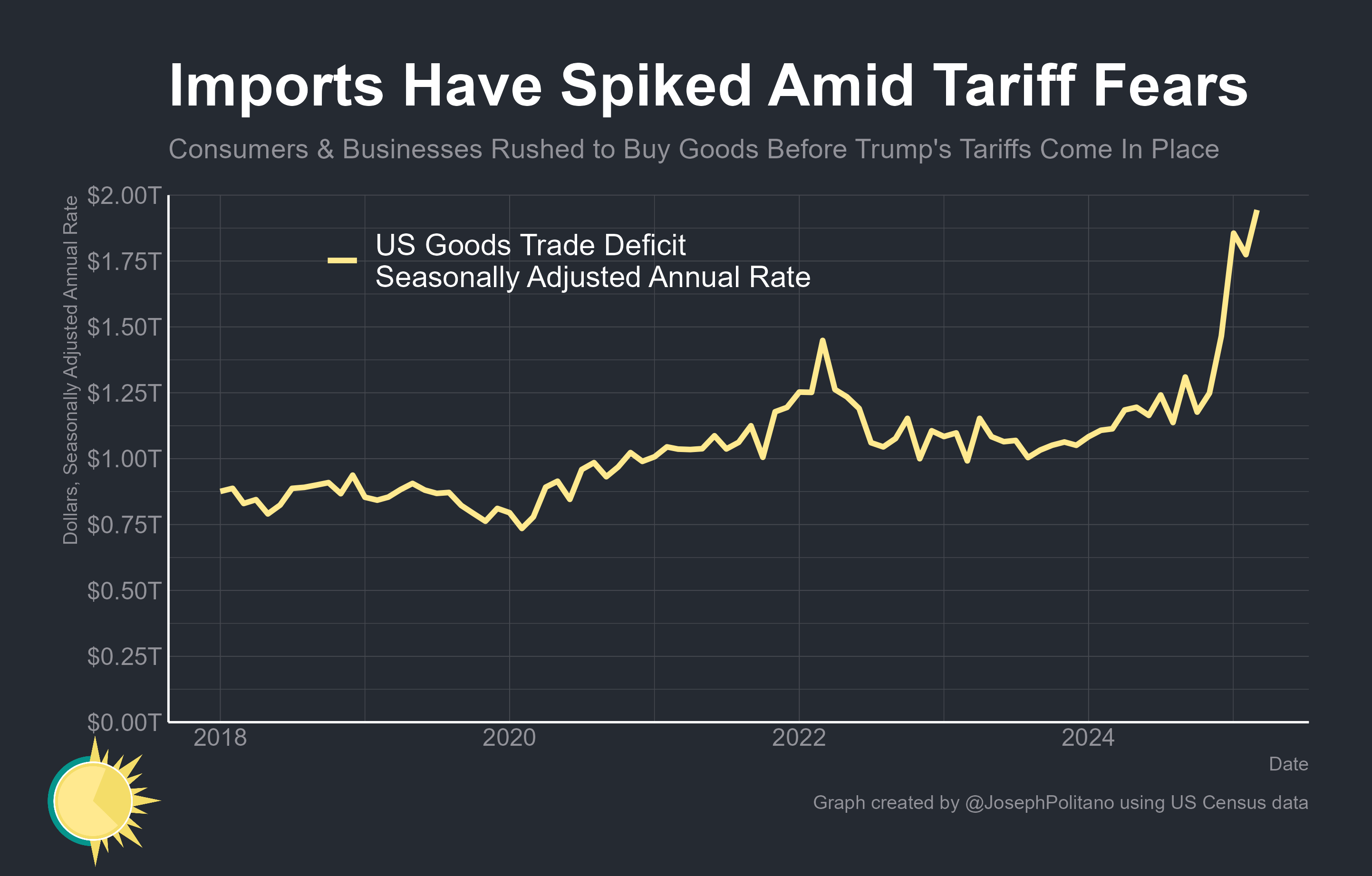
March 2025: The U.S. Trade Deficit In Goods Jumped To Another Record High. According to Apricitas Economics, “The US goods trade deficit jumped to another record high in the preliminary March data released today, beating the previous record high set in January—there was a massive rush to import consumer goods before more tariffs went in place.” [Apricitas Economics, 2025-04-29]
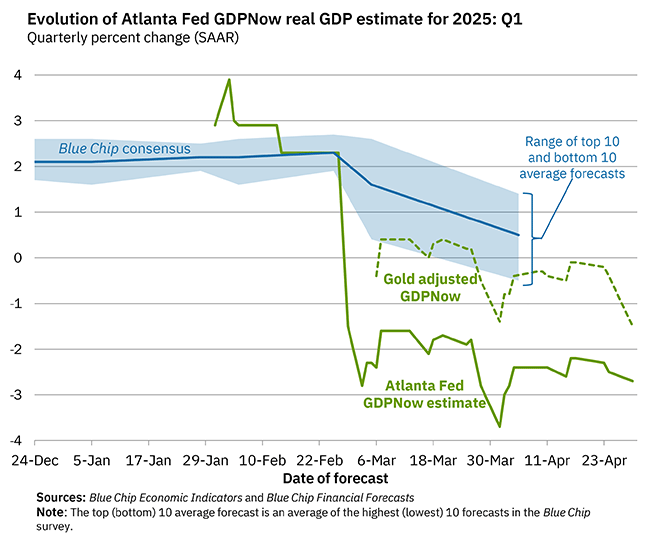
The Final GDP Now Model Release Of The Quarter Dropped To -2.7 Percent, While The Alternate Gold-Adjusted Model Dropped To -1.5 Percent, As Estimates Of Imports Grew. According to the Atlanta Federal Reserve, “The final GDPNow model estimate for real GDP growth (seasonally adjusted annual rate) in the first quarter of 2025 is -2.7 percent on April 29, down from -2.4 percent on April 24. The final alternative model forecast, which adjusts for imports and exports of gold as described here, is -1.5 percent. After this morning’s Advance Economic Indicators release from the US Census Bureau, the standard and alternative model nowcasts of the contribution of net exports to first-quarter real GDP growth declined from -4.90 percentage points and -2.85 percentage points, respectively, to -5.26 percentage points and -4.05 percentage points.” [Atlanta Federal Reserve, 2025-04-29]
Consumer Confidence
April 2025: Consumer Confidence Fell To Its Lowest Level Since May 2020. According to Bloomberg, “US consumer confidence fell in April to an almost five-year low on growing pessimism about prospects for the economy and labor market due to tariffs. The Conference Board’s gauge of confidence decreased nearly 8 points to 86, the weakest since May 2020, data released Tuesday showed. It marked the fifth straight monthly decline, the longest such stretch since 2008. The median estimate in a Bloomberg survey of economists called for a reading of 88.” [Bloomberg, 2025-04-29]
April 2025: Consumer Expectations Fell To Their Lowest Level Since 2011, Lower Than They Ever Reached During The Pandemic. According to the Conference Board, “The Conference Board Consumer Confidence Index® fell by 7.9 points in April to 86.0 (1985=100). The Present Situation Index—based on consumers’ assessment of current business and labor market conditions—decreased 0.9 points to 133.5. The Expectations Index—based on consumers’ short-term outlook for income, business, and labor market conditions—dropped 12.5 points to 54.4, the lowest level since October 2011 and well below the threshold of 80 that usually signals a recession ahead. The cutoff date for preliminary results was April 21, 2025.” [Conference Board, 2025-04-29]
A Measure Of Expectations Below 80 Has Often Signaled A Recession Ahead. April 2025 Saw A Measure Of 54.4. According to the Conference Board, “The Conference Board Consumer Confidence Index® fell by 7.9 points in April to 86.0 (1985=100). The Present Situation Index—based on consumers’ assessment of current business and labor market conditions—decreased 0.9 points to 133.5. The Expectations Index—based on consumers’ short-term outlook for income, business, and labor market conditions—dropped 12.5 points to 54.4, the lowest level since October 2011 and well below the threshold of 80 that usually signals a recession ahead. The cutoff date for preliminary results was April 21, 2025.” [Conference Board, 2025-04-29]
April 2025: The Share Of Consumers Expecting Worse Business Conditions In Six Months Fell To Its Lowest Level Since March 2009. According to Bloomberg, “The share of consumers that expected business conditions will be worse six months from now rose to the highest level since March 2009, when the economy was in a recession. The share seeing fewer jobs in the short-term also rose to a 16-year high.” [Bloomberg, 2025-04-29]
Mark Zandi: A Confidence Fall Of 20 Points Over Three Months Normally Results In A Recession, By April 2025 It Had Fallen 19.3 Points. According to Mark Zandi, “Here we go on this week’s data storm. The Conference Board consumer confidence survey fell sharply to 86 in April. It is off 19.3 points in the past 3 months. Just shy of the recession threshold of 20. Unless the trade war cools off very (very) soon, recession appears dead-ahead.” [Mark Zandi, 2025-04-29]
Giveaways To Big Companies
April 2025: House Republicans Added Legislation Eliminating The Fee Funding Auditor Regulation, And Shutting Down The Post-Enron Accounting Oversight Board. According to the Financial Times, “Republican lawmakers are planning to shut down the US audit regulator, which was founded in the wake of the Enron scandal more than two decades ago, as part of a reform package designed to deliver Donald Trump’s deregulatory agenda. The proposal to eliminate the independent Public Company Accounting Oversight Board was published late on Friday by the leadership of the House Committee on Financial Services, for inclusion in the giant tax and spending bill being considered by Congress. Under the draft legislation, a levy on listed companies and broker-dealers that funds the PCAOB would be scrapped and the organisation’s responsibilities would be folded into the Securities and Exchange Commission.” [Financial Times, 2025-04-26]
CFA Institute Head: “If Capital Formation Is A Priority For The Administration, This Disrupts That.” According to the Financial Times, “Sandy Peters, head of global advocacy at the CFA Institute, a professional body for investors, said the creation of the PCAOB led to dramatic improvements in audit quality. ‘The largest and most efficient capital markets need a strong, apolitical and independent audit regulator and accounting standard setter,’ she said. ‘If capital formation is a priority for the administration, this disrupts that.’” [Financial Times, 2025-04-26]
Strangled Economy
Illegal Fiscal Tightening
House Democrats: At Least $430 Billion Owed To The American People Has Been Blocked By The Trump Administration. [House Democrats, accessed 2025-04-29]
Protectionism
Higher Prices
Punchbowl: Amazon Will Display Tariff Costs. [Punchbowl News, 2025-04-29]
After The White House Criticized These Reports, Amazon Said That It Would Not List Tariff Prices, Unlike Other Sales Taxes. According to Bloomberg, “Amazon.com Inc. said Tuesday it never planned to widely display the cost of President Donald Trump’s tariffs on products after the White House blasted the reported move. ‘The team that runs our ultra low cost Amazon Haul store has considered the idea of listing import charges on certain products,’ the company said in a statement. ‘Teams discuss ideas all the time. This was never a consideration for the main Amazon site and nothing has been implemented on any Amazon properties.’ The White House earlier Tuesday seized on a brief Punchbowl News report that the e-commerce giant would ‘soon’ begin displaying the cost of US tariffs on individual products next to the total listed price. White House Press Secretary Karoline Leavitt blasted the purported plans as ‘a hostile and political act.’ ‘Why didn’t Amazon do this when the Biden administration hiked inflation to the highest level in 40 years?’ she told reporters at a briefing. Leavitt said she had spoken to Trump about the report, and went on to criticize Amazon’s compliance with censorship demands by the Chinese government.” [Bloomberg, 2025-04-29]
Bloomberg: Temu Has Passed On Almost All Of The Tariff Costs To American Consumers. According to Bloomberg, “Discount Chinese retail app Temu appears to be passing on nearly all of Donald Trump’s new import taxes to US consumers, more than doubling the cost of some products in a move that may add to concern about the inflationary impact of tariffs. Previously exempted from any levies under the so-called ‘de minimis’ rule, parcels priced up to $800 now face an ad-valorem tax — of 120% of a product’s value — or a per postal item fee of at least $100 starting May 2. PDD Holdings Inc.-owned Temu is requiring customers to pay those levies on top of the original cost of the goods. A look at 14 shipped-from-China items on Temu’s bestsellers list showed taxes exceeded the value of the product. A $19.49 power strip, for instance, attracted $27.56 in import charges as of Monday, or 1.41 times the price of the product.” [Bloomberg, 2025-04-28]
Companies Benefiting And Losing Out
UPS
Even As Air Freight Volumes Have Plumeted, Prices Have Whipsawed “As Traders Reacted To Each Piece Of News From The White House.” According to the Financial Times, “Airfreight volumes have also fallen sharply, according to US industry association the Airforwarders Association, with its members” bookings from China falling roughly 30 per cent. ‘A lot of members have just stopped receiving orders from China,’ said executive director Brandon Fried. ‘It’s also creating a whipsaw effect on prices and booking rates as traders reacted to each piece of news from the White House.’” [Financial Times, 2025-04-27]
Layoffs
April 2025: UPS Announced 20,000 Job Cuts And 73 Building Closures. According to CBS, “UPS on Tuesday announced it is planning to cut 20,000 jobs this year, part of a cost-cutting effort that’s linked to fewer deliveries from Amazon, its biggest customer. The shipping company, which operates in over 200 countries, currently has around 490,000 employees. The layoffs will impact slightly over 4% of its workforce. This follows an announcement from UPS last year that it would cut 12,000 positions. The move is part of the company’s plan to consolidate UPS’s facilities and workforce. Along with the job cuts, the company announced it will also close 73 of its buildings by the end of June 2025 and said that it may target additional buildings for closure.” [CBS, 2025-04-09]
GM
April 2025: General Motors Pulled Earnings Guidance And Suspended Share Buybacks Amid Tariff Uncertainty. According to Bloomberg, “General Motors Co. is pulling earnings guidance for 2025 and putting $4 billion in share buybacks on hold until it has more clarity on the impact of US tariffs. The Detroit automaker’s decision to withdraw its forecast and partly suspend stock repurchasing underscores how President Donald Trump’s trade policies are upending business plans in Corporate America. GM joins a growing list of US companies pulling earnings projections as they grapple with additional levies on imports — and retaliation from America’s trading partners. ‘Because the original guidance didn’t include impact from tariffs, prior guidance can’t be relied upon,’ Paul Jacobson, the company’s chief financial officer, said on a call with reporters. ‘We will update when we have more information on tariffs.’” [Bloomberg, 2025-04-29]
DB Profits Surge
Deutsche Bank’s Profits Surged 39 Percent To Their Highest Level In 14 Years. According to the Financial Times, “Deutsche Bank has reported its highest quarterly pre-tax profit in 14 years as its trading unit achieved record revenues amid heightened global market volatility. Pre-tax profit rose 39 per cent year on year to €2.8bn in the first quarter of 2025, exceeding analysts’ expectations by 7 per cent. Revenues grew 10 per cent to €8.5bn, the highest level in a decade, while costs fell 2 per cent, helped by lower litigation charges.” [Financial Times, 2025-04-28]
Tariff-Driven Uncertainty Drove Trading Profits To More Than Make Up For A Decline In Real World Economic Activity. According to the Financial Times, “The investment bank’s performance was underpinned by record revenues in the fixed income and currencies (FIC) division, which rose 17 per cent year on year. This was partially offset by an 8 per cent decline in origination and advisory revenues, following a significant writedown on an unnamed position in leveraged finance. Deutsche’s results echo a broader trend among global banks that have benefited from market volatility triggered by US tariffs, even as fears of rising corporate defaults and weaker investment have begun to weigh on sentiment.” [Financial Times, 2025-04-28]
Plummeting Port Volumes
Adam Miller, CEO Of One Of The Country’s Largest Trucking Companies: Some Clients Have “Canceled Orders Or They’ve Stopped Ordering.” According to the Financial Times, “Arizona-based Knight-Swift Transportation, one of the largest US trucking companies, warned of lower anticipated volumes, citing uncertainty caused by the tariffs threat. Chief executive Adam Miller said some of the group’s largest customers were ‘expressing concern’ that the cost of tariffs would feed into lower volumes in May. ‘There are some that have told us that, yes, they”ve cancelled orders or they”ve stopped ordering, particularly from China, and we”ll figure out how to adjust their supply chain to avoid the cost,’ he said.” [Financial Times, 2025-04-27]
Weaker Exports
Liquid Natural Gas
April 2025: The American Petrolium Industry Warned That The Lack Of Excess Shipbuilding Capacity Meant That The Fee Schedules Proposed Would Raise LNG Export Prices. According to the Financial Times, “The liquefied natural gas industry has warned the Trump administration it cannot comply with new rules aimed at forcing them to use US transport vessels by imposing levies on Chinese-built ships docking at US ports. It warns that the rules published by US trade representative Jamieson Greer on April 17 could damage a $34bn-a-year export industry that is central to the president’s ‘energy dominance’ agenda, according to lobbying letters sent by the American Petroleum Institute to the administration this week. The new rules are part of US efforts to increase the pressure on China over what Washington argues are unfair trade practices, while boosting the domestic manufacturing of ships. However, they have caused alarm among US exporters, who worry they will dramatically increase the cost of contracting vessels. The LNG industry has already benefited from a three-year delay in the implementation of the rules to the sector, which is heavily reliant on Chinese and foreign-built vessels. The USTR is also allowing LNG producers to gradually phase-in the use of US-built and flagged vessels over a 22-year period. US authorities could still order the suspension of LNG export licences if the terms of the new rules are not met. But the API warns in letters to the US secretaries of energy and the interior that it is impossible for LNG producers to comply with the rules. There are currently no US-built vessels capable of shipping LNG and no surplus capacity at US shipyards to build LNG carriers by the deadline of 2029, according to people briefed on the contents of the letters.” [Financial Times, 2025-04-27]
Context
This appears to be another example of the Trump administration’s flawed approach to industrial policy. By only imposing a fee, but not providing any other support for expanding ship building capacity (and being generally inconsistent about policy permanence), the administration is relying on the lean companies that have grown up in a competitive market environment to make massive, long-run, risky capital investments.
Spending Cuts
The Stop-Start Nature Of The Trump Administration’s Trade Policy Has Led Corporations To Cut Spending Wherever They Can. According to the Wall Street Journal, “The new directive inside C-suites: Trim anywhere you can. The unpredictability of President Trump’s stop-start trade offensive is paralyzing companies on just about every front except one—taking an ax to costs. The chemical company Dow is delaying construction of a new plant. Boston Scientific, the medical-device maker, is speeding up efforts to cut discretionary spending including travel. The railroad operator Norfolk Southern, meanwhile, is more closely scrutinizing consultant fees. Andre Schulten, chief financial officer of Procter & Gamble, said: ‘We will have to pull every lever we have in our arsenal to mitigate the impact of tariffs within our cost structure.’” [Wall Street Journal, 2025-04-27]
More Sensitive Financial Markets
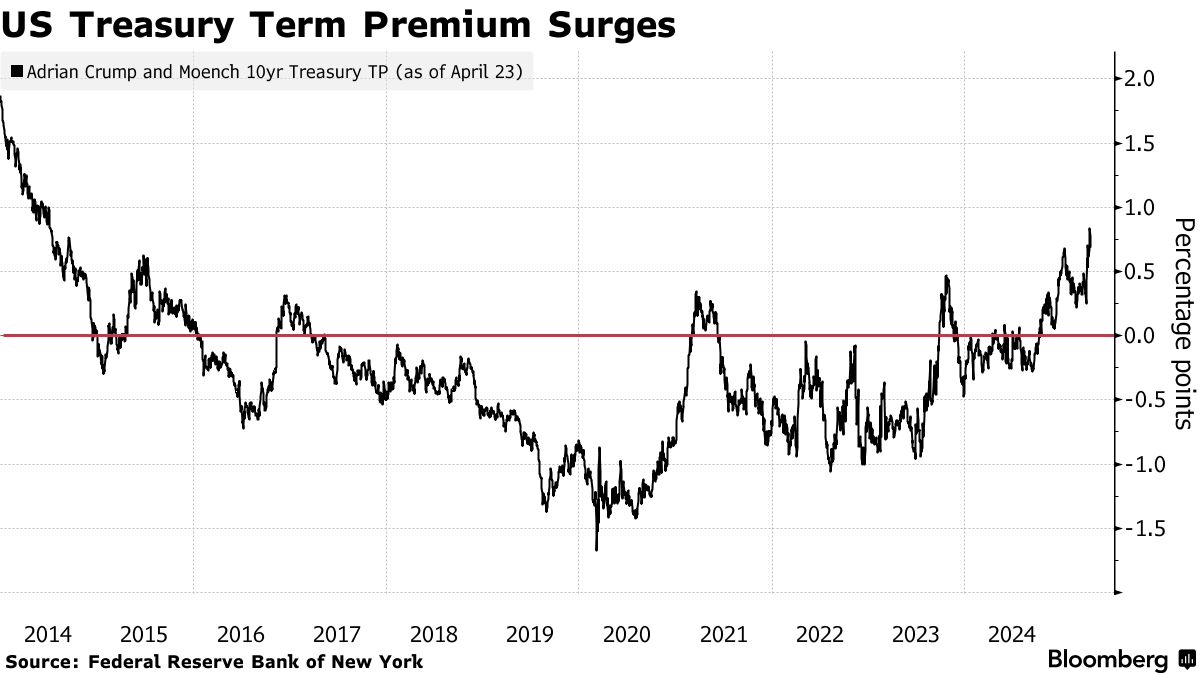
The “Sell America” Trade Has Led To An Increase In The Risk Perception Of The United States, Raising The Term Premium For Bonds. According to Bloomberg, “The ‘Sell America’ trade that gripped markets this month has left a potentially lasting dent in investors” willingness to hold the US government’s longest-maturity debt, a mainstay of its deficit-financing toolkit. For bond managers at BlackRock Inc., Brandywine Global Investment Management and Vanguard Group Inc., the problem is that as President Donald Trump approaches his 100th day in office, he has generated a growing list of unknowns, forcing traders to focus on a broad array of issues beyond just the likely path of interest rates. To name a few: What do Trump’s trade war, tax-cut agenda and scattergun policymaking mean for already weakening economic growth, sticky inflation and massive fiscal shortfalls? Will he again threaten to fire Federal Reserve Chair Jerome Powell? Is he actively seeking a weaker dollar? The result is a heightened notion of risk that’s leading bond buyers to question the traditional haven status of US government debt and require higher yields on longer maturities. By one measure, that added cushion, which traders dub the term premium, is around the highest since 2014. ‘We”re in a new world order,’ said Jack McIntyre, who with his team oversees $63 billion at Brandywine. ‘Even if Trump backpedals on the tariffs, I think uncertainty levels are still going to be elevated. So that means term premium stays elevated.’” [Bloomberg, 2025-04-27]
Higher Term Premiums Raise The Cost Of Issuing Longer Term Debt, Making The Fiscal Situation Even More Tenuious. According to Bloomberg, “One reason a fatter premium matters is that every fraction of a percentage point in extra yield counts for the government at a time when it’s paying upwards of $1 trillion per year to service its debt. At BlackRock, which oversees almost $12 trillion, the broad slide across US asset classes earlier this month magnified its concerns around the government’s finances post-pandemic, and how US bonds were vulnerable to shifting investor confidence.” [Bloomberg, 2025-04-27]
Things Breaking
Amid The Dollar’s Post-Liberation Day Collapse, British Finance Firm Argentex Was Forced To Accept A Takeover At A 94 Percent Discount To Its Previous Value. According to Bloomberg, “Argentex Group Plc, the UK finance firm set up to help customers manage volatile currency swings, should have taken some of its own advice. The London-based brokerage amassed US dollar trades for its clients yet didn’t obtain enough collateral from them in return, people familiar with the matter said. That’s partly because Argentex pursued a high-risk strategy with some customers known as ‘zero-zero lines,’ according to the people, who requested anonymity as details aren’t public. This left Argentex exposed to the slump in the dollar triggered by US President Donald Trump’s announcements on tariffs, and facing demands for repayment from Barclays Plc and Citigroup Inc. that it struggled to meet, the people said. That came to a head this week when Argentex — which built its name offering staid hedging strategies to legions of corporates looking to fortify their balance sheets against the vagaries of the $7.5-trillion-a-day foreign-exchange market — nearly collapsed. While Argentex is far from a major player among dealers in currencies, its troubles show the far-reaching impact of the Trump administration’s tariffs. The company announced Friday it had agreed to sell itself to rival IFX (UK) Ltd. for about 2.5 pence per share, 94% below where the stock traded a week ago, while Chief Executive Officer Jim Ormonde stepped down with immediate effect.” [Bloomberg, 2025-04-25]
In Renting Its Balance Sheets To Clients, Argentex Was Faced With A Liquidity Crisis As The Dollar Moved Persistently. According to Bloomberg, “Argentex entered into derivatives agreements with banks including London-based Barclays and New York-based Citigroup, agreeing to post collateral — or margin — for its trades. This is a buffer against potential losses that banks can seize and sell if bets begin to sour. Typically, a FX brokerage would then demand similar levels of margin from its own clients to protect itself. Yet Argentex pursued zero-zero lines with some of its corporate customers, declining to ask them for either an initial deposit of margin or so-called variation margin in response to how the trades fared, the people said. Zero-zero lines — a reference to both the zero initial margin at the start of a trade and then the zero variation margin throughout its lifetime — have been in use by London’s FX brokerages since at least the early 2010s, according to one senior market participant, who requested anonymity. The strategy has proliferated in recent years, led in part by Argentex, the person said. The bulk of FX brokerages in the UK now offer zero-zero lines to their corporate clients, said Daniel Kinnear, a veteran of the currency-sales business who now runs EAKO Capital in London. This allows them to compete against rival brokerages as well as the banks and financial-technology firms that make up the cutthroat industry, he said. ‘The key risks relate to the funding gap that this can create between the credit extended to the corporate clients and the trading lines that the FX brokerage has with its own liquidity providers,’ said Kinnear, who previously worked at Wall Street banks including Deutsche Bank AG, Barclays and Nomura Holdings Inc. ‘FX brokers need to ensure that they have access to sufficient liquidity — either through their own equity or debt facilities — to fund any margin calls.’ FX brokerages can mitigate the risks of zero-zero lines by holding excess cash and ensuring their trades aren’t skewed toward one currency. Yet Argentex had not done that sufficiently, the people said.” [Bloomberg, 2025-04-25]
Code
usingYFinancejpy =get_prices("JPY=X"; startdt =Date(2025,3,1), enddt =Date(2025,4,23), interval="1d") |> DataFrameeur =get_prices("EUR=X"; interval="1d", startdt=Date("2025-03-01"), enddt=Date("2025-04-29")) |> DataFramegpb =get_prices("GBP=X"; interval="1d", startdt=Date("2025-03-01"), enddt=Date("2025-04-29")) |> DataFramechf =get_prices("CHF=X"; interval="1d", startdt=Date("2025-03-01"), enddt=Date("2025-04-29")) |> DataFrame# Normalize the adjclose for each to be 100 before April 2, 2025jpy.adjclose =100.0.*(jpy.adjclose ./ jpy.adjclose[23])eur.adjclose =100.0.*(eur.adjclose ./ eur.adjclose[23])gpb.adjclose =100.0.*(gpb.adjclose ./ gpb.adjclose[23])chf.adjclose =100.0.*(chf.adjclose ./ chf.adjclose[23])currencies = [jpy, eur, gpb, chf]dropmissing!.(currencies)# Remove the rows that have a value for adjclose that is NaN filter!.(row -> !isnan(row.adjclose), currencies)#%% Plot all of the currencies plot(jpy.timestamp, jpy.adjclose, xlabel ="Date", ylabel ="Dollar Strength (100 = April 1, 2025)", title ="Dollar Collapse: JPY, EUR, GBP, CHF", label ="JPY", legend =true)plot!(eur.timestamp, eur.adjclose, label ="EUR")plot!(gpb.timestamp, gpb.adjclose, label ="GBP")plot!(chf.timestamp, chf.adjclose, label ="CHF")hline!([100.0], linestyle=:dash, label ="")vline!([DateTime(2025,4,2,23,00)], linestyle=:dash, label ="Announcement")
Context: Blowups At Financial Firms Often Predate A Crisis
Argentex’s business was simple. Margin calls are a frustration for anyone involved in financial markets, especially for companies that are not primarily in finance. That is because they require frequent movements of cash that often have to be managed daily. For credit-worthy companies looking to hedge their foreign currency exposure, British firms invented the zero-zero line to avoid that hassle. So long as the firms credit risk was good, they could pay a flat fee and Argentex would manage their margin calls with the banks.
In theory, this is a risk-free business for Argentex. Their exposure to the specifics of currency movements was zero. They simply entered into offsetting trades with companies and banks.
Unfortunately, when the market moved for structural reasons, as has happened with the capital flight from the U.S. following the Trump administration’s tariffs, Argentex’s cash holdings were insufficient for the margin calls banks gave it, and a frozen debt market made it hard to monetize the offsetting positions it had with companies. As a result, Argentex was forced to accept a fire sale of its business.
While this in itself will have little to no impact on the global financial market, it is exactly these types of small firms doing “low-risk” trades blowing up that can predate a financial crisis. That is not always the case. But it is the type of thing to be aware of.