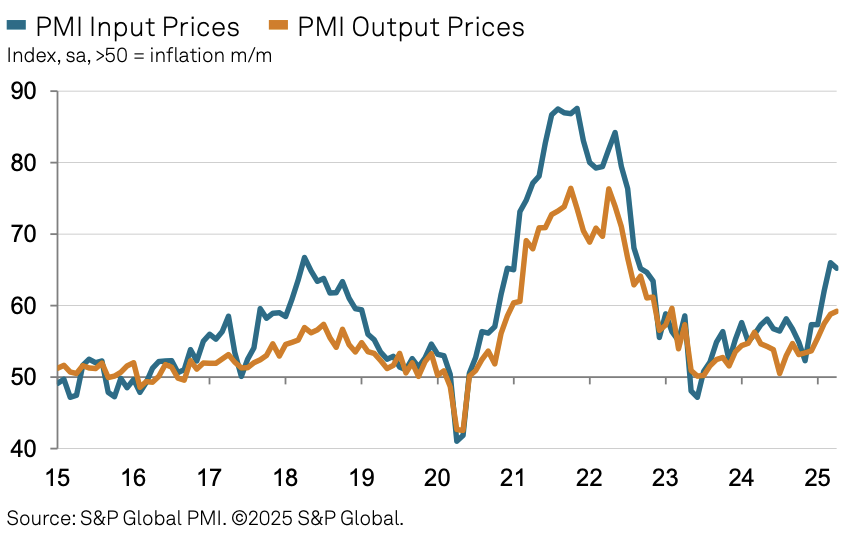
Today’s saw more significant disruption caused by recent Trump administration tariff policies. Construction spending unexpectedly fell in March 2025, manufacturing performance remains subdued with job losses reported for the first time since June 2024, and major retailers including Walmart, Amazon, and Target have cut orders from Chinese suppliers in response to tariffs. The impacts include rising consumer prices, supply chain disruptions, and manufacturers facing squeezed margins as input prices rise faster than output prices.
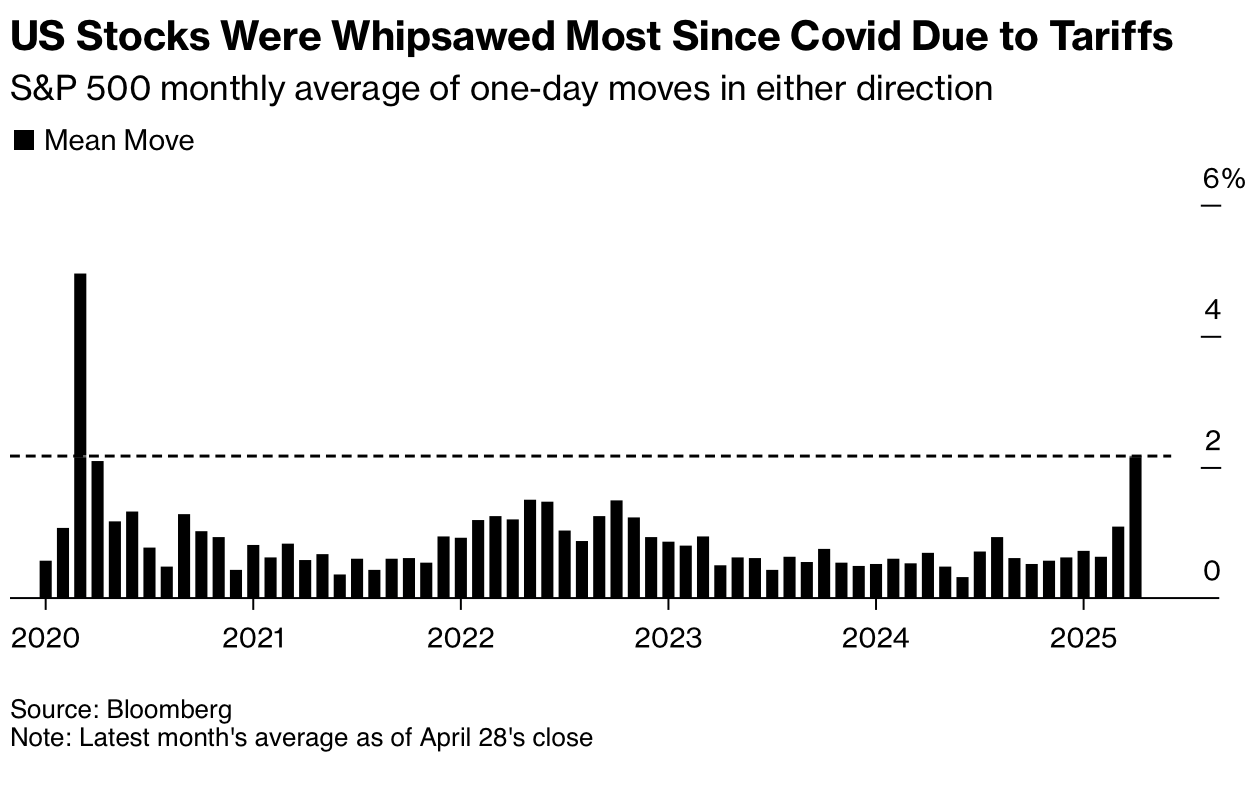
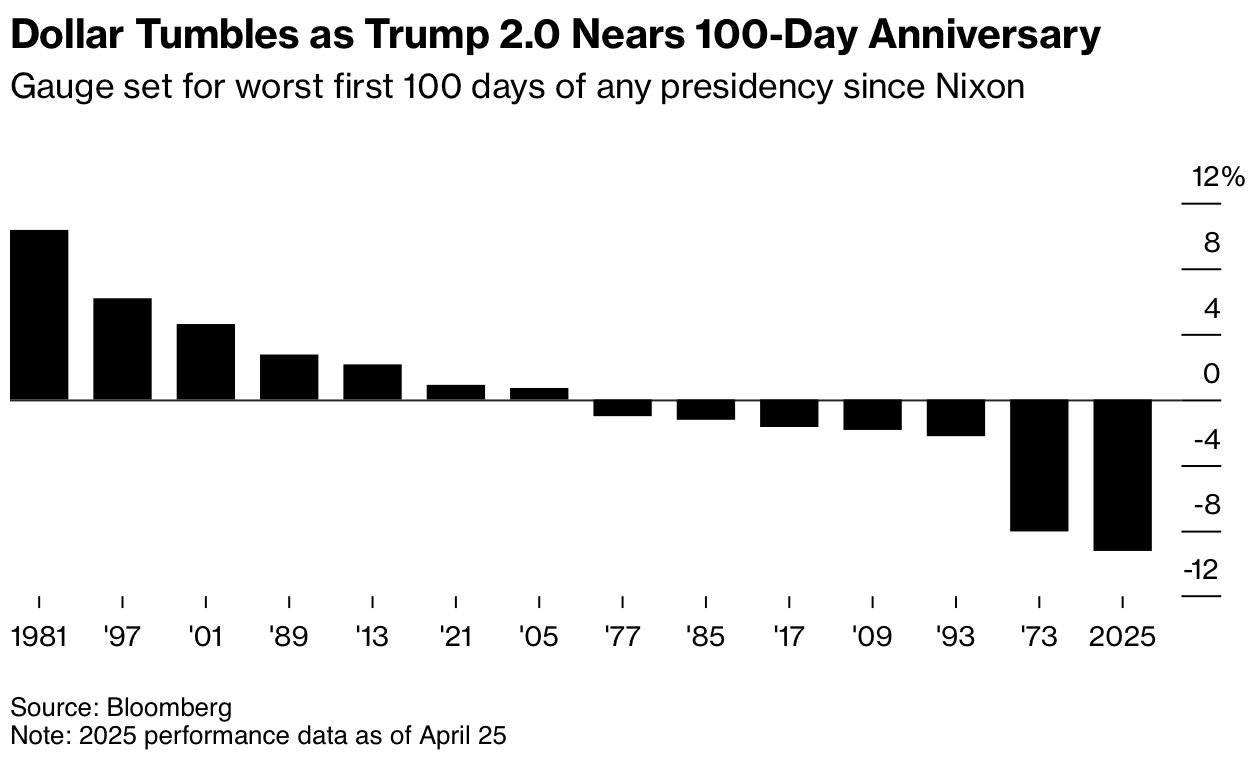
Financial markets are also showing significant stress with the S&P 500 experiencing its most volatile month since March 2020, the dollar experiencing its largest drop in value since Nixon’s presidency, and $50 billion in outflows from bond funds. Private credit markets are showing concerning signs with 40% of borrowers having negative cash flows, leading to “Capital Relief Trades” that eerily resemble pre-2008 financial instruments.
Meanwhile, the Trump family crypto enterprise seems to have accepted a $2 billion gift from the UAE, which just so happens to be under consideration for more lax treatment to import Nvidia chips, despite the concerns about shipments being diverted to China.
Releases
Construction Spending
March 2025: After February Spending Data Was Revised Downward, March Construction Spending Unexpectedly Fell. According to Reuters, “U.S. construction spending unexpectedly fell in March amid broad declines in outlays on private and public projects. The Commerce Department’s Census Bureau said on Thursday that construction spending dropped 0.5% after a slightly downwardly revised 0.6% increase in February. Economists polled by Reuters had forecast construction spending gaining 0.2% after a previously reported 0.7% jump in February.” [Reuters, 2025-05-01]
S&P Global Headline: Subdued Manufacturing Performance In April As Confidence In Outlook Falls And Prices Rise. [S&P Global, 2025-01-01]
April 2025: Job Losses In Manufacturing Were Reported For The First Time Since June 2024. According to S&P Global, “Although order books were supported by domestic demand, tariffs resulted in heightened uncertainty and a noticeable drop in new export sales. Confidence in the outlook fell to its lowest since last June, while job losses were recorded for the first time in six months.” [S&P Global, 2025-01-01]
April 2025: Manufacturing Inputs Rose In Price Faster Than Outputs, Squeezing Manufacturer Margins. According to S&P Global, [S&P Global, 2025-05-01]
This is a plot of the difference between the growth rate of wages and the Federal Funds Rate, which is commonly seen as a floor to interest rates. As can be seen, the difference between the two is normally positive. When this is the case, it can be reasoned that firms see the value of their employees as high. On the other hand, when this spread is negative, it can be reasoned that firms see the value of their employees as low.
Unfortunately, this tends to occur before major economic downturns, and even more unfortunately, it has been the case for some time now that this rate is negative. Zooming in, this trend has not been reversed by the early days of the Trump administration.
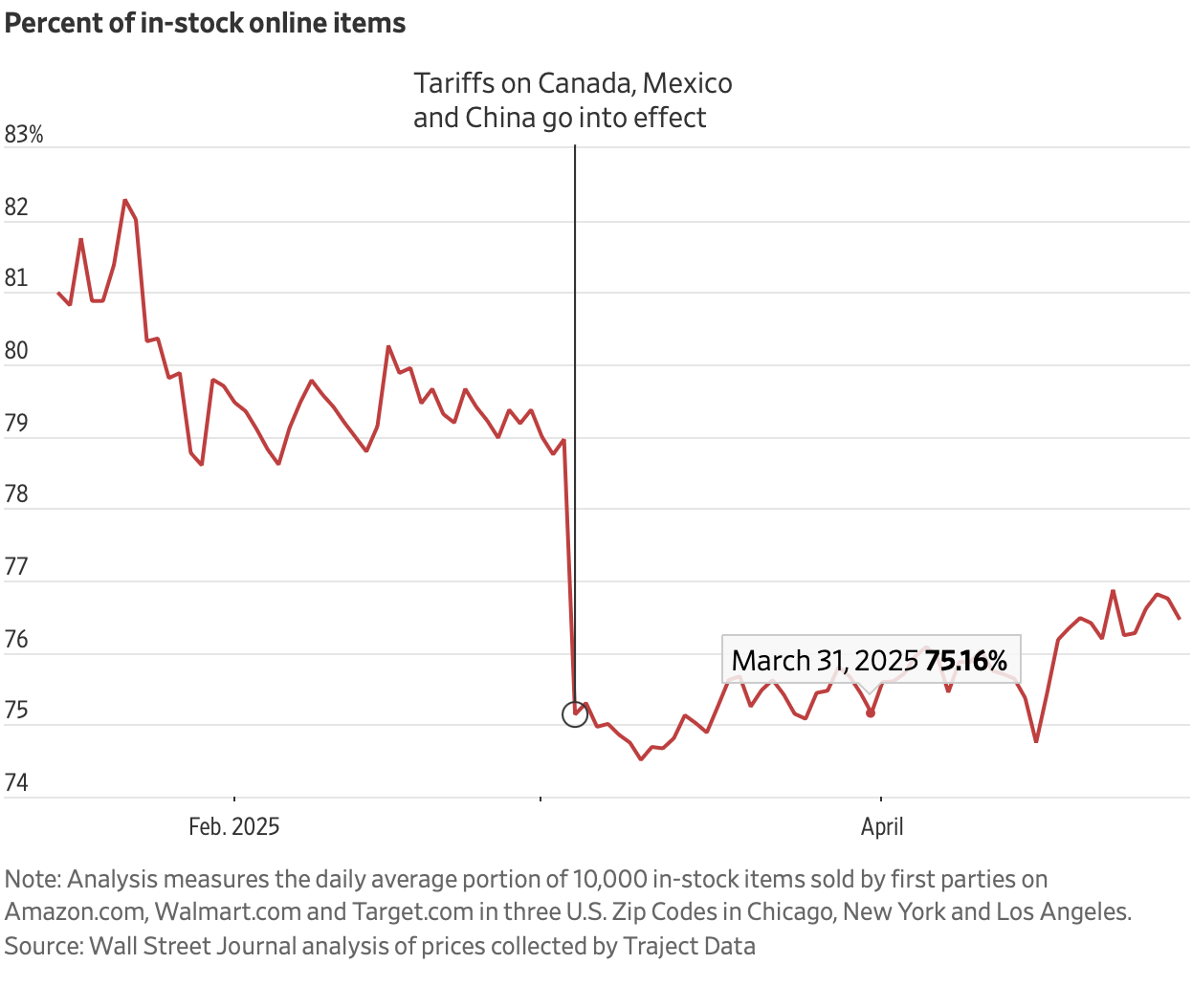
Wallmart, Amazon, And Target Have Cut Orders From China In Response To Trump’s Tariffs. According to the Wall Street Journal, “Walmart has paused some winter holiday orders from Chinese manufacturers, according to people familiar with the situation. Earlier this month, Target paused shipment of goods that it buys directly from manufacturers in China, according to people who are aware of its shipments. The pause has bought them time. Amazon canceled some vendor orders from China after tariffs were announced. The Journal’s analysis shows the percentage of in-stock items dropped by about 4 percentage points after Trump’s tariffs against Canada and Mexico went into effect in early March. Inventories didn’t bounce back after those tariffs were paused a couple of days later. The number of ships sailing from China to the U.S. filled with goods is plunging amid cancellations, according to firms that track shipments and U.S. port officials.” [Wall Street Journal, 2025-04-29]
Amazon Sellers Have Been Testing How Much They Can Raise Prices Before They Are Dinged By The Algorithm In Anticipation Of Tariff-Effected Goods. According to the Wall Street Journal, “At Amazon, independent merchants make up more than 60% of its sales, with a large percentage of goods coming from China. Amazon has algorithms in place that penalize sellers if they raise their costs too much or sell something above the price found elsewhere. Some sellers have tested raising prices by as much as 30% to see how much of an increase they can make before Amazon’s systems will downgrade their listings, according to Brandon Fuhrmann, an Amazon merchant who sells kitchen products. When that occurs, they lower their prices, he said. Many sellers have tested smaller increments of about 5%, he said. Prices for some household goods rose by small increments in April, including items costing $50 or less, as well as for chargers, Bluetooth speakers and other electronics from certain brands, the Journal’s analysis shows. Broadly, prices for consumer goods have yet to increase. Fuhrmann said many tariff-affected shipments still haven’t come through ports.” [Wall Street Journal, 2025-04-29]
April 2025: Chinese Sellers That Use Amazon And/Or Wallmart Have Raised Their Prices By As Much As 30 Percent. According to Bloomberg, “‘We’ve started to see Chinese online exporters raise retail prices on Amazon and Walmart by as much as 30% since earlier this month,’ said Wang Xin, head of the Shenzhen Cross-Border E-Commerce Association, which represents some 3,000 exporters. ‘The price hikes are natural as no one can get through this level of tariff with their old pricing.’” [Bloomberg, 2025-04-30]
Tool Makers
April 2025: Haas Automation, A Maker Of Factory Equipment Said It Would Delay A $500 Million Factory In Nevada If The Tariffs Remained In Place. According to the Wall Street Journal, “Haas Automation, a California-based builder of factory machinery, makes a similar argument. It imports cast iron from China to make the frames for its products. Peter Zierhut, vice president of outside operations for Haas, said the U.S. has no foundries capable of generating the more than 100 million pounds the company consumes each year, and he sees little chance any will return. Building a new foundry would require hundreds of millions of dollars in investment to turn out a commodity that is worth just a few dollars per pound, he said. Finding workers would be tough as well, he said. ‘It just doesn’t seem realistic that cast iron—a super low-tech industry—is going to build their operations in the United States,’ Zierhut said. The tariffs the company is paying on iron and other parts from China could raise the price of its machines by about 20%, he said. Meanwhile, competitors based in South Korea, Taiwan and Japan are sending their products to the U.S. at just a 10% to 14% tariff. Haas said it has already cut production and eliminated overtime at its plant in Oxnard, Calif. The company is building a $500 million factory in Nevada to serve what it had expected to be increased demand for its machines, but Zierhut said that without tariff relief the plant’s opening might be delayed.” [Wall Street Journal, 2025-04-28]
Haas’ Production And Overtime At Its Existing Oxnard, CA Factory Has Already Been Cut. According to the Wall Street Journal, “Haas said it has already cut production and eliminated overtime at its plant in Oxnard, Calif. The company is building a $500 million factory in Nevada to serve what it had expected to be increased demand for its machines, but Zierhut said that without tariff relief the plant’s opening might be delayed.” [Wall Street Journal, 2025-04-28]
Toolmakers Like Stanley Black And Decker Have Raised Prices In Response To Trump’s Tariffs, With A Second Price Increase Planned For July. According to Thomas Black in Bloomberg, “Price increases, though, can cause consumer demand to drop and spark general inflation, making the pass-through of tariffs a delicate balancing act. Manufacturers, such as Stanley Black & Decker Inc., Lincoln Electric Holdings Inc. and Illinois Tool Works Inc., are already raising prices to help offset tariffs along with cost cuts while looking in the long term at how to reconfigure their supply chains, and they probably won’t be alone. Stanley, which makes power tools, adopted a high-single-digit percentage price increase in April and is planning to raise prices again in July to make up for tariffs.” [Thomas Black in Bloomberg, 2025-04-30]
Stanley Has Considered Not Including Batteries In Their Equipment When They Import It To Meet Trump’s Tariff Rules. According to Thomas Black in Bloomberg, “In fact, only a third of Stanley’s production in Mexico is exempt from tariffs under the USMCA, and the company is scrambling to change that. Products, like a power drill, may have to exclude the lithium batteries, which are imported from Asia, in the packaging of products to meet the rules of origin under the trade pact.” [Thomas Black in Bloomberg, 2025-04-30]
Context: Tools are a Vital Input in expanding Manufacturing
If you want to build anything, you will need tools to do it. The poor execution of Trump’s tariffs is making those tools more expensive, thereby raising the price of moving production here.
Unitary Executive
April 2025: The Trump Administration Told The U.S. Court Of International Trade That It Was Not The Body That Could Review His Emergency Declaration. According to Bloomberg, “The Trump administration asked the US trade court to reject a lawsuit by small businesses challenging the president’s global tariffs, arguing that judges don’t have the authority to review the national emergency he invoked to justify the sweeping levies. The businesses are improperly questioning the veracity of President Donald Trump’s assertion of a national emergency, ‘inviting judicial second-guessing of the president’s judgment,’ the Justice Department said in a filing late Tuesday in the US Court of International Trade. Trump is attempting to stave off claims that his trade war is based on a false emergency and therefore illegal. The 78-year-old Republican issued the tariffs after asserting in an executive order that US trade deficits had become a major threat to national security and military readiness. ‘Congress designated itself — not the judiciary — as the body to supervise emergency declarations and the adequacy of the president’s response,’ said the government.” [Bloomberg, 2025-04-30]
Earlier, The Trump Administration Had Pushed To Move All The Cases Against His Tariffs To The U.S. Court Of International Tade. According to Bloomberg, “President Donald Trump wants legal challenges to his sweeping tariffs to be heard by a specialized trade court, an approach that worked in his favor during his first administration even though it didn’t give him an immediate victory. The Trump administration is seeking to transfer three cases filed in federal courts in Florida, Montana and California to the US Court of International Trade, or CIT, whose judges handle technical disputes over tariffs. That court ruled against the president in lawsuits targeting his 2018 steel tariffs, but Trump emerged victorious when an appeals court sided with him.” [Bloomberg, 2025-04-23]
Small Businesses
Financial Times Headline: Tariffs Hit Home For Small US Businesses That Rely On Chinese Imports. [Financial Times, 2025-04-30]
Chelsey Brown, Owner Of A New York Based Home Goods Brand Shut Down Her Business And Laid Off Her Employees Becuase Trump’s Tariffs Would Increase Her Prices Beyond Where Customers Would Pay. According to the Financial Times, “Chelsey Brown, founder of New York-based home goods brand Curio Blvd, decided to temporarily shutter her business and lay off her two employees next month after the tariffs made the cost of importing her keepsake boxes unsustainable. Brown said she took out a $50,000 loan to pay the levies on inventory customers pre-ordered for the Mother’s Day shopping rush and could not afford to import other products that were already manufactured. US factories did not have the necessary equipment to manufacture her $180 oak storage boxes, she said, adding that she was quoted a production cost of $250 per unit that would be made of lower-quality wood. ‘We would have to sell [box] for $400 and it is just not possible,’ Brown said. ‘We can’t raise our prices by 100 per cent, or we won’t have customers.’” [Financial Times, 2025-04-30]
American Textile Makers Have Slowed Hiring Due To Uncertainty Over Trump’s Tariffs, Even As They Stood To Benefit. According to the Wall Street Journal, “The chief executive of Kings Mountain, N.C., manufacturer STI Fabrics said he already is winning new business from furniture makers looking to switch to domestic suppliers from Chinese vendors. ‘Now that things are flipped on their head, our fabrics are actually a much better value,’ the 59-year-old said. For example, STI—which makes the brand Revolution Performance Fabrics—sells chenille fabrics wholesale for $3 a yard, while Chinese materials typically sold for $2 to $2.70 a yard, Gibbons said. With a 145% base tariff, that per-yard cost is on track to rise to about $5 or $6. Gibbons said he and his son, Anderson, the company’s chief revenue officer, have been fielding ‘constant phone calls, texts, emails—“when can we meet?”’ from furniture makers and retailers over the past several weeks. Gibbons estimated he will need to hire 100 workers for a third shift to produce materials for couches, chairs and ottomans for customers such as Pottery Barn and Room & Board. But he is taking his time as he hires new staff, with President Trump’s on-again, off-again rollout of new duties making such a big investment risky for now. The Wall Street Journal reported that the Trump administration is considering slashing tariffs on some Chinese imports by more than half. If the 145% tariff rate is ‘going to stay, I needed to add third shift back yesterday,’ Gibbons said. ‘But I”m not sure it’s going to stay.’” [Wall Street Journal, ]
Big Businesses
Despite Trump Rolling Back Some Automotive Tariffs, GM Announced Up To $5 Billion In Expected Losses Despite Pulling From Its “Covid Playbook.” According to the Financial Times, “General Motors has said it will pull out its ‘Covid playbook’ to offset an up to $5bn hit from President Donald Trump’s sweeping tariffs with cost cuts, as it slashed its annual profit guidance for the year. In a letter to shareholders on Thursday, the US carmaker said it now expected to report annual adjusted earnings of between $10bn and $12.5bn before interest and taxes, compared with a previous range of $13.7bn to $15.7bn. Just two days earlier, the company had pulled its guidance and temporarily suspended share buybacks due to the uncertainty surrounding the US trade policy, marking the latest carmaker to either abandon or cut its outlook in recent days. GM’s warning of a tariff exposure of between $4bn and $5bn — including $2bn for vehicles imported from South Korea — came even after Trump offered some relief to the car industry earlier in the week by sparing auto companies from some of his steepest levies.” [Financial Times, 2025-05-01]
Kraft-Heinz Cut Its Profit Estimates On The Back Of Weakening Consumers. According to Bloomberg, “Kraft Heinz Co. trimmed its annual sales and profit outlook, citing worsening consumer sentiment and the cost of tariffs. The owner of the Heinz and Oscar Mayer brands said organic sales, which exclude currency changes and other items, will decline 1.5% to 3.5%. That’s down from an earlier projection of flat to down 2.5%. The firm also reduced its adjusted profit guidance. Kraft is ‘acutely aware of the building pressures across food,’ such as tariffs, consumer concerns about a recession and ‘incremental inflation,’ Kraft Heinz CEO Carlos Abrams-Rivera said in recorded commentary.” [Bloomberg, 2025-04-29]
Capital Flight
April 2025: The S&P 500 Had On Average The most Volatile Month Since March 2020. [Bloomberg, 2025-04-29]
Trump’s First 100 Days Had The Largest Drop In The Value Of The Dollar Since Nixon’s Presidency. [Bloomberg, 2025-04-29]
April 2025: A Net Of $50 Billion Was Removed From Bond Funds. The Most Since 2022. According to Bloomberg, “In April’s tariff-driven market turbulence, investors yanked roughly $60 billion from fixed-income mutual funds, while bond ETFs overall weathered the storm. A modest $10 billion of cash was injected into the exchange traded funds even as Wall Street slashed its exposure to risky corporate debt during a spike in recession angst. Money managers navigating the cross-asset volatility were drawn to their easy liquidity and lower costs of ETFs. The wrapper has benefited from fixed income flows for nearly every single month now over the past three years. It was a different story for staid mutual funds, which are only priced at the end of a trading day. Credit strategies in these mainstays of American retirement accounts are set for the worst monthly exodus in more than two years on fears that the trade war will ravage earnings across Corporate America.” [Bloomberg, 2025-04-30]
Private Markets Turning To “Capital Relief Trades”
FT Headline: Big Investors Turn Borrow Against Private Equity Holdings Amid Cash Crunch. [Financial Times, 2025-05-01]
2021 - 2024: The Share Of Private Credit Borrowers With Negative Cash Flows Jumped From 25 To 40 Percent. According to Bloomberg, “Private credit funds are facing pressures of their own. At the end of 2024, more than 40% of their borrowers had negative free cash flow from their businesses, the International Monetary Fund warned in a report last week. That’s up from closer to 25% at the end of 2021.” [Bloomberg, 2024-04-30]
April 2025: The First Known Significant Risk Transfer (SRT) From Private Credit Was Issued. According to Bloomberg, “Apollo Global Management Inc. and other investors have bought the first known bonds that offload risk from bank loans extended to private credit funds known as business development companies. Japan’s Sumitomo Mitsui Banking Corp. sold securities known as significant risk transfers earlier this year to shed risk from at least $3 billion of credit lines it had provided to BDCs, a popular fund structure among direct lenders, according to people with knowledge of the transaction. Carlyle Group Inc. and Ares Management Corp. also bought slices of the first-of-its-kind $375 million security, said the people, who asked not to be identified because they’re not authorized to speak publicly.” [Bloomberg, 2025-04-30]
As Private Credit Has Exploded Into A $1.6 Trillion Industry, Companies Involved Have Looked To SRTs As “Capital Relief Trades.” According to Bloomberg, “The deal marries two of Wall Street’s hottest markets: The amount of loans globally underlying SRTs is expected to jump as much as 15% this year to $320 billion, according to estimates from Bloomberg Intelligence, as banks deploy so-called capital relief trades in an effort to offload some of their exposure and free up resources for additional lending or investor payouts.vPrivate credit, meanwhile, has ballooned into a $1.6 trillion industry, with BDCs raising a record $24 billion from the US bond market last year to help fund deal financings.” [Bloomberg, 2025-04-30]
By Bundling And Securitizing Private Credit Portfolio And Selling Exposure To It, Banks Can Reduce The Amount Of Capital They Need To Hold. According to Bloomberg, “SRTs, also known as synthetic risk transfers, are effectively a sort of credit default insurance that banks take out from institutional investors by bundling parts of a loan portfolio into a security. The deals lower the amount of regulatory capital the bank is required to hold as a backstop for the loans, while investors including pensions, sovereign wealth funds and hedge funds get returns that are frequently in the low double-digits.” [Bloomberg, 2025-04-30]
Context: This is Similar to 2008
Private credit has increasingly taken up a larger share of corporate borrowing. To companies, it is advantageous, as covenants in the debt typically prevents the lenders from selling, which gives security, while lenders get to deploy their capital at above-market rates, collecting an iliquidity premium.
As the borrowers have become worse, and rates have increased, however, some borrowers have had to resort to payment-in-kind (PIK) plans where they assume more debt rather than making payments. Naturally, this has made lenders nervous, but because they are holding these securities to maturity, they have not been forced to mark them down. Enter these risk transfers, which allow them to sell a share in the returns of their whole portfolio, rather than just of an individual loan.
These sales reduce the risk they assume, and allow them to make even more loan. The buyers of these securities get “diversified” above-market returns, and are free to trade them. Unfortunately, given the buyers, it is almost certain that they used leverage to purchase these transfers, which makes the results that come if there is a structural economic downturn (which makes those loan portfolios less diversified) all the more drastic.
Insurance
2024: Almost 80 Percent Of Global Insured Losses Came From The United States. According to Bloomberg, “As natural disasters become more frequent, the US is bearing the brunt of insured losses. In 2024, America accounted for almost 80% of the global total, with losses concentrated in Florida, Texas, California, Louisiana and Colorado, Swiss Re said. The development has led to rising insurance premiums. In hurricane-exposed Florida, for example, premiums per household are now twice the national average.” [Bloomberg, 2025-04-29]
Because Insurance Losses Have Grown Faster Than Premiums, Insurers Have Started To Raise Rates Faster In Higher Risk Areas. According to Bloomberg, “As natural disasters become more frequent, the US is bearing the brunt of insured losses. In 2024, America accounted for almost 80% of the global total, with losses concentrated in Florida, Texas, California, Louisiana and Colorado, Swiss Re said. The development has led to rising insurance premiums. In hurricane-exposed Florida, for example, premiums per household are now twice the national average. In a separate report also published on Tuesday, Zurich Insurance said that extreme weather events led to about $2 trillion in economic losses over the past decade and will continue to disrupt ‘ecosystems, agricultural productivity and human health.’ The outlook is now ‘alarmingly bleak,’ Zurich Insurance said. Insurers and reinsurers have responded by raising prices in high-risk areas while seeking new sources of capital to buttress their balance sheets. For large, one-off disasters, insurers are passing more of the risk to capital markets via catastrophe bonds, a fast-growing market that’s seen record levels of issuance in recent months. ‘Insurance coverage is not keeping up with growing losses, leading to more underinsured or uninsured households and businesses,’ Zurich Insurance said in a statement.” [Bloomberg, 2025-04-29]
Weaker Exports
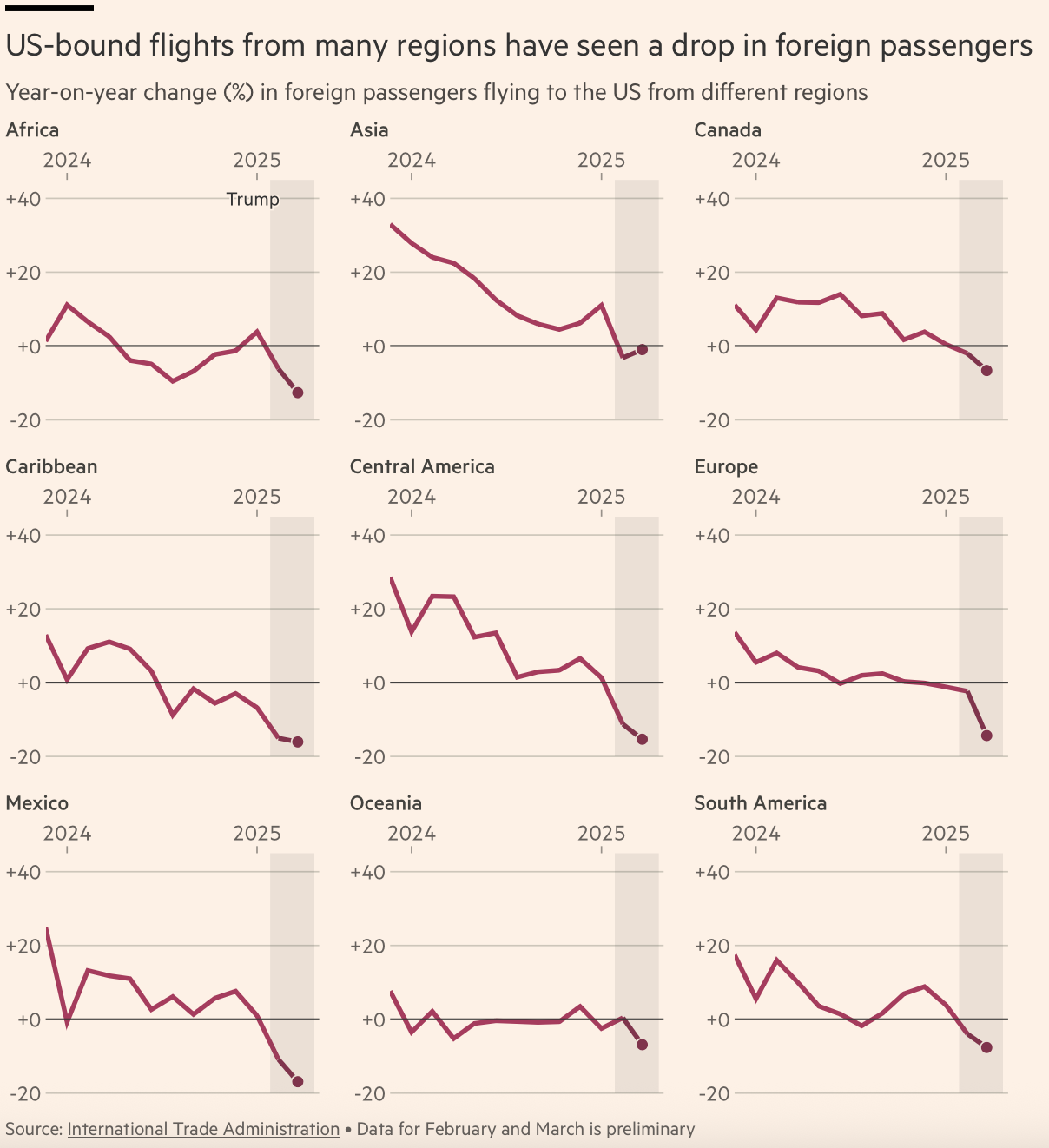
Demand From Foreigners To Come To The Untied States Has Fallen. According to the Financial Times, “Air France-KLM and Lufthansa report signs of changing demand on transatlantic route. Two of Europe’s largest airlines have warned that some Europeans are starting to avoid US travel, as President Donald Trump’s policies risk hitting some of the world’s busiest flight paths. Air France-KLM and Lufthansa have this week reported signs of weakening demand on transatlantic routes among European passengers, although they said the impact had been limited. ‘We know there are a lot of customers that are holding back in buying tickets for a little more clarity on . . . the border, and things like that,’ Air France-KLM chief executive Ben Smith told analysts on Wednesday, as the airline reported quarterly results. Its chief financial officer Steven Zaat said there had been a shift in booking patterns as demand from American travellers flying to Europe grew, while some Europeans turned away from US trips. Transatlantic bookings from Europeans for travel in May and June were down 2.4 per cent compared with the previous year. Travel in the other direction, driven by high spending American tourists, was up 2.1 per cent.” [Financial Times, 2025-04-30]
March 2025: Abu Dhabi And Binance Decided To Use World Liberty Financial’s Stablecoin In A $2 Billion Investment. According to Bloomberg, “World Liberty Financial, the Trump family’s decentralized finance project, said its new stablecoin is being used for a $2 billion investment in crypto exchange Binance Holdings Ltd. by Abu Dhabi’s MGX. MGX made the minority investment in Binance in March, but the stablecoin that would be used to settle the deal wasn’t disclosed. The companies will use World Liberty’s USD1 stablecoin for the transaction, World Liberty co-founder Zach Witkoff said on Thursday on a panel alongside Eric Trump at the Token2049 conference in Dubai. ‘We thank MGX and Binance for their trust in us,’ he said.” [Bloomberg, 2025-05-01]
As Binance Co-Founder Chanpeng Zhao Pushed For A Pardon For His Money Laundering Crimes, Binance And World Liberty Negotiated Over Creating A Stablecoin Together. According to Bloomberg, “World Liberty had engaged in discussions with Binance about developing a stablecoin together, Bloomberg News reported in March, just before USD1 was unveiled. Binance co-founder Changpeng Zhao, who in 2023 pleaded guilty to anti-money laundering failures, has pushed the Trump administration to grant him a pardon, according to a Wall Street Journal report.vZhao said on March 13 that he and the exchange ‘have no business deals’ with World Liberty or its principals. World Liberty said in an April 27 post on X that its founders met with Zhao ‘to talk about growing global adoption, setting new standards, and pushing crypto to the next level.’” [Bloomberg, 2025-05-01]
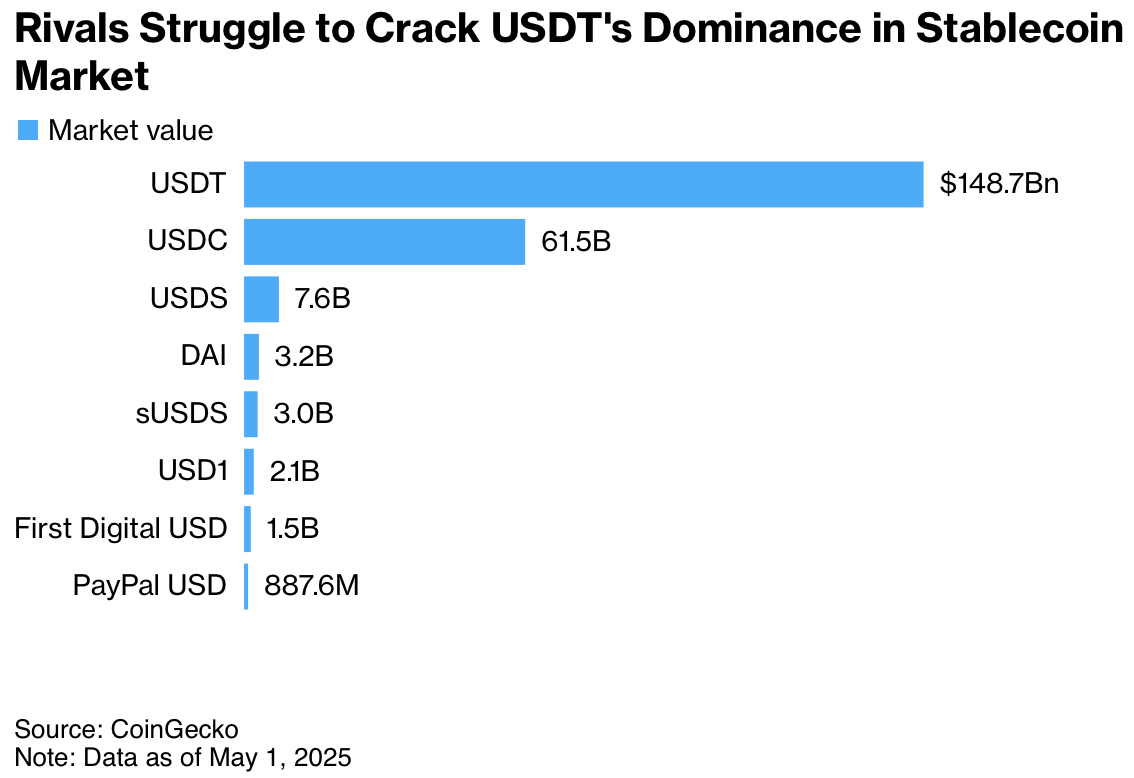
Because Stablecoins Do Not Pay Interest, But Keep Their Money In Interest-Paying Securities, They Have Been Extremely Profitable. According to Bloomberg, “Stablecoins are cryptocurrencies that aim to maintain a one-to-one value with a less volatile asset like the US dollar. Typically, they do this by relying on reserves of cash and cash-equivalent assets like US Treasury bills and money market fund holdings. World Liberty plans to publish monthly attestations on its Treasury holdings, Witkoff said in the interview. Rising interest rates and growing crypto adoption has bolstered the profitability of stablecoin issuers in recent years. Tether Holdings SA, which issues the world’s largest stablecoin USDT, said it made $13 billion in profit last year. But the existing dominance of Tether and rival Circle Internet Group Inc. has made it a tough market to crack for newcomers.” [Bloomberg, 2025-05-01]
This Deal, Which Accounts For More Than 95 Percent Of The USD1 In Existance, Made It The Sixth Largest Stablecoin In The World. According to Bloomberg, [Bloomberg, 2025-01-01]
May 2025: Bloomberg Reported That The Trump Administration Was Considering Making It Easier For The UAE To Import Nvidia Chips. According to Bloomberg, “The US is weighing a potential easing of restrictions on Nvidia Corp. sales to the United Arab Emirates, according to people familiar with the matter, who said President Donald Trump could announce the start of work on a bilateral chip deal during his upcoming trip to the Gulf. Nothing has been officially decided, the people said, emphasizing that the debate over semiconductor trade rules for the UAE and other countries remains ongoing in Washington. But talks about modifying AI chip curbs for the UAE in particular have been gaining steam at both the Commerce Department and the White House, said the people, who requested anonymity to discuss private conversations.” [Bloomberg, 2025-01-01]
The Biden Administration Placed Restrictions On The UAE’s Imports Over Concerns About Those Chips Being Diverted To China. According to Bloomberg, “The US government has required a license to export Nvidia chips to the UAE and other Gulf nations since 2023, over concerns that the hardware could be diverted to China.” [Bloomberg, 2025-05-01]
 [S&P Global,
  [Wall Street Journal,
  [Bloomberg,
  [Bloomberg,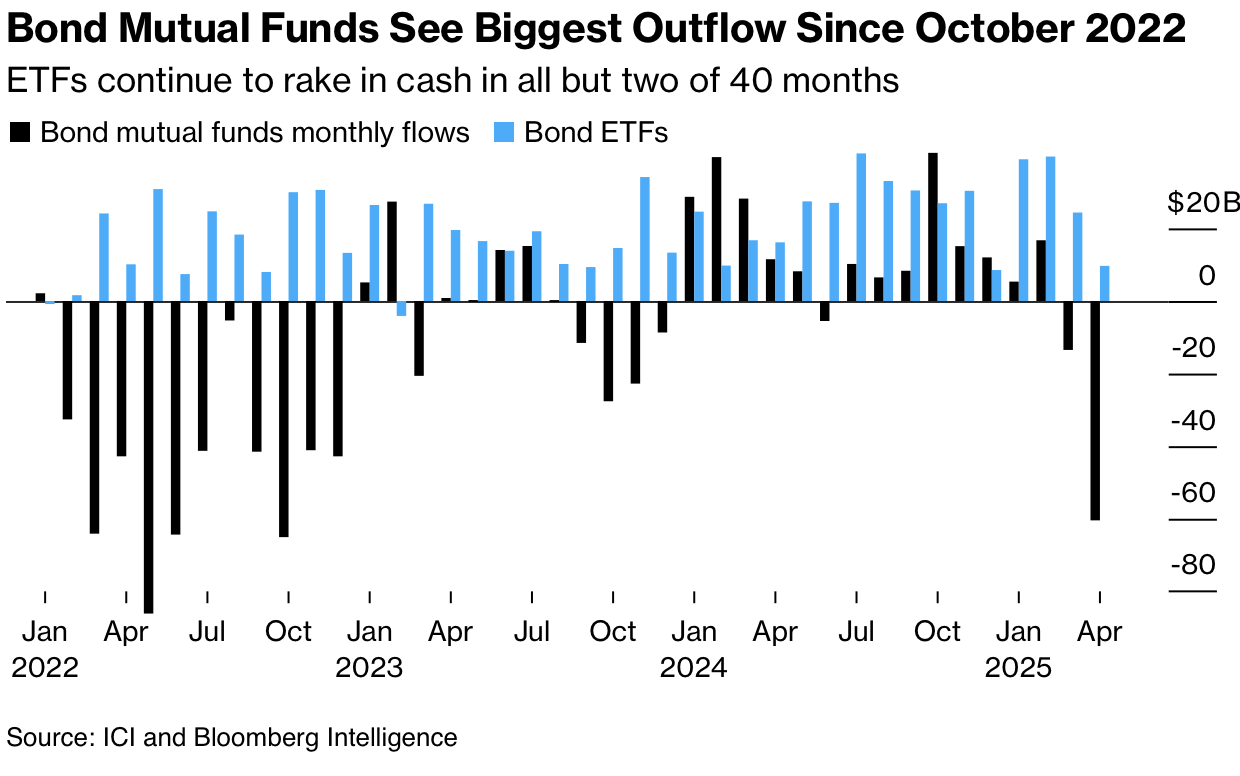
 [Financial Times,
  [Bloomberg,