As the fallout from the Trump administration’s policy choices continues to make its way through the economy, some signs of structural weakness are emerging. The labor market is showing preliminary signs of scarring: permanent job losses as a share of the workforce have reached their highest level since 2021, signaling not cyclical layoffs but the obsolescence of entire job categories through technological change and global restructuring. Wage growth has decelerated to its slowest compound annual rate since February 2022, despite a tight employment market—a combination that historically presages economic difficulties ahead. These fundamental indicators suggest the economy has lost its earlier momentum, creating a challenging backdrop for policy decisions.
Trade uncertainties are casting increasingly long shadows across multiple sectors. Import expectations have collapsed—with a projected 20% decline in overall imports and a stunning 75-80% drop from China—threatening not merely higher prices but significant supply chain disruptions. This trade shock is resonating through the economy from manufacturing (where future output expectations have plummeted) to consumer spending (Cash App data shows falling discretionary spending even during tax refund season)
In financial markets, some sophisticated investors have begun repositioning for uncertainty: private credit funds trading at steep discounts and the dollar’s unexpected weakness despite superficial market recoveries. Together, these indicators suggest an economy approaching an inflection point where temporary disruptions risk calcifying into structural challenges requiring immediate policy attention, which, unfortunately, the Trump administration and Republicans in Congress have shown no sign they are capable of achieving.
Releases
Employment
April 2025: Permanent Job Losers Hit Their Highest Share Of The Labor Force Since 2021
Code
include("../scripts/oxocarbon-plot.jl")theme(:oxocarbon)usingFredData, DataFrames, Dateskey =ENV["FRED_API_KEY"]f =Fred(key)lf=get_data(f, "CLF16OV"; observation_start="2021-11-01", observation_end="2025-04-01").dataperm=get_data(f, "LNS13026638"; observation_start="2021-11-01", observation_end="2025-04-01").dataplot(lf.date, 100.0.* (perm.value ./ lf.value), legend=false, xlabel="Date", ylabel="Percentage", title="Permanent Job Losers as a Share of The Labor Force", linewidth=2)hline!([100.0* (perm.value[end] / lf.value[end])], linestyle=:dash, label="")
A rising share of permanent job losers signals that the economy is experiencing structural changes rather than temporary disruptions. Unlike workers on temporary layoff who expect to return to their jobs, permanent job losers face obsolescence - their positions have been eliminated by technological change, globalization, or shifting consumer preferences. This distinction matters enormously: while temporary layoffs tend to reverse as economic conditions improve, permanent job losses reflect fundamental shifts in what the economy needs. When increasing numbers of workers fall into this category, it suggests that entire industries or occupations are disappearing, leaving workers stranded without clear paths back to employment.
April 2025: Wages Grew At The Slowest Compound Annual Rate Since August 2023, The Second Slowest Since February 2022
NOTE: It would be unfair to compare wage growth under Trump to the wage growth that was seen during the first few months after his first term ended, as the labor market was still normalizing in such a way that would unfairly bias the statistics against him. Therefore, I decided to compare wage growth from when the unemployment rate returned to its March 2020 level, in October 2021.
Trade War
National Retail Federation: Imports In The Second Half Of 2025 Are Expected To Fall By At Least 20 Percent Year Over Year, Meaning “Higher Prices On Shelves And Fewer Choices For Consumers.” According to CNN, “Imports into the United States during the second half of 2025 are expected to fall at least 20% year over year, according to the National Retail Federation. The decline from China will be even starker: JP Morgan expects a 75% to 80% drop in imports from there. ‘If not easily replaced by imports from other countries, a collapse of this magnitude would not only sharply boost prices but also significantly disrupt supply chains,’ JP Morgan detailed in its report. That means less work, higher prices on shelves and fewer choices for consumers. Seroka says the countdown has already begun. ‘Many major retailers have told us they have about a six- to eight-week supply of inventory in their systems now,’ Seroka said. ‘United States manufacturers and consumers alike will find difficult decisions in the weeks and months to come if policies don’t change.’” [CNN, 2025-05-01]
American Trucking Association: “The Longer The Tariffs Last, The Greater The Pain For Truckers As Well As The Families And Businesses We Serve.” According to CNN, “The American Trucking Associations has been calling on President Trump to make deals with key trading partners including Canada, Mexico and China to protect trucking jobs. ‘The longer tariffs last, the greater the pain for truckers as well as the families and businesses we serve,’ said Chris Spear, president and CEO of American Trucking Associations last month. ‘Not only will tariffs reduce cross-border freight, but they will also increase operational costs. The price tag of a new truck could rise by up to $35,000, amounting to a $2 billion annual tax and putting new equipment out of reach for small carriers.’” [CNN, 2025-05-01]
Falling Profits
May 2025: Amazon Forecast Profit Falling Billions Below Expectations Due To “Inherently Unpredicatable” Trade Circumstances. According to Bloomberg, “Recessionary fears. Global economic and geopolitical conditions. Tariff and trade policies. They were all among the factors that Amazon.com Inc. cited when it issued a forecast late Thursday for profit to fall billions of dollars below Wall Street’s expectations. ‘None of us knows exactly where tariffs will settle or when,’ Chief Executive Officer Andy Jassy said on a call with analysts. For now, Amazon said, its future results are ‘inherently unpredictable.’” [Bloomberg, 2025-05-02]
March 2025: Bezos Filed Plans To Sell Billions Of Dollars In Amazon Shares. According to Bloomberg, “Jeff Bezos plans to sell as many as 25 million shares of Amazon.com Inc. over the next 13 months, potentially cashing out as the world’s largest online retailer grapples with uncertainty over tariffs. Bezos adopted what’s known as a 10b5-1 trading plan on March 4, which entitles the Amazon co-founder to sell until May 29, 2026, according to a Friday filing. At Friday’s share price, the total value would be about $4.8 billion.” [Bloomberg, 2025-05-02]
Manufacturing
April 2025: Global Manufacturing Contracted, With The Future Output Index Hitting Its Lowest Level Since October 2022. According to Bloomberg, “Global manufacturing activity contracted for the first time this year in April, dragged down by shrinking orders and employment. The JPMorgan Global Manufacturing Index decreased to 49.8 from 50.3 a month earlier as uncertainty around US trade and tariff policies weighed on demand and business expectations. Figures below 50 indicate contraction. The future output index fell to the lowest level since October 2022 and has slid 4.5 points since President Donald Trump was elected in November.” [Bloomberg, 2025-05-02]
Consumers
Q1 2025: Block Profits Tumbled As Cash App Spending Came In Below Forecasts Due To Declining Discretionary Spending. According to Bloomberg, “Shares of Block Inc. sank the most in more than five years after the digital-payments company led by Jack Dorsey posted first-quarter results below analysts” estimates and lowered its full-year profit guidance as a result of a more challenging macroeconomic environment. The stock tumbled as much as 24% to $44.27 soon after the open of exchanges Friday morning in New York. The company said it now expects gross profit to grow 12% to $9.96 billion this year, down from its previous expectation of at least $10.22 billion. The reduced guidance came after gross profit growth for Block’s Cash App unit came in below expectations following softer Cash App card spending than the company had forecast, Dorsey wrote in a letter to shareholders. The largest hit came from a decline in discretionary spending in categories including media and travel, Chief Financial Officer Amrita Ahuja said in an interview. Cash App card spending remained resilient in essential categories like gas and groceries, Ahuja added.” [Bloomberg, 2025-05-01]
April 2025: Despite Consumers Getting Tax Refunds, Their Spending Response Was Less Robust Than In Recent Years. According to Bloomberg, “‘What we saw shift in the first quarter was a change in behavior on the Cash App customer base during the tax-refund season versus what we”ve seen in past tax seasons,’ Ahuja said. ‘This gross profit guidance really reflects a view that what we saw in Cash App this quarter may be a sign of a changing macro backdrop where we have wider error bands and uncertainty.’” [Bloomberg, 2025-05-01]
Financial Markets
Private Markets
Oaktree Co-CEO Robert O’Leary: Before Trump’s Tariffs, Private Credit Was Already Trading At A 10-30 Percent Discount, Which Could Be Exacerbated. According to Bloomberg, “Private credit fund investors are offloading stakes at significant discounts ahead of more potential pain for the US economy, Oaktree Capital Management Co-Chief Executive Officer Robert O’Leary said. Oaktree sees more chances to buy marked-down assets in continuation vehicles and in secondary markets, where private asset holders sell stakes in relatively illiquid funds to bring returns to their own investors. That activity has been building in private equity for some time, but credit investors are now putting up bigger trades, O’Leary said in an interview. Discounts are starting at about 90 cents on the dollar and going as low as 70 cents, he said. ‘Those are trades that happened when we didn’t have a tariff problem, and the economy was in relatively good condition,’ O”Leary said.” [Bloomberg, 2025-05-02]
Capital Flight
May 2025: Large Block Trades Betting On Higher Rates In Five And Ten Year Treasury Notes Were Executed. According to Bloomberg, “In the aftermath of the [employment] data, a couple of large futures block trade in both 5- and 10-year note contracts added to the downside pressure and kept yields supported near highs of the day. The combined risk weighting across the two sales was equal to just over $1 million per basis point move.” [Bloomberg, 2025-05-02]
May 2025: As Asian Long-Dollar Trades Unwound, The Dollar Fell For A Fourth Of Five Consecutive Weeks. According to Bloomberg, “A dollar gauge dropped Friday, ending lower for the fourth time in the last five weeks, as the prospect of trade deals created an appetite for other currencies. The Bloomberg Dollar Spot Index fell 0.8% Friday, erasing gains earlier in the week. The yen and Australian and New Zealand dollars were among best performers in the Group of 10, advancing more than 1% after China signaled an openness to tariff talks with the US. ‘It seems that market is expressing some optimism on the China headlines,’ said Aroop Chatterjee, managing director for macro strategy and emerging markets at Wells Fargo in New York. ‘It’s clear that dollar longs against Asia FX are being unwound.’” [Bloomberg, 2025-05-02]
While Headline Markets Have Recovered From Trump’s Tariff Announcements, The Dollar Has Weakened, Undermining Those Gains. According to Bloomberg, “Even as US markets have recovered in recent days on signs of trade deals and economic strength, the “sell America” theme appears to remain intact and the dollar gauge is now down almost 7% for the year.” [Bloomberg, 2025-05-02]
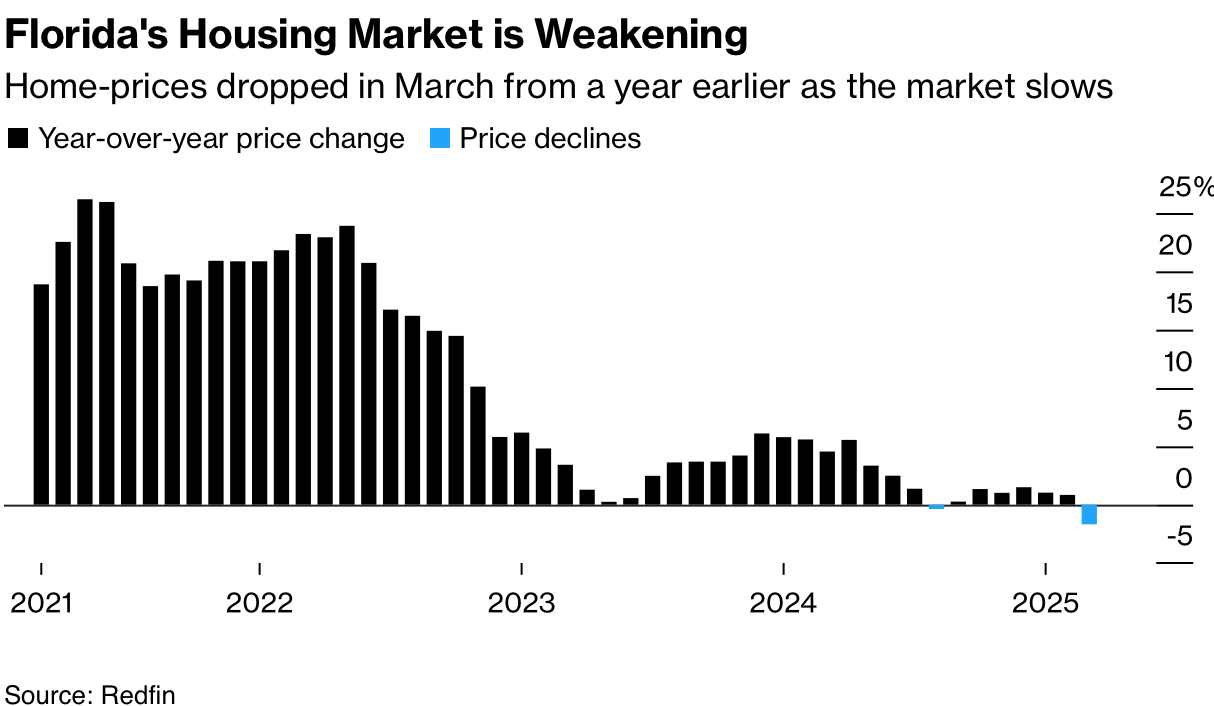
March 2025: Florida Home Prices Fell By The Most They Have Since At Least 2012. According to Bloomberg, “Florida’s housing boom has now shifted into reverse, with prices sliding by the most in at least 13 years. The median price for all types of homes fell 1.7% in March from a year earlier, according to Redfin Corp. data going back to 2012.” [Bloomberg, 2025-05-02]
Corruption
May 2025: A Group Of Trump Tied Figures Launched A Five To Six Figure Association To Have Off The Record Discussions With Members Of The Trump Administration. According to the Wall Street Journal, “A new group out of Washington, D.C., aims to offer an alternative to longstanding executive networks like the Business Roundtable, but with a MAGA makeover. American Growth Partnership, founded by several former Republican campaign and congressional aides, will offer monthly briefings and off-the-record roundtable discussions between its members and Trump appointees, aides and policymakers. The group will start this month. Membership will be tiered and start from $50,000 to $100,000, according to a person familiar with the matter. Its first event will allow chief executives and other members to meet with Federal Trade Commission Chairman Andrew Ferguson. Its second event will be with Brendan Carr, chairman of the Federal Communications Commission. Both agencies have companies such as Meta Platforms and Paramount in their crosshairs and are being closely watched by business leaders. The group was founded by: Garrett Ventry, the founder of lobbying and public affairs firm GRV Strategies and former senior Capitol Hill aide with deep ties to the Trump administration Richard Walters and Jim McCray, former senior advisers to the Trump-Vance presidential campaign and Republican National Committee Josh Helton, a former senior adviser to the Republican National Committee Jason Thielman and Tim Edson, who had both worked at the National Republican Senatorial Committee. The group plans on leveraging its connections within the Trump administration to offer business leaders briefings from officials that could help them navigate business issues ranging from economic policy to tariffs and antitrust. It will also do monthly updates with members based on their own interactions with the administration.” [Wall Street Journal, 2025-05-01]