As has become standard, today’s report starts with Trump’s trade war, and how these tariffs have led to higher consumer prices, supply chain disruptions, and significant challenges for small businesses, that employ 80 percent of American workers, lacking the flexibility of larger corporations to adapt. The document highlights Trump’s dismissive “let them eat cake” statements regarding these economic hardships, including comments that children could “have two dolls instead of 30” and people “don’t need to have 250 pencils.”
In addition, it goes into a bit more depth about how things are starting to break. The oil price collapse driven in party by Trump’s trade war has taken prices below where American drillers need them to be in order to break even. This estimate of breakeven prices is probably too low, as it doesn’t account for the increase in prices drillers will need to pay for goods like pipes that they need.
Financial markets in general are not at their best. Trump’s lax enforcement is enhancing the appeal of gamified products like zero day to expiration (0DTE) options on individual stocks. Furthermore, the private market participants seem to be making strides in getting access to more Americans’ savings, even as more evidence emerges of weakness in the balooning field of private debt.
Finally, it concludes with more instances of Trump’s blatant corruption. # Trade War
Trump’s “Let Them Eat Cake” Statements
May 2025: Trump Downplayed Concerns About Higher Prices, Saying Children Could Do With Fewer Dolls And Pencils. According to the Wall Street Journal, “Trump has paused sweeping tariffs on dozens of countries to allow for negotiations but has kept in place severe levies on Chinese imports, which have already led to some consumer-price increases. The president has played down concerns, saying last week that ‘maybe the children will have two dolls instead of 30.’ Pressed on those comments Sunday, he insisted people could do with less. ‘They don’t need to have 250 pencils. They can have five,’ he said on NBC. ‘We don’t have to waste money on a trade deficit with China for things we don’t need, for junk that we don’t need,’ Trump said. He pointed to lower gasoline and food prices. Asked about rising concern from small businesses, Trump ruled out possible measures to grant relief. ‘They”re not going to need it,’ he said. ‘They”re going to make so much money.’ Republican strategist Marc Short, who served in the first Trump administration, said the toll of Trump’s trade war would soon be more visible—and criticized the president’s quip about dolls. ‘I don’t know if there is a restriction on what, you know, Ivanka or Tiffany could have,’ he said on NBC, referring to Trump’s adult daughters. ‘But I think that is sort of a “let them eat cake” moment.’” [Wall Street Journal, 2025-05-04]
May 2025: Trump Ruled Out Support For Small Businesses During His Trade War. According to the Wall Street Journal, “Trump has paused sweeping tariffs on dozens of countries to allow for negotiations but has kept in place severe levies on Chinese imports, which have already led to some consumer-price increases. The president has played down concerns, saying last week that ‘maybe the children will have two dolls instead of 30.’ Pressed on those comments Sunday, he insisted people could do with less. ‘They don’t need to have 250 pencils. They can have five,’ he said on NBC. ‘We don’t have to waste money on a trade deficit with China for things we don’t need, for junk that we don’t need,’ Trump said. He pointed to lower gasoline and food prices. Asked about rising concern from small businesses, Trump ruled out possible measures to grant relief. ‘They”re not going to need it,’ he said. ‘They”re going to make so much money.’ Republican strategist Marc Short, who served in the first Trump administration, said the toll of Trump’s trade war would soon be more visible—and criticized the president’s quip about dolls. ‘I don’t know if there is a restriction on what, you know, Ivanka or Tiffany could have,’ he said on NBC, referring to Trump’s adult daughters. ‘But I think that is sort of a “let them eat cake” moment.’” [Wall Street Journal, 2025-05-04]
Higher Prices
Even Manufacturers Who Have Seen An Uptick In Business, Have Also Been Squeezed By Higher Prices On Necessary Goods. According to the Wall Street Journal, “Donny Chaplin, president of Grand River Rubber & Plastics in Ashtabula, Ohio, said he has seen a rush of new inquiries and orders. Two previous customers that had switched to Chinese suppliers a few years ago came back in recent days wanting to buy rubber gaskets from Grand River again, for the plastic pails they manufacture. Three manufacturers of oil filters also got in touch, wanting to shift business from China, with two already placing orders. All together, the new business will be worth about $5 million a year if it is completed, or roughly 10% of Grand River’s revenue. That might require the company to hire new employees and expand production lines, so Chaplin said he’s asking for long-term contracts. That will also protect the company if the tariffs disappear, he said. Grand River and other manufacturers say the tariffs are increasing production costs, especially given their reliance on imported Chinese materials that now carry 145% levies. Grand River buys factory supplies from China, including safety glasses, machine tools and ear plugs, and it imports a small amount of rubber from countries whose goods now face 10% tariffs. Chaplin said the company can probably manage these higher costs but will have to pass them on to its customers through price increases.” [Wall Street Journal, 2025-05-04]
Despite Having Reduced Its Reliance On Chinese Materials By Half Over The Past Decade, Husco International Will Have To Raise Prices On The Components It Manufactures. According to the Wall Street Journal, “Husco International, a family-owned manufacturer near Milwaukee that makes components for autos and farm equipment, has halved its reliance on Chinese materials over the past decade, in response to tariffs from Trump’s first term and the general worsening of U.S.-China relations, Chief Executive Austin Ramirez said. But 20% of the manufacturer’s inputs by value still come from China. ‘We can’t just stop. These are critical components that go into our customers” goods,’ he said. ‘We have to keep importing and I have to pay the tariffs.’ He’s trying to cover this extra cost by raising prices.” [Wall Street Journal, 2025-05-04]
The “Asteroid” Coming For America’s Small Businesses
Ryan Petersen: “If They Don’t Change The Tariffs, It’s Going To Be An Extinction-Level, Asteroid-Wiping-Out-The_Dinosaurs Kind Of Event, Only These Aren’t Dinosaurs. These Are Dynamic, Healthy Businesses.” According to the Wall Street Journal, “As the founder and chief executive of Flexport, which helps companies move all kinds of stuff from wherever it’s made to wherever it’s sold, Petersen was perfectly situated to explain the traffic jam in a clear way. Once the boat was unstuck, he even published a children’s picture book called ‘The Big Ship and the Little Digger,’ turning the complexities of ocean freight and global trade into simple language that anyone could understand. Now he’s doing it again to make another crisis accessible—and not for a bunch of children. This time, Petersen is explaining to anyone who will listen why hefty U.S. tariffs on Chinese imports could be catastrophic for America’s small businesses. ‘If they don’t change the tariffs, it’s going to be an extinction-level, asteroid-wiping-out-the-dinosaurs kind of event,’ he told me. ‘Only these aren’t dinosaurs. These are dynamic, healthy businesses.’ He knows this because those businesses are his customers. They use Flexport to transport products from the factory to your front door. Petersen’s company handles everything from booking space on planes, trucks and enormous ocean carriers to managing all the tedious paperwork along the way. It’s a sleek tech platform that gives Petersen a window into the entire global economy, providing a real-time look at the situation on the ground and on the water. He can track exactly how much it costs to ship any item anywhere—and how much more it costs because of tariffs. His company has visibility into about 1% of U.S. trade, he said, which is more than enough data for him to connect dots. ‘We have a pretty good view of what’s happening,’ he says. And what’s happening isn’t pretty.” [Wall Street Journal, 2025-05-02]
Because Of Their Smaller Order Size, Small Businesses Often Have Had A Harder Time Moving Their Orders Around. According to the Wall Street Journal, “This past week, he traveled from San Francisco to Washington, D.C., where he spent two days meeting with government officials to make the case that tariffs pose an existential threat to his customers. America’s biggest and most powerful businesses have armies of lobbyists and CEOs who dine with the president. Even for them, tariffs are disruptive. But for America’s small businesses, they could be destructive. Through no fault of their own, he explains, their business models have broken. They can’t afford the latest tariffs on Chinese goods. But Vietnam’s factories won’t bother with their production jobs, so they also can’t move their manufacturing out of China. ‘If they could,’ Petersen said, ‘they would have.’ Meanwhile, there is too much in flux to figure out what they should do. And if they haven’t moved their supply chains already, there’s no point in moving them yet. ‘It’s either too late or too early,’ Petersen said. They”re about as stuck as that humongous ship in the Suez Canal.” [Wall Street Journal, 2025-05-02]
80 Percent Of American Employment Is At Firms With Fewer Than 500 Employees. According to the Wall Street Journal, “Without the resources of their larger counterparts, small businesses could get particularly slammed by scarce or higher-cost goods, worries Apollo Global Management chief economist Torsten Slok. ‘The important statistic in that context is that 80% of employment in the U.S. economy is in businesses with less than 500 workers,’ he said.” [Wall Street Journal, 2025-05-02]
Slowing Growth
Q1 2025: Companies From Airlines, To Household Goods Makers, To Restaurants Reported Softer Demand. According to the Wall Street Journal, “Still, worries about tariffs, job security and possible price increases are causing some Americans to tighten their belts. American Airlines and Delta Air Lines said domestic leisure travel has softened, with the most price-sensitive travelers in particular cutting back. Pampers maker Procter & Gamble and OxiClean maker Church & Dwight reported that U.S. sales growth slowed in the first quarter. Restaurant chains including Chipotle Mexican Grill and Starbucks have experienced slower U.S. sales. McDonald’s said first-quarter sales at U.S. locations that have been open more than a year fell by 3.6% from a year earlier.” [Wall Street Journal, 2025-05-02]
Empowering China
April 2025: China Lifted Sanctions On European Lawmakers In A Bid To Improve Relations With The European Union.; According to Bloomberg, “China removed sanctions against European lawmakers amid speculation that President Donald Trump’s sweeping tariffs could lead to a reset of relations with the European Union. The lifting was confirmed by European Parliament president Roberta Metsola on Wednesday. ‘Our parliamentary committees must be able to discuss European interests with their Chinese counterparts without fear of repercussions,’ Metsola said, according to a statement. The sanctions, imposed in 2021, had targeted five Members of the European Parliament and the Parliament’s Subcommittee on Human Rights. They were imposed in response to measures taken earlier by the EU over human-rights practices in Xinjiang. Beijing has been trying to enhance ties with nations around the world since President Donald Trump announced his sweeping tariffs earlier this month.” [Bloomberg, 2025-04-30]
Those Sanctions Had Led To The Shelved Ratification Of An Investment Deal With The Economic Bloc. According to Bloomberg, “President Xi Jinping’s government is showing signs of increased sophistication when it comes to geo-economic strategy. In an effort to avoid isolation by the White House in the global trading system, Beijing has come up with some new tricks. Back at the end of Donald Trump’s first term, China sealed a landmark investment deal with the European Union in what appeared to be a move to encourage it (see last week’s newsletter) to serve as a neutral player rather than US ally. But the EU shelved its ratification after Beijing sanctioned several European legislators in retaliation for the bloc’s sanctions against China over human rights concerns.” [Bloomberg, 2025-05-03]
Republican Budget Cuts
Trump’s Budget
Trump’s Budget Proposal Would Cut Non-Defense Discretionary Spending To Its Lowest Level Since 2017. According to the Financial Times, “Donald Trump has called for $163bn in cuts to federal spending in a sweeping budget proposal that guts programmes his administration deems ‘woke’, ‘wasteful’ or ‘weaponised against ordinary working Americans’. In a budget blueprint submitted to Congress on Friday, the US president pressed for non-defence spending to be slashed by 22.6 per cent to the lowest level since 2017 alongside a sharp increase in the defence budget.” [Financial Times, 2025-05-02]
Trump’s Budget Proposal Could Close The Part Of The Government In Charge Of Setting Units Of Measure. According to the Financial Times, “Smaller but still important organisations are also feeling the squeeze. The Atomic Spectroscopy Group of the National Institute for Standards and Technology (NIST), part of the commerce department, is reportedly scheduled to close this month. The atomic measurements made by the group are a standard international reference point and used by experts from cosmologists to makers of industrial products.” [Financial Times, 2025-05-23]
Hill Budget
House Republicans Advanced Legislation Cutting Funding For The FAA To Modernize Air Traffic Control. According to Bloomberg, “Republicans on the House Transportation and Infrastructure Committee have advanced legislation that would give the FAA $12.5 billion to modernize air traffic control. That’s down from $15 billion in an earlier proposal.” [Bloomberg, 2025-05-04]
Vulnerabilities In The Existing Air Traffic Control System Led To United Canceling Flights Into Newark. According to Bloomberg, “The Trump administration’s plan to modernize the aging US air traffic-control system has gained fresh urgency after vulnerabilities with the existing system pushed United Airlines Holdings Inc. to cut flights at the second-busiest hub serving New York City.” [Bloomberg, 2025-05-04]
April 2025: Crude Oil Fell 16 Percent As OPEC+ And Its Allies Upped Production While Trump’s Trade War Depressed Demand. According to Bloomberg, “Crude sank 16% in April, after OPEC+ rocked the market with a surprise decision to increase production more than expected from this month, just as non-members including Guyana also ramp up output. With the trade war starting to drag on economies from the US to China, endangering the outlook for energy demand, banks including Morgan Stanley have warned of a glut.” [Bloomberg, 2025-04-30]
April 2025 Saw The Largest Monthly Oil Price Drop Since 2021. According to Bloomberg, “Oil was little changed after the biggest monthly drop since 2021, as signs that the Saudi-led OPEC+ alliance may be entering a prolonged period of higher output added to concerns the trade war will hurt demand.” [Bloomberg, 2025-04-30]
May 2025: OPEC+ Moved Forward Its Meeting To Set June Prices, In A Move Markets Anticipated As Signaling A Further Increase In Production. According to Bloomberg, “Oil slumped as OPEC+ pulled forward a meeting to weigh further production increases, inflaming concerns about swelling global supplies that have dragged down crude prices this year. West Texas Intermediate futures slipped more than 1% to trade below $59 a barrel, down about 7% this week, after OPEC+ moved up its video conference to discuss June production levels by two days to May 3.” [Bloomberg, 2025-05-01]
Higher-Cost American Producers Have Been Hit Harder By The Fall In Prices
May 2025: American Oil Producers Previewed Tighter Financial Circumstances. According to Bloomberg, “The drop in prices is already showing signs of squeezing a key industry that Trump pledged to help. Some of the biggest US shale-oil producers plan to slash about 4% of their drilling rigs by the end of the year. Chevron Corp. said on an earnings call on Friday that it would reduce share buybacks, citing a softening market.” [Bloomberg, 2025-05-01]
Q1 2025: American Oil Majors Reported Lower Profits, Due To Lower Oil Prices And Higher Production Costs. According to the Wall Street Journal, “Exxon Mobil and Chevron posted lower first-quarter earnings Friday, hurt by narrow refining margins, lower oil prices and rising costs. Their outlook has dimmed since the end of the quarter. Oil prices have dropped sharply in the wake of President Trump’s April 2 tariff blitz, presenting a new test of the U.S. oil majors’ ability to keep profits and payouts to investors aloft. For years following the pandemic, both companies have trimmed billions in costs to reassure investors that they are prepared to weather the next downturn in oil prices.” [Wall Street Journal, 2025-05-02]
March 2025: Before Trump’s Tariffs Took Hold, American Oil Producers Were Reporting Higher Breakeven Oil Prices. [Dallas Federal Reserve, 2025-03-27]
Financial Markets
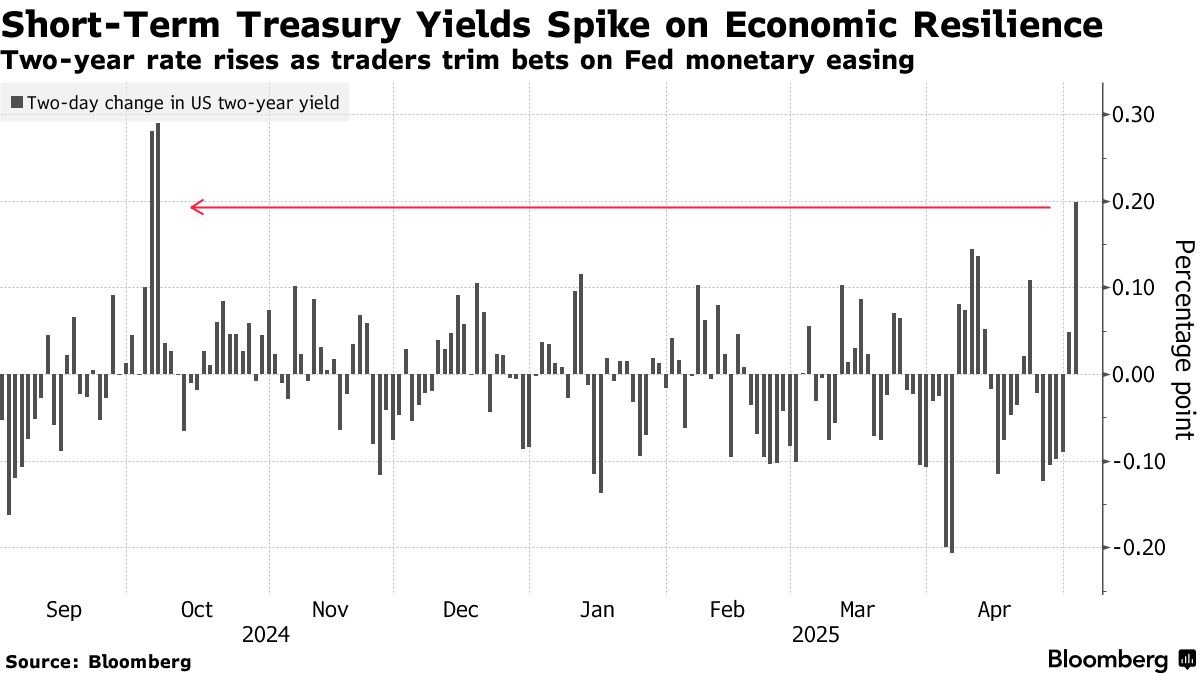
May 2025: In Contrast To Trump, Traders Responded To The April 2025 Employment Report By Dialing Back Bets On Interest Rate Cuts, Leading To The Largest Two Day Spike In Short Term Yields Since October 2024. According to Bloomberg, “Fifteen minutes after the April employment report hit early Friday, President Donald Trump seized on the surprisingly strong job growth to ratchet up his pressure on Federal Reserve Chair Jerome Powell, saying there was no reason to hold off on cutting interest rates. Bond traders came to the exact opposite conclusion. The pace of hiring — as well as a manufacturing report on Thursday that wasn’t as downbeat as expected — drove traders to dial back rate-cut bets that had steadily mounted as Trump’s trade war unleashed havoc in financial markets and sowed fears of a US recession. After piling into short-term Treasuries, anticipating the Fed would start easing policy as soon as next month to contain the fallout, they reversed course. Two-year yields shot up, staging the biggest two-day jump since October, and futures traders started pricing in what Fed officials have been consistently trying to drive home — that they will remain in wait-and-see mode until there’s more evidence that the economy has turned. ‘With inflation being above the Fed’s target, tariffs which can move prices higher and a still solid labor market, I think the Fed is unlikely to do anything,’ said Priya Misra, portfolio manager at JPMorgan Asset Management. ‘But they are data dependent and the data could turn weaker by the time the Fed meets mid-June.’” [Bloomberg, 2025-05-04]
April 2025: Year Ahead Inflation Swaps Reached Their Highest Level Since 2022. According to Bloomberg, “At the same time, one-year inflation swaps in early April rose to the highest level since 2022 amid worries about the impact of tariffs on import prices. Despite a pullback, they’re still more than 70 basis points higher than in January.” [Bloomberg, 2025-05-02]
Gamification
Bloomberg: Trump’s SEC Is Expected To Approve Zero Day To Expiration (0DTE) Options On Individual Stocks. According to Bloomberg, “Nasdaq Inc. wants to increase the number of days that options on megacaps like Nvidia Corp. and Tesla Inc. can expire, in what could be a key step toward expanding Wall Street’s zero-day trading boom to single stocks. The explosive growth in the buying and selling of derivatives with less than one day to expiration — known as 0DTE options — has so far been largely contained to contracts tied to major indexes such as the S&P 500 and a handful of corresponding ETFs. That’s because they boast daily expirations, whereas options on single equity names only expire on a Friday. Nasdaq has filed a proposal to expand those weekly expirations for a small group of qualified stocks to add both Monday and Wednesday. Pending an approval from the US Securities and Exchange Commission, options with those maturities are expected to start trading as early as the first half of 2026, according to the exchange operator. The move is aimed to help investors ‘more precisely manage their portfolios and their risk in a transparent, liquid, and secure marketplace,’ a spokesperson said.” [Bloomberg, 2025-05-01]
Unlike Index Options, Sing-Stock Options Are Settled In Kind Rather Than In Cash, Exposing Traders To Volatility Outside Of Normal Trading Hours. According to Bloomberg, “The route to success with individual names is likely to be more complicated. Single-stock options are typically physical settled, rather than cash settled as in the case of index options. That creates extra risk especially for retail traders, who may not be aware of the difference. In the event a stock gets assigned upon expiration and then plunges overnight on news such as disappointing earnings, the contract owner can be exposed to substantial losses.” [Bloomberg, 2025-05-01]
Private Markets
Investment Company Institute Washington Conference Focused On Retail Investing In Private Markets. According to Bloomberg, “The half-lit ballroom at the JW Marriott in Washington buzzed with the restrained energy typical of a traditional asset-management conference — dark suits, legacy names and philosophies on portfolio allocation. Sipping their coffees Thursday at the buffet breakfast less than two miles from Capitol Hill, many of the attendees had expected to hear conversations about President Donald Trump’s tariffs and the ensuing market chaos. But as one of the first keynote speakers took the stage, some were caught by surprise. ‘I”m going to focus today on one of ICI’s strategic priorities: giving retail investors real access to private markets,’ said Eric Pan, the chief executive officer of the Investment Company Institute, which organized the three-day conference that ended Friday. ‘As we look to the future, we need to continue pushing the boundaries, and private markets may well be an important new opportunity for retail investors.’ For an industry built on liquidity, transparency and public markets, the trend was clear: Private assets, once reserved for institutional investors and the ultra wealthy, are fast becoming mainstream. Across the industry, traditional asset managers are seeking ways to combat squeezed margins as fees in their stock and bond funds keep dropping. Investing behemoths such as Vanguard Group, BlackRock Inc. and State Street Corp. have partnered with or acquired businesses to create private credit and equity products that generate more lucrative fees.” [Bloomberg, 2025-05-02]
Apollo CEO Mark Rowan Expected Retail And Retirement Funding To Be “One Of The Largest Sources Of Capital Formation For Us.” According to Bloomberg, “As the conference was wrapping up Friday morning, Apollo Global Management Inc. CEO Marc Rowan was reinforcing the same message to a different audience. ‘I expect traditional asset managers to be potentially one of the largest sources of capital formation for us,’ Rowan told analysts in call to discuss Apollo’s first-quarter results, when he mentioned his firm’s recent tie-ups with State Street and Lord Abbett. ‘We are all in the early days, and these partnerships are about experimentation.’” [Bloomberg, 2025-05-02]
Private Credit Weakness
2024: Only 40 Percent Of Private Credit Funds Used Third-Party Appraisals Of Loan Values. According to Bloomberg, “But valuations in direct lending remain a concern. Just 40% of private credit funds reporting data to the US Securities and Exchange Commission use third-party appraisals, the Bank for International Settlements pointed out last year. ‘There’s substantial evidence that suggests direct lenders — through optimism and/or self-interest — are camouflaging problem loans, postponing defaults and bankruptcies, leading to potential over-statement of loan valuations, portfolio yields, and fund returns,’ Jeffrey Diehl and Bill Sacher of Adams Street, which manages $62 billion of assets, wrote in a report last week.” [Bloomberg, 2025-05-03]
The Floating Rate Nature Of Private Credit Makes It So That A Mark Of A Company’s Debt Is Essentially Entirely Dependent On Assessing The Company’s Ability To Pay. According to Adams Street Partners, “Direct lenders value loans quarterly based on an estimate of fair market value. Since private credit loans are floating rate, their valuations are more sensitive to idiosyncratic factors than to changes in base rates or credit spreads. Absent a major macroeconomic dislocation, direct loan values are primarily determined by the fundamental performance of the underlying company. If performance has been weak, lenders must decide whether to hold the loan at par or mark it down and if so, by how much.” [Adams Street Partners, 2025-04-23]
Lender Fees Are Largely Determined By Valuation Marks. According to Adams Street Partners, “Since direct lending alpha is eroded by left-tail loan losses, investors should pay close attention to companies paying PIK interest and/or those whose valuation marks seem inconsistent with business fundamentals. Lender valuations are a key driver of management/incentive fees, fund leverage covenants, and fund performance, so lenders are generally reluctant to book non-accruals, markdowns, defaults, and bankruptcies. False optimism can cause lenders to delay markdowns and non-accruals in favor of offering loan modifications that buy time, hoping company fundamental performance improves or base rates decline.” [Adams Street Partners, 2025-04-23]
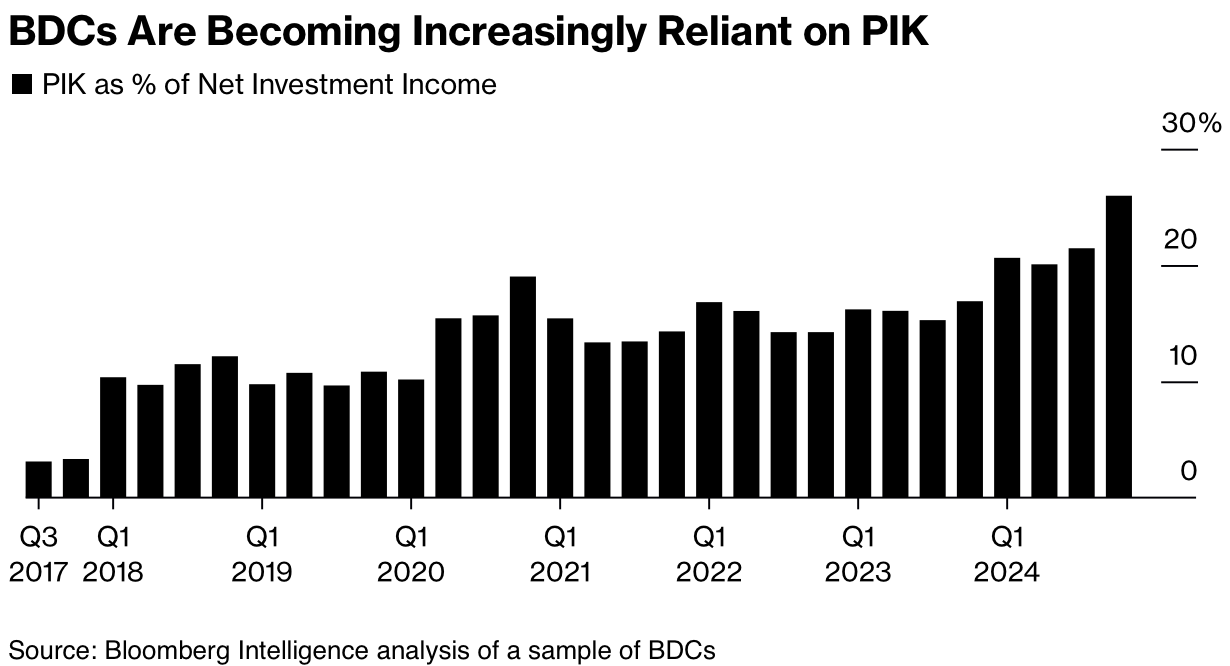
As Creditors Have Started To Pay Back Loans In Kind (Piling On More Debt), Business Development Companies Have Valued That Debt More Highly Than Would Be Expected. According to Bloomberg, “Creditors are increasingly turning to these costly notes, known as payment-in-kind. More than a quarter of net investment income at a sample of BDCs tracked by Bloomberg Intelligence was made up of PIK at the end of the fourth quarter of last year. ‘PIK loans are often valued surprisingly high, with approximately 75% valued at over 95 cents on the dollar by the end of September,’ EY wrote in a report last month. ‘This discrepancy raises doubts about the consistency of valuations, especially when compared to similar loans in the public market, which are often valued lower.’” [Bloomberg, 2025-05-03]
Despite Direct Lenders’ Assurances That They Are Able To Take Advantage Of Market Weakness, Market Participants Have Profited Off Of Their Stock Price Declines. According to Bloomberg, “Hedge funds are betting that trade wars, a shrinking economy and rising strain among borrowers will begin to hit private credit in the US. So far, the gamble’s paying off. Short sellers have made about $1.7 billion on paper so far this year from wagers against seven of the biggest direct lenders, including Apollo Global Management Inc., Ares Management Corp. and Blue Owl Capital Inc., according to data compiled by S3 Partners LLC. While direct lenders have touted tariff-induced volatility as a chance for them to grab a larger slice of the debt market, their share prices have fallen in recent months on policy and economic uncertainty. Adding to the headwinds, the International Monetary Fund warned last month of concern among market participants that borrowers’ deteriorating credit quality has not been reflected in the industry’s loan valuations.” [Bloomberg, 2025-05-03]
Marketwatchers Have Been Concerned By The Pace Of Loan Price Adjustments By Private Lenders. According to Bloomberg, “While direct lenders have touted tariff-induced volatility as a chance for them to grab a larger slice of the debt market, their share prices have fallen in recent months on policy and economic uncertainty. Adding to the headwinds, the International Monetary Fund warned last month of concern among market participants that borrowers” deteriorating credit quality has not been reflected in the industry’s loan valuations. Alternative asset managers are ‘very exposed if we do have a recession. If company revenue falls, cash flow falls which means leverage goes up and free cash flow goes out the window,’ said Scott Roberts, a senior managing partner at Belvedere Direct Lending Advisors.” [Bloomberg, 2025-05-03]
The Relatively New Vintage Of Private Credit As An Asset Class Has Raised Questions About How It Will Handle An Economic Downturn. According to Bloomberg, “Market participants are also worried about fierce competition between private credit funds pushing down returns, and that a focus on loans to weaker and smaller companies exposes them to borrowers most vulnerable to a recession. Many direct lenders have never been through an extended downturn, they add, making it harder to know how the loan books will perform.” [Bloomberg, 2025-05-03]
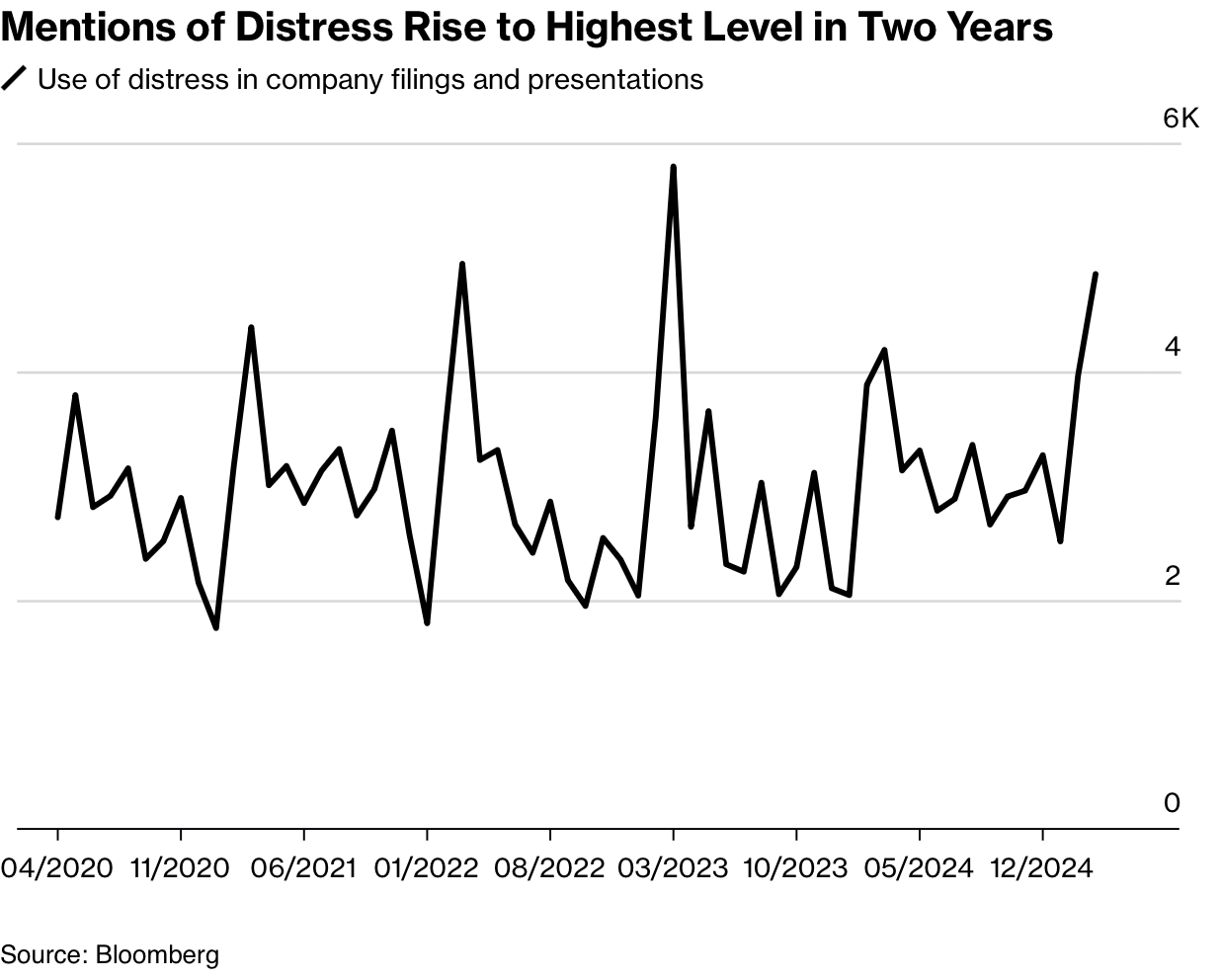
Mentions Of Distress In Filings By Private Credit Participants Have Surged. According to Bloomberg, [Bloomberg, 2025-05-03]
Capital Flight
May 2025: Amid A Collapse In The Value Of The Dollar, The Taiwanese And Hong Kong Central Banks Had To Intervene Against Their Local Currencies. According to Bloomberg, “Asian currencies turbocharged by dollar weakness are attaining rarely seen superlatives and triggering central bank intervention to curb excessive gains. The Hong Kong Monetary Authority on Friday sold a record amount of local dollars to prevent its advance and protect the currency’s 42-year-old peg to the greenback. Taiwan’s central bank also intervened as its currency soared the most since 1988. The offshore yuan rallied to its strongest since November. The volatility shows how an exodus from the world’s reserve currency can ripple through financial markets, as President Donald Trump’s shifting tariff policies fuel concern over a US recession. Last week, speculative traders became more bearish on the dollar than at any time since September, in a sign of growing reluctance among investors to hold US assets. Asian currencies including the yen and yuan are benefiting from a combination of repatriation buying and as alternative investments amid the ‘sell America’ wave. The strategy appeared to remain intact even as both Beijing and Washington seemed to be softening their stance on the trade war, with the former saying it is evaluating the possibility of talks with the US.” [Bloomberg, 2025-05-04]
As The Prospects For The Dollar Have Declined, The Yuan Has Become More Popular As A Safe Place To Park Money Among Asian Exporters. According to Bloomberg, “The Taiwan dollar led gains in Asia on Friday with a 3% advance, as foreign investors flooded into the local stock market amid bets US companies” demand for the island’s semiconductors will remain strong. Currency gains snowballed as domestic exporters sold the greenback frantically on wagers it may keep falling, according to traders who asked not to be identified. The rapid gains prompted the Taiwanese central bank to say it ‘entered the market at appropriate time’ to adjust price moves. In the options market, traders became the most bullish on the island’s currency since 2008. Similar to their Taiwanese peers, Chinese exporters also no longer see the dollar or Treasuries as a viable shelter amid trade conflicts. They have been shifting their strategy of hoarding dollars and are preferring the yuan instead, a Bloomberg survey showed. ‘With the dollar under pressure, and the risk of lower rates given elevated recession risks in the US, the risk and reward of maintaining dollar deposits looks markedly different for Asian exporters,’ Goldman Sachs Group Inc. analysts led by Kamakshya Trivedi wrote in a note. Currencies including the yuan, Taiwan dollar and ringgit will likely advance.” [Bloomberg, 2025-05-04]
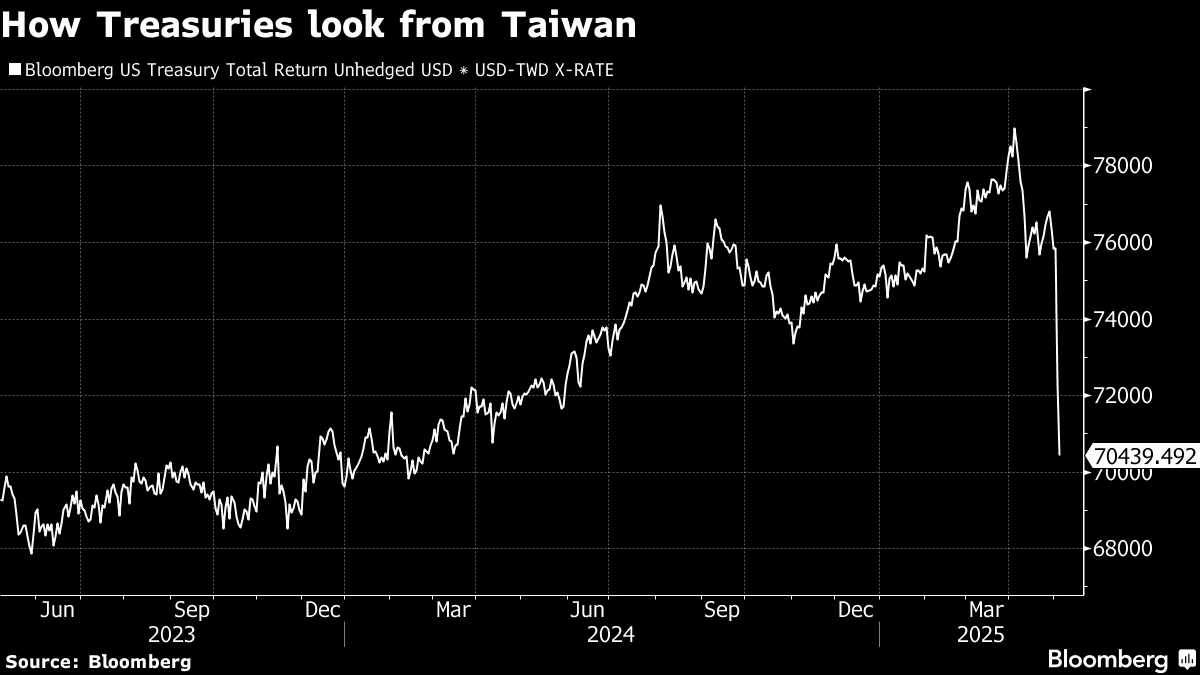
Taiwanese Treasury Investors Have Seen Years Of Gains Wiped Out. [Bloomberg, 2025-05-05]
Key Personnel Risk
2025: Michael Gibson, The Director Of The Fed’s Division In Charge Of Bank Stress Tests Announced Plans To Leave By The End Of The Year. According to Bloomberg, “Michael Gibson, director of the Federal Reserve’s supervision and regulation division, will leave at the end of the year following more than three decades at the US central bank, according to people familiar with the matter. Gibson, who joined the central bank as an economist in 1992, rose within the agency under former Fed Governor Daniel Tarullo following the 2008 financial crisis. On Friday, he informed some staff of his plan to retire from the Fed, said the people, who asked not to be identified because the move hadn’t been publicly announced. A Fed spokesperson declined to comment. After stints in the research and international finance divisions, Gibson now leads a unit responsible for supervising and monitoring Wall Street lenders. That unit administers the Fed’s stress tests — an annual health check-up that evaluates the resiliency of the biggest banks and assesses whether they can keep lending during a severe recession.” [Bloomberg, 2025-05-02]
Trump’s Nominee For Vice Chair For Supervision Will Has Yet To Be Confirmed. According to Bloomberg, “Gibson’s announcement comes as Fed Vice Chair for Supervision nominee Michelle Bowman waits to be confirmed by the Senate. The Senate Banking Committee plans to vote on her nomination Tuesday. Bowman is expected to support a lighter touch on banking regulation than her predecessor, Michael Barr, who resigned from the role earlier this year. She has been a sharp critic of a landmark plan to require banks to hold more capital that was unveiled in 2023.” [Bloomberg, 2025-05-02]
Corruption
Lobbyists And Trade Groups Have Coached Their Clients To, Among Other Things, Contribute To Trump’s Super PAC or Presidential Libarary Before Meeting Him. According to the Wall Street Journal, “Lobbyists and trade groups working with chief executives are coaching clients that it is best to bring data and specifics to meetings with the president or his staff. In particular, showing a tariff could hurt a red state or area is a popular pitch. As one GOP strategist who has coached clients put it: Make the case that you will have to lay off people in Ohio versus in a blue state like Massachusetts. Others have promised Trump the possibility of an announcement, such as jobs, that will benefit him politically. Another tactic is to appear on Fox News just before planning to meet with him or White House staff, some lobbyists say. Some have contributed millions to his super PAC or his presidential library fund.” [Wall Street Journal, 2025-05-04]
Crypto
May 2025: Numerous Convicted Or Suspected Criminals Were Able To Feature Prominently At A Dubai Crypto Event Thanks To Trump’s Dismantling Crypto Regulation. According to the Wall Street Journal, “Here, Changpeng Zhao, founder of the Binance exchange, who left a California jail in September, greeted fawning supporters. Justin Sun, a crypto billionaire, pitched a new U.S. exchange-traded fund tied to his company’s cryptocurrency. Arthur Hayes, whom a judge sentenced to house arrest for money-laundering violations, said it was time for the industry to go on the attack. What changed? President Trump returned to power and swept away most of their problems. His administration dismantled and redirected the law-enforcement agencies that were investigating crypto companies and billionaires, and it tore down the regulations that the industry loathed. He granted a pardon to Hayes and several other crypto felons. Zhao has been pushing for the Trump administration to give him a clean sheet, too.” [Wall Street Journal, 2025-05-02]
Despite Having Paid A Record Fine Due To Letting “Terrorists, Drug Traffickers, And Sanctioned Actors” Use The Platform, Binance And Trump’s World Liberty Financial Have A “Growing Alliance.” According to the Wall Street Journal, “After lunch, attendees stampeded to hear from Zhao, known as CZ. In addition to Zhao’s four-month prison sentence, Binance, the world’s largest crypto exchange, paid a record $4.3 billion fine to the U.S. in 2023 for allowing terrorists, drug traffickers and sanctioned actors to move billions of dollars through the platform. With the room so full that people stood in the aisles, security guards slammed shut the heavy wooden doors, while those outside begged to be let in. A laser show by a dancer in a conical hat, and thundering techno beats, signaled Zhao’s entrance. ‘We”ve come on like rockstars,’ said Raoul Pal, a crypto investor who interviewed him. Zhao, who now lives in Abu Dhabi, told the crowd he”d been advising a dozen governments on how to introduce more favorable crypto regulations. He was optimistic: ‘I”m always bullish.’ Pal didn’t ask about the jail stint. Afterward, at a Binance Clubhouse event, CZ said he was a victim of ‘a war on crypto under the last administration…But now there is a counterreaction. Now they”ll let us accelerate much faster.’ Several listeners leapt to their feet and cheered. […] Early in the afternoon, Eric Trump strode onto the main stage with Zach Witkoff, son of President Trump’s special envoy to the Middle East Steve Witkoff. They were there to promote their company World Liberty, which recently launched its own dollar-pegged cryptocurrency, USD1, known as a stablecoin. The younger Witkoff had just returned from a trip to Pakistan, where he signed an agreement to help its government boost crypto adoption. He stopped over in Abu Dhabi to meet Zhao. World Liberty’s growing alliance with Binance is at the center of a spiraling web of financial conflicts around the Trump family, which is now in business with a felon seeking a pardon. Binance has also been pushing for Treasury officials to remove the overseers the department appointed after the company’s plea deal, the Journal reported last month.” [Wall Street Journal, 2025-05-02]
Justin Sun, While Pushing For An ETF Of His Cryptocurrency, Coordionated On Plans To Push Billions Of Dollars Into The Trump-Benefiting USD1. According to the Wall Street Journal, “Justin Sun, founder of the Tron blockchain network who spent $6.2 million on a banana-taped-to-a-wall artwork several months ago, said in a speech he wasn’t ‘here for the money.’ He said the new exchange-traded fund, based on Tron’s own cryptocurrency, was awaiting approval from the Securities and Exchange Commission. The SEC paused a lawsuit against Sun earlier this year after he invested $75 million into the Trump family’s crypto venture World Liberty Financial. […] He touted USD1 as a device for seamless cross-border payments, or as a way to pay for a stay at his family’s hotels. Witkoff, an American flag pinned to his jacket lapel, said a recently announced $2 billion investment into Binance by MGX, a state-backed U.A.E. investor, would be paid in USD1. Since MGX needed to buy the USD1 to pay Binance, the deal propelled the cryptocurrency’s market value into the ranks of the largest stablecoins. The more USD1 in circulation, the more the Trump family can profit from the assets underpinning its value, chiefly U.S. Treasury debt. ‘We thank MGX and Binance for their trust in us,’ Witkoff said. ‘I think it’s only the beginning.’ To add to World Liberty’s sprawling business entanglements, Witkoff also announced a new partnership with Sun to issue billions of dollars more of USD1 on Tron.” [Wall Street Journal, 2025-05-02]
 [Bloomberg,
  [Bloomberg,
  [Bloomberg,
  [Bloomberg,