May 7, 2025
Summary
The Fed kept interest rates unchanged at 4.25-4.5%, citing “uncertainty about the economic outlook” and noting increased risks for both higher unemployment and inflation. Stagflationary warnings from the real economy abounded, with the data center industry has warned that the Trump administration’s restrictions on renewable energy could undermine America’s competitive position in the global AI race, as China takes a more proactive approach to grid modernization.
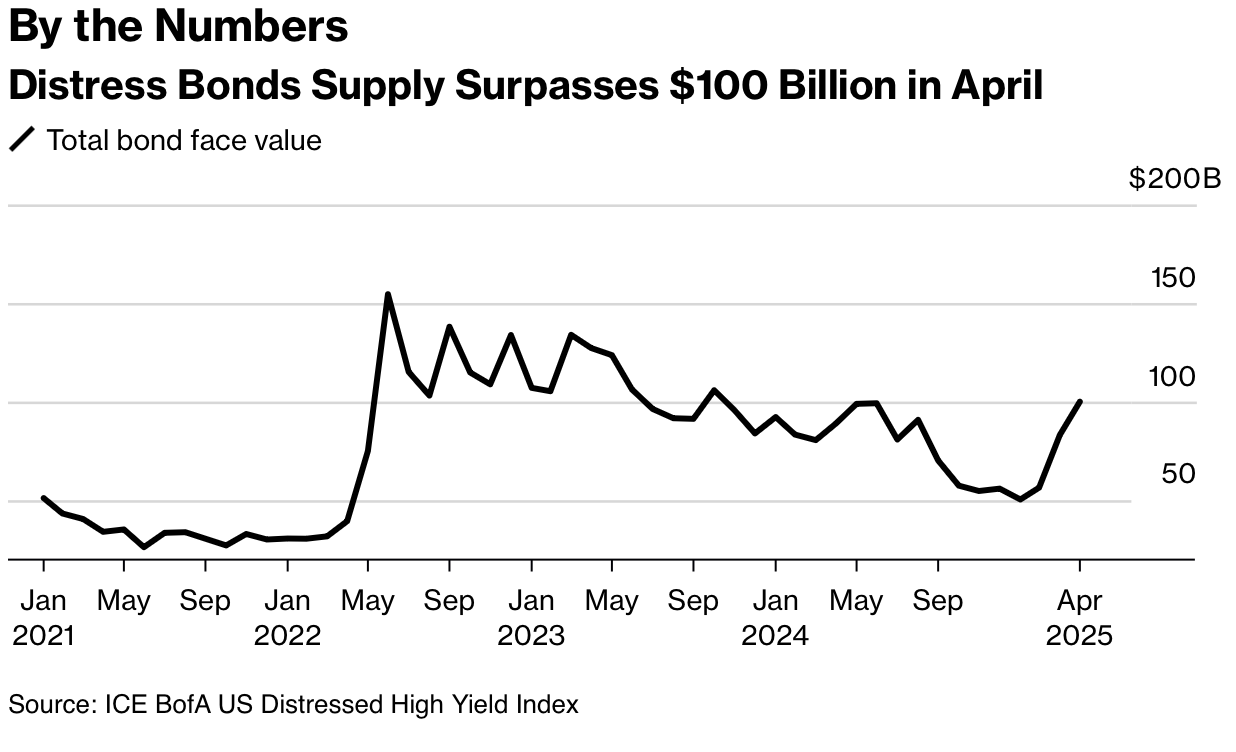
Financial markets are showing concerning signals with distressed bonds surpassing $100 billion in April 2025, a $17 billion increase in a single month. This represented about 7.1% of the ICE BofA US High-Yield Index, reaching a 10-month high as investors offload risky credits amid tariff-driven market uncertainty. Corporate America is responding to uncertainty with defensive financial strategies. Ford has withdrawn its 2025 forecast, estimating Trump’s tariffs could cost it between $1.5-2.5 billion. Meanwhile, companies are choosing share buybacks over capital investments, with S&P 500 companies announcing a record $518 billion in buybacks over a three-month period.
And in standard benefiting cheaters, the administration has significantly reduced regulatory oversight by cutting staff at key financial agencies (SEC, FDIC, OCC) and the IRS, where 31% of tax auditors have been eliminated despite previous Treasury analysis showing high-income audits return $6 for every $1 invested. At the same time, more evidence of the Trump family’s malpractice in their crypto schemes emerged.
Stagflationary Pressure
May 2025: The Fed Kept Interest Rates Unchanged Amid “Uncertainty About The Economic Outlook.” According to Bloomberg, “Here are five key takeaways from Wednesday’s FOMC rate decision announcement and Federal Reserve Chair Jerome Powell’s press conference: Policymakers voted unanimously to keep their benchmark rate unchanged, at a target of 4.25% to 4.5%, while saying in their statement that ‘uncertainty about the economic outlook has increased further.’ The risks of both higher unemployment and higher inflation have risen, they said. Powell repeated language he has used for months now, with regard to the potential to resume cutting rates: ‘We don’t think we need to be in a hurry.’ He said that there are cases where it would be appropriate to cut, or to stand pat, and ‘I couldn’t confidently say that I know’ which it’s going to be. Powell brushed off political pressure from President Donald Trump to cut rates, saying that ‘doesn’t affect doing our job at all.’ He also said that he’s never asked for a meeting with any president, ‘and I never will.’ The Fed chair echoed Trump administration officials in expecting that the first-quarter GDP figures – which showed a decline from the previous quarter – will be revised highe Job creation is ‘fine,’ wages are ‘in good shape,’ and layoffs aren’t at high levels. As for inflation, that’s ‘moving sideways at a fairly low level,’ he said – even if above the Fed’s target. Treasuries hit their highs of the session after the Fed news, though moves were modest. Two-year yields were flat as of 3:31 p.m. in New York, at about 3.78%. The S&P 500 was down about 0.2%, while the Bloomberg Dollar Spot Index was up 0.5%.” [Bloomberg, 2025-05-07]
May 2025: The Data Center Industry Warned The Trump Administration That Without Quick-To-Deploy Renewable Energy, Which It Has Tried To Block, The U.S. Risks Falling Behind China In AI. According to the Financial Times, “The US data centre industry has warned that the Trump administration’s crackdown on renewable energy could slow its growth and undermine Washington’s goal to win the global artificial intelligence race. Renewables have become a flashpoint since Donald Trump re-entered the White House, with his administration suspending clean energy developments on federal land, pausing federal loans and last month cancelling high-profile projects such as Equinor’s $5bn Empire Wind site. For tech companies struggling to secure reliable energy supplies to power and train AI, a clampdown on renewables could create power bottlenecks, drive up costs and push operators towards dirtier energy, experts said. Simon Ninan, senior vice-president at Hitachi Vantara, which builds equipment and infrastructure for data centres, said the Trump administration’s ‘antagonistic approach’ towards renewable energy could make it ‘impossible to satisfy the data growth that’s happening’. ‘Strategically, the US could risk undermining its current pole position in the global AI race . . . China, on the other hand, has taken a proactive approach towards grid modernisation and efficient power distribution.’ Energy shortages could ‘result in cancellation or delays in data centre build-outs or infrastructure upgrades’, he said. The Trump administration has warned that losing the AI race to China is a bigger threat to the world than global warming and has advocated increasing the use of fossil fuels to power them. But experts warn it will be difficult to meet surging demand without adding a lot more renewable energy capacity, which is faster and cheaper to deploy than building gas power plants.” [Financial Times, 2025-05-06]
- Gas Turbine Markers Have Warned That Lead Times For Larger Models Can Stretch To 2029. According to the Financial Times, “While large-scale gas generation projects are being fast-tracked by major grid operators such as PJM, MISO and ERCOT, this may come at the expense of cheaper sources such as renewables. Gas turbine suppliers such as Siemens and GE Vernova have warned lead times can stretch to 2029 for larger models.” [Financial Times, 2025-05-06]
Q1 2025: Cardboard Box Shipments Fell To Their Lowest Quarterly Level Since 2011.  [Bloomberg, 2025-04-28]
April 2025: The Total Face Value Of Distressed Bonds Shot Up $17 Billion To More Than $100 Billion, In A Historical Reversal Of Usual Trends. According to Bloomberg, “The total amount of distressed bonds in the ICE US Distressed Index rose by $17 billion in April, pushing the pile to a whopping $100 billion, as investors race to offload risky credits in the tariffs-driven turmoil, according to a Bloomberg Intelligence report compiled by analysts Philip Brendel and Negisa Balluku. April has been historically the strongest month for US high yield bonds for the past 28 years. Last month, however, bucked the trend as Trump amid the tariff threat. The market uncertainty has roiled bonds and loans across the board, particularly those of consumer firms. Distressed bonds, counting those with option-adjusted spreads of over 1,000 bps, take up about 7.1% of the ICE BofA US High-Yield Index at the end of April, marking a 10-month high, the analysts write. The widening in spreads, coupled with the unpredictable policy outlooks, could further reinforce the risk-off sentiment, they said.” [Bloomberg, 2025-05-06]
April 2025: The Share Of Distressed Bonds In The ICE BofA US High-Yield Index Jumped 7.1 Percent To A 10-Month High. According to Bloomberg, “The total amount of distressed bonds in the ICE US Distressed Index rose by $17 billion in April, pushing the pile to a whopping $100 billion, as investors race to offload risky credits in the tariffs-driven turmoil, according to a Bloomberg Intelligence report compiled by analysts Philip Brendel and Negisa Balluku. April has been historically the strongest month for US high yield bonds for the past 28 years. Last month, however, bucked the trend as Trump amid the tariff threat. The market uncertainty has roiled bonds and loans across the board, particularly those of consumer firms. Distressed bonds, counting those with option-adjusted spreads of over 1,000 bps, take up about 7.1% of the ICE BofA US High-Yield Index at the end of April, marking a 10-month high, the analysts write. The widening in spreads, coupled with the unpredictable policy outlooks, could further reinforce the risk-off sentiment, they said.” [Bloomberg, 2025-05-06]
 [Bloomberg, 2025-05-06]
Torsen Slok’s Stagflationary Charts
Corporate Uncertainty
May 2025: Pulling Its Forecast, Ford Estimated That Trump’s Tariffs Could Cost It Between $1.5 And $2.5 Billion. According to the New York Times, “Ford Motor said on Monday that the Trump administration’s tariff policies were likely to lower its 2025 profit, before interest and taxes, by about $1.5 billion. The company also dropped its forecast for the year, saying that predicting the future had become too hard. Ford is less affected by President Trump’s 25 percent tariffs on vehicles than other automakers because most of the vehicles it sells in the United States are made in the country. The automaker said its estimate of how much tariffs would hurt its finances include changes the company was making to reduce costs, including buying more parts and producing more vehicles in the United States. Excluding those measures, Ford expects tariffs to cost it $2.5 billion.” [New York Times, 2025-05-05]
Amid Massive Uncertainty, Corporations Have Planned To Embrace Their Most Flexible Financial Strategy: Buybacks. According to the Financial Times, “US companies are planning to buy back a record $500bn of their own shares, as they seek to deploy their huge cash piles at a time when President Donald Trump’s policies are adding to uncertainty over making capital investments. Companies listed on the blue-chip S&P 500 index said last week they expect to repurchase $192bn of their stock over the coming months, the highest weekly figure in data going back to 1995, according to Deutsche Bank. The tally of announced buybacks over the past three months has now risen to $518bn — the biggest rolling three-month sum on record, the bank said. The rush of repurchases comes as a better than forecast start to earnings season leaves US companies flush with cash. With corporate outlooks clouded by uncertainty over trade tariffs, many have been attracted by share prices that, despite a recent rebound, are still lower than at the beginning of the year. ‘The numbers are spectacular,’ said Brian Reynolds, chief market strategist at Reynolds Strategy, who ditched his bearish forecast for large-cap US stocks given the ‘size and rapidity of [last week”s] buyback surge’. Trump’s unconventional trade manoeuvrings have in a number of cases made planning for the future more difficult, forcing groups such as Colgate, General Motors and Delta Air Lines to cut sections of their earnings guidance. Rising buybacks are ‘a reflection of the fact that global tariff uncertainty is getting in the way of planning for operational investment’, said a former co-head of equity capital markets at a large US investment bank.” [Financial Times, ]
Context: Buybacks and Financial Flexibility
When a has cash on its balance sheet, it has three real options: it can increase spending on labor, it can increase spending on capital, or it can return the cash to its shareholders. How and what it decides is largely a function of its outlook on the future.
If it thinks that the labor market will become much more competitive, it will likely increase wages and benefits to retain its employees. If it sees a shortage of qualified workers for the work it feels needs to be done, it will increase hiring. With each type of increased labor expenditure, the company is making a fairly long-term commitment. Hiring is expensive, and wages, once raised, are difficult to cut.
If it sees a shortage of capital, it will likely invest in new equipment, technology, or facilities. These expenses often take place over a long period of time, or require a large upfront investment. Furthermore, as much as economists fetishize capital substitution, the specialized nature of what a firm acquires often means that the only hope for recouping the investment made is to use that capital for its entire lifespan.
That leaves returning capital to shareholders. While it is economic dogma that buybacks and dividends are the same thing, that could not be further from the truth in the mind of a CFO. Companies that cut their dividends are penalized heavily by the market. Companies that cut their buybacks are not. Furthermore, buybacks are easy to reverse: in at the market offerings. Also, buybacks are generally taxed more favorably than dividends.
Therefore, when a company has cash, and does not know what to do with it, the default option has become to buy back its own shares.
Capital Flight
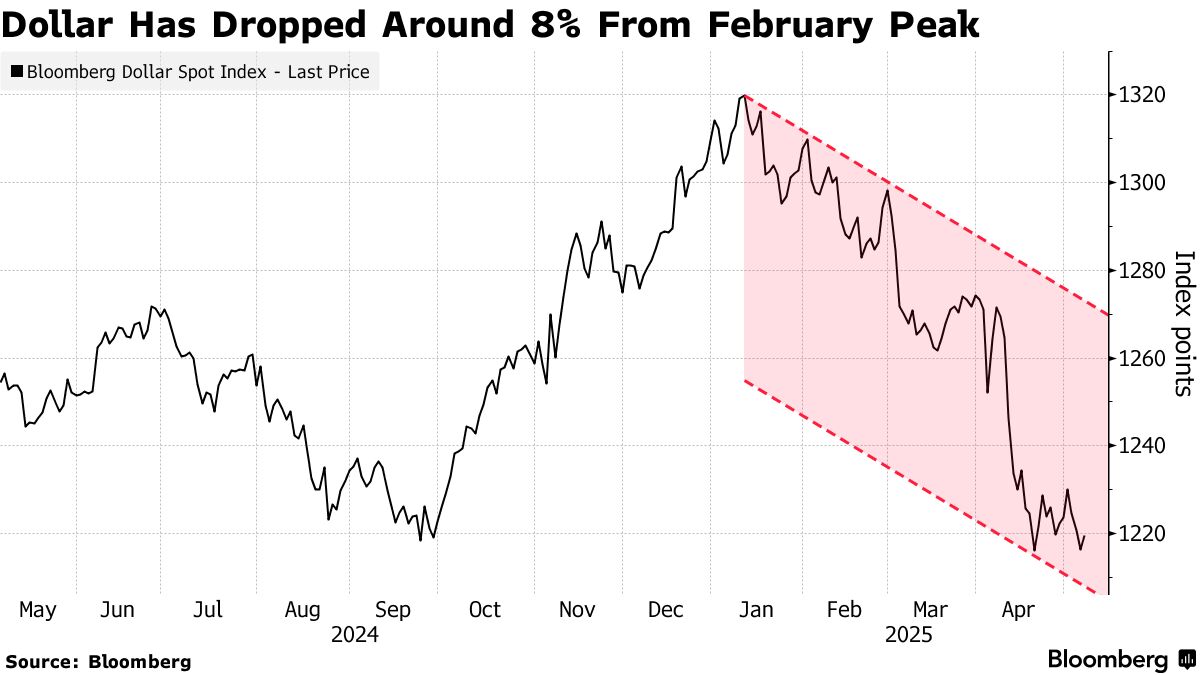
In An Effort To Appease The Administration, Asian Countires May Let $2.5 Trillion Flow Out Of The U.S. According to Bloomberg, “The dollar may face a $2.5 trillion ‘avalanche’ of selling as Asian countries unwind their stockpile of the world’s reserve currency, according to Stephen Jen. Asian exporters and investors may have amassed an ‘extremely large’ pile of dollars through the years, widening the region’s trade surplus with the US, Eurizon SLJ Capital’s Jen and Joana Freire wrote in a note on Wednesday. As a US-led trade war deepens, some Asian investors might repatriate chunks of funds or ramp up levels of protection against a weakening dollar — potentially triggering an exodus from the world’s reserve currency. ‘We suspect these dollar hoardings by Asian exporters and institutional investors may be extremely large – possibly on the order of $2.5 trillion or so – and pose sharp downside risks to the dollar vis-à-vis these Asian currencies,’ Jen and Freire wrote. The greenback’s long-term appeal is coming under threat as Donald Trump’s efforts to remake the global trade order prompt investors to reconsider their US exceptionalism trade strategies. An outsized jump in the Taiwan dollar on Monday added to speculation that Asia’s policymakers may be prepared to let their currencies appreciate versus the dollar as part of efforts to secure a trade deal with the US.” [Bloomberg, 2025-05-07]
Margin Calls On Naked Long-Dollar Positions Could Accelerate Capital Flight. According to Bloomberg, “Accelerating the multi-trillion dollar flows may be ‘naked long-dollar positions’ prevalent among Asian countries that run large external surpluses, he wrote, referring to positions that are not hedged against fluctuations in the dollar. Some of these countries include China, Taiwan, Malaysia and Vietnam.” [Bloomberg, 2025-05-07]
 [Bloomberg, 2025-05-07]
Context
When Americans buy things from abroad, they generally give dollars to the sellers of those goods. In essence, this is a trade of goods for dollars, where agents in foreign countries acquire dollars in exchange for their goods. That is the source of the accounting identity that the capital account (net foreign investment) and the current account (net exports) must sum to zero.
With a five-decade long trend of trade deficits, foreigners have accumulated massive amounts of dollars. For Americans, this has been extremely beneficial. We have had our consumption subsidized, our power over the global economy has grown, and most importantly, those dollars have been used to, almost exclusively, invest here.
That means that our government has been able to run persistent deficits, reducing short-term tax burdens for what we have purchased, our financial markets have been buoyed, and we have had consistent access to cheap capital that has enabled us to build the technologies and infrastructure that were, up until January, on pace to define the next 50 years.
Now, however, the Trump administration has cast serious doubt as to the value proposition of still being invested in the United States. That means that the trillions of dollars invested here by foreigners have become a lot less valuable now, and as a prospect for the future. Therefore, under a scarily reasonable set of assumptions, those benefits could be taken away.
Corruption
Crypto
Trump’s Dinner For Foreign Crypto Enthusiasts
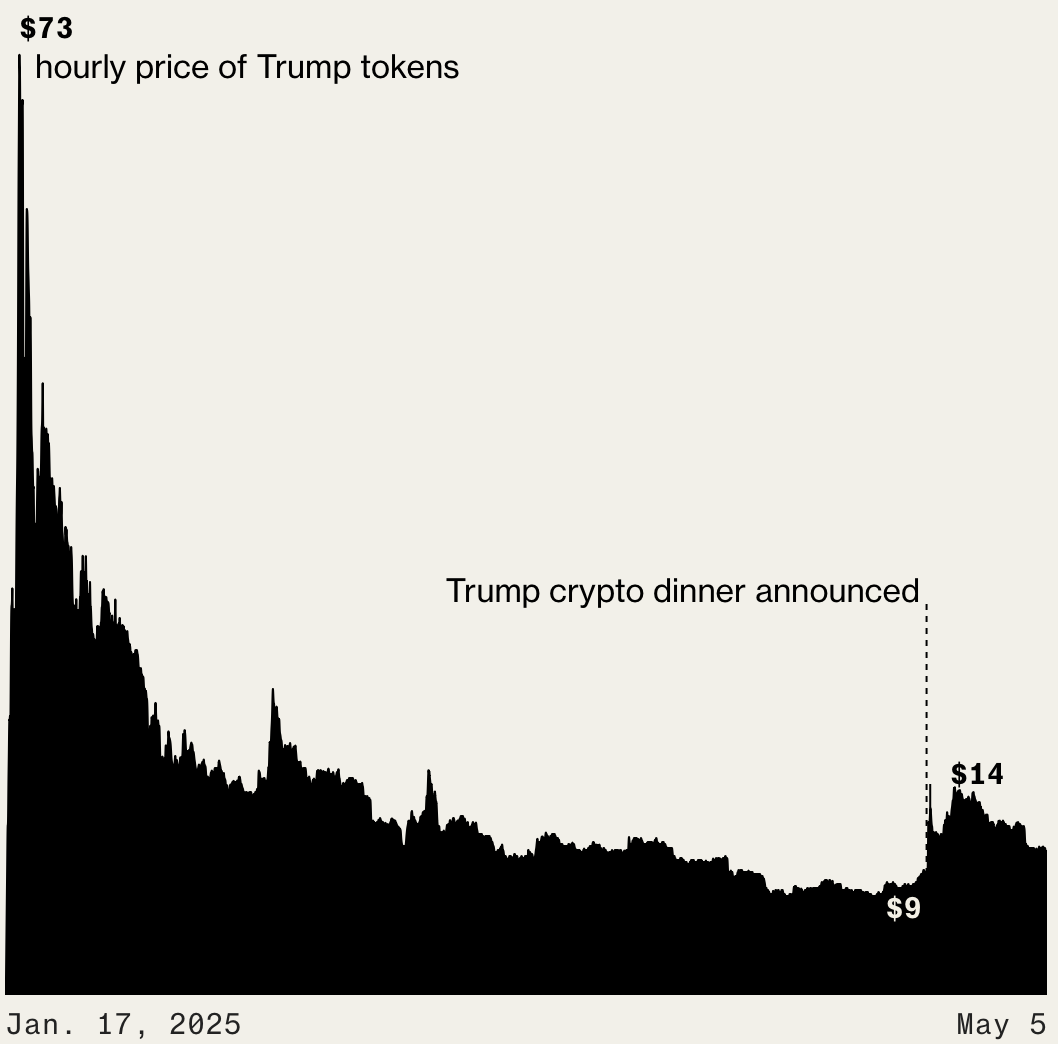
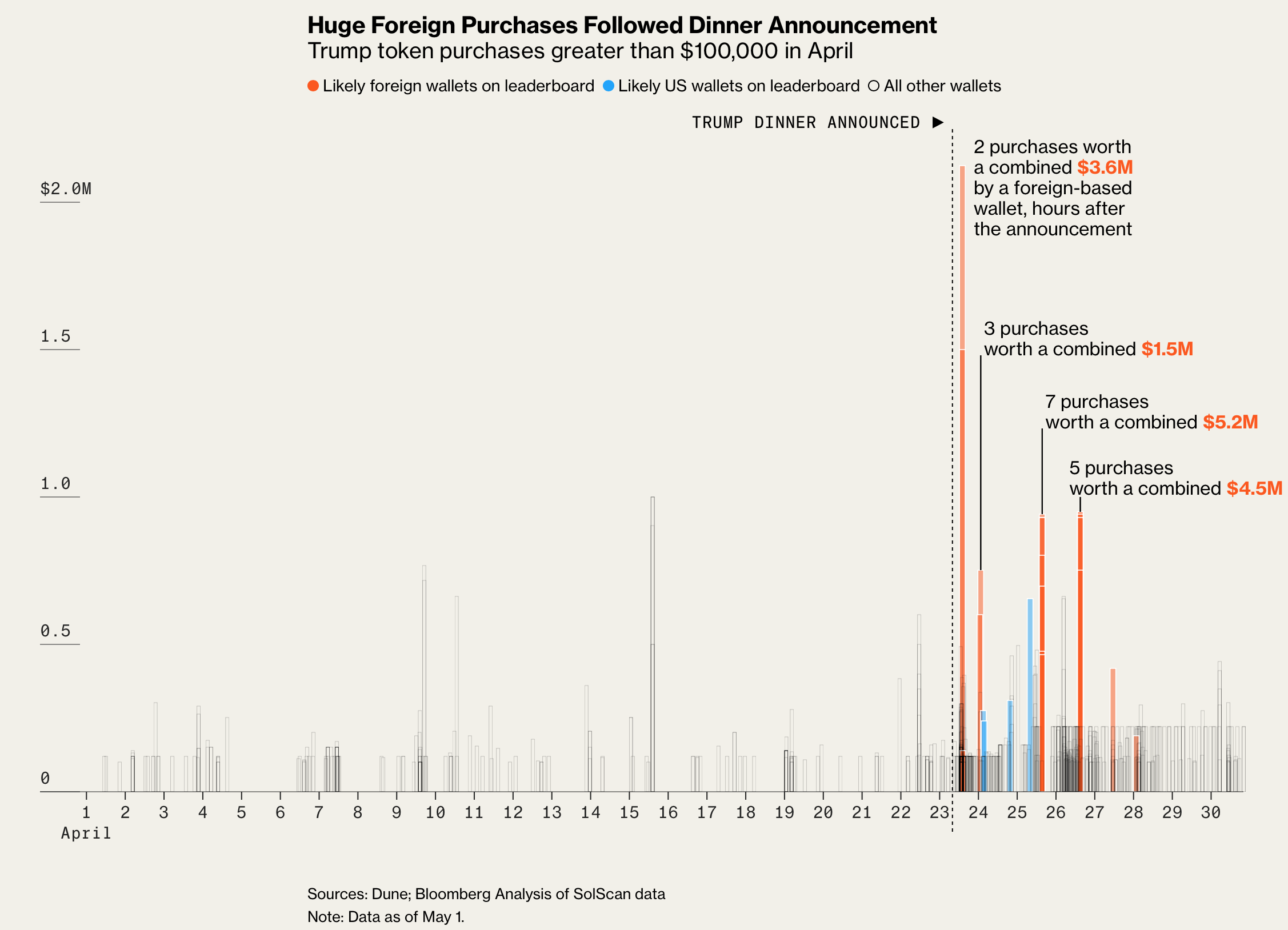
Bloomberg: 56 Percent Of The Top 220 Holders Of Trump’s Cryptocurrency, The Top 200 Of Which Will Get To Meet With Trump, Have Used Foreign Crypto Exchanges That Ban U.S. Users. According to Bloomberg, “More than half of the top holders of President Donald Trump’s memecoin — who are jockeying for dinner with the president — have used foreign exchanges that say they ban US users, suggesting that many of the purchasers are based outside the US. Buyers of the Trump token, a cryptocurrency the president began marketing days before his inauguration, drove sales higher in the past two weeks after its issuers announced an unprecedented promotion: More than 200 of the memecoin’s largest holders would be invited to attend a May 22 dinner with Trump at his Virginia golf club, while the top 25 would qualify for an exclusive reception beforehand and what the memecoin’s website describes as a ‘VIP’ tour. Now, an analysis by Bloomberg News shows that all but six of the top 25 holders who have registered on the website’s leaderboard used foreign exchanges that say they exclude customers living in the US. More broadly, at least 56% of the leaderboard’s top 220 holders used similar offshore exchanges. The prevalence of these likely foreign buyers echoes concerns that congressional Democrats have expressed about the ethics of marketing the coin with a promise of presidential access. And it raises questions about how attendees at the promotional dinner, who are publicly identified only by three- or four-letter usernames they”ve chosen, will be vetted.” [Bloomberg, 2025-05-07]
76 Percent Of The Token Value Of Those Holders Belonged To Foreign Owners, Or Americans Breaking The Law. According to Bloomberg, “76% of the token value held among the top 220 wallets likely belongs to foreign owners because the wallets used exchanges that are not available to US residents” [Bloomberg, 2025-05-07]
Of The Three Largest Exchanges Used By These Buyers, Two Had Been Forced To Pay More Than $4.5 Billion In Penalties To The U.S. Government. According to Bloomberg, “It’s possible that some US purchasers found ways to use foreign exchanges despite prohibitions – say, by using a virtual private network, or VPN, to mask a US-based IP address. Most exchanges say they take steps such as collecting users” personal information to try to prevent such workarounds. The three foreign exchanges that top Trump coin holders used most often to fund their accounts or to purchase the Trump memecoin are Binance, Bybit and OKX, all of which have imposed restrictions on US users. (Bloomberg’s analysis found that six holders on the Trump coin leaderboard made purchases on OKX before the company launched a trading platform in the US on April 15. An OKX spokeswoman said that until then, the company did not allow purchases by US residents.) Representatives for Binance and Bybit didn’t respond to requests for comment. Two of the three exchanges have run afoul of US law previously. Binance paid the US more than $4 billion after it pleaded guilty in November 2023 to violating federal anti-money laundering and sanctions laws through lapses in internal controls. OKX pleaded guilty to anti-money laundering violations in February and forfeited more than $420 million.” [Bloomberg, 2025-05-07]
 [Bloomberg, 2025-05-07]
 [Bloomberg, 2025-05-07]
$100 Million Or More Were Made By Traders Front Running Melania’s Memecoin
January 2025: Two Dozen Digital Wallets Poured $2.6 Million Into Melania Trump’s Memecoin Minutes Before It Was Announced. Twelve Hours Later, They Had Made $99.6 Million. According to the Financial Times, “A small group of traders earned a $99.6mn windfall by buying Melania Trump’s cryptocurrency token in the minutes before it was made public, an analysis by the Financial Times has found. Melania Trump unveiled the $MELANIA coin in a social media post late on January 19, just hours before her husband was inaugurated as the US president. In the two and a half minutes before her post went live on Truth Social, two dozen digital wallets bought $2.6mn of the tokens from the crypto marketplace where they had been deposited. The traders profited when Melania Trump’s post sent the price of the tokens soaring. The wallets offloaded most of their coins rapidly, with 81 per cent of their sales taking place within 12 hours. Crypto transactions can be tracked on digital ledgers known as ‘blockchains’, but the entities or individuals who control the wallets that hold and trade coins generally remain anonymous. The $MELANIA memecoin, a type of crypto token with no functions beyond being a vehicle for speculation, was launched about two days after Donald Trump had launched his own $TRUMP token. The launch of the two coins comes as the Trump family and its business associates have backed a wide array of crypto ventures. Donald Trump’s administration has been more accommodative in its regulation of crypto than Joe Biden’s government. The launch process for memecoins enables the price of the tokens to rise sharply from near-zero prices if interest surges, giving earlier buyers the chance to make outsized profits. Crypto enthusiasts refer to accounts that buy big and early to exploit this feature as ‘snipers’. Memecoins are not treated as securities under US financial regulations, meaning scheme promoters are not bound by federal disclosure and insider dealing rules designed to protect retail investors. One wallet that bought prior to launch spent $681,000 on the memecoin in a single transaction 64 seconds before the existence of the project was made public. Within 24 hours, this account had made $39mn from selling most of its holdings. It made a further $4.4mn from selling the rest over the following three days. In total, the 24 accounts bought up 16.7mn of the 200mn total $MELANIA tokens scheduled for sale during the launch period.” [Financial Times, 2025-05-06]
Trump’s Memecoin Had No Traders Front-Running Its Announcement. According to the Financial Times, “When $TRUMP was launched, there were no pre-announcement purchases, with the first sale going through 42 seconds after the publication of the Truth Social post announcing it. With $MELANIA, the run of sales that started pre-launch continued. About $900,000 worth of tokens were bought by an additional 22 accounts in the 42 seconds after the launch.” [Financial Times, 2025-05-06]
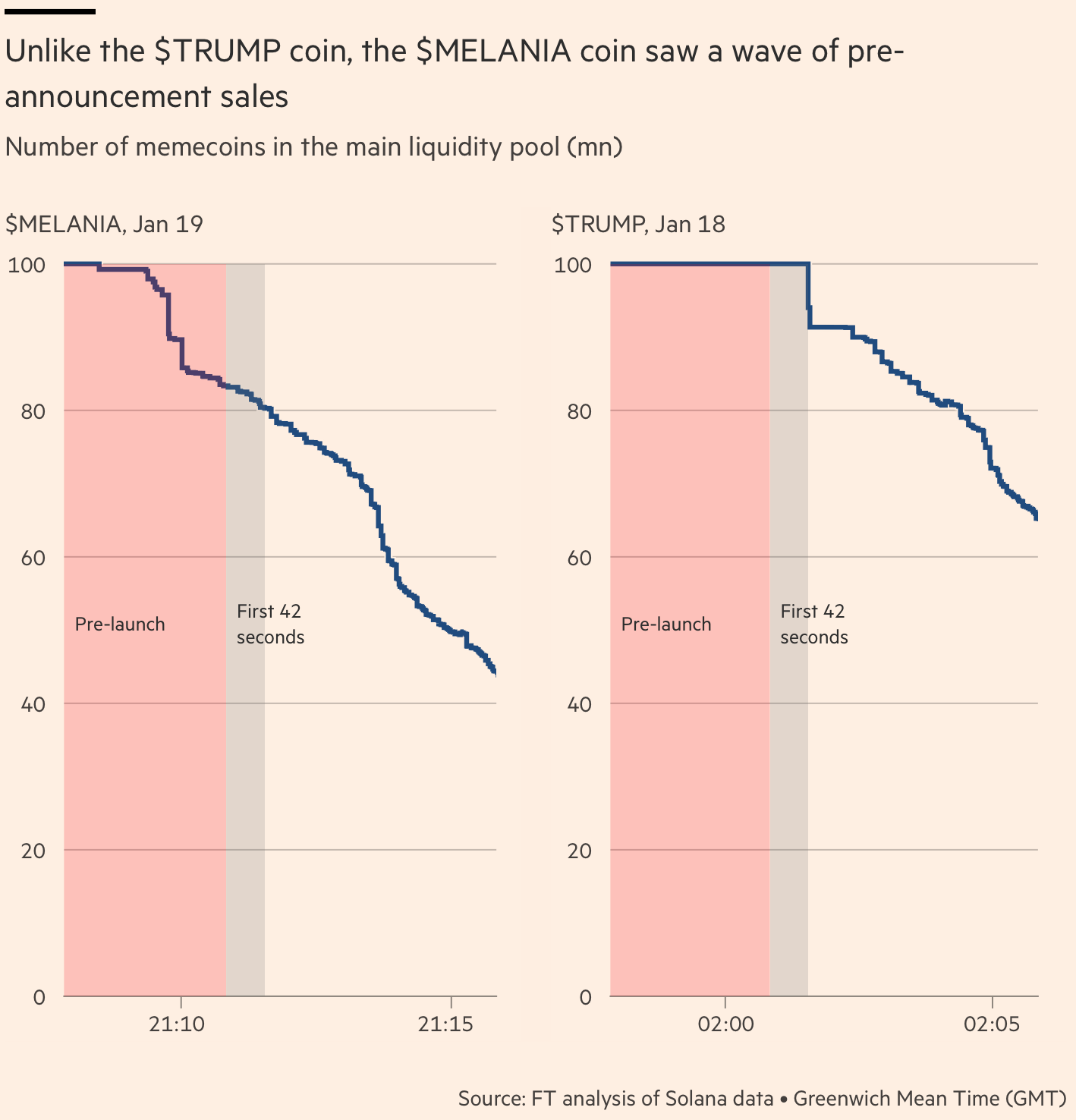 [Financial Times, 2025-05-06]
The Team Behind Melania’s Memcoin Has Withdrawn At Least $64.7 Million In Profits Of Fees And Primary Sales. According to the Financial Times, “$MELANIA was organised by a wholly different group of companies and individuals using different processes. FT analysis suggests that the entities that launched the coin — which are separate from the wallets that traded in it prior to the official announcement — have so far withdrawn profits of $64.7mn from fees and primary sales.” [Financial Times, 2025-05-06]
Helping The Rich Dodge Taxes
2023: A Treasury Analysis Found That For The Highest Earning Taxpayers, Audits Returned $6 In Revenue For Every $1 In Costs. According to Boning, Hendresen, Sprung-Keyser and Stuart, “Audits of taxpayers in the top 0.1 percent of the income distribution returned more than $6 in revenue for every dollar spent in audit resources, much more than audits of lower-income taxpayers.” [Boning, Hendresen, Sprung-Keyser and Stuart, 2023-08-01]
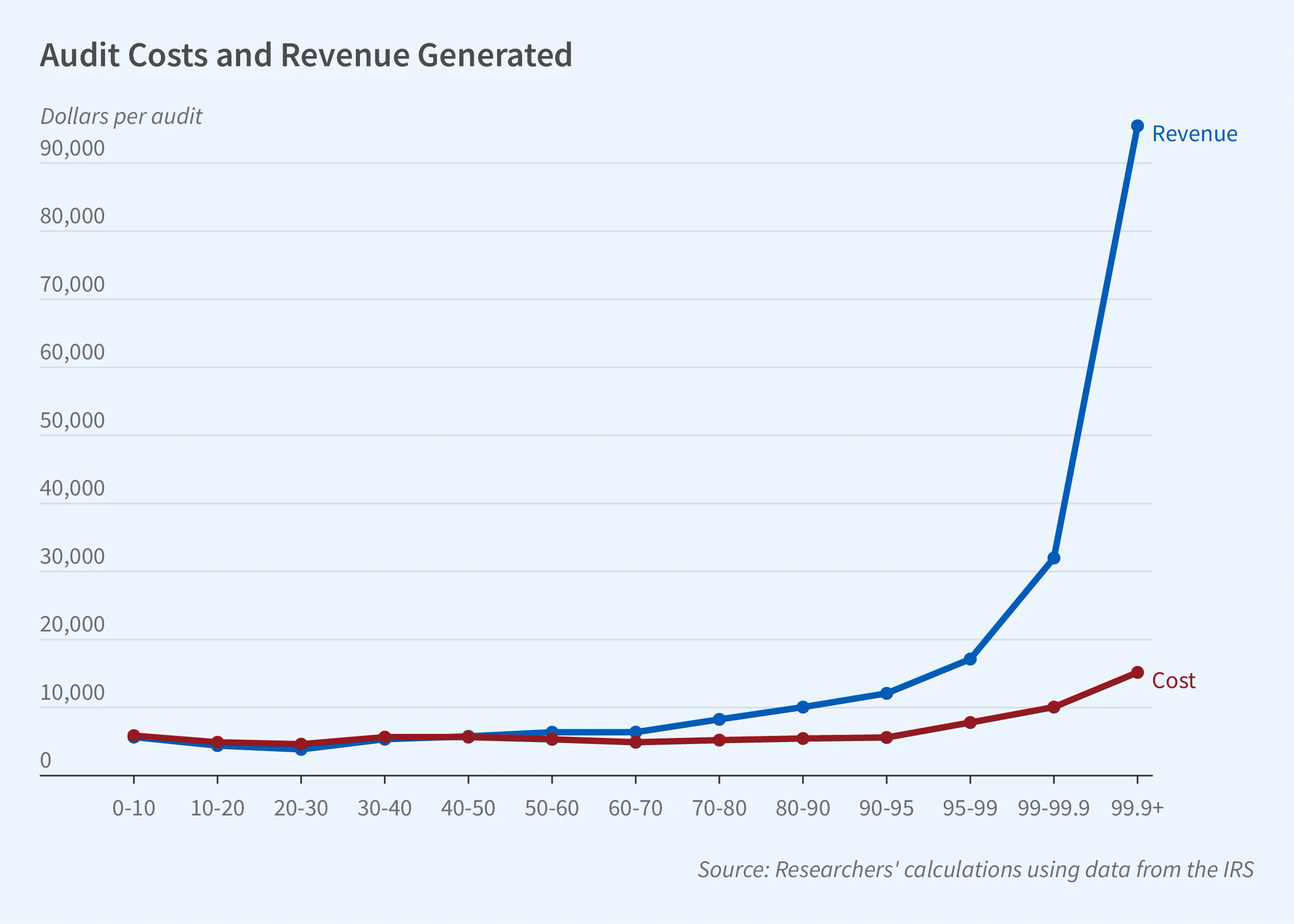
May 2025: Musk’s DOGE Helped Cut 31 Percent Of The IRS’ Auditors. According to CNBC, “The IRS has lost nearly one-third of tax auditors amid sweeping cuts from Elon Musk’s Department of Government Efficiency, a watchdog report found. As of March 2025, the agency’s workforce had fallen by more than 11,000 employees, or 11%, due to probationary terminations and the deferred resignation program, according to a May 2 report from the Treasury Inspector General for Tax Administration. The percentage of separated employees was significantly higher for certain departments — including so-called revenue agents, who conduct audits for the IRS. As of March, the agency lost 3,623 revenue agents, or 31%, according to the report.” [CNBC, 2025-05-07]
May 2025: Trump Proposed A $2.5 Billion Cut To The IRS’ FY 2026 Budget. According to CNBC, “The TIGTA report came the same day as President Donald Trump’s fiscal 2026 discretionary budget request, which called for a nearly $2.5 billion IRS budget cut to end the ‘weaponization of IRS enforcement.’” [CNBC, 2025-05-07]
Easing Market Fraud
May 2025: Trump Proposed Cutting More Than 2300 Employees At The FDIC, OCC, And SEC, Weakening Market Oversight. According to Bloomberg, “Donald Trump’s administration is set to shrink the ranks at the top US financial regulators by more than 2,300 workers, a group that includes bank examiners, criminal investigators and economists. The cuts are the steepest in decades for the Federal Deposit Insurance Corp., the Office of the Comptroller of the Currency and the Securities and Exchange Commission, the primary agencies responsible for oversight of banks, trading houses and the public markets. At the same time, the agencies are rapidly juggling their remaining staff and adjusting policies. The OCC has said it will combine supervision teams that were previously tailored to banks by size, and the SEC has reorganized its regional offices. The FDIC has yet to announce significant changes, but officials are rethinking its approach to bank supervision, according to people familiar with internal discussions. Defenders of the downsizing, which includes buyouts, layoffs, early retirements and hiring freezes, see it as part of the administration’s stated goal of rolling back rules to boost growth and unleash lending. The agencies shrunk during Trump’s first term, too, by about 1,000 employees from 2016 to 2020 — half the level of reductions proposed since his second inauguration. But to critics, fewer examiners and investigators are a harbinger of weaker oversight and an invitation to excessive risk-taking, particularly as Trump’s trade policies have caused extreme market swings, and calls of an impending recession have some banks bracing for higher credit losses.” [Bloomberg, 2025-05-07]