May 8, 2025
Summary
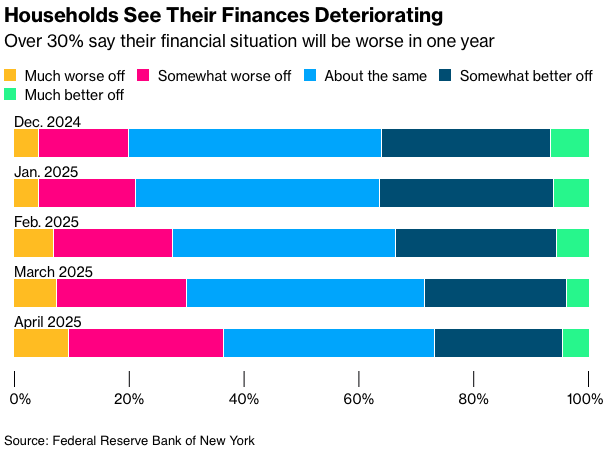
Data released today continued to paint a picture of coming stagflation. Labor productivity fell in the first quarter, but unit labor costs rose, decreasing the appeal of hiring for firms. Meanwhile, Americans’ views on the economy deteriorated, with expectations of inflation rising, and expectations of employment and perceptions of their own financial situation declining.
Trump has seen something of the alarm, announcing a sham deal framework with the UK, but one that keeps the most destructive part of his policy mix: his tariffs.
Meanwhile, his State Department seems to understand the whole point of his administration: pushing for a return on investment for his associates. The Washington post detailed how State Department officials had been pushing countries to approve Starlink, implying that it would help in negotiations over Trump’s tariffs.
Productivity
Q1 2025: Nonfarm Business Sector Labor Productivity Dropped 0.8 Percent. More Than Output As Workers Increased Hours. This Was The First Productivity Decline Since 2022. According to the Bureau of Labor Statistics, “Nonfarm business sector labor productivity decreased 0.8 percent in the first quarter of 2025, the U.S. Bureau of Labor Statistics reported today, as output decreased 0.3 percent and hours worked increased 0.6 percent. (All quarterly percent changes in this release are seasonally adjusted annualized rates.) This is the first decline in nonfarm business sector labor productivity since the second quarter of 2022.” [Bureau of Labor Statistics, 2025-05-08]
- Paul Krugman: “Productivity Isn’t Everything, But, In The Long Run, It Is Almost Everything.” According to the World Bank, “Productivity isn’t everything, but, in the long run, it is almost everything. A country’s ability to improve its standard of living over time depends almost entirely on its ability to raise its output per worker.” [World Bank, 2016-11-15]
Context: Not a good thing for Workers
When the cost of employment is rising faster than labor productivity, workers are getting more expensive for firms relative to the value they are adding. By definition, the marginal value of labor is falling, and firms will be less inclined to hire.
Trade War
IMF Growth Revisions: Trump’s Trade War Hit American Growth Harder Than Other Major Economies. According to Apollo,
April 2025: Requests By Auto Insurers To Cut Rates Dropped By More Than 80 Percent, As Inflationary Pressure From Trump’s Trade War Pushed Up Costs Insurers Could Bear. According to the Wall Street Journal, “By many rights, car insurance rates ought to start coming down for some drivers. But with the looming threat of tariffs, that process might take longer. A sterling set of results from property-and-casualty insurance carriers in 2024, particularly in auto insurance, got analysts and executives talking about renewed competition for new business with lower rates this year. Some of that now appears to be on hold. Auto insurers had seen a wave of underwriting losses during the years of high inflation after the pandemic, as the cost of repairing a car surged. In response, they started aggressively raising premiums, leading to a surge in profitability. The U.S. overall property-and-casualty industry’s net combined ratio, a measure of underwriting margins, hit its best mark in more than a decade last year, according to S&P Global Market Intelligence. But then in early April, personal auto insurers hit the brakes on filings with state regulators for lower rates, according to figures analyzed by economists at the Swiss Re Institute. In March, there were 482 requests filed with states for negative changes to personal auto insurance rates. In April, according to data available as of 30th of the month, there were just 95 such requests. In both months, the number of requests for rate increases outpaced those for decreases.” [Wall Street Journal, 2025-05-08]
- American Property Casualty Insurance Association: Trump’s’ Tariffs Could Raise Auto Insurance Costs By Between $31 And $61 Billion Over A Year. According to the Wall Street Journal, “Tariffs on autos and auto parts present what insurers argue is a strong risk of inflation to their claims costs. In mid-April, the American Property Casualty Insurance Association estimated that based on President Trump’s reciprocal tariff proposal at the time, plus tariffs on Mexico, China and Canada, plus other goods-specific tariffs, annual personal auto insurance claims costs could rise $31 billion to $61 billion over a one-year period.” [Wall Street Journal, 2025-05-08]
“Deal” With The UK
May 2025: While Trump And Starmer Announced A Trade Deal Framework, The Final Details Have Yet To Be Negotiated. According to Bloomberg, “President Donald Trump announced a trade framework with the UK, hailing it as a ‘breakthrough’ that US officials hoped would unlock other deals to expand market access for American goods. Under the agreement, Trump said Thursday the UK would fast-track US items through their customs process and reduce barriers on ‘billions of dollars’ of agricultural, chemical, energy and industrial exports, including beef and ethanol. The British government said auto tariffs would be reduced to 10% and metals duties to zero. Trump and UK Prime Minister Keir Starmer said final details of the pact would still be negotiated over the coming weeks and statements from both governments made clear that many specifics were left to be resolved later.” [Bloomberg, 2025-05-08]
The Statements From The Two Countries Differed On American Tariffs On Steel And Aluminum. According to Bloomberg, “The two sides differed on some key details, pointing to potentially thorny negotiations ahead. The British government released a statement saying US tariffs on steel and aluminum from the UK will go to zero, but the White House put out its own description less than an hour later saying they ‘will negotiate an alternative arrangement’ to the metals duties and that the agreement creates ‘a new trading union’ on the materials.” [Bloomberg, 2025-05-08]
The Deal “Punted” On Key Issues Like A Digital Service Tax And The U.K.’s Nontariff Agricultural Barriers. According to Bloomberg, “But the deal punted on some of US businesses” biggest concerns in the trading relationship. The UK will maintain its digital services tax hitting major US tech firms, with only a vague promise to work toward a future digital trade agreement. ‘The UK’s digital services tax should be further discussed and addressed to ensure it is implemented in a manner that treats American service suppliers fairly,’ said Christine Bliss, president of the Coalition of Services Industries, in a statement. The two sides also left undecided how to handle Trump’s plans for sweeping pharmaceutical tariffs. And while the UK removed tariffs on some US agricultural products, strict regulations on food standards have remained in place.” [Bloomberg, 2025-05-08]
The Framework Announced By Trump Would Keep A 10 Percent Tax On American Imports Of Goods And Services From The U.K. According to the Wall Street Journal, “Under the deal, most U.K. goods will still be subject to the global 10% tariff the U.S. imposed on all countries in April. But U.K. steel and aluminum will be exempt from the U.S.’s 25% levy and U.K. car tariffs will be lowered to 10% from 25% for the first 100,000 vehicles.” [Wall Street Journal, 2025-05-08]
Declining Vibes
April 2025: Americans Expectations Of Inflation Over The Next Three Years Hit Their Highest Level Since July 2022. According to Bloomberg, “Americans’ expectations for inflation in the medium-term climbed to an almost three-year high in April while their views on the job market worsened, according to a monthly survey from the Federal Reserve Bank of New York. Median expectations for inflation three years from now rose to 3.2% in April, the highest reading since July 2022. Estimates for year-ahead price growth, however, held steady, and longer-term inflation views edged down to 2.7%.” [Bloomberg, 2025-05-08]
April 2025: Americans View Of The Labor Market Soured As Expectations Of A Higher Unemployment Rate Hit Their Highest Level Since April 2020. According to Bloomberg, “Consumers’ views on their ability to find a job in the next three months fell to the lowest since March 2021, the New York Fed survey released Thursday showed. The drop was most pronounced for those over 60 years old. Additionally, the mean probability that the unemployment rate will be higher in a year rose to the highest since April 2020 — at the onset of the pandemic.” [Bloomberg, 2025-05-08]
April 2025: Americans Perceptions Of Their Own Financial Situation Declined To The Worst Point Since 2022. According to Bloomberg, “As the outlook for the economy and jobs market darkens, Americans’ perceptions of their future finances has deteriorated. More than a third of households expect their financial situation to be worse a year from now, the most since 2022. A similar share see their current situation as worse than a year ago. The perceived probability of missing a minimum debt payment over the next three months increased, while expected household income growth fell to the lowest since April 2021. Consumers also anticipate to pay more for gas, college and medical costs in the year ahead. Price expectations for rent jumped 1.8 percentage points to 9%.” [Bloomberg, 2025-05-089]
Corruption
While The Trump Administration Has Been Pushing Countries To Renegotiate Trade Deals With The United States, His State Department Has Been Pushing Countries To Allow Starlink. According to the Washington Post, “A series of internal government messages obtained by The Post reveal how U.S. embassies and the State Department have pushed nations to clear hurdles for U.S. satellite companies, often mentioning Starlink by name. The documents do not show that the Trump team has explicitly demanded favors for Starlink in exchange for lower tariffs. But they do indicate that Secretary of State Marco Rubio has increasingly instructed officials to push for regulatory approvals for Musk’s satellite firm at a moment when the White House is calling for wide-ranging talks on trade. In India, government officials have sped through approvals of Starlink with the understanding that doing so could help them cement trade deals with the administration, according to two people familiar with the matter, speaking on the condition of anonymity to reflect private deliberations.” [Washington Post, 2025-05-07]
- In A Comment To The Washington Post, The State Department Did Not Deny Pushing For A Quid Pro Quo. According to the Washington Post, “Asked for comment on the satellite firm, the State Department said in a statement: “Starlink is an American-made product that has been game-changing in helping remote areas around the world gain internet connectivity. Any patriotic American should want to see an American company’s success on the global stage, especially over compromised Chinese competitors.”” [Washington Post, 2025-05-07]
While Musk Put More Than A Quarter Billion Into Electing Trump, The Widespread Adoption Of Starlink Could Be Worth More Than $2 Billion Per Year. According to the Washington Post, “Musk is a key political ally of Trump’s who spent $277 million backing the president and other Republicans in last year’s elections, and he’s been working in the administration overseeing the U.S. DOGE Service, though he has said he’ll soon step down. […] Starlink’s international expansion could unlock multibillion-dollar revenue streams. Capturing just 1 percent of India’s consumer broadband market could generate nearly $1 billion annually, with comparable upside in Latin America and Africa, according to Kimberly Siversen Burke, director of government affairs at Quilty Space, a space-sector intelligence firm. She noted these are early estimates based on Quilty Space’s financial model.” [Washington Post, 2025-05-07]