May 14, 2025
Summary
Emerging data is providing a troubling picture of an economy under significant strain from multiple policy decisions. Federal Reserve Vice Chair Jefferson has explicitly warned that Trump’s tariffs are likely to “generate at least a temporary rise in inflation” and has reduced his growth estimates. Meanwhile, the housing market is showing clear signs of weakness with April transactions falling to their lowest level since the COVID lockdowns, especially in Florida where former migration patterns have reversed. Simultaneously, the administration’s explicit targeting of lower oil prices (with Trump reportedly preferring WTI in the $40-50 range, well below American producers’ breakeven costs of $61-70) threatens domestic energy production, potentially reducing US output by 1-6 percent.
More worrying still are the structural impacts of recent policy changes. Research published by the San Francisco Fed suggests Trump’s “reciprocal” tariffs could reduce real income by around 1% by 2028, with 22 states seeing economic decline. Capital is responding accordingly - clean tech companies previously eligible for Biden-era subsidies are now considering relocating operations abroad as financing disappears, while currency markets signal increasingly bearish dollar sentiment. House Republicans’ proposed tax legislation would exacerbate these trends by eliminating clean energy incentives while simultaneously increasing taxes on households earning below $15,000 and slashing Medicaid and SNAP, all while delivering significant tax cuts to those earning over $1 million per year. It is perhaps no wonder that their legislation includes the first real capital controls we have seen since the fall of the Bretton Woods system.
Weakening Outlook
Fed Vice Chair Jefferson: Trump’s Tariffs And Resulting Uncertainty Likely To “Generate At Least A Temporary Rise In Inflation,” And Marked Down His Growth Estimate. According to Bloomberg, “Federal Reserve Vice Chair Philip Jefferson said tariffs and related uncertainty could slow growth and boost inflation this year, but monetary policy is well positioned to respond as needed. Jefferson stressed heightened uncertainty about government policies, and said it is not yet clear if tariffs will have a short-lived or more persistent effect on price growth. He marked down his economic growth forecast for this year, but said he still expects the economy to continue to expand. ‘If the increases in tariffs announced so far are sustained, they are likely to interrupt progress on disinflation and generate at least a temporary rise in inflation,’ Jefferson said Wednesday in prepared remarks for a conference organized by the New York Fed.” [Bloomberg, 2025-05-14]
April 2025: Home Transactions Declined Three Percent Year Over Year, Reaching Their Lowest April Level Since 2020. According to Bloomberg, “The crucial spring home-sales season in the US, barely off the runway, is already sputtering. April is normally when transactions kick into overdrive, warmer weather drawing in buyers and sellers alike. But this year, the number of signed contracts was the lowest for the month since the Covid lockdown in 2020, according to seasonally adjusted data from Redfin Corp. Deals were down 3% from last April, already seen as a low mark.” [Bloomberg, 2025-05-14]
April 2025: Housing Inventory Piled Up As More Sellers Than Buyers Found Their Way To The Market. According to Bloomberg, “Active listings for April also ballooned to the highest level since 2019, suggesting homes are piling up on the market. And annual median price growth, measured by completed purchases, was just 1.4%, compared with the almost 6% gain recorded in April 2024.” [Bloomberg, 2025-05-025]
April 2025: Median Home Prices Grew By Just 1.4 Percent, Less Than A Quarter The Annual Rate They Had Last April. According to Bloomberg, “Active listings for April also ballooned to the highest level since 2019, suggesting homes are piling up on the market. And annual median price growth, measured by completed purchases, was just 1.4%, compared with the almost 6% gain recorded in April 2024.” [Bloomberg, 2025-05-14]
April 2025: Homeowners In Florida Were “Crushed.” According to Bloomberg, “Meanwhile, Florida is getting crushed as the pandemic-era migration of out-of-state buyers dies down and property insurance costs and other expenses of ownership soar. Homebuilders are undercutting sellers of existing homes by subsidizing mortgage rates and offering other deep discounts. Signed contracts in Miami fell 23% in April from a year earlier, the biggest drop in the country, followed by Fort Lauderdale, West Palm Beach and Tampa, Redfin’s data show.” [Bloomberg, 2025-05-14]
Rhodium Group: House Republicans’ Tax Bill Could Raise Americans’ Household Energy Costs By Seven Percent By 2035. According to the Rhodium Group, “The House Ways and Means Committee issued its proposed language for inclusion in Congress’s massive budget reconciliation package. It’s the opening attempt to reduce spending in order to partially cover the cost of nearly $5 trillion in proposed extensions and expansions of the tax cuts initially passed in 2017. While we are still analyzing the package, our preliminary analysis shows that the impact of the proposal is likely to be similar to the impact of a full repeal of the energy tax credits initially extended and expanded in 2022. This will raise energy costs for American households by as much as 7% in 2035, stifle energy technology innovation, increase pollution, and could put a meaningful portion of half a trillion dollars of new manufacturing, industrial, and clean electricity investments across the country at risk.” [Rhodium Group, 2025-05-13]
Trump’s Assault On American Oil Producers
Goldman Sachs: Trump’s Posts And Actions Revealed An “Inferred Preference For WTI […] Around $40 To $50 A Barrel.” According to Bloomberg, “President Donald Trump appears to prefer US oil prices between $40 and $50 a barrel, according to Goldman Sachs Group Inc., citing an in-house analysis of his social-media posts on the topic. Trump ‘has always been focused on oil and on US energy dominance, having posted nearly 900 times,’ analysts including Daan Struyven said in a report. His ‘inferred preference for WTI appears to be around $40 to $50 a barrel, where his propensity to post about oil prices bottoms,’ they said. Oil prices — both global crude benchmark Brent, as well as US counterpart West Texas Intermediate , or WTI — are often buffeted by the president’s prolific social-media commentary, which can reference everything from OPEC policy and US gasoline prices to sanctions against nations including Iran. His administration has favored increased domestic production, as well as a broad push for cheap energy to help bring down inflation. The US leader ‘tends to call for lower prices (or celebrate falling prices) when WTI is greater than $50,’ the analysts said. ‘In contrast, President Trump has called for higher prices when prices are very low (WTI less than $30) often in the context of supporting US production.’” [Bloomberg, 2025-05-14]
March 2025: American Oil Producers’ Breakeven Prices For New Wells Ranged From $61 To $70 Per Barrel. [Dallas Fed, 2025-04-01]
Trump’s Energy Secretary Chris Wright Has Suggested $50 Per Barrel As A Target. According to Semafor, “Chris Wright — the former oilfield services CEO and now energy secretary — has been the public face of Trump’s “drill, baby, drill” campaign, championing regulatory rollbacks to spur production while saying the administration sees $50 oil as favorable. He’s argued that lower prices would force shale operators to innovate and cut costs, just as they did in the 2014–2016 downturn. That argument isn’t landing in Houston.” [Semafor, 2025-05-13]
Lower Oil Prices Could Cut American Oil Production By Between One And Six Percent. According to Semafor, “The contradiction was clear from the start: Trump wants lower oil prices while simultaneously growing domestic output. The administration is easing regulations and cutting red tape, but the industry doesn’t see this as enough to offset price pressure. The US benchmark, West Texas Intermediate, is hovering around $60 a barrel, down around 15% this year. This price is at a level that some producers say could lead to a decline of 150,000 to 200,000 barrels per day (bpd) in US output this year. For what it’s worth, Kpler, the independent data provider where I work, projects that US oil production is expected to remain flat at 13.4 million bpd. But if prices dip, and remain, at $55 a barrel for the remainder of 2025, we estimate that US output could decline by 800,000 bpd. The administration wants prices even lower.” [Semafor, 2025-05-13]
Trade War
Federal Reserve Bank of San Francisco Working Paper: Analysis Of Trump’s “Reciprocal” Tariffs And Additional Tariffs On Mexico, Canada, And China Would Reduce Real Income, Employment, And Labor Force Participation. According to Rodr\(\text{\'i}\)guez-Clare, Ulate, and Vasquez, “We use a dynamic trade and reallocation model with downward nominal wage rigidities to quantitatively assess the economic consequences of the recent increase in the U.S. tariffs on imports from Mexico, Canada, and China, as well as the ‘reciprocal’ tariff changes announced on ‘Liberation Day’ and retaliatory measures by other countries. Higher tariffs trigger an expansion in U.S. manufacturing employment, but this comes at the expense of declines in service and agricultural employment, with overall employment declining as lower real wages reduce labor-force participation. For the United States as a whole, real income falls around 1% by 2028, the last year we assume the high tariffs are in effect.” [ Rodr\(\text{\'i}\)guez-Clare, Ulate, and Vasquez, 2025-04-22]
- Under Trump’s Tariffs, 22 States Home To A Majority Of The U.S. Population Would See Real Income Decline By 2028. According to Rodr\(\text{\'i}\)guez-Clare, Ulate, and Vasequez, “
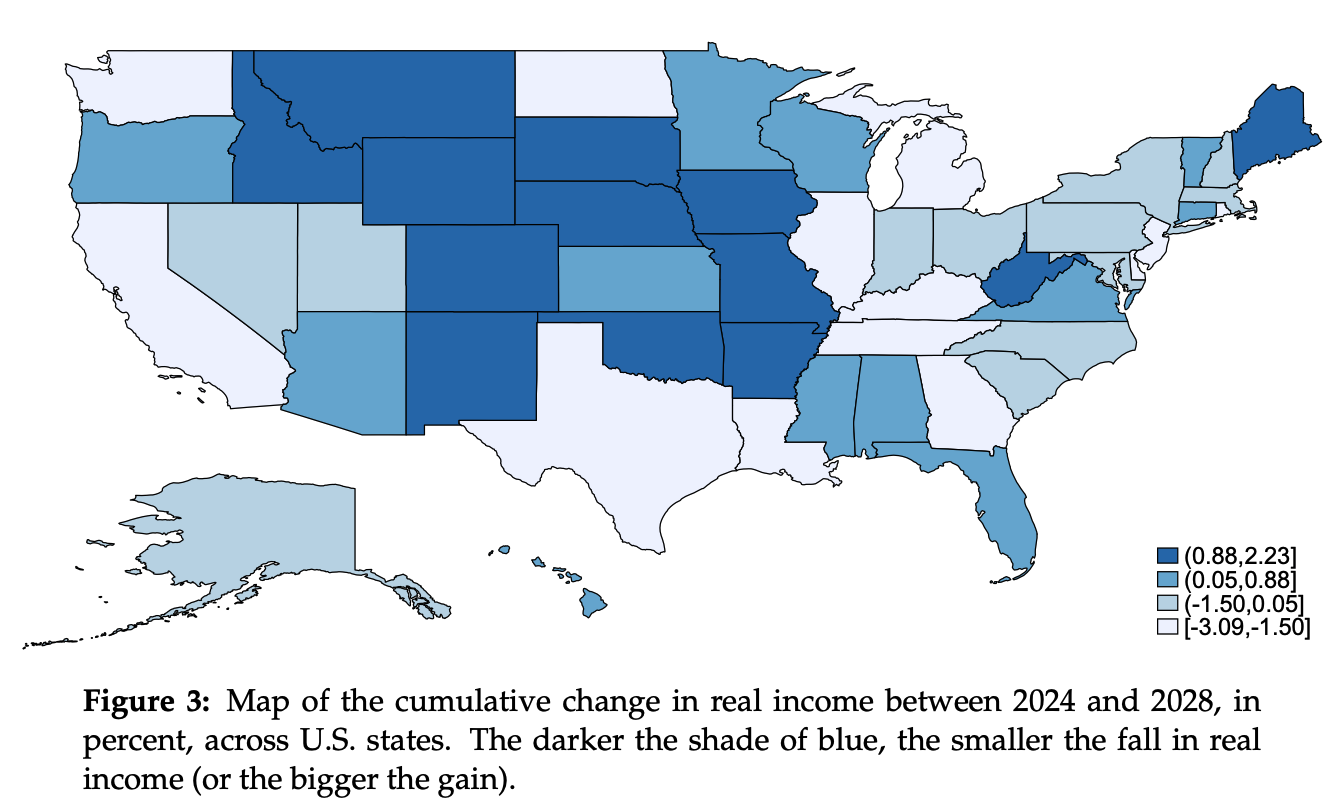 ” [Rodr\(\text{\'i}\)guez-Clare, Ulate, and Vasequez, 2025-04-22]
Capital Flight
Jigar Shah: Companies That Were Eligible For Clean Manufacturing Subsidies Under The Biden Administration Have Considered Moving Their Production Out Of The Country. According to Bloomberg, “Clean-tech companies that were eligible for support under former President Joe Biden are now considering leaving the US as the Trump administration pulls the plug on financing, according to the former head of the program that vetted the firms. As director of the Loans Programs Office at the US Department of Energy when Biden was president, Jigar Shah helped select roughly 400 companies with development plans to receive grants and loans upwards of $100 million each. Shah, who last year was included in Time magazine’s list of the most influential people for his contribution to advancing the clean-energy transition, said that since the inauguration of Donald Trump in January, many of the companies that benefited from Biden-era programs are now looking to shift all or part of their business outside the US.” [Bloomberg, 2025-05-12]
As The Trump Administration Focused On Exchange Rates, Options Traders Signaled Bearish Sentiment Towards The Dollar. According to Bloomberg, “Analysts and traders are preparing for more dollar weakness. In the options market, a gauge of sentiment toward the greenback over the coming year rose to the most bearish level since early 2020. Meanwhile, BBH strategists said they continue to treat any dollar relief rallies with skepticism. ‘Easing trade tensions have removed a significant headwind on the dollar over the short-term, but the medium- and long-term impact on the US economy will be felt in the coming weeks and months,’ Win Thin and Elias Haddad wrote in a note.” [Bloomberg, 2025-05-14]
Republicans’ Capital Controls
May 2025: House Republicans Proposed A Fee On Transfers Out Of The Country. According to Bloomberg, “Several provisions would raise taxes on immigrants. That includes a new 5% tax on transfers of money to foreign countries, known as remittances. Many immigrants in the US send money to relatives in their countries of origin. US citizens could apply for credits to offset that cost.” [Bloomberg, 2025-05-14]
Context: Capital Controls Are Bad
Capital controls as suggested by House Republicans are a truly terrible idea. They raise the threshold at which it would be profitable to invest in the United States, thereby making the country a less attractive destination for foreigners to invest.
Market Distortions
As Trade Ground To A Halt, American Scrap Copper Sellers Were Forced To Accept The Largest Discounts Ever Recorded On Their Sales. According to Bloomberg, “Copper is viewed as a barometer of the world economy because of its heavy industrial use. Scrap plays a big part of that, accounting for about a third of global supply, especially as mined ore is increasingly coming up short. The metal is a key component for electrification equipment and electric vehicles, which has sent demand higher as prices in the futures market hit record highs in the past 12 months. The US shipped 600,000 tons of scrap copper in 2024 to help meet increasing demand, making the secondary market equivalent to some of the world’s largest mines. More than half of that went to China. Then the unraveling of the essential US-China trade flows upended the scrap market. US supplies of the scrap grade known as No. 2 copper have been fetching a discount of 92.5 cents per pound relative to futures, according to data from Fastmarkets. That’s the widest spread ever.” [Bloomberg, 2025-05-14]
Republicans’ Tax Cut For The Rich
JCT: While Households At The Bottom Of Society Would See A Tax Increase Of About One Percent, Households Making More Than $1 Million Would See Their Taxes Cut By About Three Percent. According to NOTUS, “The Joint Committee on Taxation, the nonpartisan panel that scores tax legislation, published its distribution analysis of the tax bill. The committee — which found earlier in the day that the tax provisions would add $3.81 trillion to the national debt over nine years — reported that the average tax rate for households making less than $15,000 annually would actually see a tax increase from the legislation, while those making over $1 million would see a collective $96 billion decrease. (People making more than $1 million would see, on average, a tax cut of about 3%, while people making less than $15,000 would see their taxes increase by about 1%.)” [NOTUS, 2025-05-13]
- In Addition To Higher Taxes, Poor Americans Would Lose Funding For Medicaid And SNAP. According to Bloomberg, “Some of the cost for the tax bill would be defrayed through cuts to Medicaid health coverage and food stamps, both of which benefit low-income Americans. House Republicans are seeking to impose work requirements on able-bodied Medicaid recipients up to 64 years old and beneficiaries would have to pick up more costs. The GOP also has proposed cuts to the nation’s largest anti-hunger program, the Supplemental Nutrition Assistance Program. That includes expanding current work requirements to cover more beneficiaries. Beginning in 2028, states also would be required to pay a portion of food benefit costs, which are now fully paid by the federal government.” [Bloomberg, 2025-05-14]
In Addition To Increasing The Estate Tax Threshold, House Republicans’ Plan Would Index It To Inflation And Make It Permanent. According to Bloomberg, “House Republicans omitted a proposal the Trump administration floated to raise the income tax rate from 37% to 39.6% on people with very high incomes. Instead, wealthy families get another tax break: the estate tax exemption will rise to $15 million for individuals and $30 million for married couples next year, and rise with inflation afterward. Moreover, their Trump tax cuts would become permanent.” [Bloomberg, 2025-05-14]
In Addition To An Expanded Interest Expensing Tax Break, Private Equity’s Carried Interest Loophole Would Remain In Place. According to Bloomberg, “The carried interest tax break benefiting private equity, venture capital and real estate partnerships would survive again, despite the president’s push to eliminate it. Private equity also won an expanded interest expensing tax break.” [Bloomberg, 2025-05-14]
Hurting Fast-Growing Manufacturing Jobs
May 2025: Existing American Tax Incentives Pushed Panasonic To Boost Its Battery Construction In The U.S. According to the Financial Times, “Tesla battery supplier Panasonic is being pushed to accelerate supplies of its American-made products, according to the Japanese company’s chief executive, in a sign that US protectionist measures have made batteries manufactured by its Chinese rivals less competitive. Yuki Kusumi said in an interview in Tokyo with foreign media that its main customer — widely understood to be Tesla — was encouraging a quicker start to production at its new Kansas plant, most likely because Chinese batteries were less profitable to bring into the US due to a combination of subsidies and tariffs. ‘As we”ve been told by our customer to get Kansas moving quickly, we”re hurrying to do so,’ Kusumi said. He conjectured that the customer was thinking that replacing Chinese batteries with US-made Panasonic ones would help its electric vehicles sold in the US qualify for significant consumer tax credits.” [Financial Times, 2025-05-14]
- After Starting Construction On A Second Batter Plant In Kansas In 2022, Panasonic Was On Track To Boost Its American Battery Construction By 60 Percent. According to the Financial Times, “Under construction since 2022 and close to first production, Panasonic’s plant in De Soto, Kansas, will be its second battery site in the US and will lift its production capacity 60 per cent when it reaches mass production by March 2027.” [Financial Times, 2025-05-14]
…But House Republicans Tax Plans Would Eliminate Credits For Clean Energy Investment And Production. According to Bloomberg, “Clean energy industries would be hit by the Republican plan, which would roll back many provisions of former President Joe Biden’s landmark climate law. A tax credit for solar panels and other clean energy systems would be phased out, as would investment and production tax credits for wind, solar and other clean electricity production. Tax credits for the production of nuclear power and hydrogen production also would be phased out.” [Bloomberg, 2025-05-14]
Jigar Shah: Companies That Were Eligible For Clean Manufacturing Subsidies Under The Biden Administration Have Considered Moving Their Production Out Of The Country. According to Bloomberg, “Clean-tech companies that were eligible for support under former President Joe Biden are now considering leaving the US as the Trump administration pulls the plug on financing, according to the former head of the program that vetted the firms. As director of the Loans Programs Office at the US Department of Energy when Biden was president, Jigar Shah helped select roughly 400 companies with development plans to receive grants and loans upwards of $100 million each. Shah, who last year was included in Time magazine’s list of the most influential people for his contribution to advancing the clean-energy transition, said that since the inauguration of Donald Trump in January, many of the companies that benefited from Biden-era programs are now looking to shift all or part of their business outside the US.” [Bloomberg, 2025-05-12]
Private Assets
Private Asset Managers’ Demand For Americans’ Retirement Savings
$1.8 Trillion 401(k) Giant Empower Announced It Partnered With Apollo And Six Other Private Market Firms To Allow Private Assets In 401(k) Accounts. According to the Wall Street Journal, “More retirement savers are about to see private markets investments in their portfolios. The 401(k) giant Empower will start allowing private credit, equity and real estate in some of the accounts it administers later this year. The firm announced Wednesday that it has joined with seven firms to offer these investments, including Apollo Global Management and Partners Group. Wall Street firms have been pushing to get private investments into the hands of individual investors, and they see the $12.4 trillion market for 401(k)-type retirement plans as crucial to this growth. Empower, which oversees $1.8 trillion in 401(k)-type plans for 19 million people, is the biggest plan provider yet to offer these investments in 401(k)s. ‘A lot of private asset managers see tremendous opportunity there,’ said Ed Murphy, chief executive officer of Empower. ‘And we believe there are tremendous opportunities for retirement investors in private investing.’” [Wall Street Journal, 2025-05-14]
- The Lower Liquidity And Harder Valuation Problems Could Allow Those Firms To Charge American Retirees Four To Six Times Higher Than Typical 401(k) Products. According to the Wall Street Journal, “Still, it is tough to introduce these asset classes into 401(k) plans, which typically hold public stocks and bonds. Private investments are less liquid and harder to value. And many employers—which have the final say on whether to offer these funds for their employees—tend to avoid investments with high fees for fear of being sued. Empower partnership funds are likely to charge fees ranging from 1% to 1.6% of the portfolio balance annually. The average target-date mutual fund fee is about 0.28%, according to Morningstar Direct.” [Wall Street Journal, 2025-05-14]
After The First Trump Administration Changed The Rules To Allow Private Equity In Retirement Plans, Industry Executives Expressed Hope His Second Would Encourage More Money To Flow To Them. According to the Wall Street Journal, “The Labor Department during the first Trump administration issued guidance confirming that 401(k) plans can offer private equity in a diversified portfolio, such as a target-date fund. The Biden administration’s Labor Department noted that it ‘did not endorse or recommend such investments.’ Murphy said he is optimistic the Trump administration will issue further guidance designed to reassure employers, potentially paving the way for broad adoption of private investments in 401(k) plans.” [Wall Street Journal, 2025-05-14]
Private Credit Weakness
Even Before Trump’s Tariffs Hammered Their Businesses, About Half Of Private Credit Borrowers Had Negative Free Cash Flow. According to Bloomberg, “And yet, the investor giddiness isn’t always matched by what’s happening on the ground. Many companies backed by private capital, whether equity or credit, have been through the wringer as interest rates have stayed stubbornly high, and Trump-induced fears about the global economy won’t be helping. Almost half of borrowers from direct lenders had negative free operating cashflow even before the US president’s “liberation day” tariff bombshell, the International Monetary Fund warned last month. That’s keeping many of them hooked on so-called payment in kind notes, it said, where businesses put off interest payments until later at often punishing rates.” [Bloomberg, 2025-05-14]
Private Credit Has Been A Primary Driver Of Debt Restructuring. According to Bloomberg, “Other warning signs come from people reworking the debt of ailing companies. ‘Around 80% of the restructuring situations that we currently see involve private credit,’ says Jat Bains, who leads the restructuring and insolvency group at law firm Macfarlanes. George Mills, a partner in EY-Parthenon’s turnaround and restructuring team, adds that ‘nearly all’ of the complex restructuring situations his firm sees now include private credit funds.” [Bloomberg, 2025-05-14]