As more and more data comes in, the deterioration of the American economy caused by the Trump administration’s bad policies continues to become more apparent. he tariffs are causing unprecedented pressure on business margins, with retailers and wholesalers experiencing their second-largest profit margin decline on record in April 2025. Corporate earnings guidance momentum has fallen to its lowest level on record despite strong Q1 performance, reflecting deep uncertainty about the economic outlook. International business relationships are deteriorating, with European companies now treating U.S. travel as a high-risk activity similar to China, while business travel bookings to the U.S. have notably decelerated. Meanwhile, Klarna’s strong push into the country has been fairly disastrous, with credit losses surging by 17 percent year over year, and total losses more than doubling.
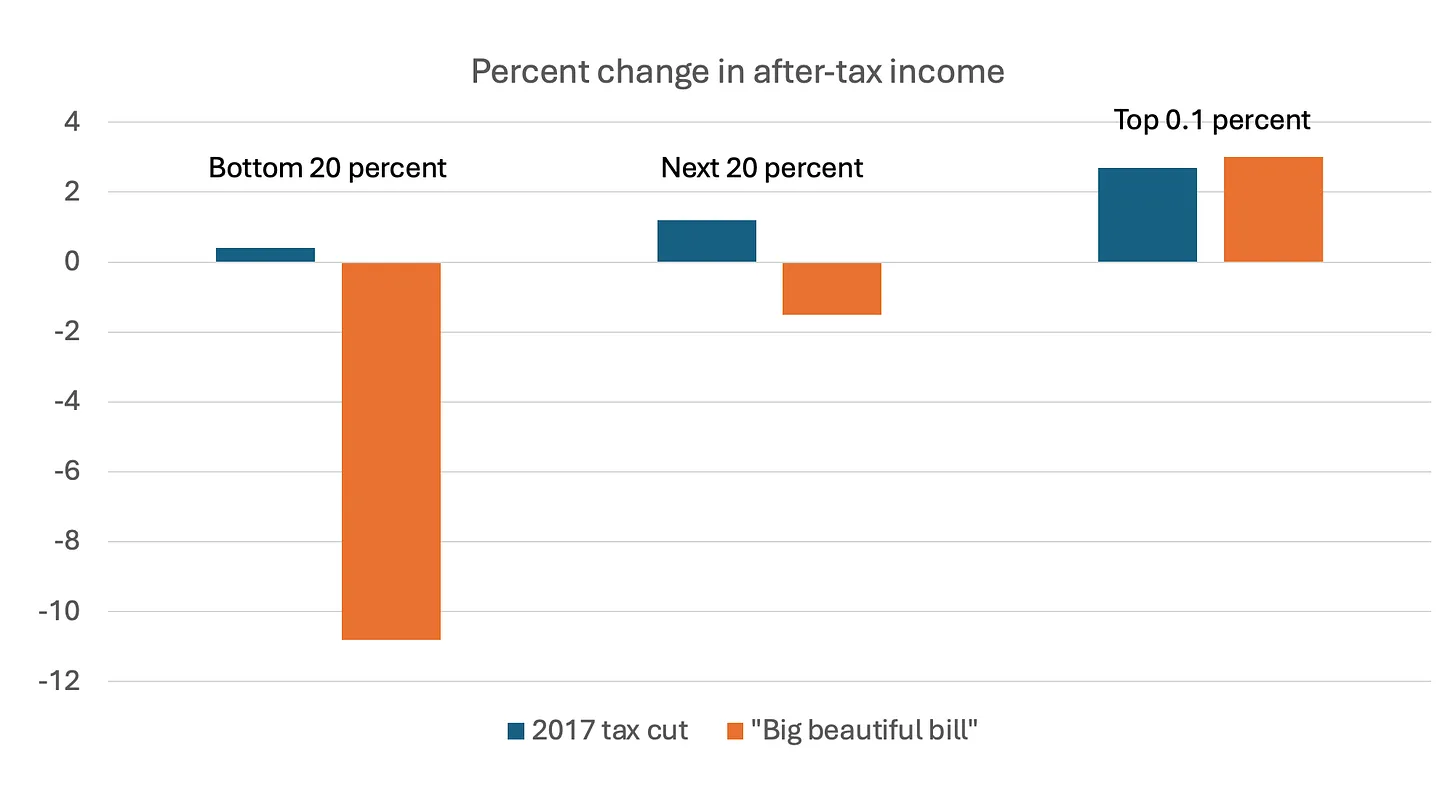
Unfortunately, the future is looking even more bleak, with Republicans pushing for an even more destructive policy mix. The GOP tax bill is projected to cut after-tax income for the poorest quintile of Americans by more than 10%, while the deficit spending it unleashes will, according to Standard Chartered, almost certainly limit the Fed’s ability to support the economy through rate cuts. Meanwhile, Trump’s capitulation to China has set an example for other countries to hold a harder line against him, and the Brazilian government, which controls the world’s second largest supply of rare-earths, has grown closer to China.
And if that wasn’t enough, Howard Lutnick has taken advantage of the capital gains tax exemption for government officials’ divestiture, while handing over control of his Cantor Fitzgerald shares to his children (whom it cannot be reasonably expected will be independent from him). Meanwhile, Trump’s SEC is trying to engineer a bailout of Private Market participants by making it much easier for retail investors to put there money into them.
Higher Costs
GOP Tax Bill
Standard Chartered: Markets Have Given Up On Short-Term Rate Cuts, And Their Expectations Of Long-Term Rate Cuts Could Be Hindered By Inflationary Pressure From Trump’s Tariffs And Republican Deficit Spending. According to Bloomberg, “With so many surveys pointing to slower growth, we doubt that the FOMC will require much weakness in hard data to justify policy easing. Yet, investors have largely eliminated hopes of a June FOMC policy rate cut (2bps of cuts are priced in), and even July has only 9bps priced in. Our baseline call for a June cut is now way out of the money, but we want to see early June data before changing it. If hard data begin to show softness, the slowdown will have been one of the most anticipated in recent decades and the Fed will be under pressure to respond quickly. By contrast, we are puzzled that the market is pricing in 75bps of policy rate cuts between the September 2025 and September 2026 meetings. That period will see both tariff-induced price increases and the impact of the tax bill, which most analysts expect to add to structural deficits. We see a limited window for cutting policy rates, and we expect it to close relatively quickly.” [Bloomberg, 2025-05-19]
Higher Costs For International Business
As The Trump Administration Has Cranked Up Border Searches, Foreign Businesses Have Started To Rate Travel To The U.S. As Similarly Risky To Regions Like China And The Middle East. According to the Financial Times, “With Donald Trump back in the White House, many corporate executives, academics and government officials in Europe and elsewhere are approaching trips to the US with a level of caution more often associated with higher-risk jurisdictions such as China and some countries in the Middle East. Stricter immigration enforcement and more aggressive border screenings — which can include searching and even copying data from travellers’ devices and, at times, denying entry — are prompting organisations to reassess the risks and protocols around even routine work travel. Contacts, emails, messages and social media posts could be subject to inspection, immigration lawyers said. Under the Trump administration, the number of border searches for January to mid-May have already surpassed those recorded in the first half of 2024 — up 10 per cent year on year — according to US Customs and Border Protection, the federal agency.” [Financial Times, 2025-05-18]
Spring 2025: European Commission Employees Were Given Burner Phones And Blank Laptops Before Travel To The Country. According to the Financial Times, “The European Commission has issued burner phones and basic laptops to some US-bound staff to avoid the risk of espionage. The Financial Times reported that commissioners and senior officials travelling to the IMF and World Bank spring meetings last month were given the new guidance.” [Financial Times, 2025-05-18]
European Airlines Have Seen “A Definite Deceleration In Business Travel Bookings” To The United States. According to the Financial Times, “The shift is starting to drip through to business travel bookings. Air France-KLM and Lufthansa have reported signs of weakening demand on transatlantic routes among European passengers. ‘There is a definite deceleration in business travel bookings,’ said Henry Harteveldt, a travel industry analyst. ‘Various airlines tell me they are seeing “slight” or “modest” deceleration in their future business travel bookings, including US domestic, within Europe, and in both directions between Europe and the US.’ He said reasons for this included weakening economies, which typically trigger a cutback in business travel, ‘as well as concerns among international business travellers regarding possible problems entering the US’. Harteveldt observed there was a ‘noticeable concern among corporate travel managers about international inbound travel to the US’.” [Financial Times, 2025-05-18]
American Universities Have Also Been Forced To Advise Non-American Employees To Be Extremely Cautious About Leaving The Country. According to the Financial Times, “Yet, US universities including Duke and Columbia are among those advising international staff and students not to leave the country unless absolutely necessary. This followed a series of detentions and deportations that have rattled confidence — even among people holding valid visas or green cards.” [Financial Times, 2025-05-18]
Context: More Friction Leads To Less Business
While for entities like the European Commission, the cost of burner phones and laptops are fairly trivial, for profit-maximizing companies, any increase in the cost of doing business with Americans makes doing that business less likely.
Higher Prices
April 2025: Profit Margins At Retailer And Wholesalers Shrunk Dramatically As They Tried To Contain Tariff-Driven Price Increases. According to Bloomberg, “Businesses absorbed much of the costs from new levies as they took effect last month, economic reports this week indicated. Profit margins at retailers and wholesalers shrank in April by the most in almost a year. Manufacturers signaled they are paying higher prices. Yet consumer inflation remained tame, and Walmart Inc. reported solid sales as it kept prices low. But the world’s largest retailer also had a warning: Change is likely coming. Walmart said consumers will start to see higher prices soon as it works through inventory and begins to pass on the costs of newer merchandise.” [Bloomberg, 2025-05-16]
Wells Fargo Senior Economist Sarah House: As Pre-Tariff Inventories Are Depleted, Firms Will Be Forced To Raise Prices. According to Bloomberg, “Sarah House, senior economist at Wells Fargo & Co., said she expects more costs to be passed on to consumers in the summer and into the fall as businesses” pre-tariff inventories are depleted and companies become resigned to the fact that higher duties may be here to stay. ‘Absorbing tariff costs through margins can be used to shield customers from price hikes for a time, but the longer the current policy stays in place, the more untenable that becomes,’ she said.” [Bloomberg, 2025-05-16]
Code
# Call custom plot themeinclude("../scripts/oxocarbon-plot.jl")theme(:oxocarbon)# Load Necessary pacakgesusingFredData, DataFrames, StatsPlots# Attach to the Fred API key =ENV["FRED_API_KEY"]f =Fred(key)# Get the data on margin changes margin_change =get_data(f, "PPITSS"; units="pch").data# Create the illustrative plotstimeline =bar(margin_change.date, margin_change.value; xlabel ="Month", ylabel ="MoM Margin Change (%)", legend =false)hline!([margin_change.value[end]], linestyle=:dash)distribution =histogram(margin_change.value; xlabel ="Margin Change (%)", ylabel ="Frequency", legend =false, bins=20, normalize=true)vline!([margin_change.value[end]], linestyle=:dash)plot(timeline, distribution, layout=(2,1), title="April 2025's Unprecedented Margin Fall", size=(800, 600))
┌ Warning: Metadata 'notes' not returned from server.
└ @ FredData ~/.julia/packages/FredData/5M7x4/src/get_data.jl:77
With data going back to November 2009, April 2025’s fall in profit margins for retailers and wholesalers was the second largest on record.
Trump’s Concern
May 2025: Trump Told Walmart To “EAT THE TARIFFS,” In A Subtle Recoegnition That His Favored Policy Could Cause Higher Prices For Americans. According to Bloomberg, “President Donald Trump said Walmart Inc. should stop trying to blame tariffs as the reason for raising its prices, as the company warned it would this week. ‘Walmart should STOP trying to blame Tariffs as the reason for raising prices throughout the chain. Walmart made BILLIONS OF DOLLARS last year, far more than expected,’ Trump said in a post on Truth Social Saturday. ‘Between Walmart and China they should, as is said, ’EAT THE TARIFFS,’ and not charge valued customers ANYTHING. I”ll be watching, and so will your customers!!!’” [Bloomberg, 2025-05-17]
Other Trade War
Brazil, A Major Potential Source Of Rare-Earths, Has Drawn Closer To China
Brazilian Reserves Of Rare-Earth Materials Represented Roughly A Fifth Of Global Known Reserves, More Than Ten Times As Much As In The United States. According to the Wall Street Journal, “Geopolitical tension is fueling interest in Brazil’s minerals. After the U.S. set new tariffs on China last month, China tightened restrictions on the export of rare-earth materials, worrying U.S. manufacturers including Tesla and redoubling their hunt for non-China alternatives. Exports of rare earths restarted this month for some companies. ‘Hopefully, we”ll get a license to use the rare-earth magnets,’ Tesla CEO Elon Musk said on the company’s April earnings call. Brazil has the world’s second-largest rare-earth reserves after China, some 21 million tons, according to the U.S. Geological Survey. That represents more than a fifth of known global reserves—and more than 10 times those in the U.S.” [Wall Street Journal, 2025-05-18]
May 2025: Brazilian President Lula Signed More Than 30 Agreements In China, Brushing Off Concern About American Perceptions. According to Bloomberg, “Brazil President Luiz Inacio Lula da Silva, who previously said negotiation came before retaliation, on Wednesday brushed off concern that forging deeper ties with China would prompt a negative US response after a state visit to Beijing that saw him sign more than 30 agreements.” [Bloomberg, 2025-05-18]
With The Goal Of Moving Up Global Value Chains, Brazil Signed Agreements Encouraging Chinese Investment In Mining, Transportation, Ports, And Jet Aircraft. According to Bloomberg, “Lula struck an unapologetic note as he rounded off his trip, saying China and Brazil are united in defending multinationalism and fighting protectionism. Brazil’s president has sought to further expand the ties, betting on Chinese investment and support for a development strategy meant to move his nation up the global value chain. The deepening relationship was on display Tuesday, as Chinese leader Xi Jinping and Lula signed deals for Chinese investment in mining, transport infrastructure and ports, as well as the purchase of jets made by Embraer SA.” [Bloomberg, 2025-05-14]
Brazil Agreed To Cooperate With China On Artificial Intelligence. According to Bloomberg, “China and Brazil also decided to cooperate on artificial intelligence and take joint action on climate, while their central banks entered a currency swap agreement to provide liquidity to each other’s markets over a period of five years.” [Bloomberg, 2025-05-14]
“Deal” With China
May 2025: The Chinese Ministry Of Commerce Accused The United States Of Not “Uphold[ing] The Consensus Of Geneva” According to Joe Weisenthal, “At the May 15 regular press conference, China’s Ministry of Commerce already laid out its stern and clear position on this matter. After the U.S. issued the relevant guidelines, China immediately raised concerns through the China-U.S. economic and trade consultation mechanism, engaging in communications with the U.S. side at multiple levels. We pointed out that the U.S. actions seriously undermine the consensus reached during the high-level Geneva talks between China and the U.S., and we demanded the U.S. correct its erroneous behavior. China has taken note of the recent adjustment to the wording in the U.S. press release. However, the discriminatory nature and market-distorting essence of the guidelines themselves remain unchanged. The U.S. is abusing export control measures by imposing stricter restrictions on Chinese chip products under baseless accusations. It even interferes with Chinese companies’ use of domestically produced chips within China. This overreach is a classic example of unilateral bullying, and China firmly opposes it. The U.S. actions seriously infringe upon the legitimate rights and interests of Chinese enterprises, severely threaten the security and stability of global semiconductor supply chains, and gravely disrupt global technological innovation. Tripping others won’t make you run faster. These unilateral, protectionist efforts to block and isolate other countries will ultimately damage the U.S.’s own industrial competitiveness. In the end, it’s like lifting a stone only to drop it on your own foot. China urges the U.S. to immediately correct its mistaken policies and stop its discriminatory measures against China. Both sides should uphold the consensus from the Geneva high-level talks, enhance communication through mechanisms such as the China-U.S. economic and trade consultations, effectively manage differences, and negotiate to address each other’s concerns. The goal should be to build a sustainable, long-term, and mutually beneficial bilateral economic and trade relationship. If the U.S. persists in going its own way and continues to substantially harm China’s interests, China will take resolute measures to safeguard its legitimate rights and interests.” [Joe Weisenthal, 2025-05-19]
Unintended Consequences
Former US Trade Negotiator Stephen Olson: Trump’s Caving To China Validated Their Hardline Response To His Tariffs. According to Bloomberg, “China’s defiant stance in negotiating a tariff truce with the US has convinced some countries they need to take a tougher position in their own trade talks with the Trump administration. The pause reached a week ago gave structure to what promise to be prolonged and difficult rounds of talks between Washington and Beijing, which still faces average US import taxes near 50% when past levies are factored into the 30% rate agreed to in Geneva, Switzerland. Yet US President Donald Trump’s willingness to retreat so much from the earlier 145% duty on China surprised governments from Seoul to Brussels that have so far stuck with the US’s request to negotiate rather than retaliate against its tariffs. After China’s tough negotiating tactics earned it a favorable — albeit temporary — deal, nations taking a more diplomatic and expedited approach are questioning whether that’s the right path. ‘This shifts the negotiating dynamic,’ said Stephen Olson, a former US trade negotiator who’s now a visiting senior fellow with ISEAS — Yusof Ishak Institute in Singapore. ‘Many countries will look at the outcome of the Geneva negotiations and conclude that Trump has begun to realize that he has overplayed his hand.’” [Bloomberg, 2025-05-18]
South Korea’s Leading Presidential Candidate Noted That There Was No Need For A Rushed Agreement. According to Bloomberg, “While officials are loathe to signal publicly any hardening of their approach, there are signs particularly from larger nations that they’re realizing they hold more cards than previously thought and can afford to slow the pace of negotiations. South Korea’s leading presidential candidate Lee Jae-myung said there’s no need to rush for an early agreement in trade negotiations with the US, criticizing the interim government for what he called a hasty engagement with the Trump administration.” [Bloomberg, 2025-05-18]
May 2025: India’s External Affairs Minister Cast Doubt On Trump’s Deal Framework Claims./ According to Bloomberg, “While Trump also said that India was prepared to lower all tariffs on US goods, the nation’s External Affairs Minister Subrahmanyam Jaishankar told reporters that trade talks are ongoing and ‘any judgment on it would be premature.’” [Bloomberg, 2025-05-18]
Weaker Economy
For Major Corporations
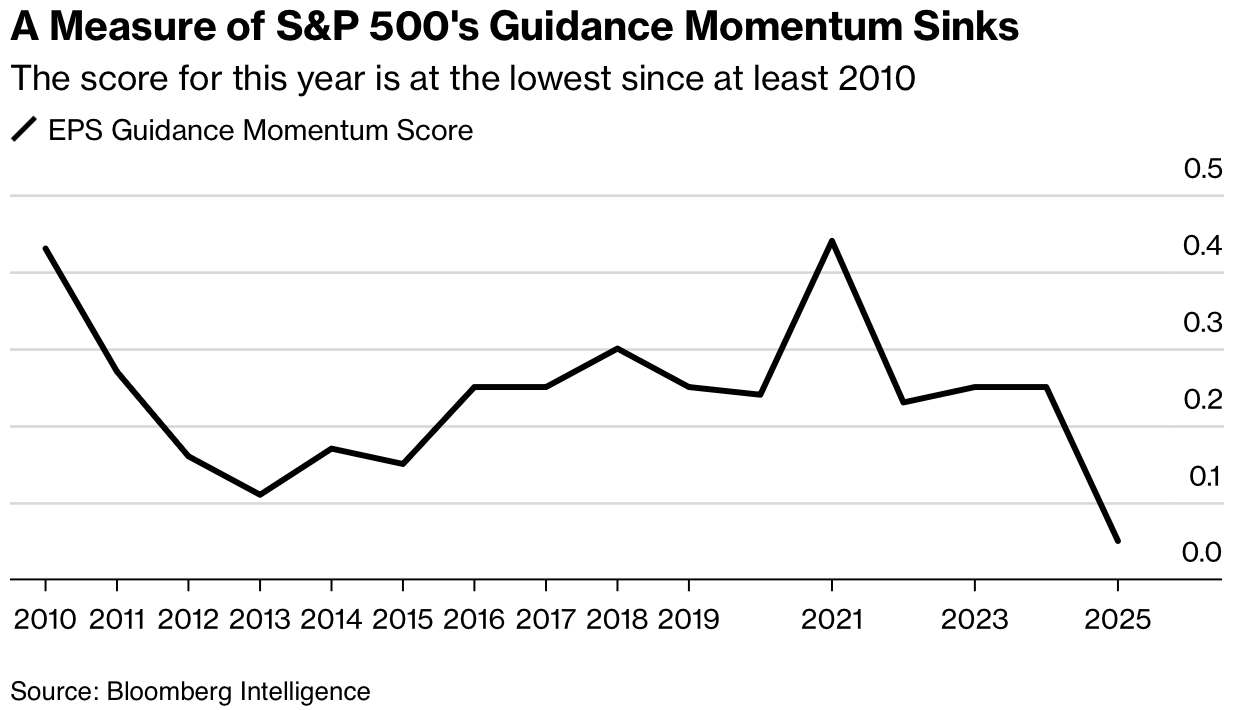
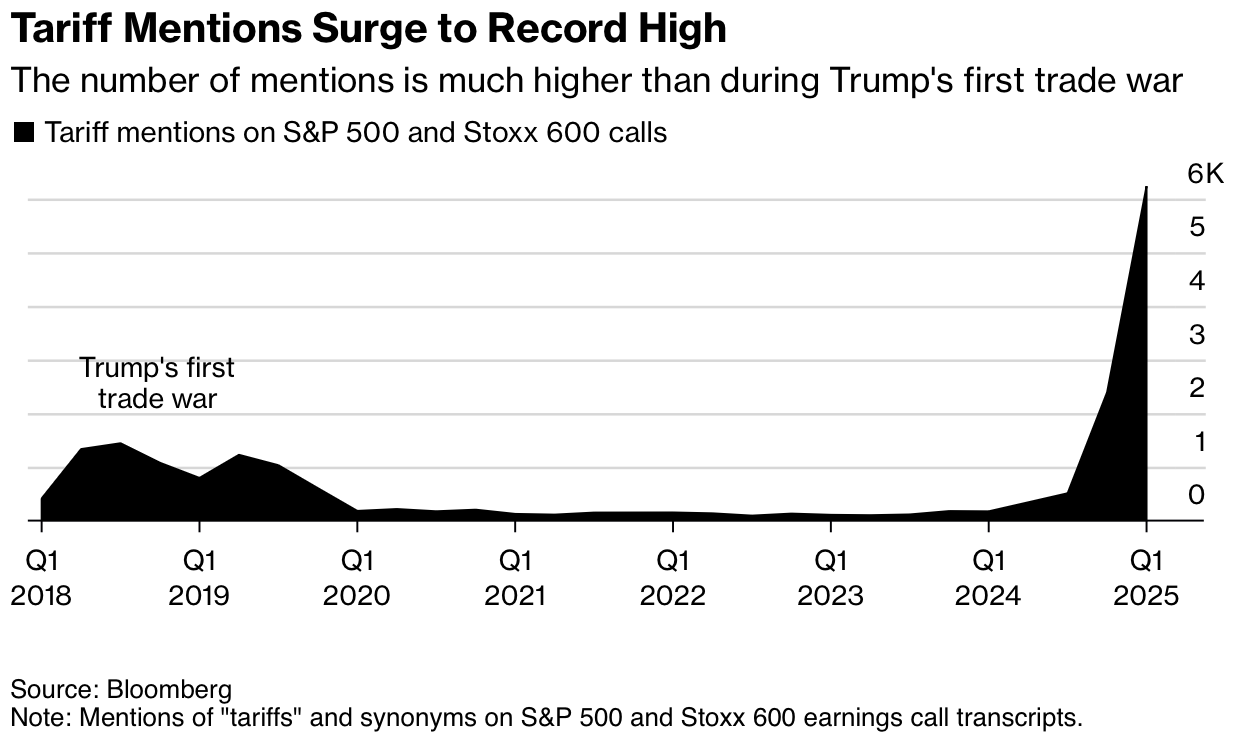
Q1 2025: Uncertainty Has Driven A Measure Of Positive Revisions To Earnings Guidance To The Lowest Level Since At Least 2010. According to Bloomberg, “One thing is clear as the first-quarter earnings season draws to a close: The uncertain outlook for the global economy is superseding better-than-feared results even as stocks rally on signs of easing trade tensions. Corporations across the US, Europe and China are pulling their forecasts for the year or providing grim outlooks, citing rising costs, weak consumer sentiment and a lack of business confidence as a result of President Donald Trump’s worldwide trade offensive. ‘This earnings season wasn’t about the numbers, it was about the narrative,’ said Scott Ladner, chief investment officer at Horizon Investments LLC. ‘Nobody cared what you did in the first quarter other than to determine the jumping off place for the new tariff economy.’ In the US, a measure that reflects the proportion of S&P 500 Index members that raised their earnings outlook compared to those that held or reduced, the so-called profit guidance momentum, fell to the lowest level since at least 2010, according to an analysis from Bloomberg Intelligence’s equity strategists Gina Martin Adams and Wendy Soong. That is in spite of S&P 500 companies delivering double the profit growth that was expected in the first quarter, according to BI.” [Bloomberg, 2025-05-17]
As Upward Revisions Have Stalled, Tariff Mentions On Earnings Calls Have Skyrocketed. According to Bloomberg, [Bloomberg, 2025-05-17]
For Lower Income Households
Tax Policy Center And Penn-Wharton Model: Republicans’ Tax Bill Would Cut After-Tax Income For The Poorest Quintile Of Americans By More Than 10 Percnent. [Paul Krugman, 2025-05-19]
Q1 2025: Buy Now Pay Later Platform Klarna Reported That Its Net Losses Had More Than Doubled From A Year Earlier As Customer Credit Losses Grew By 17 Percent. According to the Financial Times, “Klarna’s net loss more than doubled in the first quarter as more consumers failed to repay loans from the Swedish “buy now, pay later” lender as concerns rose about the financial health of US consumers. The fintech, which offers interest-free consumer loans to allow customers to make retail purchases, on Monday reported a net loss of $99mn for the three months to March, up from $47mn a year earlier. The company, which makes money by charging fees to merchants and to consumers who fail to repay on time, said its customer credit losses had risen to $136mn, a 17 per cent year-on-year increase.” [Financial Times, 2025-05-19]
Klarna Had Spent The Previous Years Focused On Aggressively Growing In The U.S. According to the Financial Times, “Klarna has focused on growing aggressively in the US in recent years, signing partnerships with merchants including DoorDash, Walmart and eBay. The push into America has raised concerns about the group’s vulnerability to a US recession.” [Financial Times, 2025-05-19]
Private Markets Bailout
May 2025: Trump’s SEC Chair Announced He Would Try To Make It Easier For Retail Investors To Put Money Into Private Markets. According to Bloomberg, “The Securities and Exchange Commission is taking a fresh look at rules that make it harder to invest in private funds. Atkins said he will ask agency staff to consider revising 23-year-old rules for private funds that require investments by closed-end mutual fund investors of at least $25,000 and restrict sales to those who meet certain standards. He noted those restrictions have resulted in many retail investors missing out on opportunities in closed-end funds. The goal is to start opening up the nearly $31 trillion private fund markets to more investors, SEC Chairman Paul Atkins said in prepared remarks for an event in Washington.” [Bloomberg, 2025-05-19]
Private Credit, Meanwhile, Is In Some Trouble
May 2025: Restructuring Experts Have Cited Private Credit As Their Primary Source Of Business. According to Bloomberg, “Private credit funds are increasingly turning to restructuring advisers to sort out their problem loans, suggesting that while the hot asset class is still raking in capital, there are risks simmering under the surface. ‘The amount of work we”ve been doing with private credit has doubled in the last three to four years and we weren’t doing any ten years ago,’ said David Morris, head of UK restructuring and chief operating officer of EMEA corporate finance at FTI Consulting. The sentiment is echoed by others. George Mills, a partner in EY-Parthenon’s turnaround and restructuring team, said ‘nearly all’ complex restructuring situations his firm sees now include private credit, while Jat Bains, who leads the restructuring and insolvency group at law firm Macfarlanes, put that figure at ‘around 80%.’” [Bloomberg, 2025-05-17]
The Strain In Private Credit Has Followed A More Than Doubling Of Private Credit Default Rates With “Continued Stress And Elevated Losses.” According to Bloomberg, “Some of this increase in workload likely reflects private credit’s rapid growth into a $1.6 trillion corner of the financial market. But it’s also a sign that borrowers are increasingly feeling the strain of stalling economies, trade tensions and persistently high interest rates. The default rate in Fitch Ratings” privately monitored ratings portfolio, which is made up of mid-sized US companies, jumped to 8.1% last year, from just 3.6% in 2023. Fitch attributed the rise to high rates impacting company cash flows and liquidity, and said ‘continued stress and elevated losses’ are likely in 2025.” [Bloomberg, 2025-05-17]
Corruption
By Selling His Assets And Putting The Proceeds In A Portfolio That Does Not “Pose A Conflict Of Interest,” Lutnick Has Avoided Capital Gains Taxes. According to Bloomberg, “Lutnick won’t have to pay capital gains taxes on the sales as long as he puts the proceeds into Treasuries or a broadly based mutual fund — assets that don’t pose a conflict of interest.” [Bloomberg, 2025-05-19]
May 2025: With Undisclosed Terms, Lutnick Transferred His Ownership Stake In Cantor Fitzgerald To His Children, With The Help Of Some Private Equity Money. According to Bloomberg, “US Commerce Secretary Howard Lutnick sold his stakes in the Wall Street business group he ran for more than three decades, passing ownership to his children and private outside investors and cashing out at least hundreds of millions of dollars. Lutnick’s ownership of brokerage and investment bank Cantor Fitzgerald LP has been transferred to trusts for the benefit of his children, including Brandon and Kyle, his two oldest sons, who were appointed earlier this year to oversee the group, according to a statement Monday. Terms weren’t disclosed. A minority investment also came from an investor group led by 26North Partners, founded in 2022 by Josh Harris, co-founder of Apollo Global Management Inc. The group also includes Glenn August, the founder of private-credit investor Oak Hill Advisors. ‘Kyle and I are honored to continue building on our father’s legacy, leading Cantor Fitzgerald alongside the exceptional executive team we have in place today,’ Chief Executive Officer Brandon Lutnick said in the statement.” [Bloomberg, 2025-05-19]
Lutnick Was Able To Sell More Than $360 Million In Public Shares. According to Bloomberg, “As part of the divestment, the billionaire sold his beneficial stakes back to his public companies, which remain controlled by private parent firm Cantor Fitzgerald. Newmark bought his shares for $127 million, while BGC paid $151.5 million, the companies said in separate statements. In addition, Howard Lutnick agreed to sell his 8.97 million Class B shares in BGC to Cantor Fitzgerald, which would add roughly an additional $82.6 million to his divestment haul.” [Bloomberg, 2025-05-19]
IRS: For Households With Income Above $583,750, Long-Term Capital Gains Would Be Taxed At A Rate Of 20 Percent. [Internal Revenue Service, 2025-01-02]
 [Bloomberg,
  [Bloomberg,
  [Paul Krugman,