President Trump’s aggressive tariff policies are significantly disrupting US-China trade flows, with Port of Los Angeles seeing a 30% drop in inbound shipments and Chinese smartphone exports to the US plummeting 72% to 14-year lows. Additional tariffs under review could cripple the ability of those ports to modernize their cranes (or even keep up with the depreciation of their current cranes). Meanwhile, financial markets are showing serious warning signs: Treasury yields have hit their highest point since 2023 following Moody’s downgrade, the euro is strengthening against the dollar, and investors are increasingly betting on Treasury selloffs. JPMorgan CEO Jamie Dimon has warned of “extraordinary complacency” amid rising stagflation risks, while the Trump administration’s immigration policies threaten to remove a critical labor supply that had been helping contain inflation.
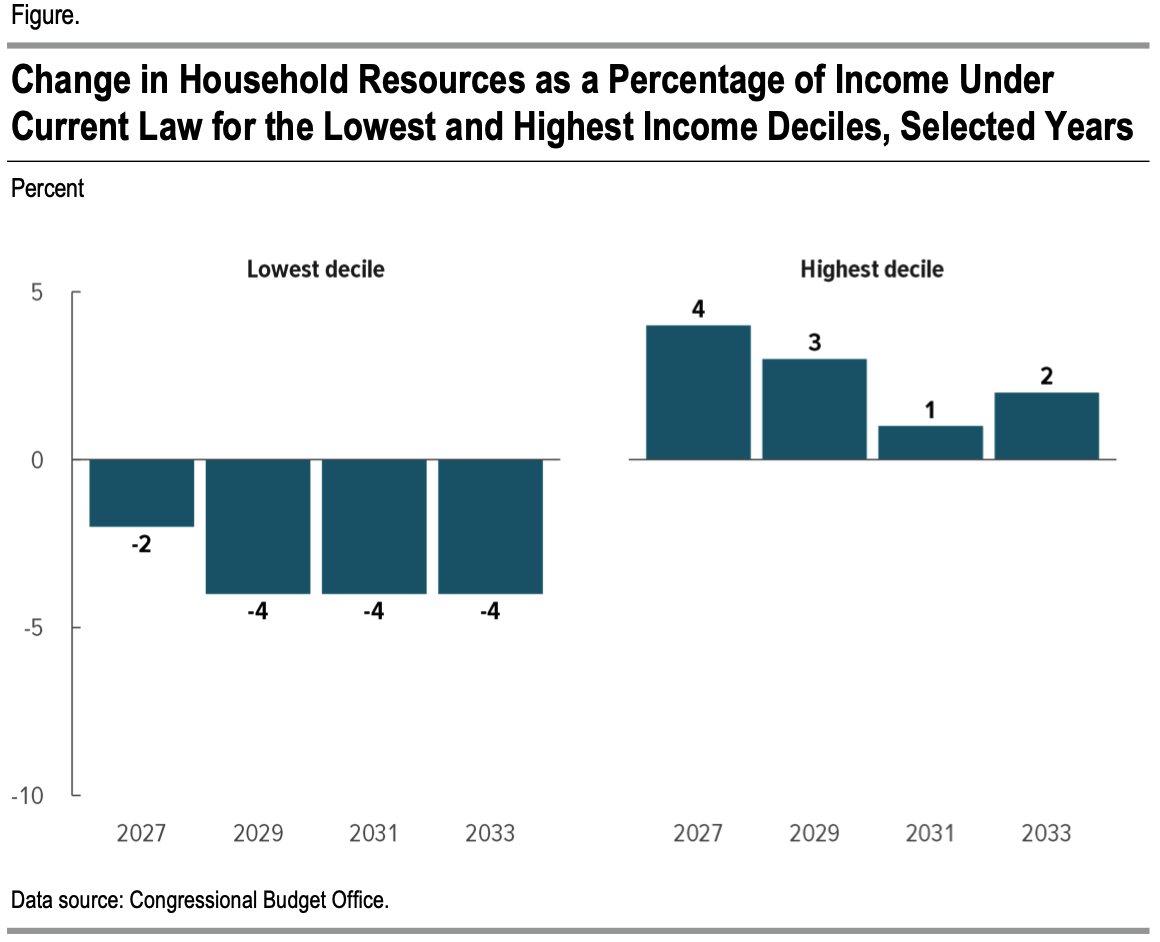
Meanwhile, The CBO produced more evidence that House Republicans’ tax plan would cut income for the poorest Americans, even as it gives millions to the richest. That isn’t a problem for the Trump administration, where evidence of the massive corruption he has displayed with his memecoin seems to be par for the course, as evidence emerged of his nominee to lead the IRS taking hundreds of thousands of dollars to promote nonexistent tax credits.
And in the world of private markets, the growing interconnections between banks and private credit markets (with lending doubling to $1.2 trillion since 2019) are raising systemic risk concerns. No wonder this administration wants to make it easier for them to access retail investor money.
Trade War
Amid Trump’s Tariffs, Inbound Shipments To The Port Of Los Angeles Dropped 30 Percent, Leading To Less Demand For Port Workers. According to Bloomberg, “Inbound shipments to the Port of Los Angeles — the busiest container hub in the US — dropped as much as 30% in early May as President Donald Trump’s tariffs discourage trade. ‘Fewer containers mean less work on the waterfront, from the number of labor gangs that are out there responding to the shift requirements of cargo, to the truckers and warehouse workers,’ Port of Los Angeles Executive Director Gene Seroka said on a call with reporters Monday. ‘The impact was felt almost immediately during that first week of May.’ The drop in port activity came as importers and retailers — especially those with business in China — grappled with Trump’s tariffs announced in early April.” [Bloomberg, 2025-05-19]
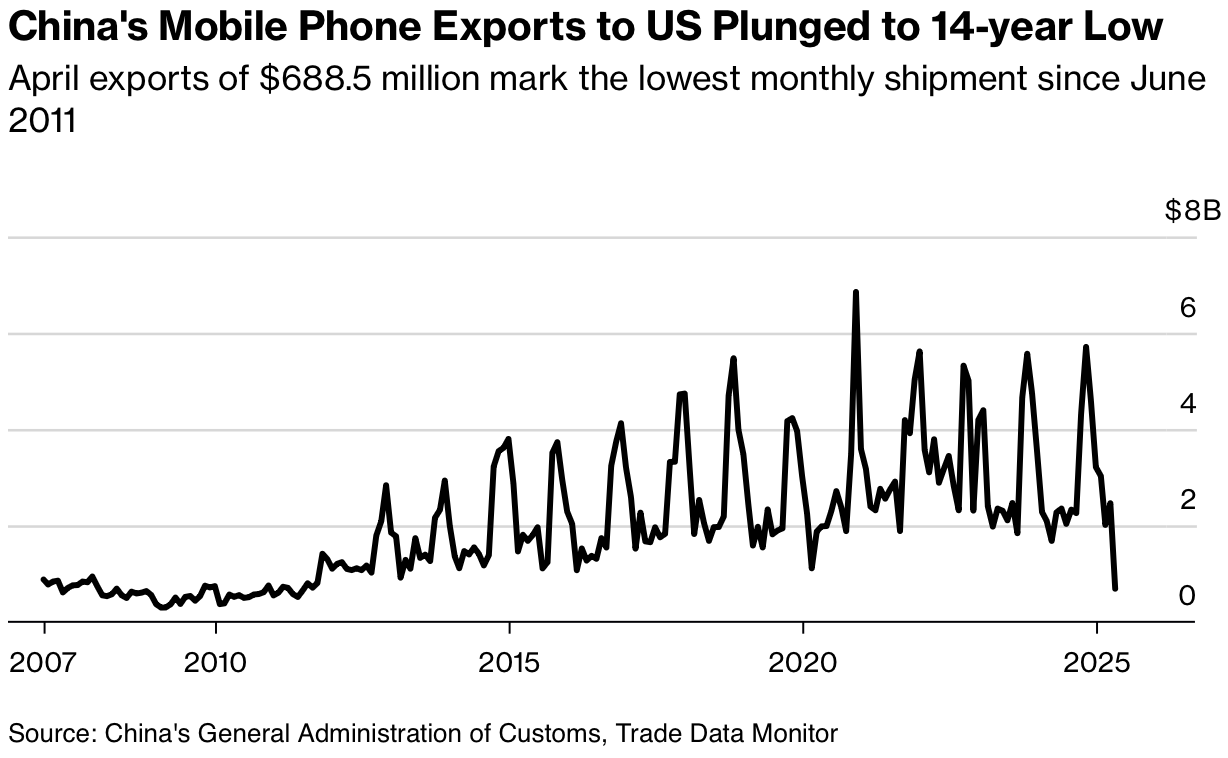
April 2025: Shipments Of Smartphones From China To The United States Dropped To April 2011 Levels, As Trump’s Tariffs Choked Off Economic Activity. According to Bloomberg, “Chinese shipments of Apple Inc.’s iPhone and other mobile devices to the US dived to their lowest levels since 2011 in April, underscoring how the threat of US tariffs choked off the flow of big-ticket goods between the world’s two largest economies. Smartphone exports slid 72% to just under $700 million last month, sharply outpacing an overall 21% drop in Chinese shipments to the US, detailed customs data showed on Tuesday. That highlighted the way the Trump administration’s tariffs campaign — peaking with 145% levies on Chinese goods — is disrupting tech supply chains and diverting electronics elsewhere.” [Bloomberg, 2025-05-20]
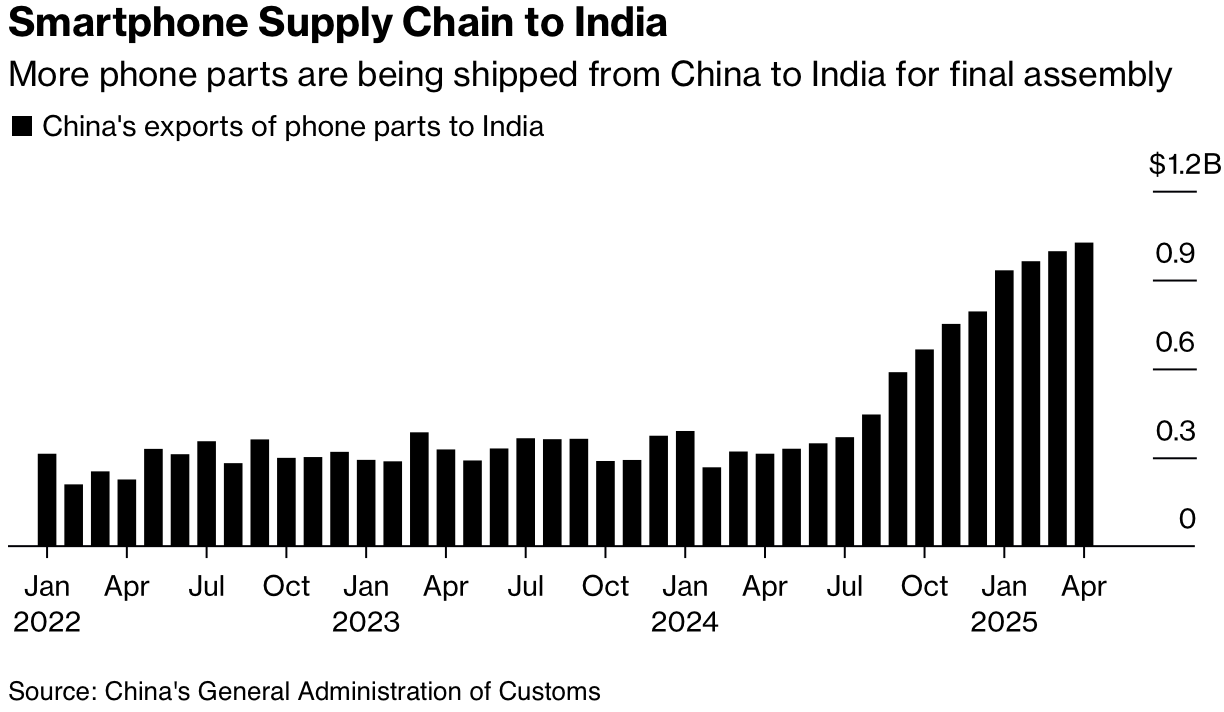
Even As Exports To The United States Collapsed, Exports Of Smartphone Parts To India Surged, Suggesting China Will Not Be Cut Out Of That Supply Chain. According to Bloomberg, “The value of phone component exports to India — home to Apple’s biggest iPhone production base outside of China — roughly quadrupled over the course of the past year, according to China’s General Administration of Customs. Apple has accelerated a shift of production to India, though Trump recently criticized that practice and urged Apple to bring iPhone manufacturing home. The device has never been produced in the US, a project that appears unfeasible at least in the short run.” [Bloomberg, 2025-05-20]
American Association Of Port Authorities: Trump’s Proposed 100 Percent Tariffs On Cranes Put Ports In A Position Where They Have To Either Pay Billions, Or Scale Back Modernization. According to Bloomberg, “Import tariffs imposed on Chinese-built cranes could cost key US cargo handling facilities nearly $6.7 billion and inhibit infrastructure investment, according to a group that represents 81 ports across the country. ‘Ports would have no choice but to pay these tariffs or drastically scale back their port modernization plans,’ said Cary Davis, chief executive officer of the American Association of Port Authorities. ‘That affordability problem leads to a capacity problem.’ Davis testified on Monday at a hearing in Washington on the US Trade Representative office’s proposal to levy a 100% tariff on Chinese-made port cranes, known as ship-to-shore cranes and other cargo-handling equipment.” [Bloomberg, 2025-05-19]
Following The Initiation Of Trump’s Trade War, The Head Of The European Chamber Of Commerce In Hong Kong Noted A Larger Chinese Openness To European Business. According to Bloomberg, “China is giving European business leaders its warmest welcome in years, in an effort to strengthen ties as Beijing seeks to counter Donald Trump’s tariff pressure and stabilize its slowing economy. The Chinese government in recent weeks has offered delegations rare, unscripted access to senior policymakers and showered them with assurances of improved conditions, according to European business groups. ‘They rolled out the red carpet for us,’ said Inaki Amate, chairman of the European Chamber of Commerce in Hong Kong. In March he led a delegation to Beijing, where he was invited to lunch by Xia Baolong, China’s top official for Hong Kong and Macau affairs, and met with Hua Chunying, the Foreign Ministry’s vice minister. Presented with 10 requests, Xia ‘said yes to everything,’ Amate recalled, without elaborating on what the conditions were. ‘He said, “whatever you need you just ask us and we will make it work.”’” [Bloomberg, 2025-05-20]
Debt Market Strangness
Consequences Of The Downgrade
Hong Kong’s Strict Regulation Of Its Mandatory Pension Fund System Means That Billions Of Dollars Could Be Forced To Flow Out Of Treasuries Following Another Downgrade. According to Bloomberg, “Hong Kong’s pension fund managers have flagged the risk of potential forced selling on their Treasury holdings after a downgrade by Moody’s Ratings of US debt, according to people familiar with the matter. Funds operating under the city’s HK$1.3 trillion ($166 billion) Mandatory Provident Fund system are only allowed to invest over 10% of their assets in Treasuries if the US has a AAA or equivalent rating from an approved agency. After last week’s cut by Moody”s, the only remaining such score is from Japan’s Rating & Investment Information Inc. The Hong Kong Investment Funds Association has raised managers” concerns to the Mandatory Provident Fund Schemes Authority and the Financial Services and the Treasury Bureau, said the people, asking not to be named because the information is private. The association recommended that authorities make an exception for US Treasuries, by allowing funds to invest in the assets even if they are rated one notch below AAA, the people said. The situation underscores the risks of the US falling foul of the unusually strict investment mandates governed by Hong Kong laws. The bulk of global investors do not require the top-tier rating to invest freely in US Treasuries — a factor which minimizes the risk of forced sales.” [Bloomberg, 2025-05-20]
Hong Kong’s Strict Financial Regulation Caps Exposure To All But The Absolute Safest Bonds. According to Bloomberg, “MPF funds are only allowed to invest over 10% of portfolios in a single issuer if they are an exempt authority. The designation applies to any government with a top rating from an approved agency, as well as to a specific list of issuers that includes the Hong Kong and Chinese governments. Unlike these Hong Kong funds, global holders of Treasuries generally don’t rely on the US maintaining a certain credit rating. A recent survey conducted by Bloomberg Intelligence of more than a dozen fixed-income mandates for large mutual funds and separately managed accounts showed that Treasuries were their own asset class without any rating stipulation.” [Bloomberg, 2025-05-20]
May 2025: Following Moody’s Downgrade, 30 Year Treasury Yields Hit Their Highest Point Since November 2023. According to the Financial Times, “US long-term borrowing costs climbed to their highest level since late 2023 as the stripping of the country’s triple A credit rating and progress on President Donald Trump’s massive tax and budget bill fuelled concerns about the government’s mounting debt burden. Yields on 30-year US Treasuries rose as much as 0.14 percentage points to 5.04 per cent on Monday, exceeding a peak reached during the tariff sell-off last month and putting the country’s long-term borrowing costs at their highest point since November 2023. They later fell back to 4.91 per cent. Yields move inversely to prices.” [the Financial Times, 2025-05-19]
Code
# Set up my cutom plot theme include("../scripts/oxocarbon-plot.jl")theme(:oxocarbon)# Call Necessary Packages usingFredData, DataFrames, Dates# Set up Fred API key =ENV["FRED_API_KEY"]f =Fred(key)# Gather Data on 30 Year Yield And short term ratest30 =get_data(f, "DGS30"; observation_start="2021-05-20", observation_end="2025-05-19").dataeffr=get_data(f, "EFFR"; observation_start="2021-05-20", observation_end="2025-05-19").data# Create a plot showing the difference between the twoplot(t30.date, 100.0.* (t30.value - effr.value); title="30Y - Short Term Rates", xlabel="Date", ylabel="Spread (bps)", linewidth=2, label="Spread")hline!([0.0], linestyle=:dash, label="")
NOTE: In a healthy economy, 30 year treasuries should yield more than overnight risk-free borrowing. However, large moves like the ones we have seen recently are indicative of major structural changes, and should not be taken lightly.
Failure To Absorb Shocks
KKR: Treasuries Have Not Been As Effective Hedges Against Risk As They Have Been Historically. According to Bloomberg, “Government bonds are no longer working as an effective hedge against risky assets, creating a challenge for global investors and spurring a search for asset diversification, according to KKR & Co. Bigger fiscal deficits and stickier inflation suggest that bonds will not always rally when stocks sell off, breaking down the traditional relationship between the two assets, Henry McVey, KKR’s head of global macro and asset allocation, said in a research note. ‘During risk off days, government bonds are no longer fulfilling their role as the “shock-absorbers” in a traditional portfolio,’ McVey wrote.” [Bloomberg, 2025-05-20]
Stagflationary Outlook
Weaker Growth
Citing “An Extraordinary Amount Of Complacency,” Jamie Dimon Warned Of An Underrated Risk Of Stagflation. According to Bloomberg, “JPMorgan Chase & Co. Chief Executive Officer Jamie Dimon warned against complacency in the face of a slew of risks, citing everything from inflation and credit spreads to geopolitics. Dimon said the chances of elevated inflation and stagflation are greater than people think, cautioned that America’s asset prices remain high and said that credit spreads aren’t accounting for the impacts of a potential downturn. ‘Credit today is a bad risk,’ he said at the firm’s investor day on Monday. ‘The people who haven’t been through a major downturn are missing the point about what can happen in credit.’ The Trump administration’s fast-changing tariff policies sent markets spiraling on recession fears and concerns about the safety of US assets, but they”ve rebounded as the president touted progress in tariff negotiations. Even after the US was stripped of its last top credit rating by Moody’s Ratings on Friday, the S&P 500 erased an initial decline on Monday as traders seemed to look beyond the downgrade. ‘People feel pretty good because you haven’t seen an effect of tariffs,’ Dimon said. ‘The market came down 10%, it’s back up 10%; I think that’s an extraordinary amount of complacency.’” [Bloomberg, 2025-05-19]
Capital Flight
KKR Research Note: “CIOs Are Considering Moving Assets Out Of The United States.” According to Bloomberg, “Government bonds are no longer working as an effective hedge against risky assets, creating a challenge for global investors and spurring a search for asset diversification, according to KKR & Co. Bigger fiscal deficits and stickier inflation suggest that bonds will not always rally when stocks sell off, breaking down the traditional relationship between the two assets, Henry McVey, KKR’s head of global macro and asset allocation, said in a research note. […] ‘Many CIOs are considering moving assets out of the United States toward other parts of the world,’ McVey said.” [Bloomberg, 2025-05-20]
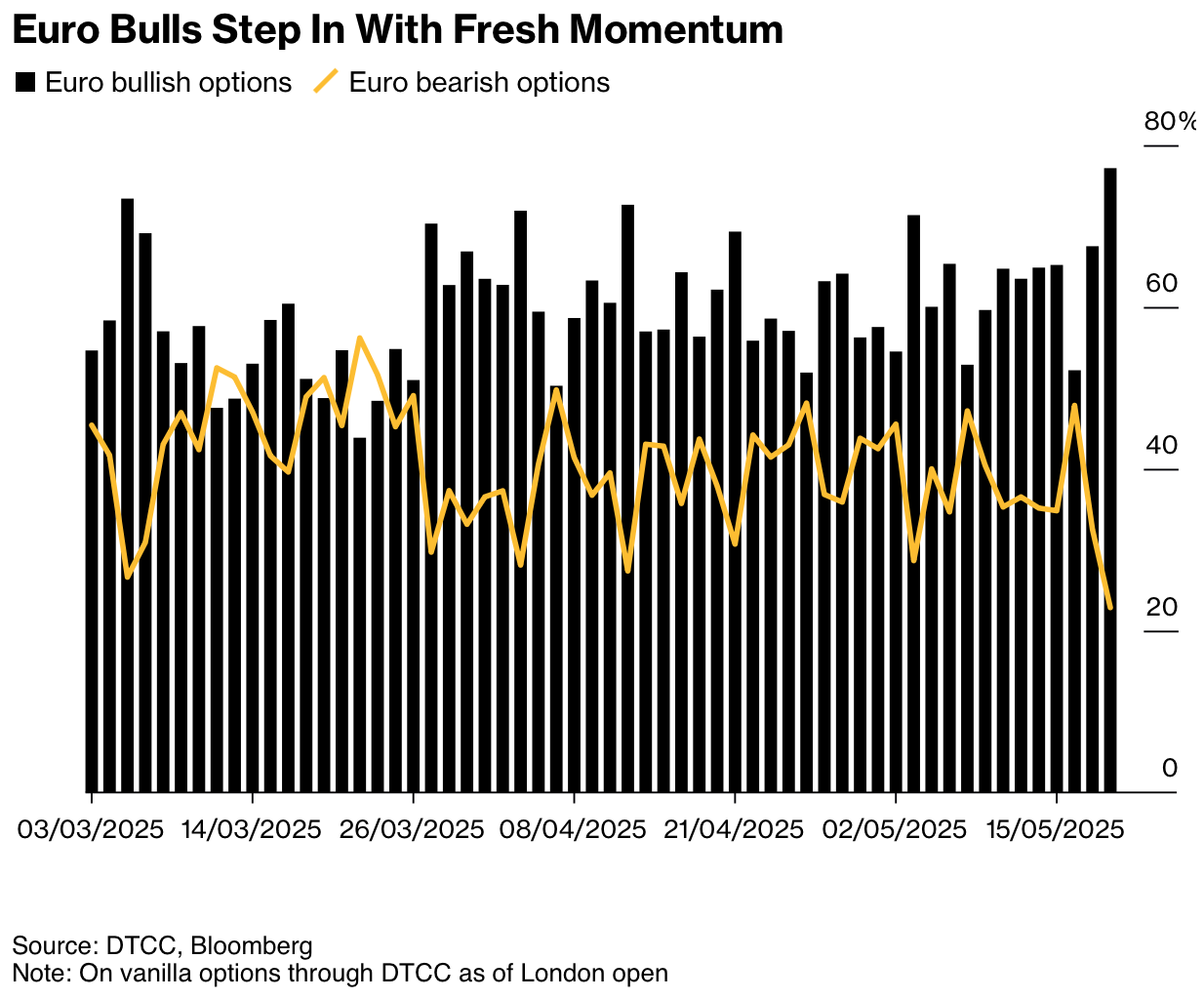
DTCC: Following Moody’s Downgrade, Bets On The Euro Strengthening Relative To The Dollar Reached Their Highest Point This Year. According to Bloomberg, “Traders are growing more confident that the euro’s rally has further to run, with upbeat signals emerging just as Group-of-Seven finance ministers and central bank governors meet in Canada. Many hedge funds are eyeing gains past $1.20, according to traders familiar with the transactions, who asked not to be identified because they aren’t authorized to speak publicly. Data from the Depository Trust & Clearing Corporation show that bullish euro bets through options outpaced bearish ones early Tuesday by the widest margin this year, extending Monday’s momentum. The common currency rose to a 10-day high Monday near $1.13, buoyed by a softer dollar following last week’s downgrade of US debt by Moody’s Ratings. Comments by European Central Bank President Christine Lagarde that a stronger euro was an “opportunity,” not a threat, also boosted the currency.” [Bloomberg, 2025-05-20]
Danske Bank Noted Broad Dollar Selling. According to Bloomberg, “Danske Bank A/S analysts cited broad dollar selling and Lagarde’s rhetoric as support for the euro’s latest strength, framing it as a market response to erratic US policy signals. They reiterated their 12-month euro forecast of $1.20, even as they made a modestly more hawkish shift in their Federal Reserve view.” [Bloomberg, 2025-05-20]
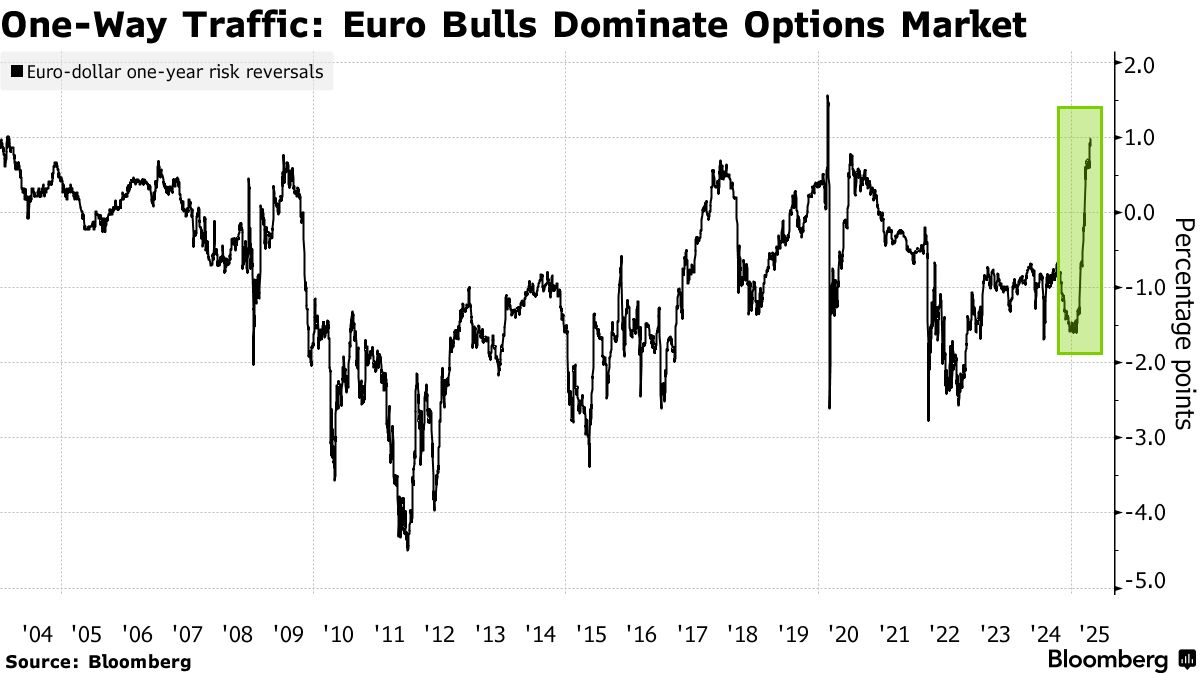
Excluding The Pandemic, The Implied Volatility Difference Between Buillish And Bearish Bets On The Euro (Bearish And Bullish Bets On The Dollar) Reached A Two-Decade High. According to Bloomberg, “In another sign that conviction for further euro gains is building, so-called risk reversals — which measure the difference in implied volatility between bullish and bearish plays — have rallied in recent days. The move is most pronounced in the one-year tenor, where sentiment is now the most bullish in two decades, excluding the pandemic-era.” [Bloomberg, 2025-05-20]
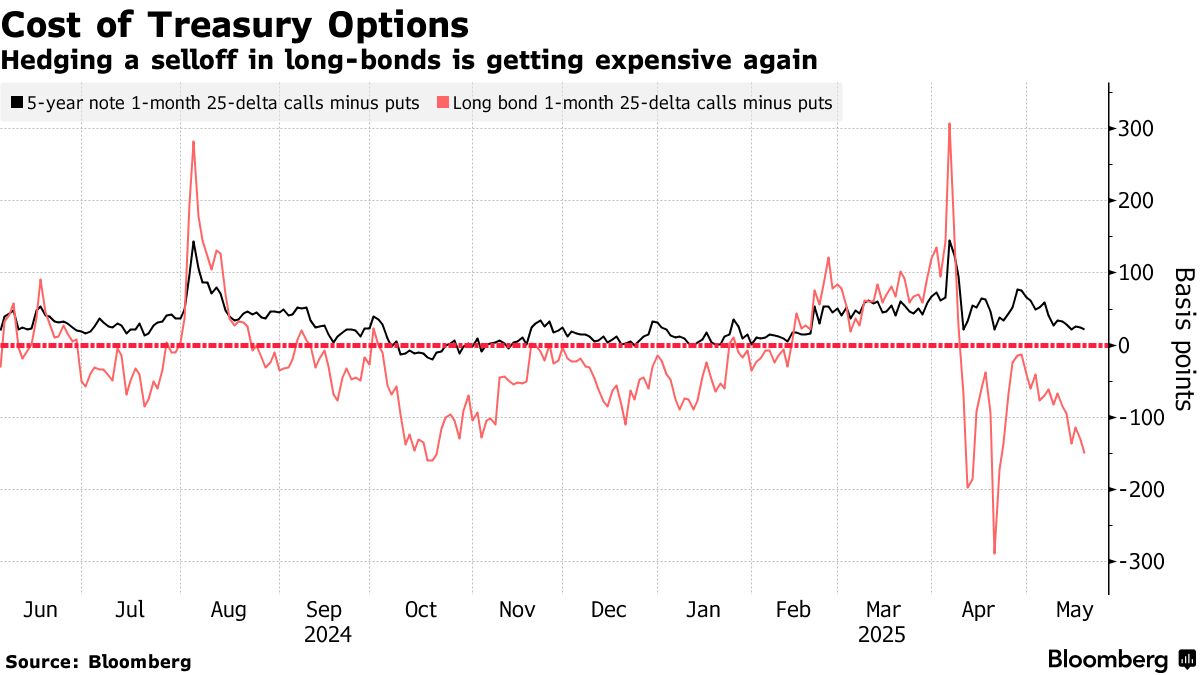
CME Data: Options Bets On Treasuries Signal Market Expectations Of A Treasury Selloff. According to Bloomberg, “Traders are piling into bets that long-term Treasury yields will surge on concerns over the US government’s swelling debt and deficits, a situation made more precarious by President Donald Trump’s tax-cut bill. The murky economic outlook is fueling hedging activity in Treasury options, with investors targeting higher rates on longer-dated bonds by the end of the year. The latest spurt of downside wagers echoes sentiment on Wall Street where strategists from Goldman Sachs Group Inc. to JPMorgan Chase & Co. are lifting their forecasts for yields. Plays favoring the 10-year yield testing 5% are among some of the bigger positions. Monday’s CME open interest data confirmed a large wager on 10-year yields rising toward 5% in the coming weeks, indicating new risk for a heavy premium of $11 million. Over the past week, a trend of options flows hedging a move higher in yields has emerged, reflected in the so-called options skew, which shows rising premiums to reflect a bond market selloff.” [Bloomberg, 2025-05-20]
Bloomberg: The Cost Of Hedging Against A Treasury Selloff Has Reached Its Highest Level Since The Spike After Trump Announced His Tariffs. According to Bloomberg, “Premiums to protect against bigger losses on the long-end of the Treasury curve are now at their highest level since April, when markets were shaken by the potential economic fallout from Trump’s aggressive trade policies. The current move in options skew means that traders are driving up the price of puts that hedge against the risk of a yield spike, relative to call options that would profit from the opposite.” [Bloomberg, 2025-05-20]
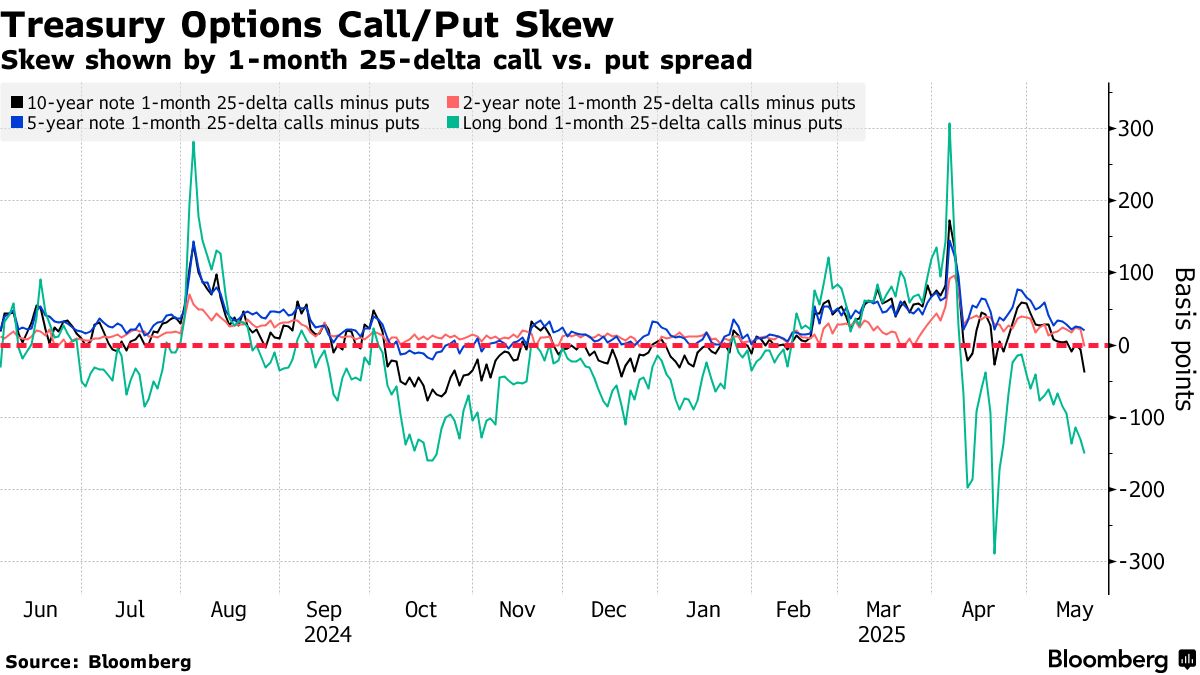
Context: Bond Option Pricing And Its Implications
The above plot shows changes in relative option prices, but I need to define a few terms before I can explain what it means. An option with 25-delta is an option that, based on prevailing market information, has a 25 percent change of having a non-zero value at when it expires. All of the options plotted are quoted at a constant maturity of one month, meaning they are options that will expire in one month. The skew plotted on the y axis is the difference in price between calls (options that pay off if the underlying asset goes up) and puts (options that pay off if the underlying asset goes down).
When it is negative, that means that the cost of insuring against a 25 percent downside move is more expensive than insuring against a 25 percent upside move. What it tells you is that with “Long Bonds” (30 years), since Trump’s liberation day Tariff announcement, it has gotten much more expensive to insure against a downside move than an upside move. With shorter maturities, that has also happened, but to a much less extreme degree.
That is indicative of a steepening yield curve, which could be a sign of higher longer-term inflation expectations.
Inflationary Pressure
FOMC Members Have Expressed Concerns About Rising Inflation Expectations. According to Bloomberg, “Williams, like many of his colleagues, said the Fed can take its time in assessing new data. While he acknowledged inflation has been coming down and the economy is close to full employment, he’s monitoring delinquencies and the appetite for consumer spending. He also described the Fed’s current policy setting as ‘slightly restrictive’ and in a good place. Bostic expressed particular concern over inflation and the public’s expectations for future price increases. ‘Given the trajectory of our two mandates, our two charges, I worry a lot about the inflation side, and mainly because we”re seeing expectations move in a troublesome way,’ Bostic said.” [Bloomberg, 2025-05-19]
2020 - 2024: Roughly 5.5 Million Immigrants Jointed The Workforce in Key Industries, Boosting Economic Growth And Holding Back Inflation. According to Bloomberg, “The services sector largely took advantage of the immigrant workforce. The share of foreign-born workers in transportation grew to 9.2% in 2024, from 8.6% a year earlier. Immigrants were also more likely to work in construction, health-care support and education compared to the prior year. Economists and Federal Reserve policymakers generally agree that the some 5.5 million immigrants who joined the workforce since 2020 have helped ease a labor shortage and limited wage growth in recent years. ‘Without immigration right now, the US labor force would be shrinking rapidly,’ Michael Clemens, a senior fellow at the Peterson Institute for International Economics, said in a webinar Tuesday. ‘Immigration is at the heart of economic growth in the US.’” [Bloomberg, 2025-05-20]
The Trump Administration’s Drastic Enforcement Actions Could Cut Off This Source Of Growth, Boosting Price Pressure At The Same Time. According to Bloomberg, “Looking ahead, forecasters anticipate immigration to play less of a role in labor force growth as illegal border crossings have essentially come to a halt and the Trump administration moves forward with efforts to deport undocumented immigrants and strip out the legal status of some 800,000 workers.” [Bloomberg, 2025-05-20]
NYT Headline: Hawaii’s Prized Kona Coffee Fields Have Become A Target For ICE. [the New York Times, 2025-05-14]
Hawaii Has Been The Only State To Develop A Significant Commercial Coffee Industry. According to the New York Times, “Hawaii is the only U.S. state with significant commercial coffee production, led by the Big Island, where coffee cultivation began in the 1820s. In 1873, Henry Nicholas Greenwell, an English immigrant who settled on the island and whose descendants still grow coffee, took Kona to the World’s Fair in Vienna and won an award there for excellence.” [the New York Times, 2025-05-14]
Meanwhile, there is no tariff exclusion for coffee
Code
# Get Coffee Datacoffee =get_data(f, "CUSR0000SEFP01"; observation_start="2020-04-01", observation_end="2025-04-02", units="pch").data# Make the Plotbar(coffee.date, coffee.value; title="April 2025: Coffee Prices Rose By The Most Since '22", xlabel="Date", ylabel="CPI Coffee % Change, MoM", legend=false)hline!([coffee.value[end]], linestyle=:dash)
┌ Warning: Metadata 'notes' not returned from server.
└ @ FredData ~/.julia/packages/FredData/5M7x4/src/get_data.jl:77
Inability To See Second Order Inflation
May 2025: Trump CEA Chair Miran Discounted The Possibility Of Trump’s Policies Driving Inflation. According to Bloomberg, “The White House’s chief economist dismissed the idea that tariff increases will have a lasting impact on US inflation, and cited the potential for interest rates to get back down to pre-Covid levels. ‘Imports are only 14% of the economy — the ability of those types of things to move the needle on inflation are limited,’ Stephen Miran, chair of the Council of Economic Advisers, said in an interview on Bloomberg Television’s Surveillance. ‘We have been introducing tariffs since day-one of this administration. And what we have seen is tariffs have started to come up’ yet there’s ‘been no real meaningful effect on inflation.’” [Bloomberg, 2025-05-20]
May 2025: Miran Cited House Republicans’ Tax Plan As A Disinflationary Force. According to Bloomberg, “‘In the short run, can there be volatility in prices and economic activity, just as there were in financial markets? Yeah, it can happen,’ he said. ‘But over time, we have the leverage — and that”ll allow us to force the burden of the tariffs onto other countries.’ As inflation pressures dating from the Biden administration’s ‘reckless’ spending diminish, that will ‘provide scope for interest rates to come down,’ Miran said. ‘We”re going to bring interest rates down through expanding the supply side of the economy,’ through policies including deregulation and Republican’s tax package, Miran said. ‘We get interest rates back to where they were pre-Covid, that’s another point off the deficit,’ he said, referring to the budget deficit to GDP ratio — which has run in excess of 6% in recent years.” [Bloomberg, 2025-05-20]
Republican Tax Plan
CBO: While The Lowest Decile Of American Households Would See Persistent Drops In Income, The Highest Declie Would See Persistent Increases. According to the Congressional Budget Office, [the Congressional Budget Office, 2025-05-20]
House Republicans Included Capital Controls As A Partial Way To Pay For Their Tax Cuts For The Rich. According to Bloomberg, “A Republican proposal to tax remittances would deliver an economic blow to some of the US’s poorest neighbors, including a close ally of President Donald Trump. The bill, presented to the US House of Representatives last week, would levy a 5% tax on remittances for non-citizens and foreign nationals. That’s on top of a roughly 5% to 10% fee already charged on the payments by senders like Western Union Co. and MoneyGram International Inc., services migrants in the US use to send money to family members back home.” [Bloomberg, 2025-05-20]
Remittances From American Workers Have Been A Key Driver Of Consumption Growth In Mexico And Central America. According to Bloomberg, “Migrants from El Salvador, Guatemala and Honduras sent home record amounts of remittances last year, helping drive economic growth across Central America. Remittance flows have surged since Trump’s took office in January as migrants increase the amount of money they send home in anticipation of being deported. The funds are used largely for consumption by poorer families who often have few other sources of income. Mexico and Central America are the world’s most dependent areas for remittances sent from the US. ‘The effect isn’t just macroeconomic, it’s at a microeconomic level too, affecting families,’ Guatemala Central Bank chief Alvaro Gonzalez Ricci said in a written response to questions. ‘The importance of remittances to the Guatemalan economy is growing, not just as a proportion of GDP, but also because the flows of millions of dollars boosts family consumption.’” [Bloomberg, 2025-05-20]
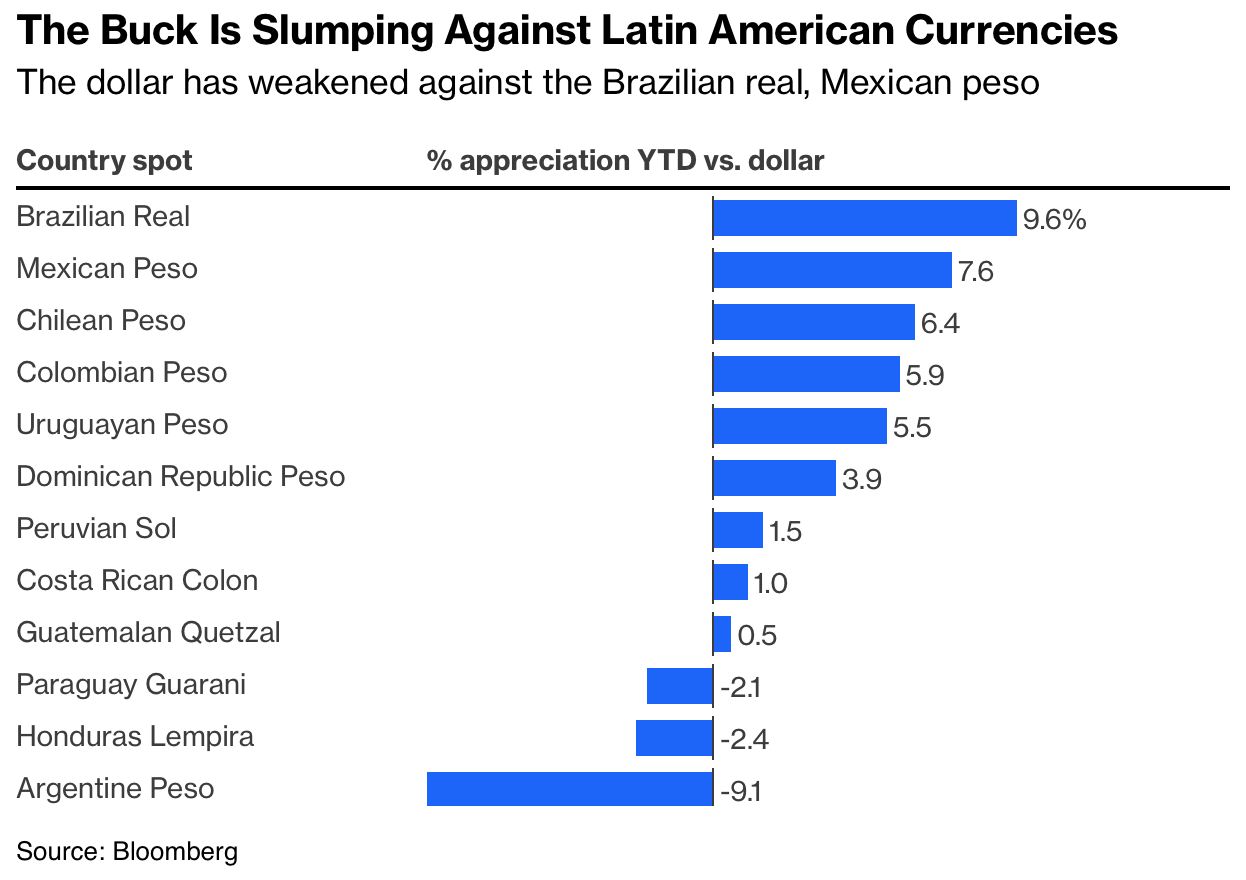
A Weaker Dollar Further Danishes The Value Of Remittances. [Bloomberg, 2025-05-20]
Corruption
Trump’s Nominee To Run The IRS Was Paid To Promote Tax Credits The IRS Denied Exist. According to the Wall Street Journal, “Senate Democrats pressed President Trump’s pick to run the Internal Revenue Service on his promotion of tribal tax credits and recent acceptance of campaign donations from people tied to those claims. Sen. Ron Wyden (D., Ore.) detailed how Billy Long was paid more than $65,000 to refer friends to a firm that sold purported tax credits that the IRS has told Democratic lawmakers don’t exist. Then, according to official filings, people connected to those credits donated to Long’s dormant political campaign after Trump picked him to lead the IRS. Those donations effectively went directly to Long, because he used money from them and others to retire a $130,000 debt that the campaign owed to him.” [the Wall Street Journal, 2025-05-20]
In Addition To Being Paid $65,000 By Its Promoters, They Contributed $130,000 To His Dormant Campaign Committed, Which Long Used To Pay Back A Loan He Had Given To His Committee. According to the Wall Street Journal, “Senate Democrats pressed President Trump’s pick to run the Internal Revenue Service on his promotion of tribal tax credits and recent acceptance of campaign donations from people tied to those claims. Sen. Ron Wyden (D., Ore.) detailed how Billy Long was paid more than $65,000 to refer friends to a firm that sold purported tax credits that the IRS has told Democratic lawmakers don’t exist. Then, according to official filings, people connected to those credits donated to Long’s dormant political campaign after Trump picked him to lead the IRS. Those donations effectively went directly to Long, because he used money from them and others to retire a $130,000 debt that the campaign owed to him.” [the Wall Street Journal, 2025-05-20]
Trump Coin Corruption
Financial Times: 16 Of The 25 Crypto Accounts That Won Their Dinner With Trump Had Sold All Of Their Trump Coins, Making As Much As Several Million Dollars In The Process. According to the Financial Times, “Traders who won a ticket to a banquet with Donald Trump by entering a contest to buy large amounts of the president’s memecoin may have netted multimillion-dollar profits, a Financial Times analysis has revealed. The competition, announced on April 23, offered dinner to people who held the largest quantities of the $TRUMP memecoin over a specified window in a publicly visible crypto wallet. The contest helped push the price of the token from $9.26 to $15.33 when it was announced. Many traders started moving tokens out of their wallets as the window closed on May 12 and their place at the dinner at the Trump National Golf Club in Virginia was confirmed — despite the contest website’s exhortation to ‘Hold Big. Hold Strong. Hold $TRUMP’. The FT has identified that 16 of the 25 winning ‘VIP’ accounts, which have been awarded seats at ‘an unforgettable Gala DINNER with the President’ plus an ‘exclusive Reception . . . with YOUR FAVORITE PRESIDENT’ and a VIP tour, now have no Trump coins left in their public wallets. The event is due to be held on May 22. Trump has made crypto a major part of his second presidency, with his administration aiming to loosen digital asset rules and foster growth in the industry. His family is also involved in a broad range of crypto ventures. Trump’s tokens have no other purpose beyond being a vehicle for speculation. The owners of the accounts are not known, although each has given their wallet a short nickname on the coin website. Of the 25 VIPs, 22 only started accumulating $TRUMP after the contest was announced. Of these, five sold at a time that means they may have made profits from taking part in the contest. FT estimates suggest these gains may range from about$52,000 for an account known as ‘NACH’ to $2.6mn potentially made by ‘Woo’.” [the Financial Times, 2025-05-17]
Of The 195 Other Wallets With The Right To Go To The Dinner With Trump, 56 Sold After The Contest Closed. According to the Financial Times, “In addition to the 25 VIP winners, a further 195 people have won the right to attend the “gala dinner”. FT analysis shows that 56 of these contest winners have emptied the wallets they submitted as part of their entry.” [the Financial Times, 2025-05-17]
Dinner Participants Assciated With Morten Christensen Shorted Trumpcoin On Different Exchanges To Get Access To The Dinner Without Committing Actual Capital. According to Bloomberg, “Other Trump memecoin holders who said they’re coming to the dinner include Vincent Liu, chief investment officer of crypto investment firm Kronos Research, Sangrok Oh, founder and CEO of digital asset manager Hyperithm, which is based in Tokyo and Seoul, and Morten Christensen, who runs an airdrop tracking site and is in Mexico. Christensen says he and four of his crypto-loving friends spent about $1,200 each to secure a spot at the dinner. They all purchased Trump memecoins while also shorting it on exchanges, and then dumped their holdings after the contest to win a seat at the dinner ended, he said.” [Bloomberg, 2025-05-20]
Justin Sun Was One Of The 25 Trumpcoin Buyers Who Would Recieve A Tour Of The White House. According to Bloomberg, “Crypto entrepreneur Justin Sun announced that he’s joining a high-profile dinner with the US President Donald Trump later this week. Sun, the China-born founder of the Tron blockchain, said on the social media platform X that he is the top holder of TRUMP coin, a memecoin launched by Trump-linked entities, and will be attending the dinner at Trump National Golf Club in Potomac Falls, Virginia, on Thursday. Sun did not immediately respond to a request for comment. ‘Honored to support @POTUS and grateful for the invitation from @GetTrumpMemes to attend President Trump’s Gala Dinner as his TOP fan!’ Sun wrote on X. As the top holder of $TRUMP, I”m excited to connect with everyone, talk crypto, and discuss the future of our industry.’ The memecoin’s issuer announced in April that the top 220 holders of the memecoin are invited to a dinner with the president on May 22 where Trump will talk about the future of crypto. The top 25 holders will be eligible for a tour of the White House.” [Bloomberg, 2025-05-20]
Before Trump Took Office, The SEC Was Suing Sun For Unregistered Securities Sales. According to Bloomberg, “Sun was sued by the US Securities and Exchange Commission in 2023, alleging at the time that he worked with companies he owns and controls – the Tron Foundation, BitTorrent Foundation Ltd., and Rainberry Inc. — to engineer the offer and sale of unregistered securities. After former SEC chair Gary Gensler left the agency, the SEC and lawyers of Sun are seeking to pause the case.” [Bloomberg, 2025-05-20]
Code
# Call the necessary packages usingYFinance, TimeZones# Set up the timezone et_tz = tz"America/New_York"# Get the data for the price and volume of trump cointrump_coin =get_prices("TRUMP-OFFICIAL-USD"; startdt=Date(2025,4,22), enddt=Date(2025,5,21), interval="15m") |> DataFrameannouncement=ZonedDateTime(DateTime(2025,4,23,12), et_tz)# Create the line plotplot(trump_coin.timestamp, trump_coin.close; title="\$TRUMP surge during dinner invite window", xlabel="Date", ylabel="Price (USD)", linewidth=2, label="Price", legend=:topright, )# Add a vertical line for the announcementvline!([DateTime(announcement)], label="Announcement", linestyle=:dash)vline!([DateTime(ZonedDateTime(DateTime(2025,5,12),et_tz))], label="Close", linestyle=:dash)right_axis =twinx()bar!(right_axis, trump_coin.timestamp, trump_coin.vol ./1_000_000.0; label="Volume", alpha=0.35, color=colorant"#525252", ylabel="Volume (millions)", legend=:right)
Private Markets
2019 - Present: Bank Lending To Private Equity And Private Credit Firms Doubled From $600 Billion To $1.2 Trillion. According to the Financial Times, “US bank lending to buyout firms and private credit groups has helped fuel a steep rise in loans to non-bank financial institutions, even as regulators fret that growing ties between the two sectors could become a systemic risk. Loans to non-banks reached approximately $1.2tn by the end of March, according to a report by Fitch Ratings, a 20 per cent increase year on year driven by lending to the private capital industry. Commercial loans were up just 1.5 per cent during the same period. The increase comes as regulators home in on the interconnectedness of banks to private equity and the fast-growing private credit sector, an opaque area of the market that has relatively little regulatory oversight. Regulators have asked banks to disclose more information about their relationships with so-called NBFIs to get a better overview of their exposure to the sector. S&P Global data shows that bank loans to NBFIs have risen since the start of the pandemic, from approximately $600bn at the end of 2019 to over $1tn at the start of this year, as businesses have increasingly turned to private credit for funding.” [the Financial Times, 2025-05-19]
Fitch: The Second Order Effects Of This Lending Could Be Difficult To Assess, Even As The IMF Noted A Surge In Private Credit Lending To Negative Free Cash Flow Companies. According to the Financial Times, “Borrowers that source funding from private credit funds and direct lenders are typically riskier and more levered. As some of these loans are made with money borrowed from banks, there are concerns that bad credit could bleed through to the broader financial system. The Fitch report states that for now a downturn in the private credit sector is ‘unlikely to have widescale financial stability implications for the largest banks’. However, it cautions that it is difficult to fully assess the risks and that ‘second order effects are more difficult to quantify’. The IMF warned in its Global Financial Stability Report last month that increased lending to NBFIs by banks ‘could make the financial system more vulnerable to high levels of leverage and interconnectedness’. It also highlighted that more than 40 per cent of borrowers from private lenders had negative free cash flow at the end of last year, up from 25 per cent three years prior.” [the Financial Times, 2025-05-19]
As Private Equity Distributions Have Dropped, Ivy League Endowments Have Started To Sell Their Stakes. According to the Financial Times, “US college endowments are seeking to sell stakes in ageing private equity funds to free up cash for new investments, at a time when the university sector is under pressure from federal funding cuts. At least four US universities — including Harvard and Yale — have either recently completed or are actively exploring discounted secondary market sales of private equity stakes held by their endowment funds to boost their ability to meet capital calls, according to public disclosures and interviews conducted by the Financial Times. Harvard is a regular user of secondary markets and in recent years has used the market to offload stakes in older funds as discounts narrowed. But pressure on endowment funds to raise cash from older investments has increased as private equity distributions have declined.” [the Financial Times, 2025-05-17]
2014 - 2024: Private Equity Distributions Fell By Almost Two Thirds. According to the Financial Times, “Distributions from buyout funds as a percentage of net asset value have fallen from an average of 29 per cent in the period from 2014 to 2017 to only 11 per cent last year, according to Bain & Company’s latest global private equity report.” [the Financial Times, 2025-05-17]
Private Credit
Jamie Dimon: “Credit Today Is A Bad Risk.” According to Bloomberg, “JPMorgan Chase & Co. Chief Executive Officer Jamie Dimon warned against complacency in the face of a slew of risks, citing everything from inflation and credit spreads to geopolitics. Dimon said the chances of elevated inflation and stagflation are greater than people think, cautioned that America’s asset prices remain high and said that credit spreads aren’t accounting for the impacts of a potential downturn. ‘Credit today is a bad risk,’ he said at the firm’s investor day on Monday. ‘The people who haven’t been through a major downturn are missing the point about what can happen in credit.’” [Bloomberg, 2025-05-19]
Qatar Investment Authority: Private Credit Has Become “A Very Crowded Market.” According to Bloomberg, “As one of the hottest asset classes right now, private credit has drawn major interest from the Middle Eastern sovereign wealth funds, including Mubadala Investment Co. and Abu Dhabi Investment Authority. Their counterpart in Qatar, however, appears to be taking a more cautious view. ‘It’s becoming a very crowded market,’ said Mohammed Al Sowaidi, head of the $524 billion Qatar Investment Authority. One of the major pitfalls when investing in private credit is that it may look like a credit piece but in reality it’s more of an equity story, Al Sowaidi said. ‘So we”re very careful,’ he said, adding that the QIA’s strategy in private credit is ‘to focus on fewer managers and to go with scale.’” [Bloomberg, 2025-05-20]
Sixth Street Co-CIO On Private Credit, “Spreads Aren’t Moving As Much As They Should.” According to Bloomberg, “Sixth Street Partners Co-Chief Investment Officer Josh Easterly warned shifting fundamentals within credit markets present a risk that many investors and money managers are overlooking. ‘Private credit markets are relatively complacent,’ Easterly said in a Bloomberg Television interview Tuesday, attributing the problem to a mismatch between capital pouring into the sector and valuable opportunities to deploy it. ‘Spreads aren’t moving as much as they should,’ he said. Investors flooding into private debt and credit overall are underestimating the impact of both interest rate and credit spread risk, according to Easterly, who is also co-president of Sixth Street and chief executive officer of the firm’s direct lending platform, Sixth Street Specialty Lending Inc.” [Bloomberg, 2025-05-20]
Oil Market
ConocoPhillips CEO Warned That Without Higher Oil Prices, American Oil Production Could Not Profitably Increase Production. According to Reuters, “U.S. shale oil output will flatten out if prices remain where they are now and will start to decline with prices in the $50s per barrel, the CEO of ConocoPhillips said on Tuesday in the latest prediction that oil’s slump could curb U.S. supply. The comments from Conoco CEO Ryan Lance come as forecasters including OPEC and the International Energy Agency have trimmed their expectations for shale output after prices sank to the lowest since 2021 this year at near $55 for U.S. crude. ‘The breakeven probably hasn’t moved a lot,’ Lance said at the Qatar Economic Forum in Doha. ‘I think long-term, if you’re going to see oil prices in a comfortable range - maybe in the 70s, or 65-75, we’ll still see continued modest growth out of the U.S.’. ‘But we see plateauing production, probably the end of this decade, coming out of the U.S., unless there’s going to be another technological breakthrough in our business. And don’t bet against our industry.’” [Reuters, 2025-05-20]
 [Bloomberg,
  [Bloomberg,
  [Bloomberg,
  [Bloomberg,
  [Bloomberg,
  The above plot shows changes in relative option prices, but I need to define a few terms before I can explain what it means. An option with 25-delta is an option that, based on prevailing market information, has a 25 percent change of having a non-zero value at when it expires. All of the options plotted are quoted at a constant maturity of one month, meaning they are options that will expire in one month. The skew plotted on the y axis is the difference in price between calls (options that pay off if the underlying asset goes up) and puts (options that pay off if the underlying asset goes down).
 [the Congressional Budget Office,
  [Bloomberg,