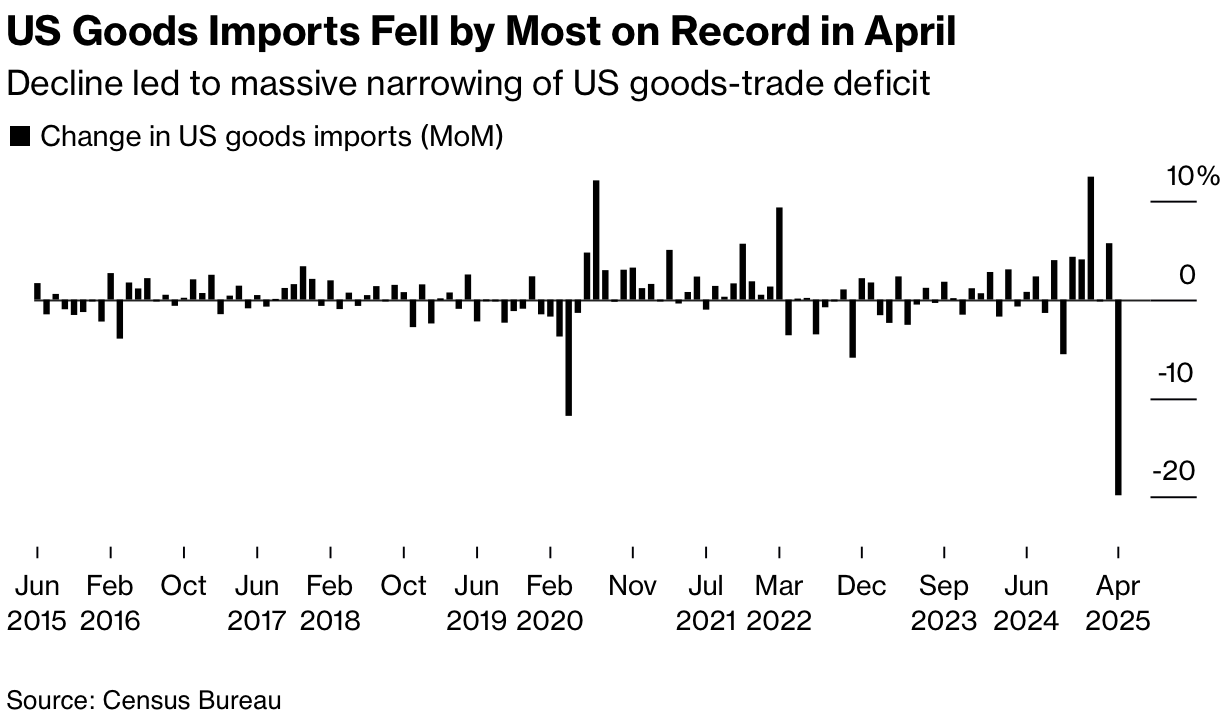
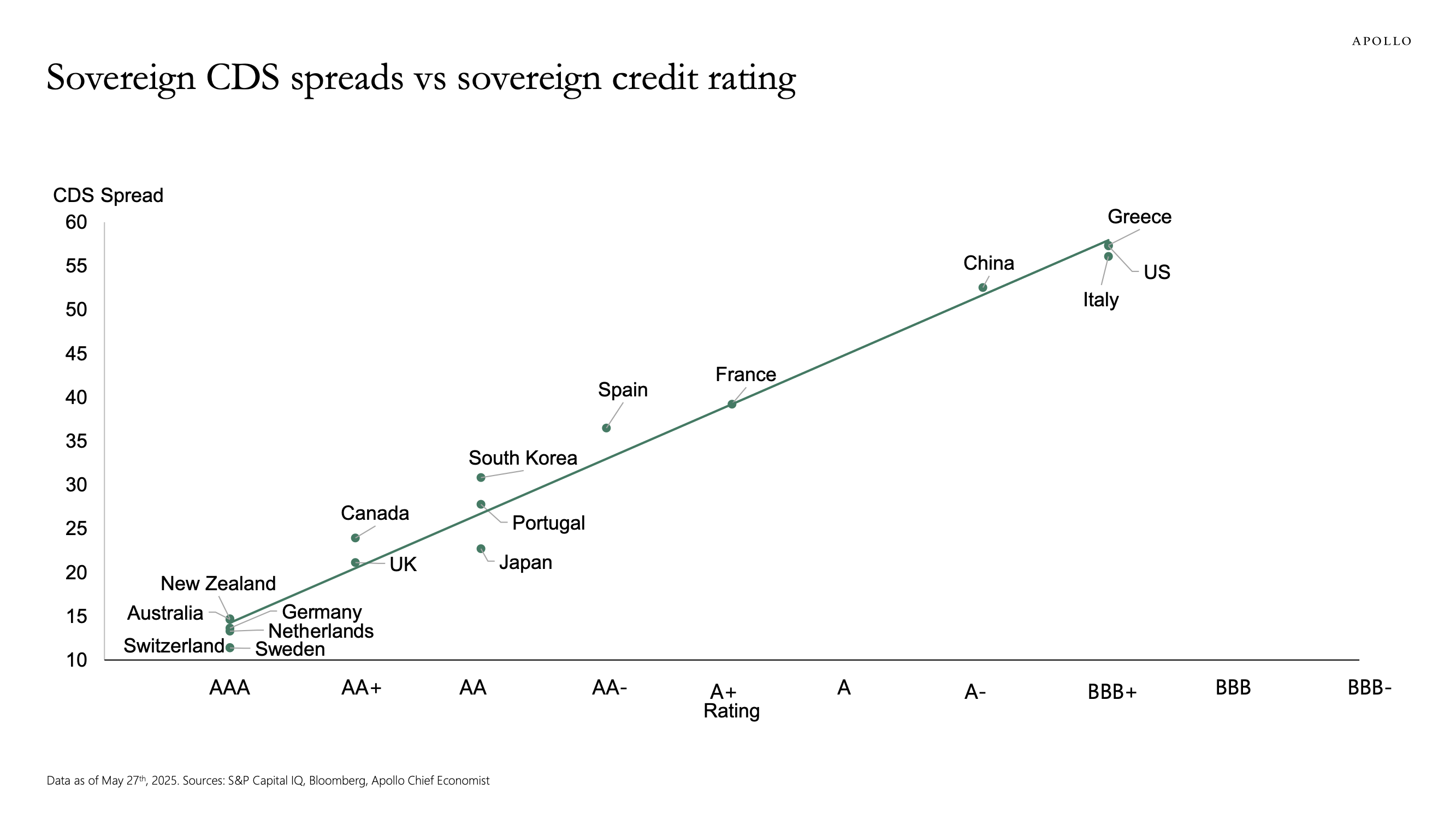
There was not a lot of hard news helpful in prosecuting the case that the administration is mismanaging the economy, but if we do find ourselves in a prolonged decline, some indicators that would look obvious in retrospect (but which could be noise currency) emerged. In particular, the sharp decline in consumption, especially durable goods consumption is a worrying sign. Furthermore, the stories about a collapse in shipping were not exaggerated, as goods imports slumped by the most on record (including during the pandemic). Finally, Torsen Slok at Apollo noted how expensive credit default swaps on American debt have become, trading at similar spreads to perpetual basket cases Italy and Greece.
Low Consumption
Code
# Load up the custom plot hemeinclude("../scripts/oxocarbon-plot.jl")theme(:oxocarbon)# Load the other necessary packagesusingFredData, DataFrames, Dates, StatsPlots# Connect to the API key =ENV["FRED_API_KEY"]f=Fred(key)# Load the datareal_goods_consumption=get_data(f, "DGDSRX1"; observation_start="2024-05-02", observation_end="2025-05-30", units="pch").datareal_durable_goods=get_data(f, "PCEDGC96"; observation_start="2024-05-02", observation_end="2025-05-30", units="pch").datareal_nondurable_goods=get_data(f, "PCENDC96"; observation_start="2024-05-02", observation_end="2025-05-30", units="pch").data# Make the plotbar(real_goods_consumption.date, [real_durable_goods.value real_nondurable_goods.value]; label=["Durable""Nondurable"], xlabel="Date", ylabel="MoM Percent Change", title="April 2025: Real Durable Goods Consumption Fell", alpha=0.7,)plot!(real_goods_consumption.date, real_goods_consumption.value; label="", color=colorant"#673AB7", linestyle=:dash, )scatter!(real_goods_consumption.date, real_goods_consumption.value, label="Total", color=colorant"#673AB7")hline!([0], label="", color=:black, linestyle=:dash, linewidth=2)
NOTE: January is typically a month where you see a decline in goods consumption (as it follows the busy holiday season). That durable goods declined notably in April is telling, as they are more indicative of the overall state of the economy than nondurables, as households generally have more discretion about when to purchase them.
April 2025: “Consumers Hit The Brakes.” According to Bloomberg, “US consumers hit the brakes in April while goods imports plummeted by a record as companies adjusted to higher tariffs.” [Bloomberg, 2025-05-30]
May 2025: Despite Facing Weak Demand For Farm Equipment, John Deere Has Been Forced To Consider Price Hikes To Deal With More Than $500 Million In Tariff-Related Costs. According to the Wall Street Journal, “Deere & Co. is considering a reshuffle of its production among existing factories globally and weighing price increases as it aims to offset more than $500 million in expected costs from the Trump administration’s new tariffs. The Moline, Ill.-based farm equipment manufacturer on May 15 said it incurred about $100 million in tariff expenses in the latest quarter and expects more than $400 million in additional expenses through the end of its fiscal year in October. The company booked $7.1 billion in net income for the year ended last October, down 30% from a year earlier, and roughly $45 billion in net sales, down 19%. At the same time as new tariff costs, Deere and other manufacturers continue to face weak demand for farm equipment from farmers grappling with lower crop prices and higher production costs.” [Wall Street Journal, 2025-05-30]
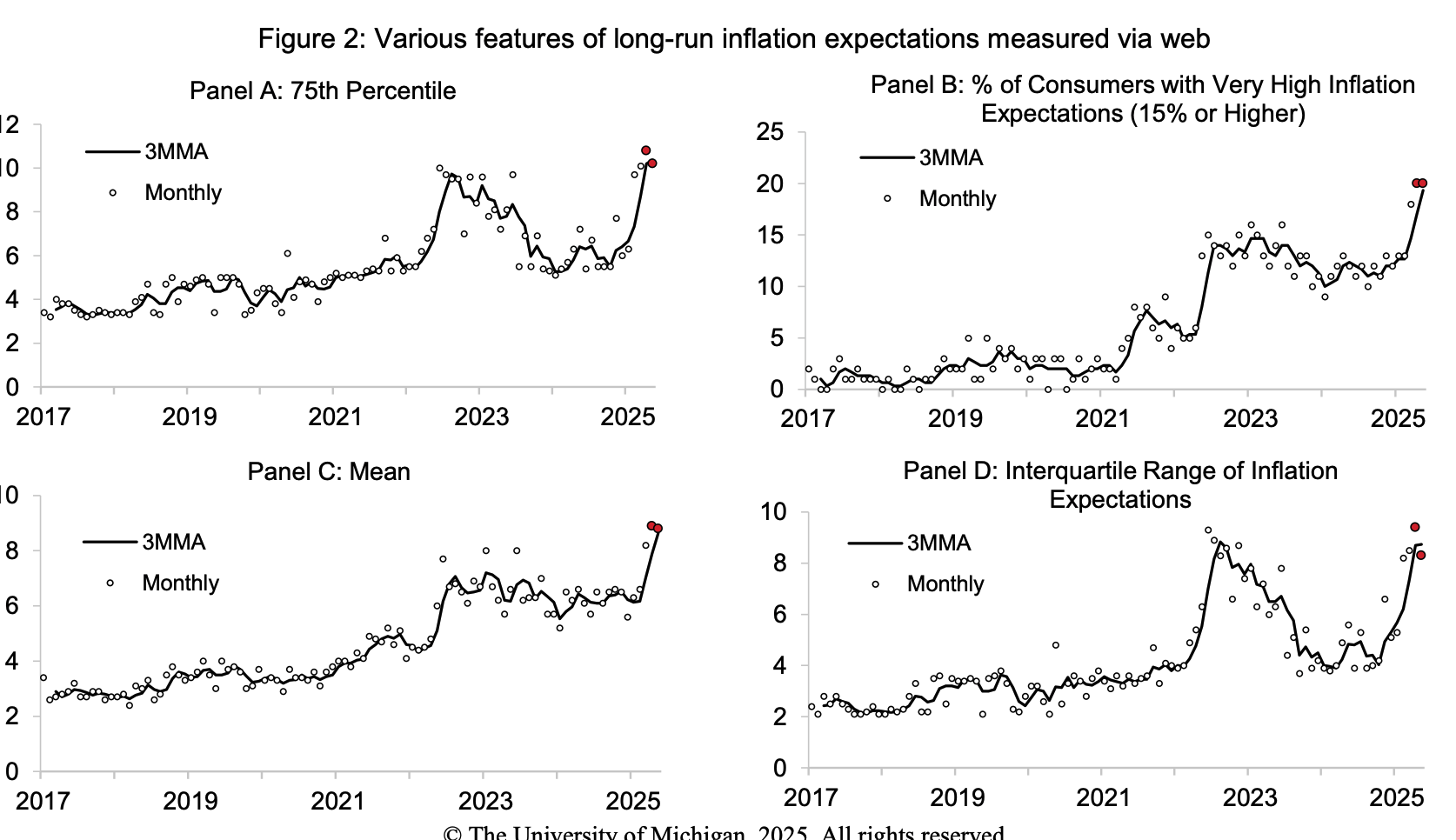
University Of Michigan: Through The Start Of 2025, Consumers Inflation Expectations Have Exhibited Substantial Uncertainty And Variance, In Contrast To The Pre-Pandemic Trend. According to the University of Michigan Survey of Consumers, “This report updates the charts in ‘Current versus Pre-Pandemic Long-Run Inflation Expectations’ (October 25, 2024), which presented results from seven years of parallel data collection via web to fully contextualize current inflation expectations relative to pre-pandemic expectations. The historical data, available in the appendix to the October 2024 report, showed that different features of long-run inflation expectations exhibit very similar characteristics over time. Expectations were stable in the years leading into the pandemic; they worsened through mid-2022 and softened thereafter through October 2024. This update adds seven additional months of data to the charts. After four months of sharp increases to start 2025, long-run expectations receded in May. The past three months” readings have all been above the peak readings from the post-pandemic inflationary episode. Expectations exhibit substantial uncertainty, particularly in light of frequent developments and changes with economic policy.” [University of Michigan Survey of Consumers, 2025-05-30]
[University of Michigan Survey of Consumers, 2025-05-30]
Inventories
Code
# Gather Datasales=get_data(f, "CQRMT"; observation_start="2023-01-01", observation_end="2025-05-30").datainventories=get_data(f, "INVCQRMT"; observation_start="2023-01-01", observation_end="2025-05-30").data# Add in shifted arraysusingShiftedArrays, Statistics# Make a combined dataframedf =DataFrame(; date=sales.date, sales=sales.value, inventories=inventories.value, ratio=inventories.value ./ sales.value, )# create a column that is the change in the ratiodf.change_ratio = [NaN; diff(df.ratio)]# Make the plotbar(df.date, df.change_ratio; legend=false, xlabel="Date", ylabel="Change in Inventory/Sales Ratio", title="Q1 2025: Inventories Grew Faster Than Sales", alpha=0.7)right_axis=twinx()plot!(right_axis, df.date, df.ratio; label="Inventory/Sales Ratio", ylabel="Inventory/Sales Ratio", color=colorant"#525252", linewidth=2, legend=:bottomleft )
During the first quarter of 2025, the retail and manufacturing sectors accumulated more inventory than they increased sales, likely in anticipation of Trump’s tariffs raising prices. Holding inventory isn’t free, and those firms had to use resources to accumulate it, resources which could not be used to more productive ends.
Capital Flight
May 2025: Apollo Noted American Credit Default Swaps Were Priced As If American Debt Was Rated BBB. [Apollo, Apollo]
 [Bloomberg,
  [University of Michigan Survey of Consumers,
  [Apollo,