The impacts of Trump’s policies seem to be starting to make their way into economic statistics. In April, for the first time since before the pandemic, construction spending was lower than it was a year earlier. Even more alarming, every major component of construction spending declined in April from March. As this happened, data for the first quarter showed that corporate profits fell by the most since the pandemic.
The Trump administration, rather than respond with concern, continued to try to break the economy, pulling investments, and refusing to allow areas effected by disasters to rebuild in stronger ways, despite research conducted by the first Trump administration showing that it had a high return on investment.
Congressional Republicans, however, do seem to understand that the administration is rapidly making the country a less appetizing place to invest, pushing to add capital controls so poorly thought out that they are almost certain to accelerate the process.
Meanwhile, AEA research demonstrating the negative employment effect of elevated Trade policy uncertainty came out, although it tested much lower levels of uncertainty than the Trump administration has created.
Releases
Construction Spending
Code
# Include custom plot themeinclude("../scripts/oxocarbon-plot.jl")theme(:oxocarbon)# Load packagesusingFredData, DataFrames, Dates# Connect to the FRED APIkey =ENV["FRED_API_KEY"]f=Fred(key)#=# Get full construction data=#cons_1ya =get_data(f, "TTLCONS"; observation_start="2019-03-01", observation_end="2025-04-01", units="ch1").data# Make the Plotbar(cons_1ya.date, cons_1ya.value ./1_000; xlabel="Date", ylabel="Change, Construction Spending (\$, Billion), YoY", title="April 2025: Construction Spending Dropped", label="",)hline!([0.0], linestyle=:dash, linewidth=2, label="")vspan!([Date(2020,2,1), Date(2020,4,1)], label="Recession", alpha=0.25, color=:grey,)hline!([cons_1ya.value[end] /1_000], label="April 2025", linestyle=:dash,)#=vspan!([Date(2021,1,20), Date(2025,1,20)];=##= label="Democratic Presidency",=##= alpha=0.25,=##=)=#
In Line With Stephen Miran’s Mar-A-Lago Accord Idea, House Republicans Passed Legislation Ripping Up The Country’s Open Capital Account. According to Bloomberg, “Buried deep in the more than 1,000-page tax-and-spending bill that President Donald Trump is muscling through Congress is an obscure tax measure that’s setting off alarms on Wall Street and beyond. The item — introduced in legislation that passed the House last week as Section 899 and titled ‘Enforcement of Remedies Against Unfair Foreign Taxes’ — calls for, among other things, increasing tax rates for individuals and companies from countries whose tax policies the US deems ‘discriminatory.’ This includes raising tax rates on passive income, such as interest and dividends, earned by investors who are potentially sitting on trillions in American assets. Cloaked in technicalities, the implication of the ‘revenge’ measure, as it’s quickly becoming known, is clear to analysts: If signed into law, it would further drive away foreign investors at a time when their once ironclad confidence in Treasury bonds and other US assets has already been shaken by Trump’s erratic trade policies and the nation’s deteriorating fiscal accounts. […] The proposed tax is separate from Trump’s tariff-heavy trade agenda, which is now snarled in court, but the thrust is the same, and its aims align with some of the positions set forth by the economist Stephen Miran in a paper last November and those seeking a so-called Mar-a-Lago global restructuring accord. All seek to address perceived unfair treatment of the US by the rest of the world using targeted tools designed to put the country on a more even footing. But after years of foreign investors piling into US assets, experts fear the consequences of Section 899 may be far-reaching. The provision amounts to ‘weaponization of US capital markets into law’ that ‘challenges the open nature of US capital markets by explicitly using taxation on foreign holdings of US assets as leverage to further US economic goals,’ George Saravelos, head of FX research at Deutsche Bank AG, wrote in a report on Thursday. ‘We see this legislation as creating the scope for the US administration to transform a trade war into a capital war if it so wishes, a development that is highly relevant in the context of today’s court decision constraining President Trump on trade policy.’” [Bloomberg, 2025-05-29]
Section 899 Could Add Another 20 Percentage Points To The Statutory Rate Applied To Foreign Investors’ American Holdings. According to Bloomberg, “The measure would boost the federal income tax rate on passive US income earned by investors and institutions based in the targeted countries, first by five percentage points, then rising by another five points each year to a maximum of 20 points above the statutory rate.” [Bloomberg, 2025-05-29]
While Section 899 Echoed Miran’s Idea Of “User Fees” For Treasuries, Other Legislation Would Be Necessary To Fully Enact It. According to Bloomberg, “Fast forward to this Friday, and some analysts are playing down the whole Section 899 saga. In the case of Treasuries specifically, they point to carve-outs under the existing Portfolio Interest Exemption (PIE), which, under certain circumstances, exempts bonds where the foreign investor owns less than 10% of the voting power of the issuer. That would probably mean trillions of dollars in both US Treasuries and corporate debt held by foreign investors could escape the tax, and may be why the Joint Committee on Tax has estimated that Section 899 will only increase revenue by about $116 billion over a decade. All of which raises the question of why bother with Section 899 in the first place if you”re only going to simultaneously exempt a majority of US bond holdings? As Michael McNair put it yesterday: ‘Congress wouldn’t draft a “retaliatory surtax” that raises only a few billion unless they expected the portfolio interest base to re-enter the tax net.’ Section 899 only really makes sense, he argues, if PIE is simultaneously repealed. So now, investors around the world are once again left to decide for themselves how serious the administration is about all of this, and whether it will reverse course in the event that investors push back. For all the inconsistencies in some of the administration’s policies, you could argue that Trump’s love of tariffs, his hatred of imports, and his ambivalence towards exports, are proving to be some of his most consistent positions. And for all the back and forth on a potential Mar-a-Lago Accord aimed at depreciating the dollar, Section 899 sounds a lot like Stephen Miran’s suggestion in his 2024 paper of imposing ‘user fees’ on Treasuries. (Miran recently downplayed the paper, describing it as ‘a zombie that I just haven’t been able to kill’).” [Bloomberg, 2025-05-30]
Morgan Stanley: Section 899 Style Capital Controls Would Accelerate Capital Flight. According to Bloomberg, “Morgan Stanley’s strategists included the provision in frequently asked questions related to the tax-and-spending bill and concluded that Section 899 would weaken the dollar and European stocks with US exposure. Gilles Moec, the chief economist at AXA Group, said it could add to the pressure on long-term interest rates, which this month touched multi-year highs. Others see it dragging on the US currency.” [Bloomberg, 2025-05-29]
George Saravelos (Deutsche Bank): Section 899 Could Concievably Reduce The Yield Foreign Buyers Recieve For Treasuries By 100 Basis Points. According to Bloomberg, “Yesterday, Wall Street woke up to Section 899 in the ‘One Big Beautiful’ tax bill currently working its way through the Senate. The new tax code would introduce retaliatory taxes on foreign investors from countries who impose ‘unfair’ taxes on US businesses. The definition of unfair is clearly open to interpretation, but awareness of Section 899 was enough to spook markets after George Saravelos at Deutsche Bank (and Odd Lots guest) pointed out that there was something else to worry about aside from the usual trade wranglings. Here’s George in the note that set off alarm bells: ‘What we are most focused on is not this court ruling — which inevitably could delay trade negotiations even more – but something else: Section 899 of the “Big Beautiful Bill” that is currently making its way through the US Senate. There remains a lot of uncertainty on the exact applicability of this new legislation, but overall our interpretation is that if it is voted through, it effectively introduces the most wide-ranging adverse changes to the tax treatment on foreign capital in the US since the Deficit Reduction Act of 1984 and the Foreign Investors Tax Act of 1966. We see this legislation as creating the scope for the US administration to transform a trade war into a capital war if it so wishes, a development that is highly relevant in the context of today’s court decision constraining President Trump on trade policy.’ What does Section 899 imply for foreign buyers of Treasuries specifically? It potentially suspends the foreign government (i.e. central bank) exception put in place by Ronald Reagan, of all people. Put simply, as George does in his note, the result of this change could be that ‘the de facto yield on US Treasuries would drop by nearly 100 basis points.’ Buyers of US government bonds would ostensibly be less incentivized to buy American debt, since they”ll get lower returns, at a time when the US government arguably really needs them to keep doing so.” [Bloomberg, 2025-05-30]
Note: Treasury Demand And User Fees
If the Trump administration is successful in following through on Miran’s “user fee” idea, that will functionally mean that foreign buyers of Treasuries will receive a lower yield than the face value. Generally, it can be assumed that these buyers care more about the yield they receive than the yield that is stated, so in order to supply the same amount of capital to us, they will demand a higher yield to compensate them for it. Higher treasury yields will, however, translate directly into higher prices for Americans, as things like mortgage, auto, and credit card debt are generally all priced according to treasury yields.
Declining Traffic
May 2025: Even As The Number Of People Crossing The Windsor-Detroit Tunnel, The Crossing Took Longer. According to the Financial Times, “Tal Czudner, chief executive of the Windsor-Detroit Tunnel Corporation, said the volume of vehicles travelling through the tunnel had declined little compared with a year earlier, but the number of people had fallen 18 per cent. The discrepancy shows that while commuter traffic is holding steady, fewer families and friends are crossing the border on the weekend for leisure.” [Financial Times, 2025-05-30]
Through May 2025, Trade Between Canada And Detroit Has Dropped Off Notably. According to the Financial Times, “Shipping has been affected, too, with Port Windsor chief executive Steven Salmons noticing a decline in volume at the port, which usually has about 5mn tonnes pass through annually. Three steel shipments were cancelled in mid-March because the deal was made before the tariffs, and the shipper was worried the customer would not accept the higher price, Salmons said. Typically, the steel travels to the Detroit Three car plants in Ohio, Michigan and Indiana. There also had been ‘significantly less’ salt shipped, Salmons said, which goes to US cities such as Chicago to treat roads in winter. Next month, when cities had started buying, Salmons said, they likely would face shortages and higher prices. Meat prices also could rise, as less canola is shipped to Toledo, Ohio, to be used in feed for cattle and chickens. About 20 per cent fewer trucks crossed the Ambassador Bridge in the first four months of the year, even as a few miles away workers are nearing the end of construction on a new bridge, named after hockey legend Gordie Howe, a Canadian who played 25 seasons with the Detroit Red Wings.” [Financial Times, 2025-05-30]
Inflation
National Restaurant Association: Trump’s Tariffs Would Force Restaurants To Raise Prices. According to Bloomberg, “Minimizing the impact of the trade war has become a crucial move as profits come under increasing pressure, with the National Restaurant Association estimating that it’s 30% more expensive to run eateries now than in 2019. Tariffs would leave businesses no choice but to raise prices given already-tight margins of 3% to 5%, the group has said. Meanwhile, uncertainty around the effect of the duties on prices has prompted many diners to be more judicious about eating out.” [Bloomberg, 2025-05-27]
April 2025: Sysco, The Giant Restaurant Supplier, Cut Sales Outlooks As Consumers Dined Out Less. According to Bloomberg, “While little known to diners, Sysco is an industry giant and uniquely situated to influence menus. It supplies food to 400,000 establishments in the US, where it generates more than 70% of its roughly $80 billion in annual revenue. […] Sysco has rebounded from the pandemic when restaurants took a hit, but growth has recently slowed. In April, the Houston-based company reduced its sales outlook as consumers cut back on dining out. Its shares are down roughly 6.5% this year, compared to about a 1% decline for the S&P 500 Index.” [Bloomberg, 2025-05-27]
Empirical Research
May 2025: American Economic Association Paper Found Trade Policy Uncertainty Led To A Reduction In Employment, With Larger Effects On Goods Production. According to Poilly and Tripier for the American Economic Association, “We have shown that higher TPU has adverse effects on employment at the US state level. This primarily goes through a reduction in the number of employees rather than in hours worked per employee. Looking at the heterogeneous effects at the industry level, we find that state-level employment in goods industries is more sensitive to a rise in TPU than in services industries, which is partly driven by employment dynamics in the durable goods industry. States that are more specialized in good-producing industries, when they face higher uncertainty, tend to postpone hiring by more, which explains the drop in employment.” [Poilly and Tripier for the American Economic Association, 2025-05]
Code
# Load the statsplots packageusingStatsPlots, Statistics# Gather the dataepu_cat=get_data(f, "EPUTRADE"; observation_end="2025-04-30").data # Data only goes through April as of 2025-06-02equity_cat=get_data(f, "EMVTRADEPOLEMV"; observation_end="2025-05-30").data # Data only goes through May as of 2025-06-02#=# Make the plots=#epu_hist =histogram(epu_cat.value; xlabel="EPU: Trade", ylabel="Frequency", normalize=true, label="", bins=100, )vline!([epu_cat.value[end]], label="April 2025", linestyle=:dash, linewidth=2, )vline!([median(epu_cat.value)], label="Median", linestyle=:dash, )vline!([quantile(epu_cat.value, 0.75)], label="Shock Tested", linestyle=:dash, linewidth=2, )equity_hist =histogram(equity_cat.value, xlabel="Equity Market Vol: Trade", ylabel="Frequency", normalize=true, label="", bins=100, )vline!([equity_cat.value[end]], label="May 2025", linestyle=:dash, linewidth=2, )vline!([equity_cat.value[(end-1)]], label="April 2025", linestyle=:dash, linewidth=2, )vline!([median(equity_cat.value)], label="Median", linestyle=:dash, )vline!([quantile(equity_cat.value, 0.75)], label="Shock Tested", linestyle=:dash, linewidth=2, )plot(epu_hist, equity_hist, layout=(2,1), size=(800, 600), title="TPU is Mucher Higher Than Tested", )
NOTE: Poilly and Tripier (2025) found their relationship between trade policy uncertainty and employment testing with the response of employment to uncertainty in its 75th percentile. As can be seen in the plot above, April (and May for the dataset that includes it) showed trade policy uncertainty elevated far beyond that level.
Weakening Economy
Q1 2025: Corporate Profits Fell By The Most Since The Pandemic. According to Bloomberg, “US corporate profits fell in the first quarter by the most since 2020, indicating large companies were already feeling some pressure prior to the Trump administration’s sweeping tariffs on global trading partners. The 2.9% decrease in profits followed a 5.4% advance in the fourth quarter, according to Bureau of Economic Analysis data out Thursday. Despite the drop, profits remained well above historical norms relative to gross domestic product, which fell 0.2%.” [Bloomberg, 2025-05-29]
Reduced Investment
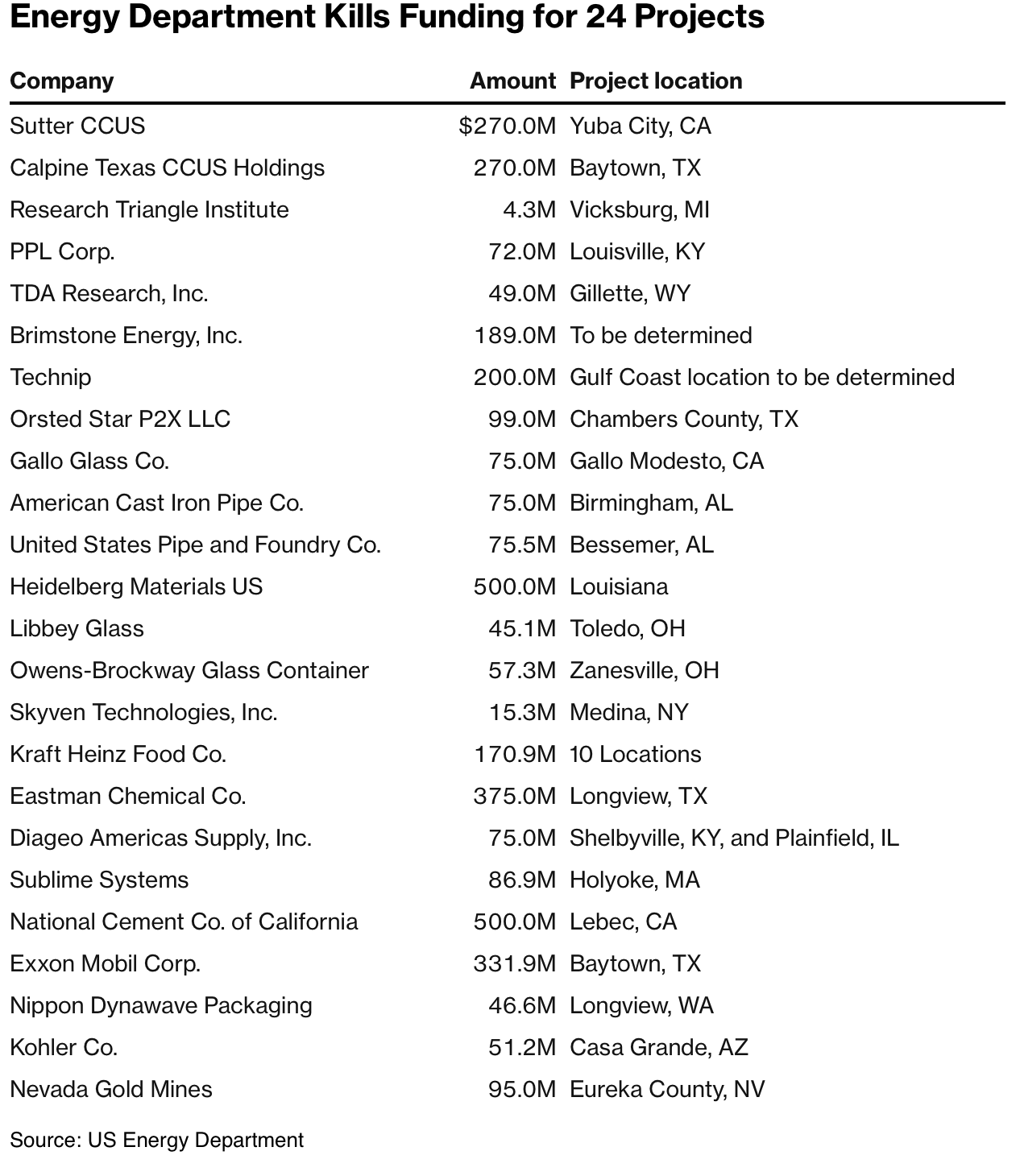
By The End Of May 2025, The Trump Administration Had Canceled Roughly $3.7 Billion In Government Projects. According to Bloomberg, “The Energy Department is canceling some $3.7 billion in government support for clean energy projects it said did not warrant continued backing from the Trump administration. The agency said the move came after it found the projects ‘failed to advance the energy needs of the American people, were not economically viable and would not generate a positive return on investment of taxpayer dollars.’ Sixteen of the 24 projects were awarded during the Biden administration between Election Day and President Donald Trump’s Jan. 20 inauguration, the department said in a statement. Among the canceled awards was $331 million to Exxon Mobil Corp. for a project to use hydrogen instead of natural gas at the company’s Baytown, Texas, Olefins Plant; $170 million to Kraft Heinz Co. for a series of clean energy projects; and $500 million to Heidelberg Materials AG for a low-carbon cement project, according to a list provided by the Energy Department.” [Bloomberg, 2025-05-30]
Trump’s First Administration Authored A Report Demonstrating A Very High Return On Investment From FEMA Hazard Mitigation Funding. According to Bloomberg, “A 2019 report partially funded by FEMA estimates every $1 in federal grant money spent on hazard mitigation saves $6 in disaster damages in the future. The return on investment is higher for federal spending on flood mitigation. For example, by granting $11.5 billion to help states build up river defenses between 1993 and 2016, the federal government avoided $82 billion in losses from the deaths, flooded property and associated business disruptions communities would have suffered without those protections, according to the researchers” calculations. ‘Mitigation, or preparedness, saves lives,’ said Jiqiu Yuan, a co-author of the report and chief resilience officer at the National Institute of Building Sciences. ‘We want to make clear the saving is to the whole society — that’s not only to the government, that’s not only to the building owners, that’s not only to the insurance business.’” [Bloomberg, 2025-05-29]
…But, In His Second Term, Trump Has Denied States Funding To Improve Resilience Against Future Disasters, A “Stark Departure” From Earlier Practice. According to Bloomberg, “When a series of deadly storms and tornadoes pummeled Arkansas in mid-March, downing power lines and tearing up homes, Governor Sarah Huckabee Sanders asked the federal government for money to not only help repair the damage, but also boost the state’s defenses against future disasters. On May 8, President Donald Trump approved the state’s request for funds to help individuals and families recover. But a week later, the Federal Emergency Management Agency told Huckabee Sanders, a Republican who was Trump’s press secretary during his first term, that it was denying the second pot of money — the Hazard Mitigation Grant Program — to help the state rebuild stronger, according to a rejection letter seen by Bloomberg News. Later in the month, the agency denied a hazard mitigation funding request from Virginia, weeks after Trump approved other aid as part of a major disaster declaration for mid-February winter storms. Virginia officials say they”are exploring the appeals process but do not have any further details.” These denials mark a stark departure from how previous administrations have handled such requests. In recent decades, presidents have routinely signed off on those funds as part of the large aid package that comes with major disaster declarations, according to interviews with six state hazard mitigation officials and former FEMA officials and advisors. Unlike the type of help Trump has continued to approve, which states use to cover immediate needs after a wildfire or hurricane, hazard mitigation funds pay for extra protections to help communities better withstand future natural disasters, such as elevating buildings in flood zones or adding safe rooms to homes in tornado-prone areas.” [Bloomberg, 2025-05-29]
The Trump Administration Ended A Grant Program To Fund Disaster Preparedness. According to Bloomberg, “The agency also canceled a Biden-era grant program to fund disaster preparedness outside the recovery of a specific hurricane, tornado or wildfire, saying it was ‘wasteful’ and ‘ineffective.’ Disaster experts argue ending that program, called Building Resilient Infrastructure and Communities, while also pulling back on post-disaster hazard mitigation money is a short-sighted move that could cost the government more money in the long run.” [Bloomberg, 2025-05-29]
Former Chair Of FEMA’s Advisory Council: Trump’s Approach (Relying On State Funding To Build Back Stronger) Would Not Work, As “That Money’s Just Not There.” According to Bloomberg, “In a leaked draft memo from April first reported by CNN and confirmed by Bloomberg News, FEMA, the nation’s top agency for disaster response and recovery, recommended the White House ‘not automatically approve’ applications for hazard mitigation funds as one of several ways to immediately cut federal disaster costs. Per the memo, it’s ‘an action the President has already taken.’ The agency did not respond to questions about hazard mitigation. ‘I think what they”re suggesting is if you want to build back stronger, it needs to come from your state dollars,’ said Carrie Speranza, the former chair emeritus of FEMA’s National Advisory Council before the Trump administration dismissed its members. ‘Then you look at the operating budgets of those states. That money’s just not there.’” [Bloomberg, 2025-05-29]
 [Bloomberg,