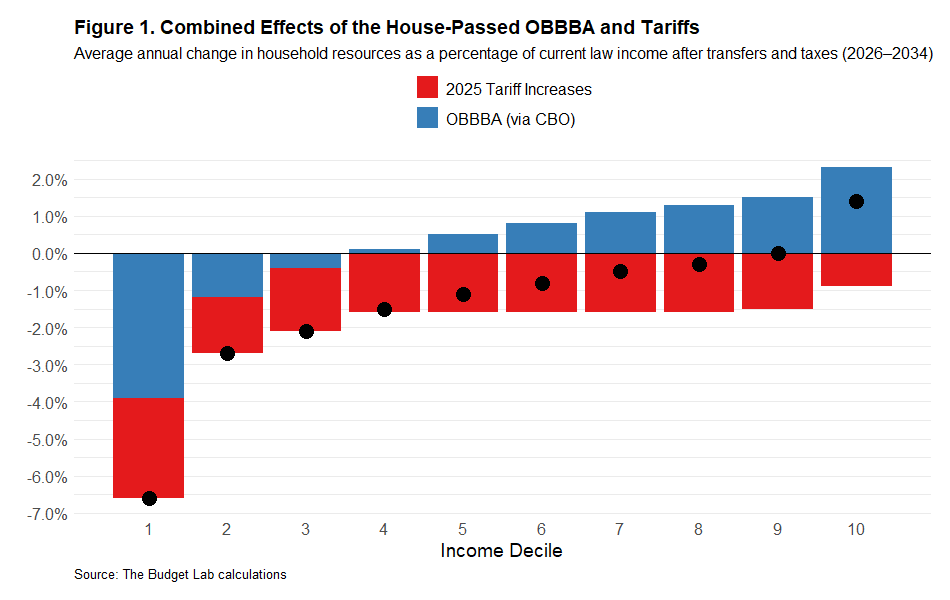
Yale Budget Lab: House Republicans Tax Cuts For The Rich And Trump’s Tariffs Would Dramatically Reduce Income For The Poorest 90 Percent Of Americans. [Yale Budget Lab, 2025-06-12]
Trade War
Higher Prices
May 2025: Some Of The Most Tariff-Exposed Categories Of Goods Saw Notable Price Increase. According to the Washington Post, “There are signs that tariffs are already rekindling inflation in some categories, including toys, which overwhelmingly come from China. Prices for toys, games and playground equipment rose by 2.2 percent in May, the largest one-month increase on record. Several goods that were getting cheaper when Trump took office — including consumer electronics and toys — have all instead risen in price by about 0.5 percent since January, according to Ernie Tedeschi, who served as a top economist in the Biden administration.” [Washington Post, 2025-06-11]
┌ Warning: Metadata 'notes' not returned from server.
└ @ FredData ~/.julia/packages/FredData/5M7x4/src/get_data.jl:77
Code
# Gather the datappi_cons=get_data(f, "PCUOMFGOMFG"; observation_start="2023-10-01", observation_end="2025-05-02", units="pc1").data # Make the plotbar(ppi_cons.date, ppi_cons.value; xlabel="Month", ylabel="% Change in Costs, YoY", title="PPI Inflation, Construction Materials", label="", alpha=0.5,)hline!([ppi_cons.value[end]], label="May 2025", linewidth=2, linestyle=:dash)vline!([Date(2025,4,1)]; linewidth=2, linestyle=:dash, label="Tariffs")
┌ Warning: Metadata 'notes' not returned from server.
└ @ FredData ~/.julia/packages/FredData/5M7x4/src/get_data.jl:77
Financial Deregulation
Anticipating The Trump Administration’s Reversal Of 2015, Guidance, Vanguard Applied To Expand Its Tax-Advantaged Dual Class Fund Structure. According to Bloomberg, “Vanguard Group Inc., the investment giant famous for low-cost index funds, is seeking regulatory approval to expand its signature tax-saving fund structure — as anticipation grows that the Securities and Exchange Commission under Paul Atkins will soon embrace the design en masse. In a Wednesday filing with the regulator, the Jack Bogle-founded firm asked for permission to use its groundbreaking dual-share class design with actively managed strategies. That would allow a mutual fund and an ETF to co-exist as distinct share classes of the same pool of assets, potentially giving mutual-fund holders some of the tax efficiency of ETFs. Vanguard pioneered the model more than two decades ago and has used it exclusively for index products under a special regulatory exemption, saving clients billions of dollars in tax liabilities in the process. The SEC rejected Vanguard’s prior effort to apply the fund blueprint to actively managed strategies in 2015. The latest filing underscores the industry’s budding anticipation that the Trump administration’s SEC will soon allow for wider usage of the design. More than 50 asset managers including BlackRock Inc. and State Street Corp., have put in applications to deploy the hybrid structure, emboldened both by a shift in leadership at the regulator and the fact that Vanguard’s patent on the design expired two years ago. Some lawyers speculate a decision could be reached within the next few months. For Vanguard, the active-fund approval could turbocharge its dominance in the exchange-traded fund market. With roughly $3.2 trillion in ETF assets, it’s currently the second-largest issuer behind BlackRock Inc. but its market share is rising. For the last five years, Vanguard has taken in more money into US ETFs on a net basis than BlackRock, data compiled by Bloomberg Intelligence showed. The Valley Forge, Pennsylvania-based issuer is also furthering its bid into active funds, though most of its products are still passive. Seven of the 15 US ETFs Vanguard has launched over the last five years are actively managed, according to data compiled by Bloomberg. Whether the dual-share model can be widely replicated across the fund management arena remains to be the seen, but the SEC greenlight could inject fresh momentum into actively managed ETFs which are taking a share of flows from passive funds.” [Bloomberg, 2025-06-11]
June 2025: Trump’s SEC Proposed Rolling Back The Reporting Window For Corporate Bonds, Asset-Backed Securities, And Mortgage-Backed Securities. According to Bloomberg, “US financial regulators want to roll back measures introduced during the Biden administration that slashed some fixed-income trade reporting to just one minute, calling for the abandonment of a planned shift away from the 15-minute status quo for disclosing many bond transactions. The Financial Industry Regulatory Authority and the Municipal Securities Rulemaking Board proposed going back to the longer time frame to address industry concerns that were raised after the 1-minute deadline was approved in 2024. The Securities and Exchange Commission, which oversees the two self-regulatory organizations, had approved the rules to speed up trade reporting for corporate bonds, asset-backed securities and some mortgage-backed securities under former Chair Gary Gensler. The rule changes hadn’t gone into effect yet.” [Bloomberg, 2025-06-11]
Big Banks And Bond Dealers Have Opposed The Measure, As Currently Larger And Infrequent Trades Were The Only Ones Effected. According to Bloomberg, “Big banks in particular disliked the measure, which was intended to bring greater bond pricing transparency for investors and reflect technological advances since the 15-minute deadline was introduced. The Bond Dealers of America said in a statement the return to the status quo would allow financial institutions to ‘shorten trade reporting times organically without a regulatory mandate.’ The regulators noted in their proposals that although the vast majority of fixed-income trades were reported in less than one minute, bigger trades above $5 million and dealers who report a small number of trades per year often take longer to report.” [Bloomberg, 2025-06-11]
NOTE: Larger trades and trades made my less frequent dealers have historically been more likely to move markets, which–in my view–would make them more important to report promptly.
Crypto
Despite Banks Warning It Could Lead To A Credit Contraction, The Senate Passed Stablecoin Legislation. According to Bloomberg, “The Senate advanced bipartisan stablecoin legislation supported by the crypto industry and President Donald Trump, with final passage of the measure likely next week. Senate leaders are expected to bat away efforts to attach language pushed by retailers and their allies in the Senate to mandate competition to Visa Inc. and Mastercard Inc. in credit card processing, as well as a Democratic push to ban Trump from profiting off his crypto ventures. The 68-30 procedural vote on Wednesday clears a key procedural obstacle. It came a day after the House Financial Services and Agriculture committees advanced broader crypto legislation, with Republicans beating back amendments targeting Trump’s crypto profits. […] Banks, especially smaller ones, have warned about a potential drain on deposits and consequently access to credit. Larger banks are considering issuing their own stablecoins, which generate profits from interest on the reserves. Democrats led by Senator Elizabeth Warren argue the stablecoin bill doesn’t do enough to protect consumers and the financial system if issuers fail, leaving customers vulnerable to losing their money and potentially fueling demands for federal bailouts.” [Bloomberg, 2025-06-11]
Corruption
June 2025: Alphabet Shareholders Sued The Company, Asking For Documents Related To Its Evaluation Of Its Decision To Keep TikTok Up. According to Bloomberg Law, “Alphabet Inc.’s leaders may have exposed it to significant legal risk by continuing to distribute TikTok through its Google Play app store, according to a lawsuit filed Tuesday. An investor sued the tech giant for documents, saying it was unwise to restore TikTok based solely on President Donald Trump’s executive order pledging not to enforce a ban on the Chinese-owned social media app. Google delisted TikTok in January, after the US Supreme Court upheld the federal law banning it, but restored it in February, about three weeks after Trump issued the order on the first day of his second term. The move appears to put Alphabet at the mercy of a mercurial president, according to the filing in Delaware’s Chancery Court. ‘The first five months of the current administration’s term is already replete with examples of President Trump changing his mind,’ the suit says. Alphabet unit Google LLC didn’t immediately respond to a request for comment Tuesday. The court complaint seeks internal files under a statute giving investors broad access to corporate records to investigate potential corporate wrongdoing. Records cases often reflect an attempt to drum up fiduciary breach claims for future litigation. The shareholder, Zhaocheng Anthony Tan, is represented by Berger McDermott LLP. The case is Tan v. Alphabet Inc., Del. Ch., No. 2025-0649, complaint filed 6/10/25.” [Bloomberg Law, 2025-06-10]
The Trump administration tends to deregulate by suspending laws rather than changing them. President Donald Trump doesn’t like the Foreign Corrupt Practices Act, but instead of asking Congress to revise it, he announced that it wouldn’t be enforced for a while. Now it will be, but a bit less. Does this mean it was legal to do bribes over the last few months? Not really, but maybe a little bit. Similarly Congress passed a law forbidding US companies from hosting TikTok on their servers or in their app stores, but Trump doesn’t like it, so he announced that he would not enforce it for a while. Does this mean it is legal for US companies to host TikTok? No, but also yes. The US Department of Justice has told Apple and Google — which run the big app stores that distribute TikTok — that they can keep distributing TikTok, and one gets the impression that Trump would prefer it if they did. So they do.
Essentially, these companies are violating the law in order to comply with Trump’s executive order, because the entity in charge of enforcing the law is controlled by Trump. This gives Trump an immense amount of power over them, and generally, that leads to bad things. These Alphabet investors, worried about that possibility have asked for internal documents related to the matter.
 [Yale Budget Lab,