June 13, 2025
Immigration
Housing
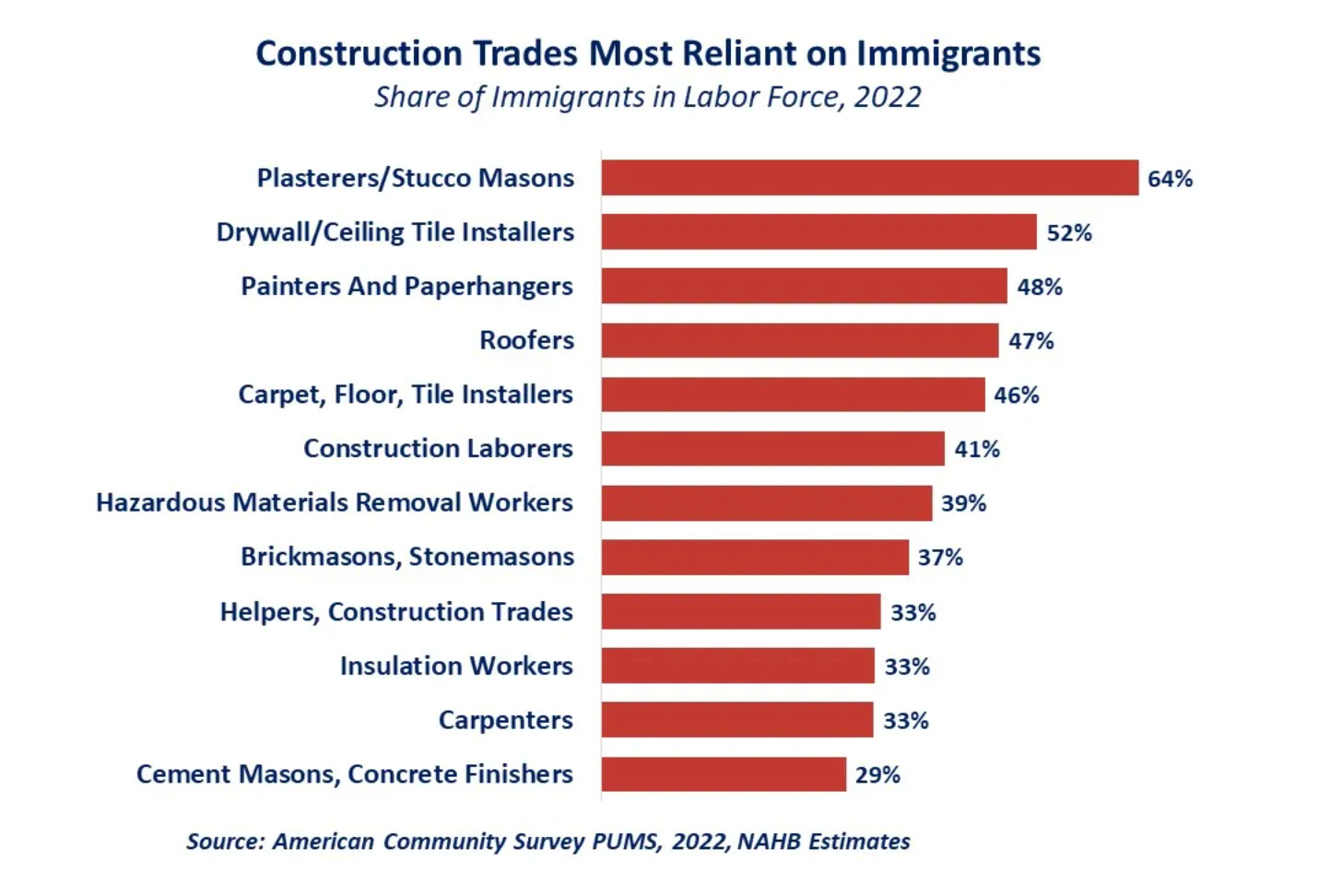
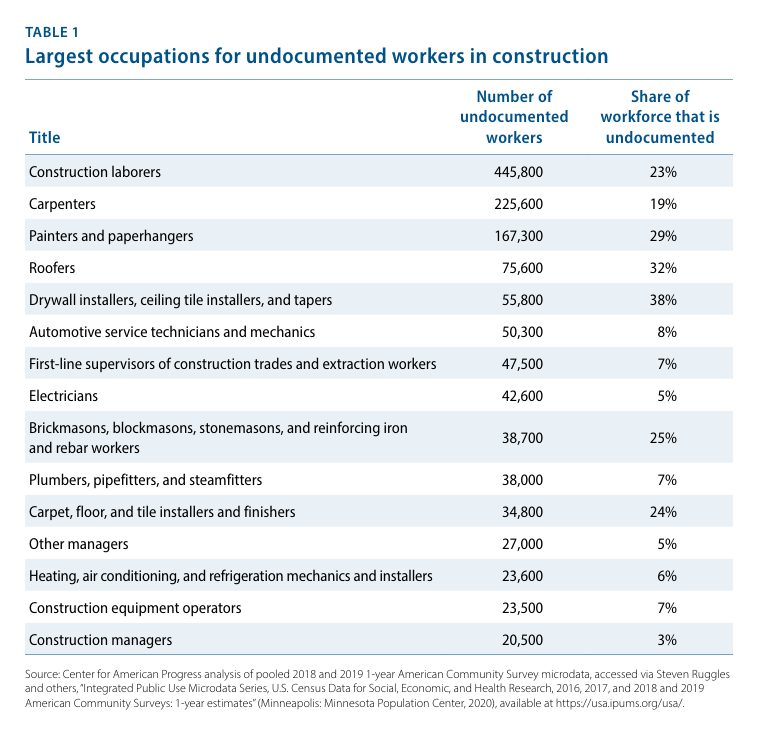
Despite Having Access To Data Showing The Vital Role Of Immigrations In Housing Construction, The Trump Administration Has Targeted Places Where Construction Workers Gather. According to the Rebuild, “The Trump administration talks a lot about criminals and drugs but the truth is they want to deport even the immigrants who are just trying to make a living here. The Wall Street Journal reports that Stephen Miller directed ICE to target Home Depot, where day laborers gather for hire to work on construction projects. These tactics, along with Republicans’ deportation approach, sabotage the homebuilding industry and make housing less affordable. Migrant workers account for approximately 40% of all construction workers and an even higher percentage in certain occupations. And it’s not just documented immigrants. Undocumented immigrants also do a lot of our homebuilding.” [the Rebuild, 2025-06-12]
In Some Crucial Areas Of Construction, Immigrants Make Up A Majority Of Workers.
 [the Rebuild, 2025-06-12]
Historically, Undocumented Immigrants Have Complemented Native-Born Construction Workers, Making Housing More Affordable For All Americans. According to the Rebuild, “Not only that, but researchers have found that deporting undocumented immigrants leads to a substantial reduction in home building. Contrary to popular myth about immigrants taking jobs, those researchers found that these immigrants were complements to rather than substitutes for native-born construction workers. So, deportation of these workers can halt an entire project, reducing employment for native-born workers as well. This is in line with other research showing that deportations kill more jobs for native-born workers than they create. Immigration enforcement that disrupts the construction workforce ultimately means higher home prices.” [the Rebuild, 2025-06-13]
Consumption
Q1 2025: Coca-Cola Sales Fell By 3 Percent, Largely Driven By A Decline In Consumption By Latinos Trump’s Policies Have Tried To Drive Out Of Public Life. According to the Wall Street Journal, “Coca-Cola has long looked to Hispanic consumers for sales growth—a group the company has said holds an annual $2.1 trillion in spending power. Now Coke and other brands are discovering what it means to lose them. Fear and uncertainty are driving changes in shopping behavior. The Trump administration’s sweeping deportations of immigrants living in the country illegally have made many Latinos—including those with legal status—fearful of being stopped by immigration officers. Many consumers say they are retreating from public life, forgoing their regular shopping trips and restaurant meals. Beyond deportation fears, job losses in industries like construction have left Hispanics with less money to spend. And inflation has squeezed their monthly budgets. The issue has grown increasingly tense after Immigration and Customs Enforcement raids sparked protests in Los Angeles, leading President Trump to send in National Guard troops and Marines. Many demonstrators said they had family members who were afraid to leave their homes because they didn’t have legal status in the U.S. Protests have since spread to other cities. Across America—and particularly in Southern states with large Hispanic populations—consumer goods companies, food and beverage makers, restaurants and retailers are taking a hit. Coca-Cola’s sales volume in North America fell 3% in the first quarter of the year, partly because of the pullback by Hispanic shoppers, company executives said.” [the Wall Street Journal, 2025-06-11]
Colgate-Palmolive, Constellation Brands, Wingstop, And El Pollo Loco Have Found The Same Trend. According to the Wall Street Journal, “Colgate-Palmolive, Modelo brewer Constellation Brands and restaurant chains including Wingstop and El Pollo Loco over the past few months have told investors that a decrease in Hispanic spending is hurting their sales.” [the Wall Street Journal, 2025-06-11]
Q1 2025: Walgreens, Home Depot, And Dollar General All Registerd A Drop In Hispanic Consumers Of More Than 5 Percent. According to the Wall Street Journal, “Walgreens experienced a 10.5 percentage point decline in Hispanic shoppers in the first quarter, while Home Depot had an 8.7 percentage point drop and Dollar General a 6.1 percentage point decrease, according to the report.” [the Wall Street Journal, 2025-06-11]
Capital Flight
Paul Tudor Jones: The Combination Of Natural Fed Cuts And Trump’s Desire To Replace Powell With A Hack Could Cause Another 10 Percent Of Dollar Weakening. According to Bloomberg, “Paul Tudor Jones sees the US dollar dropping over the next year as short-term interest rates fall sharply, he said. Jones, who founded the $16 billion macro hedge fund Tudor Investment Corp., said the dollar may be 10% lower a year from now as the yield curve steepens. ‘You know that we are going to cut short-term rates dramatically in the next year,’ Jones said Wednesday in an interview with Bloomberg TV. ‘And you know that the dollar will probably be lower because of it. A lot lower because of it.’ In the same interview, Jones, 70, said President Donald Trump is likely to appoint an ‘uber dovish’ Federal Reserve chair to accommodate his growth agenda when Jerome Powell’s term ends next year.” [Bloomberg, 2025-06-11]
The Market Response To Israel’s Strikes On Iran Underscored How Much The Dollar Has Lost As A Haven Asset. According to Bloomberg, “The dollar’s muted rally against major peers after Israel’s strikes on Iran reinforced the impression that the greenback’s role as a global haven is fading. A Bloomberg gauge of the US currency gained as much as 0.6% at one point on Friday after Israel’s attacks targeting Iranian nuclear facilities stoked fears of a wider Mideast conflict, but the dollar pared much of the advance by midday in New York. It was last up about 0.1%. The modest recovery leaves the greenback just above the three-year low it hit this week after President Donald Trump threatened fresh levies against global trading partners. The dollar slid the past five months as Trump pushed ahead with tariffs, which have raised concern over the US economic outlook and fueled speculation foreigners will shun American assets — the so-called Sell America trade. ‘Dollar sentiment has taken a real hit,’ Sonja Marten, DZ Bank’s head of FX and monetary policy, told Bloomberg Television on Friday. It would take ‘a complete escalation in the Middle East’ to extend the dollar’s gains, she said.” [Bloomberg, 2025-06-13]
Debt Issues
June 2025: Scott Bessent Warned The Country Would Need To Borrow Between 6.5 And 6.7 Percent Of GDP. According to Bloomberg, “Treasury Secretary Scott Bessent earlier Wednesday warned that the US faces another supersized deficit for the current year. Speaking at a House panel, he told lawmakers the gap would be 6.5% to 6.7% of gross domestic product — a third straight year in excess of 6%.” [Bloomberg, 2025-06-11]
BIS: A Mere $3.5 Billion In Outflows From Stablecoins Could Lead To A Tightening In Short-Term Rates Comparable To Almost One Third Of A Fed 25 Basis Point Hike. According to the Financial Times, “Policymakers are also weighing the potential impact if a stablecoin issuer were hit with a sudden wave of redemptions, such as a panic that forces holders to dump liquid stablecoins because they can’t sell other assets. A paper from the BIS last month estimated that $3.5bn of outflows from stablecoins, over five days, could increase the yield on short-term US government debt by up to 0.08 percentage points over 10 days — comparable to a ‘small-scale’ effort by a central bank to stimulate an economy, said authors Rashad Ahmed and Iñaki Aldasoro. A market 10 times larger ‘meaningfully influences’ the transmission of Fed monetary policy, they added.” [the Financial Times, 2025-06-12]
Duration Falling Out Of Favor
BofA Head Of Rates Strategy: Stablecoins Create Additional Demand For Short-Term Treasuries, Exacerbating Yield Curve Steepness. According to the Financial Times, “Issuers are likely to have a strict list of acceptable liquid assets in which they can hold their reserves, including money market funds, repurchase agreements and Treasuries with a maturity of 93 days or less. […] But the requirement is also likely to be disruptive for the $29tn US Treasury market. Mark Cabana, head of US rates strategy at Bank of America, estimates that every dollar that flows from a bank deposit into a stablecoin creates around 90 cents of additional demand for Treasuries. The government would have to issue more short-term debt to meet demand, potentially increasing volatility as the differential between short and long-term rates widened.” [the Financial Times, 2025-06-12]
**Jeffrey Gundlach: The Massive Debt Burden Has Made Long-Duration Treasuries “Not A Legitimate Flight-To-Quality Asset.** According to Bloomberg,”‘untenable,’ a situation that may lead investors to move out of dollar-based assets, according to DoubleLine Capital’s Jeffrey Gundlach. ‘There’s an awareness now that the long-term Treasury bond is not a legitimate flight-to-quality asset,’ the veteran bond manager said Wednesday in an interview at the Bloomberg Global Credit Forum in Los Angeles. A ‘reckoning is coming.’ In a wide-ranging discussion that also touched on gold’s attractiveness, stretched market valuations, the state of private credit, artificial intelligence and long-term investment opportunities in India, Gundlach said investors should consider increasing their non-dollar-based holdings, adding that his firm was starting to introduce foreign currencies into its funds. His comments came a day before a closely watched auction for 30-year Treasury bonds.” [Bloomberg, 2025-06-11]
- Gundlach Has Avoided Longer-Term Treasury Debt, Seeing The Possibility Of Rising Yields Even If The Economy Weakens. According to Bloomberg, “As for Treasury debt, Gundlach said yields on long-term bonds could continue to rise as the economy starts to weaken. If yields reached 6%, that could prompt the Federal Reserve to step in and start quantitative easing, buying long-term Treasuries to rein in borrowing costs. DoubleLine and peers including Pacific Investment Management Co. and TCW Group Inc. have been avoiding the longest-dated US government bonds in favor of shorter maturities that carry less interest-rate risk in the face of spiraling federal debt and deficits.” [Bloomberg, 2025-06-11]
Trade War
While He Has Overstated Such Pledges Before, Trump Announced That He Expected To Have Some Of His More Drastic Tariffs Go Into Effect After His 90 Day Paus Ends On July 9. According to Bloomberg, “President Donald Trump said he intended to send letters to trading partners in the next one to two weeks setting unilateral tariff rates, ahead of a July 9 deadline to reimpose higher duties on dozens of economies. ‘We”re going to be sending letters out in about a week and a half, two weeks, to countries, telling them what the deal is,’ Trump told reporters Wednesday at the John F. Kennedy Center for the Performing Arts in Washington where he was attending a performance. ‘At a certain point, we”re just going to send letters out. And I think you understand that, saying this is the deal, you can take it or leave it,’ he added. It’s unclear if Trump will follow through with his pledge. The president has often set two-week deadlines for actions, only for them to come later or not at all. The president on May 16 said he would be setting tariff rates for US trading partners ‘over the next two to three weeks.’ Trump in April announced higher tariffs on dozens of trading partners only to pause them for 90 days as markets swooned and investors feared the levies would spark a global downturn. Yet despite the ongoing negotiations, the only trade framework the US has reached is with the UK, along with a tariff truce with China.” [Bloomberg, 2025-06-11]
Loosening Access To Key Technology
Due To China’s Stranglehold Of The Rare-Earth Minerals Industry, The Trump Administration Has Been Forced To Offer Concessions Over Key Technology Restrictions To Turn Down The Heat In The Trade War It Started. According to Bloomberg, “Trade talks between the US and China this week cemented a seismic change in Washington’s approach to the countries” economic relationship: US export curbs, meant to keep sensitive technologies out of Beijing’s hands, are now explicitly up for negotiation. At the heart of the policy shift is China’s stranglehold over rare earths and its decision to restrict supply to American manufacturers reliant on the key inputs. That dependency set off a scramble in Washington to try to gain leverage over the world’s second-largest economy — and ultimately led the US to link export controls and trade talks, a longstanding ask by Beijing.” [Bloomberg, 2025-06-11]
Sneak Inflation
In Order To Pass Along Some Of Their Higher Costs Due To Trump’s Trade War, Retailers Have Eliminated Free Shipping, Or Raised The Amount Needed To Spend In Order For It To Take Effect. According to the Wall Street Journal, “Retailers are cutting back on free shipping to offset the steep costs of tariffs. Some online merchants are eliminating free shipping, while others are raising the amount customers must spend to qualify for the perk as part of broader efforts to pass along higher costs to consumers. Modern Picnic, which sells lunchboxes designed to look like handbags, recently raised the threshold for shoppers to qualify for free shipping to $300 from $150. ‘It was a tough decision,’ said Ali Kaminetsky, the company’s founder. ‘We just had to offset these increases somewhere, and shipping seemed to be one of the more logical places.’ The company now charges $15 for shipping on orders under $300. The fee doesn’t cover all of Modern Picnic’s delivery charges, but it helps mitigate the increased expenses from tariffs and rising shipping costs, Kaminetsky said. The tactic is one way retailers are looking to cope with tariffs imposed this year by the Trump administration. The administration has set a baseline 10% duty on most countries and 30% on China, and has threatened to raise levies further in the coming months.” [the Wall Street Journal, 2025-06-10]
- Navar: The Average Minimum-Order Threshold For Free Shipping Rose To $103, A 25 Percent Increase From 2023. According to the Wall Street Journal, “The average minimum-order threshold for retailers to offer free shipping rose to $103 this year from $82 in 2023, according to Narvar.” [the Wall Street Journal, 2025-06-10]
Mounting Costs
Marelli, A Key Supplier To Nissan And Stellantis Filed For Bankruptcy Citing Trump’s Tariffs As The Final Straw. According to the Wall Street Journal, “A key supplier to Nissan and Jeep owner Stellantis filed for bankruptcy protection, marking one of the first big companies to collapse under the weight of the Trump administration’s tariffs. Marelli, which supplies lighting and other internal electronics, has been struggling with losses and a hefty debt load for years. It said it expects to continue operating in a deal with creditors and lenders that will provide more than $1 billion to finance its restructuring. The company has more than 40,000 employees around the globe. It was formed in 2019 when private-equity firm KKR bought a Fiat Chrysler auto-parts business and merged it with a Japanese-based parts supplier it owned. Marelli Chief Executive David Slump said in a court filing Wednesday that the company had already been struggling with long-term supply-chain issues stemming from the Covid-19 pandemic when its liquidity position began to worsen in March due to ‘macroeconomic headwinds associated with the imposition of tariffs in countries around the world.’” [the Wall Street Journal, 2025-06-11]