The policy-induced economic disruptions created by the Trump administration’s volitile and misguided policies have just begun to bleed into the real world. Nonetheless, the effects that have already been measured are notable. Manufacturing activity has plummeted to pandemic-era lows, with capital expenditures collapsing precisely as tariffs took effect. Meanwhile, the administration’s approach to trade policy has triggered a 93% collapse in wine exports to Canada and created a two-tiered economy where large corporations like Generac can weather tariff storms through inventory stockpiling and supply chain diversification, while smaller companies face existential threats.
On the Hill, even as Republicans push policies that would raise prices and reduce investment for Americans, they caved to a special interest to create $1 billion a year in tax exemptions for already existing investment companies based in the Virgin Islands. At the same time, the Trump administration has further undermined the free market by pushing for a “Golden Share” in the Nippon-U.S. Steel merger, analogous to the control the CCP exerts over ByteDance.
Numerous other stories that would be front-page news in another administration also came out, such as an in depth look into how politics drove DOGE’s reckless attacks on Social security, or how even the Trump administration has recognized that some parts of its mass deportation effort would hurt key parts of the American economy emerged, as did comparisons of private credit to CDOs before the GFC.
Judy Shelton
Judy Shelton, who was an author on the insane project 2025 chapter on the Fed has an editorial in the WSJ echoing what other conservatives (like Ted Cruz) have been pushing for: stopping the Fed from paying interest on reserves.
That would heavily constrain the Fed from preforming emergency actions, and generally make monetary policy more volatile.
Interestingly, however, Shelton echoed Trump’s language in attacking the Fed’s current policy, essentially criticizing Powell as having accommodated Biden, but hurting Trump (without evidence). This is dangerous, because Shelton is a lunatic who was blocked from the Fed board by three senators (Alexander, Romeny, and Collins), two of whom are no longer in the Senate, even as the Republican majority is as large as it ever was during Trump’s first term.
Releases
Empire Manufacturing Survey
June 2025: Business Activity Continued To Decline In New York As New Orders, Shipments, And Supply Availability Declined. According to the New York Fed, “Business activity continued to decline in New York State in June, according to firms responding to the Empire State Manufacturing Survey. The headline general business conditions index fell seven points to -16.0. New orders and shipments declined. Delivery times held steady, and supply availability worsened. Inventories were little changed. Employment grew slightly for the first time in several months, while the average workweek held steady. Input price increases slowed but remained substantial, while selling price increases picked up. Firms turned optimistic about the outlook, with the future general business conditions index rising above zero for the first time since March.” [the New York Fed, ]
Code
# Set up custom plot themeinclude("../scripts/oxocarbon-plot.jl")theme(:oxocarbon)# Load Necessary PackagesusingFredData, DataFrames, Dates# Set up the Fred APIkey =ENV["FRED_API_KEY"]f =Fred(key)# Load the Data Seriesexp =get_data(f, "CEFDISA066MSFRBNY"; observation_start="2020-02-01", observation_end="2025-06-02").data# Make the plotbar(exp.date, exp.value; xlabel="Date", ylabel="Future Capital Expenditures (Diffusion Index)", title="June 2025: Worst Since The Pandemic", label="", legend=:topright )hline!([exp.value[end]]; label="June 2025", linewidth=2, linestyle=:dash, )vline!([Date(2020,3,11)]; label="Pandemic Start", linewidth=2, linestyle=:dash, )vline!([Date(2025,4,2)]; label="Tariffs", linewidth=2, linestyle=:dash, )vline!([Date(2025,1,20)]; label="Inaguration", linewidth=2, linestyle=:dash, )
Trump’s BBB
A $1 Billion Carve Out For Tax Avoiders
2020 - 2025: Billionaire Golub Brothers, Who Have Spent $500,000 Lobbying And Given More Than $1.4 Million To Republicans, Attained A $1 Billion A Year Tax Carve Out As Part Of Republicans’ BBB. According to the Washington Post, “The tax bill before Congress would partially exempt the U.S. Virgin Islands from a law meant to crack down on tax havens, after a lobbying campaign by the territory’s government and a large private credit firm that stands to benefit from the measure. Over the past three years, an affiliate of the credit giant Golub Capital paid a Washington firm more than $500,000 to urge Congress to relax a global minimum tax approved as part of the 2017 GOP tax law, lobbying disclosures show. The push was supported by the Virgin Islands’ governor and Democratic member of Congress. House Republicans included a bipartisan provision partially exempting the Virgin Islands from that law in the tax legislation they approved last month — a decision that has puzzled experts on both the left and right, who say it has little clear policy justification. The Virgin Islands carve-out — estimated to cost taxpayers close to $1 billion over the next decade — has attracted scant attention as the Senate takes up the House-passed One Big Beautiful Bill, President Donald Trump’s top legislative priority. The $2.4 trillion bill extends tax cuts for individual households approved in 2017 that are set to expire at the end of this year, preserving lower rates across income brackets. But some provisions would change arcane features with significant consequences for international taxation and the business sector. Billionaire Lawrence Golub and his brother David Golub serve as the chief executive and president of Golub Capital, and have given about $2 million to federal campaigns since 2020, including more than $1.4 million to Republicans and conservative groups, according to data from the Federal Election Commission. The provision also has the support of several Democrats, though the party uniformly voted against the underlying legislation when it passed the House last month.” [the Washington Post, 2025-06-14]
The Carve Out Would Only Apply To Corporations In The U.S.V.I. Acquired By A “Closely Held” U.S. Corporation Before The End Of 2023. According to the Washington Post, “The global minimum tax applies to profits earned by foreign companies controlled by U.S. companies and individuals. This 10.5 percent minimum was aimed at discouraging U.S. companies from shifting their profits to countries with low tax rates, such as Ireland and Bermuda. The tax applied to U.S. territories such as Guam, Puerto Rico and the U.S. Virgin Islands the same way it did to foreign countries. The measure the House passed would not substantially alter the global minimum tax or how it treats U.S. territories broadly. Instead, it creates an exemption for certain income from ‘services’ provided in the Virgin Islands — specifically, for services income by a corporation based in the territory that was acquired by a ‘closely held’ U.S. corporation before Dec. 31, 2023. That means the language does not help firms that create new businesses in the territory. (The legislation would also exempt individuals, estates and trusts from the tax.)” [the Washington Post, 2025-06-14]
Golub Capital Had More Than $75 Billion In Assets, With Offices In The U.S.V.I. According to the Washington Post, “It is unclear precisely who would benefit. But Golub Capital has lobbied on the policy for at least three years. Golub Capital has more than $75 billion on its books, with offices in St. Thomas and St. Croix through its affiliate GC Investment Management.” [the Washington Post, 2025-06-14]
Experts At Right-Wing Thinktanks: Carve Out Seems To Be Rent-Seeking Rather Than Positive Economic Policy. According to the Washington Post, “‘It does not make a lot of sense. I have no idea why this is in the bill,’ said Kyle Pomerleau, an economist at the American Enterprise Institute, a center-right think tank. ‘What problem is it trying to solve? My guess is it’s a U.S. company or two, with foreign competitors, that want a lower tax burden.’ Daniel Bunn, a policy expert at the Tax Foundation, a center-right think tank, agreed. ‘If you wanted to do an economic development policy for the Virgin Islands, you wouldn’t do it this way,’ Bunn said. ‘It seems like a windfall, rather than a fix to a glitch. It should be all territories, or no territories.’” [the Washington Post, 2025-06-14]
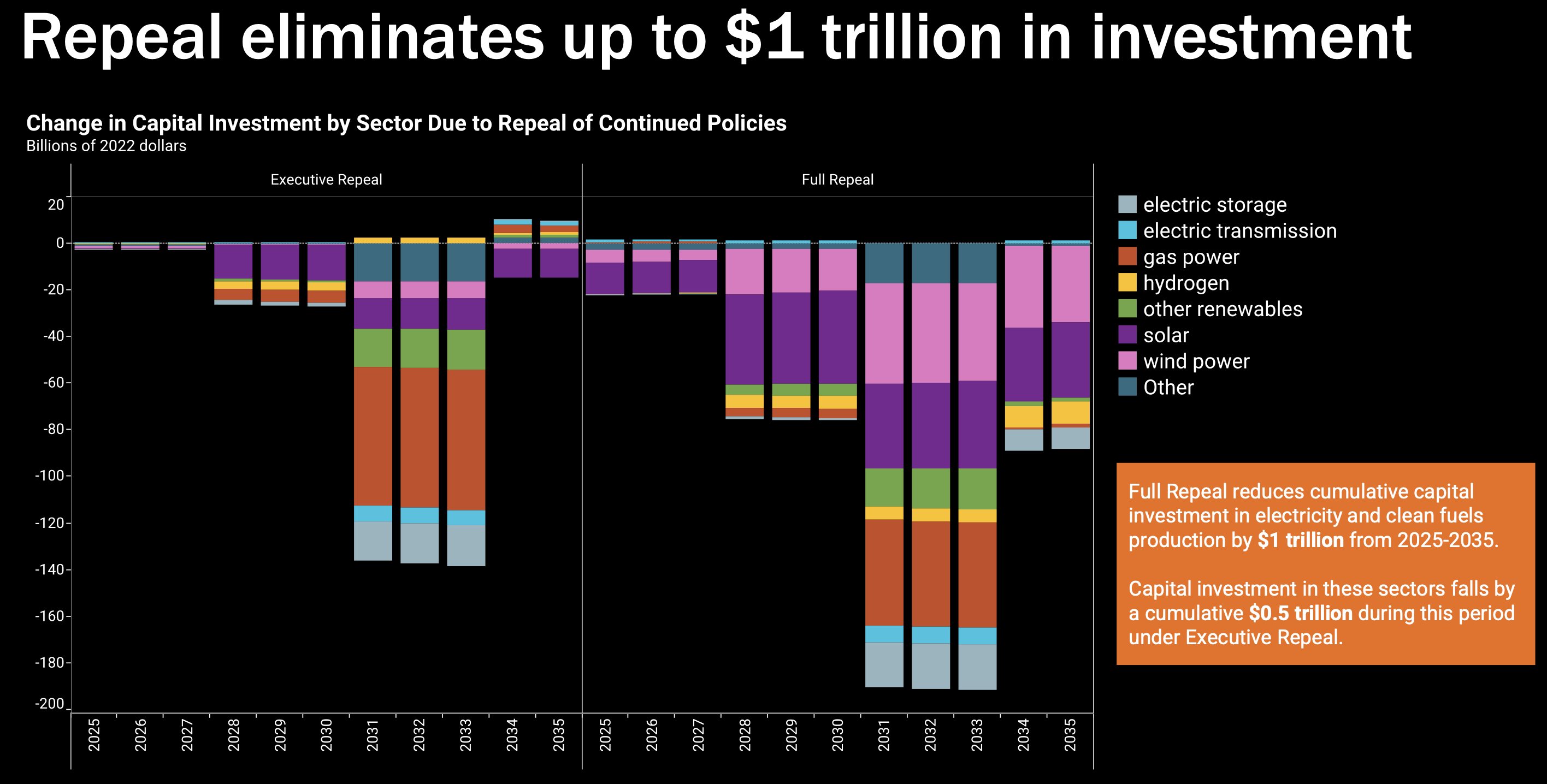
By Repealing Climate Policies From The Last Administration, Prices For American Households Will Go Up And Investment Will Go Down
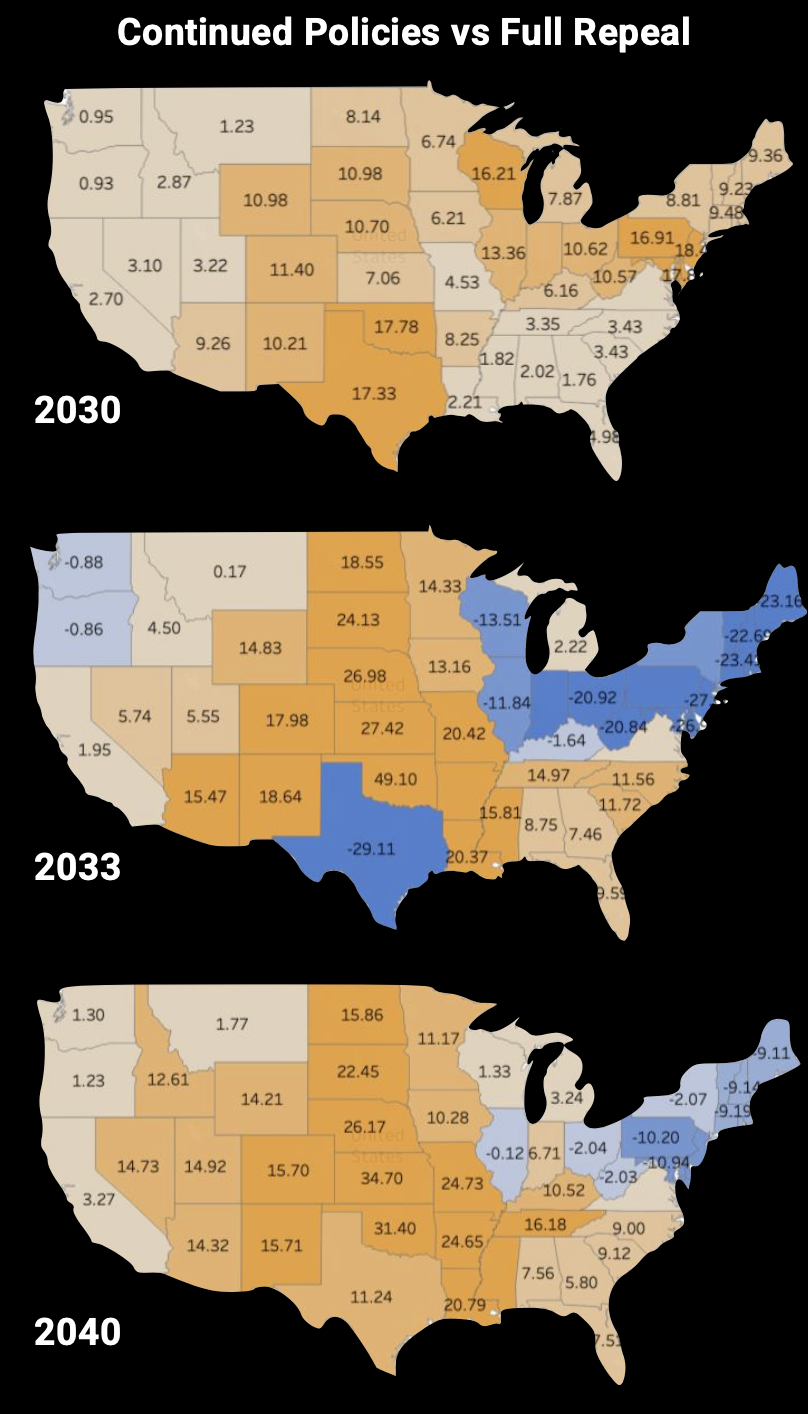
The Continued Policies Scenario Assumed The Full Suite Of Biden Administration Policies Would Continue Unabated. According to Jenkins, Farbes, Jones, Cheng, Luo, and Haley, “A trio of Continued Policies scenarios (‘Conservative’, ‘Mid-range’, and ‘Optimistic’) assume the continuation of the full suite of policies enacted under the Biden Administration, including the combined impact the Inflation Reduction Act of 2022 (IRA) and the Infrastructure Investment and Jobs Act of 2021 (IIJA). This scenario also includes a set of regulatory policies enacted by the Biden Administration, including: Environmental Protection Agency (EPA) greenhouse gas emissions regulations on power plants, light and heavy vehicles, and oil and gas sector methane pollution; Department of Energy (DOE) efficiency standards; and Department of Transportation (DOT) vehicle fuel economy standards. The range of outcomes spanned by the three scenarios reflect uncertainty about the effectiveness of policy provisions and the potential impacts of constraints on siting, interconnection, supply chains and other rate-limiting factors.” [Jenkins, Farbes, Jones, Cheng, Luo, and Haley, 2025-05-23]
The Executive Repeal Scenario Assumed Only Those Policies Mandated By Executive Actions Would Be Repealed. According to Jenkins, Farbes, Jones, Cheng, Luo, and Haley, “An Executive Repeal scenario assesses the impact of executive actions the Trump administration has stated it will take to unwind Biden-era climate and clean energy policies. This includes repeal of all EPA greenhouse gas regulations, DOT vehicle fuel economy standards, and DOE efficiency rules. The scenario also assumes executive agencies freeze distribution of all unspent funding made available by the IRA and IIJA.” [Jenkins, Farbes, Jones, Cheng, Luo, and Haley, 2025-05-23]
The Full Repeal Scenario Assumed That All Executive And Legal Policies Would Be Repealed. According to Jenkins, Farbes, Jones, Cheng, Luo, and Haley, “A Full Repeal scenario includes all of the executive actions included in the Executive Repeal scenario and also assumes full repeal of all tax incentives created by the Inflation Reduction Act at the end of 2025. On May 22, 2025, the U.S. House of Representatives passed the partisan budget bill, H.R. 1, which substantially repeals nearly all of the tax credits enacted by the IRA to support clean electricity, fuels, vehicles and manufacturing. The bill also rescinds all unobligated funding for clean energy and climate programs enacted by the IRA and the IIJA. The potential impact of H.R. 1 is thus substantively similar to this Full Repeal scenario.” [Jenkins, Farbes, Jones, Cheng, Luo, and Haley, 2025-05-23]
Republicans’ Plans To Eliminate Climate Provisions Would Raise Electricity Costs For Almost All Americans. [Jenkins, Farbes, Jones, Cheng, Luo, and Haley, 2025-05-23]
[Jenkins, Farbes, Jones, Cheng, Luo, and Haley, 2025-05-23]
North American Electric Reliability Corporation: Batteries Will Be Necessary For Data Centers
NAERC: Batteries Have Been Helpful In Managing Nuclear-Powerplant-Sized Load Shocks Generated By Data Centers. According to Bloomberg, “The sprawling campuses responsible for AI and cryptocurrency mining are being developed at a faster pace than the power plants and transmission lines needed to support them, ‘resulting in lower system stability,’ said the North American Electric Reliability Corp. in a report Thursday. That’s because data centers require tremendous amounts of power at unpredictable intervals, and are also sensitive to swings in grid voltage — making them a major wild card in a electricity system that’s unprepared for such energy use. About 1.5 gigawatts of data centers tripped offline in Northern Virginia, the world’s data center capital, last July and then another 1.8 gigawatts this past February because of voltage issues, Mark Lauby, NERC’s chief engineer said at a conference last month. Outages of those sizes can have ripple effects across the rest of the grid. ‘A loss of load of this size is comparable to a large nuclear power plant coming on-line immediately and unexpectedly, creating an imbalance due to too much generation on the system,’ NERC said in its annual state of reliability report. There is an urgency to figure out how to integrate data centers smoothly because the US is still in the early innings the AI boom, which has been deemed by Washington as a national security imperative. While the agency said better models are needed to understand how data centers use electricity, it concluded that batteries are proving helpful to keeping the grid stable.” [Bloomberg, 2025-06-12]
Corruption
DOGE At Social Security
After Musk’s Team Misinterpreted Social Security Data, They Pressured The Agency To Hire A 21-Year-Old Former Palantir Intern And Gave Him Access To Every American’s Personal Data, Despite A Court Order Barring It. According to the New York Times, “The Times’s investigation found that Mr. Musk became fixated on the program in early February after members of his team misread government spending data — a pivotal and previously unreported moment that DOGE believed had exposed massive fraud inside the agency. In response, Mr. Musk’s team mobilized dozens of Social Security employees to affirm their views about fraud and began a project to ensure dead people were properly classified so they weren’t mistakenly paid — even though DOGE officials acknowledged in an internal memo that payments were not being made in those cases. DOGE leaders pressured agency executives to hire a 21-year-old former intern at Palantir, a data analysis and technology firm, and grant him access to the personal data of every Social Security cardholder despite the executives’ concerns that he lacked sufficient training to handle such sensitive information. Mr. Musk’s deputies became so intent on their work at Social Security that they pushed employees to continue giving them access to sensitive agency data even after a federal judge demanded that DOGE’s access be cut off, according to two people familiar with the events.” [the New York Times, 2025-06-16]
After A Judge Ruled That DOGE Employees Should Not Have Access To The Data, They Pressured The Acting Leader Of The Agency To Keep Their Access. According to the New York Times, “Mr. Dudek faced another crisis on March 20, when a federal judge issued an order prohibiting Mr. Musk’s team from entering Social Security databases that contained personally identifying information. B this point, Mr. Dudek had granted such access to at least six DOGE members, including Mr. Bobba, court records show. On the night of the ruling, two DOGE leaders told Mr. Dudek that the agency should continue allowing access to the data despite the judge’s order, with one arguing that the order was so ambiguous that it could block all Social Security employees, not just members of DOGE, from gaining access, according to a person familiar with events. Mr. Dudek responded to DOGE’s arguments by going public with a stunning declaration seemingly designed to encourage the judge to more clearly reiterate her ruling. Given the order’s vagueness, he told reporters, he might have to shut down the systems used for the agency’s work ‘I believe that the two checks on the executive branch are the courts and the Constitution,’ he told The Times on March 21, essentially endorsing the idea that the court act as a guardrail for decisions being made at the agency he ostensibly led. The judge quickly sent two letters reiterating that her order applied only to members of DOGE. The agency’s work continued.” [the New York Times, 2025-06-16]
Petty Politicization
February 2025: DOGE Engineers Pushed To Cancel Social Security Contracts To Provide Services Like Giving Newborns SSNs In Maine After Gov. Mills Publicly Disagreed With Trump. According to the New York Times, “Over his first two weeks in charge of Social Security, Mr. Dudek began delivering for DOGE, releasing a plan to shrink the agency’s work force by 12 percent and agreeing to share sensitive Social Security data with immigration authorities. In early March, he took sole responsibility when reports surfaced that Social Security had canceled two contracts with Maine after its governor, the Democrat Janet Mills, publicly tangled with Mr. Trump over the state’s policies on transgender athletes. Mr. Dudek told reporters at the time that he had canceled the contracts because he was angry at Ms. Mills for challenging the president. In an internal email, he called her ‘a petulant child.’ After public criticism, he reversed the cancellations of the contracts, which provided basic services like allowing newborns to receive Social Security numbers at hospitals. But previously undisclosed documents reviewed by The Times show that the cancellation order had actually come from the Musk team. On Feb. 27, a DOGE engineer told Mr. Dudek in an email that the administration had identified roughly three dozen federal contracts in Maine as ‘nonessential,’ including the two from Social Security. ‘We should cancel them,’ wrote the engineer, Ethan Shaotran, 23, who declined to comment when reached by The Times.” [the New York Times, 2025-06-16]
MAGA Maoism
June 2025: As Part Of Agreeing To Let Nippon Steel Take Over U.S. Steel, Trump Required A Concession Of A “Golden Share” For The U.S. Government That Would Give It Control Over Parts Of The Business. According to the New York Times, “To save its takeover of U.S. Steel, Japan’s Nippon Steel agreed to an unusual arrangement, granting the White House a ‘golden share’ that gives the government an extraordinary amount of influence over a U.S. company. New details of the agreement show that the structure would give President Trump and his successors a permanent stake in U.S. Steel, significant sway over its board and veto power over a wide array of company actions, an arrangement that could change the nature of foreign investment in the United States. The terms of the arrangement were hammered out in meetings that went late into the night on Wednesday and Thursday, according to two people familiar with the details. […] Under the terms of the national security pact, which the companies said they signed Friday, the U.S. government would retain a single share of preferred stock, called class G — as in gold. And U.S. Steel’s charter will list nearly a dozen activities the company cannot undertake without the approval of the American president or someone he designates in his stead.” [the New York Times, 2025-06-15]
Among Other Things, The Golden Share Would Give Significant Control Over The Board’s Independent Directors. According to the New York Times, “Under the terms of the deal with the steel companies, the president could exert significant influence over U.S. Steel’s board. The president has the authority to directly appoint one of the board’s three independent directors, and approve or reject appointments for the other two, the two people familiar with the negotiations said.” [the New York Times, 2025-06-15]
Historically, The Concept Of Golden Shares Have Been More Common In More State-Directed Economies, And Held In National Champions. The CCP Holds A Similar Arrangement With ByteDance. According to the New York Times, ““We have a golden share, which I control, or the president controls,” Mr. Trump told reporters on Thursday. “Now I’m a little concerned whoever the president might be, but that gives you total control.” Globally, golden shares have typically been reserved for companies that countries consider national champions: Brazil owns a stake in the plane maker Embraer; China has an indirect stake in TikTok’s parent, ByteDance; and the United Kingdom holds a golden share in the defense company BAE systems.” [the New York Times, 2025-06-15]
By Encroaching On The Market In An Unprecedented Way, This Arrangement Could Risk Changing The Perception Of How Free And Open The American Economy Is. According to the New York Times, “Security experts said the adoption of a golden share in the United States could permanently alter the way that foreign investors view deal making in the country. ‘A bigger issue is the messaging that it sends to the market, which is the U.S. government is intervening increasingly in transactions that don’t seem to have — by traditional standards — significant national security risks,’ said Stephen Heifetz, a partner at the law firm Wilson Sonsini Goodrich & Rosati. ‘It is going to cause people to spend more time thinking about the obstacles to investing in the U.S. market,’ he said.” [the New York Times, 2025-06-15]
Immigration
June 2025: Despite Using E-Verify, Immigration Officials Raided Glenn Valley Foods In Southern Omaha. According to Politico, “mmigration authorities raided an Omaha meat production plant Tuesday morning and took dozens of workers away in buses, leaving company officials bewildered because they said they had followed the law. The raid happened around 9 a.m. at Glenn Valley Foods in south Omaha, an area where nearly a quarter of residents were foreign born according to the 2020 census. A small group of people came out to protest the raid, and some of them even jumped on the front bumper of a vehicle to try to stop officers in one location while others threw rocks at officials” vehicles as a white bus carrying workers pulled away from a plant. Chad Hartmann, president of the food packaging company, said the front office was stunned by the aggressive nature of federal officials” raid and confused by why the company was targeted. ‘My biggest issue is: Why us?’ Hartmann said. ‘We do everything by the book.’ The plant uses E-Verify, the federal database used to check the immigration status of employees. When he said as much to U.S. Immigration and Customs Enforcement officers who carried out the raid, they told him the E-Verify system ‘is broken.’ ‘I mean, what am I supposed to do with that?’ Hartmann said. ‘This is your system, run by the government. And you”re raiding me because your system is broken?’” [Politico, 2025-06-11]
As Trump’s Harsh Immigration Roundups Hurt Hospitality And Agriculture Industries, His Administration Directed ICE To Shift Focus Away From Those Industries. According to the New York Times, “The Trump administration has abruptly shifted the focus of its mass deportation campaign, telling Immigration and Customs Enforcement officials to largely pause raids and arrests in the agricultural industry, hotels and restaurants, according to an internal email and three U.S. officials with knowledge of the guidance. The decision suggested that the scale of President Trump’s mass deportation campaign — an issue that is at the heart of his presidency — is hurting industries and constituencies that he does not want to lose. The new guidance comes after protests in Los Angeles against the Trump administration’s immigration raids, including at farms and businesses. It also came as Mr. Trump made a rare concession this week that his crackdown was hurting American farmers and hospitality businesses. The guidance was sent on Thursday in an email by a senior ICE official, Tatum King, to regional leaders of the ICE department that generally carries out criminal investigations, including work site operations, known as Homeland Security Investigations. ‘Effective today, please hold on all work site enforcement investigations/operations on agriculture (including aquaculture and meat packing plants), restaurants and operating hotels,’ he wrote in the message.” [the New York Times, 2025-06-13]
Trade War
Kiplinger Headline: Trump Tariffs Make 2025 Father’s Day Gifts Pricier. [Kiplinger, 2025-06-14]
Falling Exports
April 2025: American Wine Exports To Canada Fell 93 Percent Year Over Year, Contributing To A 41 Percent Global Decline. According to Bloomberg, “US wine exports to Canada, its largest customer, fell by the most in more than 20 years in April as consumers and government agencies continue their boycott of American booze in retaliation against US tariffs. Wine shipments from the US to the northern nation fell 93%, the largest year-over-year decrease in monthly data from the US Census Bureau going back to 2002. The next two biggest wine markets for US producers — the UK and China — also imported less in April. The collapse contributed to a 41% global decline in US wine exports in the month, following a 28% drop in March.” [Bloomberg, 2025-06-13]
Small Guys Getting Hit Harder
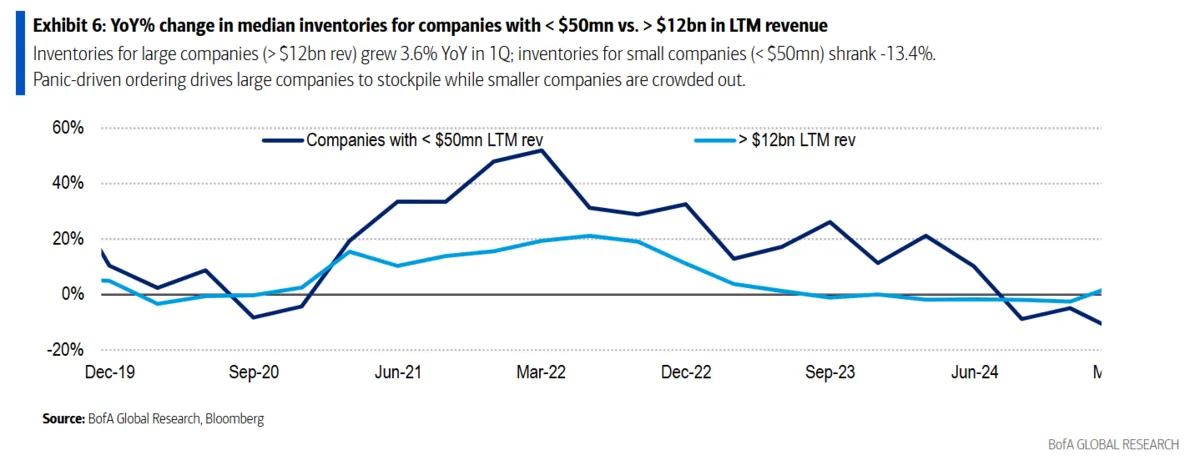
Unlike Larger Companies, Small Companies Have Not Been Able To Build Up Inventories To Smooth Tariff-Induced Shocks. According to Bloomberg, “I”m not entirely sure what the state of tariffs is right now and it’s been kind of hard to keep track of all the deal talks and deadlines, but one consistent theme that’s come up in our discussions with various business owners and business-watchers is the idea of the “small” guys getting hit harder than the “big” guys. And on that note, Bank of America’s Neha Khoda & Co. have some nice charts showing recent differences in corporate inventory builds. Put simply, smaller companies haven’t been able to build up their inventories as much as larger ones ahead of tariffs kicking in.” [Bloomberg, 2025-06-13]
Generac Holdings, The Industrial Generator Maker Said It Would Be Harder To Pass Tariff Costs On To Consumers If It Were Smaller. According to Bloomberg, “Generac Holdings Inc. recently opened a new factory for industrial generators in Beaver Dam, Wisconsin, that it announced in 2023, its seventh plant in the US. The company has been working to curb its reliance on China since Trump’s first trade war in 2018, in part by leaning more on alternative low-cost manufacturing sites including India, but there are certain things that it simply can’t buy from anywhere other than China, CEO Aaron Jagdfeld said in an interview. Back when tariffs on Chinese imports were still 145%, Generac estimated the levies would add about $125 million in costs in the second half of this year, which the company expected to fully offset through price increases and supply chain tweaks. ‘If this were a smaller company, it would be a much tougher situation to deal with because it would be very challenging to pass along price to customers and very challenging to try and shuffle your supply chain quickly,’ Jagdfeld said. ‘We have multiple suppliers for the same part in a lot of cases because we’re big enough. A lot of small companies don’t have that luxury.’” [Bloomberg, 2025-06-13]
Making It Harder To Buy Inputs
Autodesk CEO: Small And Medium Sized Manufacturing Enterprises Have Had A Harder Time Reshoring Manufacturing Activity. According to Bloomberg, “Perhaps most importantly, this production shift will happen through GM’s existing US factory infrastructure, meaning it doesn’t need to develop ecosystems of parts and materials suppliers from scratch. The lack of well-developed sourcing networks after decades of offshoring is one of the biggest hurdles to bringing many kinds of industrial work back to the US, says Andrew Anagnost, chief executive officer of Autodesk Inc., a maker of software used to design factories and improve manufacturing throughput. GM is also one of the biggest automotive manufacturers. It’s much harder for smaller and medium-sized companies with fewer financial resources to make the transition to a more US-focused supply chain, he said. ‘It’s not so much about somebody bringing a big automotive factory in and doing that stuff. It’s about building the supply chain down to the level of piece parts,’ he said in an interview at Bloomberg’s Boston office before GM’s announcement and in reference to the broader industrial ecosystem. ‘When we talk about bringing manufacturing back domestically, that’s the thing we really should be talking about. It’s that supply chain capacity. It’s all great when a big assembly factory opens up, but that’s the end of the line. That factory can be idle just as quick as anything else if it’s not being fed by something that’s resilient.’” [Bloomberg, 2025-06-13]
Capital Flight
Dollar Weakening Proved Lucrative To Hong Kong’s Central Bank, As It Was Forced To Sell A Record Amount Of HK$s For Dollars To Protect Their Pledge. According to Bloomberg, “Ironically, a key driver of the rate plunge was HKMA’s record liquidity injection early last month, when a selloff in the US dollar drove Hong Kong’s currency to hit the strong end of its HK$7.75 to HK$7.85 band. The intervention has led to a fourfold increase in the city’s interbank liquidity pool.” [Bloomberg, 2025-06-12]
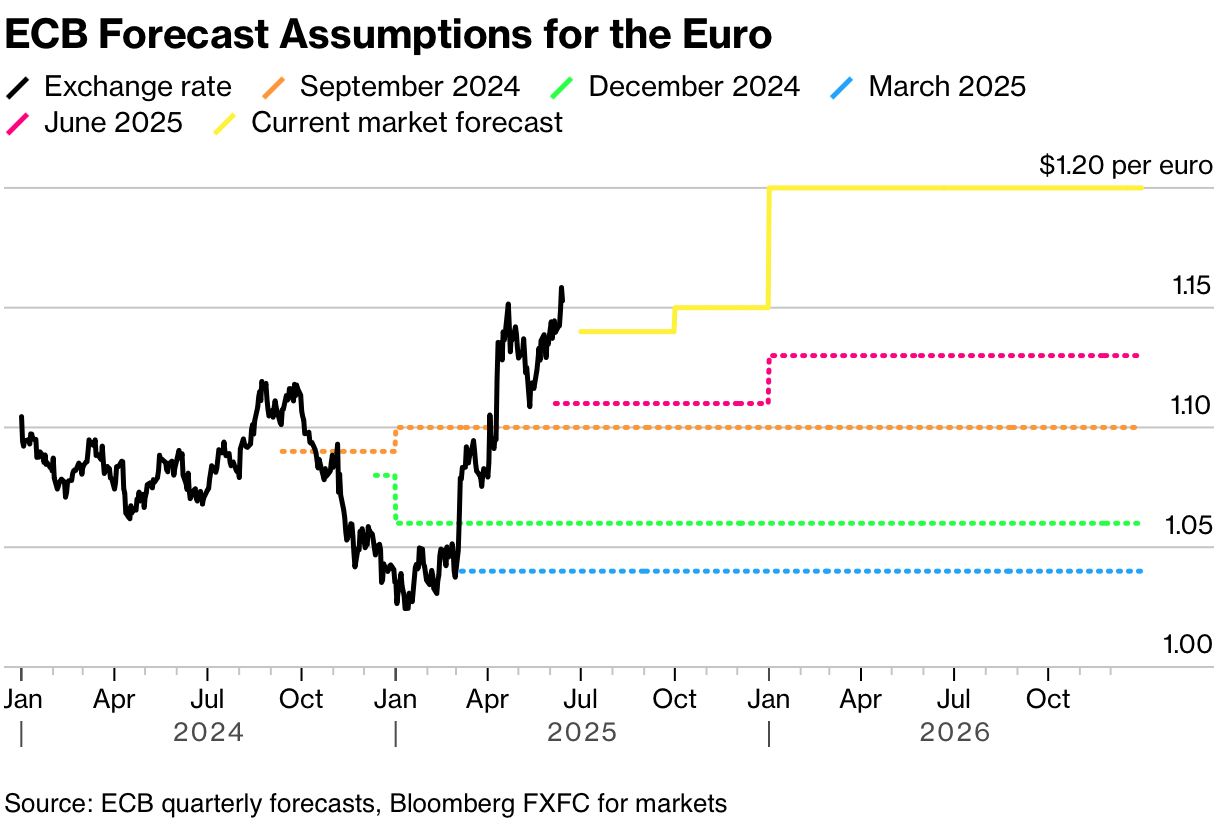
Despite Trump’s Tariffs Having Been Expected To Strengthen The Dollar, Their Effect In Undermining Confidence In Future Expectations About The U.S. Economy Helped Propel An Unexpected Strengthening Of The Euro. According to Bloomberg, “US tariff hikes were widely expected to lead to a stronger dollar. As recently as March, that was reflected in ECB policymakers” assumptions for the euro. They cut their assumption for the average level of the currency to $1.04 for this year, at a time when the currency was holding above that level. What they hadn’t accounted for was how Trump’s policies would stoke a debate about the longer-term prospects for the US economy and hence the attractiveness of American assets for overseas investors. Another surprise: the biggest shift toward fiscal expansion in Germany, Europe’s main economy, in decades. That’s all helped propel gains in the euro, which hit a four-year high, above $1.16, on June 12.” [Bloomberg, 2025-06-14]
E2: Since January, Businesses Have Canceled Or Delayed More Than $14 Billion In Clean Energy And EV Investments. According to Bloomberg, “And it’s not just home solar firms running into trouble: Since January, businesses have canceled or delayed more than $14 billion in clean energy and electric vehicle investments, according to a recent analysis by E2, a non-partisan group that advocates for renewables and policies to protect the environment.” [Bloomberg, 2025-06-09]
Private Markets
Private Credit
Jeff Gundlach: Private Credit Has Become Analogous To CDO Market Before GFC. According to Bloomberg, “In a separate conversation at the event, DoubleLine Capital’s Jeffrey Gundlach warned of over-exuberance in the asset class. ‘Private credit today is analogous to the CDO market in the mid-part of the 00s, where there’s just tremendous issuance, there’s tremendous acceptance,’ he said, referring to collateralized-debt obligations, which famously blew up during the financial crisis.” [Bloomberg, 2025-06-11]
Pretium Partners’ Roberta Gross: Likely To Be Higher Rates Of Private Credit Defaults In 2027. According to Bloomberg, “Goss added that documentation has proved that private equity is ‘winning’ and noted that she expects to see higher rates of defaults in Chapter 11 filings in 2027. So far, there have been few in-court restructurings in the private credit market, as lenders opt for quiet, cheaper solutions. ‘There’s not been enough leadership across the market in terms of pushing back on documentation. That’s going to be the biggest threat over the next couple of years,’ Goss said.” [Bloomberg, 2025-06-11]
 [Jenkins, Farbes, Jones, Cheng, Luo, and Haley,
  [Jenkins, Farbes, Jones, Cheng, Luo, and Haley,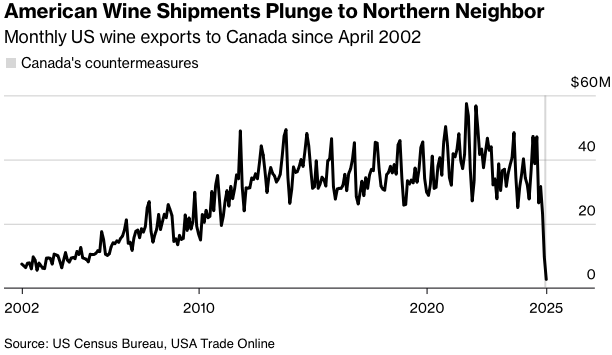
 [Bloomberg,
  [Bloomberg,