Data releases continue to build support for the idea that Trump is something of an incompetent economic manager. The only three times home prices (the main part of most Americans’ wealth) home prices have fallen in the past two years have been the past three months; numerous measures of employment have begun to indicate a market slowdown, and financial markets seem to finding new ways to signal instability; and climate-change driven costs have grown to over a trillion dollars over the previous 12 months.
His administration’s response has been to double down on instability, corruption, or outright economic harm. Legislators loyal to him have deepened the cuts they plan for Medicaid, his wild funding cuts have already forced hundreds of millions of dollars in foregone investment in the North Carolina research triangle alone, and his trade war, in addition to gutting some of the largest ports in the country, has contributed to an estimated trillion dollars in lost income by 2030. While he has been focused on milking as much money from his crypto projects as he can, it is no wonder that money is flowing out of the country well in excess of what would be expected based on economic fundamentals.
Releases
Home Prices
Code
# Set Up Custom Plot Themeinclude("../scripts/oxocarbon-plot.jl")theme(:oxocarbon)# Load necessary packagesusingFredData, DataFrames, Dates, StatsPlots, FixedEffectModels# Set Up FRED APIkey =ENV["FRED_API_KEY"]f=Fred(key)# Load Datazhvi=get_data(f, "USAUCSFRCONDOSMSAMID"; observation_start="2023-05-01", observation_end="2025-05-02", units="pch", ).data# Plot The Databar(zhvi.date, zhvi.value; xlabel="Month", ylabel="Zillow Home Value Index, MoM % Change", label="", alpha=0.75, title="Under Trump, Home Prices Have Fallen", )vline!([Date(2025,1,20)]; linewidth=2, linestyle=:dash, label="Inaguration" )vline!([Date(2025,4,2)]; linewidth=2, linestyle=:dash, label="Tariffs", )hline!([0.0], linewidth=2, linestyle=:dash, color=:black, label="", )
NOTE: The employment index in the Philadelphia Fed’s Manufacturing Business Outlook Survey is constructed as the percentage of firms reporting an increase in employment less the percentage of firms reporting a decreasing in employment. The June 2025 reading of -9.8 was the worst such reading since Trump first took office, if the readings during the pandemic (during which Trump was president are ignored). In fact, if the pandemic is ignored, the last time the reading was so bad was in August of 2016.
Trump’s BBB
Senate Republicans Planned Deeper Medicaid Cuts To Pay For Extending Trump’s Tax Cuts For The Rich. According to Bloomberg, “Senate Republicans propose to cut trillions of dollars in taxes for households and businesses in their version of President Donald Trump’s signature economic package, a plan that comes at the expense of curbing health coverage for some low-income Americans and adding to US deficits. The bill would preserve Trump’s first-term tax cuts and create several new breaks that he championed on the campaign trail — including eliminating taxes on tips. To offset the cost, senators are proposing to repeal some clean energy tax credits and scale back Medicaid benefits spending more deeply than in the House-passed bill.” [Bloomberg, 2025-06-16]
Unlike The House Bill, The Senate Plan Did Not Exempt All People With Dependents From Some Of The Cuts. According to Bloomberg, “The Senate bill makes more aggressive cuts to the Medicaid program for low-income and disabled people than the reductions in the House bill, favoring states like Texas and Florida that did not expand Medicaid under the Affordable Care Act. The Senate bill also would require parents with children 15 and older to work or do community service for 80 hours per month to qualify for health insurance through Medicaid. The House plan exempted all people with dependents from the work requirements.” [Bloomberg, 2025-06-17]
Capital Flight
Less Attraction For The Dollar
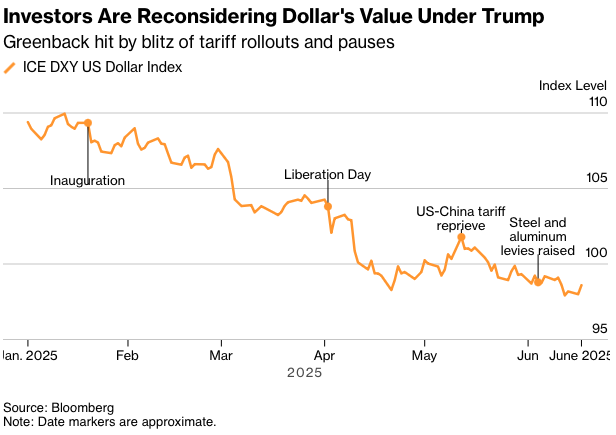
Since Trump Took Office, The Dollar Has Had Its Worst Performance Since 2010, As Trump’s Policies Have Made The Country Less Attractive To Invest In. According to Bloomberg, “There is no better barometer of global investors’ repudiation of President Donald Trump’s policies than the dollar. Since he took office, it’s lost more than 10% of its value against the euro, pound and Swiss franc and is down against every single major currency in the world. The last time the dollar plunged this much, this fast was in 2010, when the Federal Reserve was frantically printing money to prop up the economy in the wake of the financial crisis. This time, it’s several of the key pillars of the Trump agenda that are driving investors away: the across-the-board tariff hikes that shocked allies and upended trade; the push to ram through tax cuts that would add to bloated deficits and debt; the pressure campaign to get the Fed to slash interest rates; and the bare-knuckled legal tactics employed against those who oppose his policies.” [Bloomberg, 2025-06-17]
As The Dollar Weakens, Foreign Holders Of American Assets (Including American Debt) Have Marked Losses To Market. According to Bloomberg, “This is a dangerous game: The government’s annual financing needs have skyrocketed to over $4 trillion after years of runaway budget deficits. Much of that financing comes from foreign creditors, and the more the dollar sinks, the bigger the losses they suffer when converting their investments back into their local currencies.” [Bloomberg, 2025-06-17]
June 2025: Investors Bets Against The Dollar Had Reached Their Highest Level In 20 Years According to Bloomberg, “In the futures market, the bets against the dollar began to pour in from the moment Trump took office in January. By March, the wagers had grown so large that hedge funds and other investors had amassed their first net bearish position on the dollar in six months, according to CFTC data, and by mid-June, that position had swelled to $15.9 billion. On Tuesday, Bank of America released a survey showing global fund managers are more underweight the dollar now than at any point in the past 20 years.” [Bloomberg, 2025-06-17]
Code
# Load Dataecb=get_data(f, "IRSTCI01EZM156N"; observation_start="2002-01-01", observation_end="2025-05-02").dataeffr=get_data(f, "EFFR"; observation_start="2002-01-01", observation_end="2025-05-02", frequency="m", aggregation_method="avg",).dataexg=get_data(f, "DEXUSEU"; observation_start="2001-12-01", observation_end="2025-05-02", frequency="m", aggregation_method="eop",).data# Make a combined dataframedf=DataFrame(; date=ecb.date, spread=effr.value .- ecb.value, exg=diff(exg.value) ./ exg.value[1:(end-1)])# Calculate a line of best fitest =reg(df, @formula(exg ~ spread))# Create the Scatter Plotoff_trend =predict(est, df) .- df.exgdensity(100.0.* off_trend, linewidth=2, fill=true, alpha=0.25, xlabel="Predicted Euro % Appreciation - Actual Appreciation", label="All Monthly Errors Since 2002", title="Trump's Capital Outflow", ylabel="Frequency of Error Size", )vline!([100.0* off_trend[end-4]], label="January 2025", linewidth=2, linestyle=:dash)vline!([100.0* off_trend[end-3]], label="February 2025",linewidth=2, linestyle=:dash)vline!([100.0* off_trend[end-2]], label="March 2025",linewidth=2, linestyle=:dash)vline!([100.0* off_trend[end-1]], label="April 2025",linewidth=2, linestyle=:dash)vline!([100.0* off_trend[end]], label="May 2025",linewidth=2, linestyle=:dash)
NOTE: What I did to create this plot was regress the monthly change in the dollar-euro exchange rate against the difference between the interest rate set by the Fed and the ECB. This model found (as would be expected), a slightly negative relationship between the difference between the rate differential and the monthly percent change in the number of dollars per euro. As can be seen, March 2025 and April 2025 showed much higher than expected rates of dollar weakening than would be expected, while there have been no months in Trump’s term that showed statistically more dollar appreciation than would be expected. If the dollar strengthened more than the model would expect, then the vertical line for that month would be a positive x value.
Volatile Debt Markets
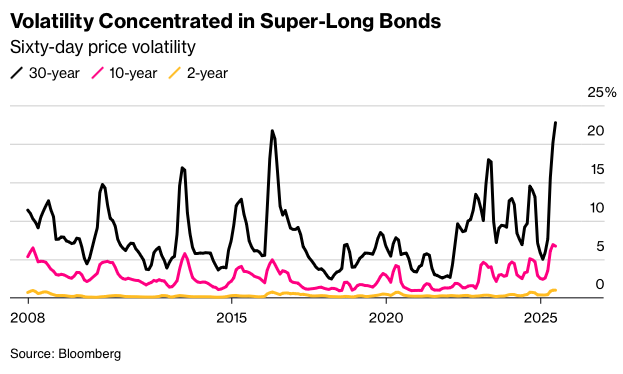
June 2025: Sixty-Day Price Volatility In 30, 10, And 2 Year Bonds Hit Their Highest Levels Since 2008. [Bloomberg, 2025-06-15]
Trump’s Follies
Trade War
Short-Term Costs
May 2025: Port Of Los Angeles Reported A 19 Percent Drop In Trade Volume. According to Bloomberg, “Import volumes through the busiest trade hub in the US fell 19% from the month before, a fallout from President Donald Trump’s tariffs. ‘It’s very slow here seasonally,’ Port of Los Angeles Executive Director Gene Seroka told reporters Friday. Seroka warned that US businesses are facing high tariffs and uncertainty during what is typically the start of the peak season, and the consequences are likely to show up on store shelves in a few months. ‘We”ve already blown past summer fashion and looking forward now to back to school and Halloween before the all important year-end holidays,’ Seroka said. ‘Cargo for those micro seasons needs to be here on the ground right now. I don’t necessarily see that in inventory levels.’” [Bloomberg, 2025-06-13]
May 2025: In Addition To Imports Falling 19 Percent, Exports Fell For The Sixth Straight Month Of Year-Over-Year Declines. According to Bloomberg, “In May, cargo handlers at the Port of Los Angeles processed a total of about 717,000 equivalent units, or TEUs. About 356,000 of those were imports, a 19% drop compared to last month and 9% lower than May 2024, Seroka said. Exports through Los Angeles fell to just over 120,000 containers, marking the sixth straight month of year-on-year declines as other countries responded with retaliatory tariffs, particularly for US agricultural goods, Seroka said.” [Bloomberg, 2025-06-13]
Long-Term Costs
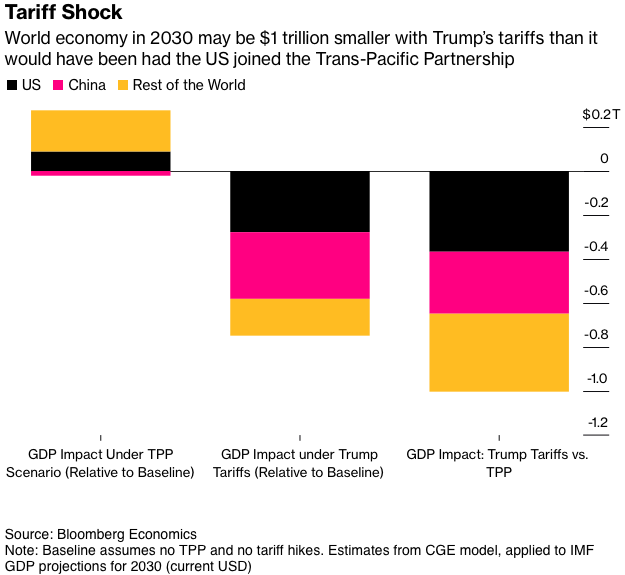
Bloomberg Economics: Trump’s Protectionist Moves Across His Presidencies Would Put The World On Track To Have Lost $1 Trillion In 2030 Income, With The U.S. As The Country Suffering The Most. According to Bloomberg, “Trump’s bid to upend the global trading system started in January 2017 when in his first few days in office, he abandoned the Trans-Pacific Partnership negotiated by the Obama administration. With that, he ripped up a carefully constructed 12-nation economic alliance designed to help contain China and rewrite global trade rules in America’s favor, instead launching the US toward greater protectionism. That move has come with economic costs. By 2030, Bloomberg Economics forecasts, if Trump’s current tariff regime endures, the global economy will be $1 trillion smaller than it would have been had the US remained in the TPP. More than a third of that loss would come because of a smaller US economy, the analysis finds, with the US share of global trade tumbling even as China’s stays steady. The consequence for Americans: 690,000 fewer jobs.” [Bloomberg, 2025-06-13]
Bloomberg Economics: By 2030, Trump’s Protectionist Policies Would Reduce Employment By 690,000 Jobs. According to Bloomberg, “Trump’s bid to upend the global trading system started in January 2017 when in his first few days in office, he abandoned the Trans-Pacific Partnership negotiated by the Obama administration. With that, he ripped up a carefully constructed 12-nation economic alliance designed to help contain China and rewrite global trade rules in America’s favor, instead launching the US toward greater protectionism. That move has come with economic costs. By 2030, Bloomberg Economics forecasts, if Trump’s current tariff regime endures, the global economy will be $1 trillion smaller than it would have been had the US remained in the TPP. More than a third of that loss would come because of a smaller US economy, the analysis finds, with the US share of global trade tumbling even as China’s stays steady. The consequence for Americans: 690,000 fewer jobs.” [Bloomberg, 2025-06-13]
Ford Has Been Forced To Idle A SUV Factor As Retaliatory Rare-Earth Restrictions Made Supply “Day To Day,” Despite Trump’s “Deal” Claiming To Have Addressed The Issue. According to Bloomberg, “Ford Motor Co. continues to struggle to obtain rare earth magnet supplies that are essential to car production and have already forced a temporary shutdown of one of its factories. The supply of the critical components has been trickling out of China, which has instituted a new approval process for exports of rare earths that continues to slow supply lines, Ford Chief Executive Officer Jim Farley said. ‘It’s day to day,’ Farley said in an interview Friday with Bloomberg TV. ‘We have had to shut down factories. It’s hand-to-mouth right now.’ Ford idled its Explorer sport utility vehicle factory in Chicago for a week last month due to a shortage of rare earth materials. Farley said he is pleased with the progress he read about from trade talks between the US and China recently, but he has yet to see an improvement in the flow of magnets. Those are used throughout vehicles to power components such as windshield wipers, seats and audio systems.” [Bloomberg, 2025-06-13]
Noting That Negotiations Would Likely Take Longer Than The Current Deadline Would Allow With The Trump Administration Pushing For “One-Sided Concessions”, European Officials Prepared Retaliatory Measures. According to Bloomberg, “The European Union believes trade negotiations with the US could extend beyond President Donald Trump’s July 9 deadline, even as the speed of the talks has increased over the past week. The EU sees reaching an agreement on the principles of a deal by July 9 as a best-case scenario, which would allow further talks to work out the details, according to people familiar with the matter. The US is expected to respond to the latest round of negotiations in the coming days and provide clarity on the next steps. […] The people cautioned that while talks were taking place in a positive environment, they remained difficult. The EU believes the US is seeking one-sided concessions and any agreement will likely be asymmetrical to Washington’s benefit. Because of that the bloc is stepping up preparations for counter-measures, including actions that could go beyond tariffs, according to the people. The commission will be consulting with member states to examine strategic areas where the US relies on the EU for possible retaliation.” [Bloomberg, 2025-06-11]
Gutting High-Tech Investment
North Carolina’s Research Triangle
Duke University, The Second Largest Private Employer In North Carolina, Announced Plans To Cut $35 Million In Spending To Prepare For Trump’s Cuts. According to Bloomberg, “Duke University, which between its university and health system employs some 50,000 people, is the second largest private-sector employer in the state. It’s seeking to slash $350 million in spending to prepare for federal funding cuts, the threat of fewer international students and a potential endowment tax. ‘We will, for the foreseeable future, have to be smaller — and do our work with fewer people,’ Duke President Vincent Price said in a message June 5, adding that layoffs are likely on the horizon for the university.” [Bloomberg, 2025-06-20]
June 2025: Citing A Year To Date $83 Million Drop In Federal Funding, UNC Has Paused Plans To Invest $218 Million Into New Infrastructure. According to Bloomberg, “As of early June, the University of North Carolina at Chapel Hill has received about $83 million less in federal research dollars so far this fiscal year compared to the same period in 2024, a university spokesperson said. Impacts have included reallocating some staff and shortening other contracts. It’s paused plans for a $218 million science research facility, and UNC’s vice chancellor for finance and operations told trustees on May 21 that 77 full time employees had been cut. ‘We are currently evaluating our research infrastructure, including our research facilities, and will continue to monitor funding trends,’ a spokesperson for the university said in an emailed statement.” [Bloomberg, 2025-06-20]
Immigration Enforcement Targeting Vital Workers
In Fields Like Garment Making, Dairy And Onion Farming, And Day Laboring, Trump’s Agressive Targeting Of Immigrations Has Made Labor Supply Issues Much Worse. According to Bloomberg, “The Los Angeles garment district is emptied out. Texas dairy farmers say workers aren’t showing up to milk cows. An Idaho onion grower already struggling to find enough crop hands says his labor supply is only getting worse. And in Ventura, California, Deputy Mayor Doug Halter said that after nearby immigration raids targeted day laborers outside of Home Depots, all the Latinos seemed to have disappeared from one of the retailer’s outposts near him. Walking through the aisles the other day, from what he could tell, there were only White people. ‘If you know this area, you”ll know that is abnormal.’” [Bloomberg, 2025-06-19]
Macroeconomic Headwinds
June 2024 - May 2025: Spending On Disaster Recovery And Other Climate-Related Needs Cost The United States Nearly $1 Trillion, Representing 3 Percent Of National Income. According to Bloomberg, “The US has spent nearly $1 trillion on disaster recovery and other climate-related needs over the 12 months ending May 1, according to an analysis released Monday by Bloomberg Intelligence. That’s 3% of GDP that people likely would have spent on goods and services they’d prefer to have, and amounts to “a stealth tariff on consumer spending,” analysts write. Hurricane Helene struck Florida in late September 2024 as the most powerful storm ever to hit the state’s panhandle. Its rampage was followed a week and a half later by Hurricane Milton. Those two storms caused $113 billion in damage, according to the National Oceanic and Atmospheric Administration. The Los Angeles fires in January added another $65 billion to the national total. The new report, “The Climate Economy: 2025 Outlook,” draws on data from dozens of public sources to demonstrate the volume of disaster-related spending, which represents $18.5 trillion globally since 2000. The biggest drivers of this trend in the US are insurance premiums — which have doubled since 2017 — post-disaster repair spending and federal aid.” [Bloomberg, 2025-06-07]
Since 2000, 36 Percent Of Income Growth Has Been Consumed By Climate-Change Exacerbated Costs. According to Bloomberg, “Overall, increased climate costs from insurance premiums, power outages, disaster recovery and uninsured damage are responsible for $7.7 trillion, or 36%, of US GDP growth since 2000. Risks are rising both from climate change, as it increases the severity and frequency of extreme weather, and from development that is insufficiently focused on resilience. Andrew John Stevenson, a Bloomberg Intelligence senior analyst, assembled a basket of 100 companies that have stood to gain from this spending. The firms, which span sectors from insurance to engineering, materials and retail, together outperformed the S&P index by 7% in each of the last three years.” [Bloomberg, 2025-06-17]
Hiring Slowdown
A Slowdown In Hiring Has Weighed Upon New Entrants To The Labor Market. According to the Wall Street Journal, “This follows an April report from the Federal Reserve Bank of New York saying labor-market conditions for recent college graduates ‘deteriorated noticeably’ in the first quarter this year, even for young college graduates who have been in the workforce longer. They found unemployment among college grads ages 22 to 27 averaged 5.8% in the first three months of this year, when President Trump’s on-again off-again tariff policies were just starting to rattle businesses and consumer confidence. Moreover, the gap between the unemployment rate for these young graduates and the broader population became its widest in about 35 years of comparable New York Fed analysis. The culprit, economists say, is a general slowdown in hiring. That hasn’t really hurt people who already have jobs, because layoffs, too, have remained low, but it has made it much harder for people who don’t have work to find employment. That includes everyone looking for work, but especially recent grads trying to land that first real job. ‘Businesses are hunkering down, and that creates a challenge for young workers entering the labor market for the first time,’ said Cory Stahle, economist at jobs site Indeed. With employers turning more cautious on hires, they are less inclined to gamble on workers with thinner résumés or skill sets, he said.” [Wall Street Journal, 2025-06-16]
Corruption
June 2025: Trump Disclosed More Than $57 Million In Income From His Involvement With World Liberty Financial. According to the Financial Times, “Donald Trump has disclosed almost $60mn in income from one of his cryptocurrency ventures, highlighting how the US president has benefited from his embrace of the digital asset industry. Trump on Friday reported income of $57.4mn derived from his involvement with World Liberty Financial, a cryptocurrency group he backs with his sons Donald Jr and Eric. The more than 200-page filing, published by the US Office of Government Ethics, an ethics watchdog, shows that Trump holds 15.75bn governance tokens — which provide him with voting rights — in the World Liberty Financial venture. The cryptocurrency enterprise was among the largest sources of income among hundreds of items, including earnings from books and property investments.” [Financial Times, 2025-06-13]
Financial Instability
Crypto
Stablecoins, As Regulated Under The GENIUS Act, Could Shift Bank Reserves From Insured Accounts To Uninsured Ones. According to the Wall Street Journal, “For one, if an individual takes money out of a sub-$250,000 account that is fully covered by government deposit insurance, and moves it to a stablecoin issuer, that money might end up in a much higher-balance account that isn’t fully insured. Those deposits can be costlier for banks and more prone to move quickly. ‘Collecting deposits from stablecoin issuers transform[s] retail deposits that can serve as a stable source of funding for banks into volatile deposits that cannot,’ according to a recent analysis paper written by researchers at the European Central Bank. Big uninsured corporate deposits were one concern during the 2023 regional banking crisis. Among Silicon Valley Bank’s depositors at the time was USDC-issuer Circle Internet Group. The company, which went public last week, said in its offering prospectus that in March 2023, it initiated transfers of ‘more than $3 billion of deposits’ from SVB, but that those transfers didn’t settle before regulators took control of SVB. USDC traded below $1 on some exchanges at the time. The dislocation was resolved soon after the government announced that all of SVB’s deposits would be guaranteed, the company said.” [Wall Street Journal, 2025-06-15]
Private Credit Boosting Risky Debt
With Robust Private Credit Demand Has Warped The Market For Risky Second-Lien Loans, Reducing The Premium Borrowers Will Have To Pay. According to Bloomberg, “Wall Street banks are back to selling second-lien loans, a riskier kind of corporate debt, thanks to demand from a wider swathe of lenders including their private credit rivals and conventional investors. Second-liens have in recent years been largely provided by private credit firms. But banks are once again selling these transactions to investors including collateralized loan obligations — the biggest buyers of leveraged loans — to slash borrowing costs for issuers. Wall Street firms are pocketing extra fees by syndicating these deals that may have otherwise been led by direct lenders. When the Bank of Montreal led a $1 billion second-lien loan for insurance firm Alera Group Inc. last month, it had enough demand from both buyer bases to sell the loan at 5.5 percentage points over the benchmark rate and at a slightly discounted price of 99.5 cents on the dollar. Typically, second-lien loans are sold at a greater discount to par to compensate investors for risk. ‘Historically, spreads on second-lien loans were far wider than first-lien loans, and companies were not in a position to service second-lien debt from a cash-flow perspective,’ said Rob Fullerton, head of leveraged finance at Jefferies Financial Group Inc. Demand is high enough that second-lien loans are often only paying about 200 basis points more interest than their first-lien counterparts, according to Fullerton. That’s making it cheaper for the borrowers, making it an easier sell to tack on such liabilities.” [Bloomberg, 2025-05-12]
Desperate For Extra Yield, Private Credit Has Been Happy To Absorb Copious Amounts Of Below-Investment-Grade Second-Lien Loans. According to Bloomberg, “As pricing on first-lien direct loans has tightened, private credit firms are looking for extra yield. Syndicated second-lien paper can provide that. Direct lenders can also have a fear of missing out. In some cases, including deals for Kaseya Inc. and Alera, banks are refinancing private debt. A second-lien loan alongside a broadly syndicated deal allows direct lenders to stay with companies they”ve extended credit to in the past. JPMorgan Chase & Co. is leading a $1.9 billion first-lien loan for insurance brokerage Trucordia, which will refinance private debt from lenders including BlackRock Inc. and Blue Owl Capital Inc. The latter is staying in by leading a $548 million second-lien portion. Mike Best, a portfolio manager for senior-secured loans at Barings, said he was surprised second-lien loans were being syndicated to a broader swath of investors, but believed direct lenders would be the ultimate buyers of the debt. ‘Now that private credit is flush with cash, and with fewer mergers and acquisition deals to put it toward, managers in the upper-end of the market might be participating in more syndicated processes,’ Best said.” [Bloomberg, 2025-06-12]
Better Performance Under Democrats
Since Eisenhower’s Inauguration In 1953, Stocks Grew Roughly Twice As Much Under Democratic Presidents Than Republican Ones. According to the Wall Street Journal, “Investing $1,000 upon President Dwight Eisenhower’s inauguration in 1953, and holding only when a Republican was president, would produce about $29,000 today, according to Paul Hickey at Bespoke Investment Group. The same sum held only during subsequent Democratic administrations would be worth more than double that. Simply buying and holding would have yielded around $1.9 million.” [Wall Street Journal, 2025-06-15]
Over that time period, Republicans held the White House for 40 years (excluding the current Trump administration), while Democrats only held it for 32 years.
 [Bloomberg,
  [Bloomberg,
  [Bloomberg,