June 23, 2025
Summary
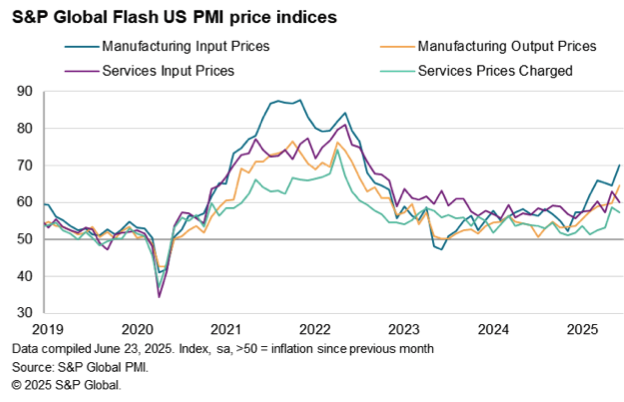
Data that came out today continued to show that Trump’s disastrous economic policies have either had negative economic effects, or failed to have positive ones. S&P’s preliminary purchasing managers index showed that his poorly thought out tariffs raised upward price pressure to the highest point it has been since the height of the post-pandemic inflation, while businesses seemed sure that they would be able to push those price increases onto consumers. Strengthening that point, Sam’s Club has identified the price increases it will make in response to Trump’s tariffs.
Meanwhile, the housing shortage has showed no signs of abaiting, with contract closings on existing homes on pace for the weakest year since 2009. To allay that, the Trump strategy seem to be to eliminate as much financial regulation as possible. Trump’s appointee to the Fed’s vice chair for supervision gave a speech talking about reducing the severity of leverage requirements by banks, and his allies in Congress have put measures to cut oversight of the government itself and accountants.
Releases
June 2025 Flash PMI
June 2025: Price Pressure, Commonly Linked To Tariffs, Spiked To The Highest Rate Since July 2022. According to S&P Global, “Price pressures rose sharply across both manufacturing and service sectors during June, the former reporting an especially steep increase, and again commonly linked to tariffs. Manufacturers’ input prices and selling prices both rose at rates not seen since July 2022, as higher costs were passed on to customers. Close to two-thirds of all manufacturers reporting higher input costs attributed these to tariffs, whilst just over half of respondents linked increased selling prices to tariffs. However, prices also rose sharply in the service sector, likewise often attributed to tariffs but also reflecting higher financing, wage and fuel costs. Service sector input costs and selling prices nonetheless rose at slower rates than in May, in part reflecting more intense competition.” [S&P Global, 2025-06-23]
June 2025: Price Hikes Linked To Tariffs Were Passed On To Consumers. According to S&P Global, “Price pressures rose sharply across both manufacturing and service sectors during June, the former reporting an especially steep increase, and again commonly linked to tariffs. Manufacturers’ input prices and selling prices both rose at rates not seen since July 2022, as higher costs were passed on to customers. Close to two-thirds of all manufacturers reporting higher input costs attributed these to tariffs, whilst just over half of respondents linked increased selling prices to tariffs. However, prices also rose sharply in the service sector, likewise often attributed to tariffs but also reflecting higher financing, wage and fuel costs. Service sector input costs and selling prices nonetheless rose at slower rates than in May, in part reflecting more intense competition.” [S&P Global, 2025-06-23]
Existing Home Sales
May 2025: Contract Closings Showed The Weakest Sales Pace Since 2009. According to Bloomberg, “US previously owned home sales rose slightly in May to a still-sluggish pace that continues to show a housing market constrained by poor affordability. Contract closings increased 0.8% to an annualized rate of 4.03 million last month, just the second advance this year, according to data released Monday by the National Association of Realtors. That compared with the 3.95 million median estimate in a Bloomberg survey of economists. It was the weakest May sales pace since 2009. The resale market, which historically makes up about 90% of total home sales, looks set to languish for the foreseeable future without some letup in financing costs or downturn in prices.” [Bloomberg, 2025-06-23]
Headwinds
2025: The Past-Due And NonAccrual Rate For Commercial Real Estate Reached Its Highest Rate Since 2014, As The Pain In Commercial Real Estate Continued To Mount. According to Bloomberg, “The pain in US commercial real estate credit continues to bubble to the surface after a surge in borrowing costs and the rise of work from home left lenders vulnerable to losses. Delinquencies continue to increase, though the rate has moderated, researcher Green Street said this past week. Distress is also climbing, rising 23% to more than $116 billion at the end of March from a year earlier, data compiled by MSCI Real Capital Analytics show. That’s the highest in more than a decade. Investors including Victor Khosla of Strategic Value Partners LLC have warned that debt maturities will lead to a ‘tsunami’ of problems for US offices in particular. There are signs that’s spreading. The past-due and nonaccrual rate for commercial real estate portfolios reached the highest since 2014 earlier this year, the Federal Deposit Insurance Corp. wrote in a report last month, citing multifamily as an increasing source of pain. Past-due and nonaccrual loans are so far past due that banks have stopped booking interest owed because they doubt they”ll ever receive it.” [Bloomberg, 2025-06-21]
Reduced Investment
Since January 2025, Businesses Had Canceled More Than $15 Billion In Planned Clean Energy Investments, Which Had Been On Pace To Create 12,000 Jobs. According to Bloomberg, “Clean energy investments in the US are shrinking fast amid the rollback of tax incentives and policy uncertainties under President Donald Trump’s administration, with Republican districts hardest hit. Businesses canceled or delayed more than $1.4 billion in new factories and clean energy projects last month, bringing the total since January to $15.5 billion, according to an analysis by E2, a non-partisan group that advocates for renewables and policies to protect the environment. The canceled projects across battery, electric vehicles and solar, were expected to create nearly 12,000 new jobs.” [Bloomberg, 2025-06-23]
Instability
June 2025: Michelle Bowman, The Fed Vice Chair For Supervision Appointed By Trump, Signaled She Wanted To Reduce Banks’ Required Capital Buffers And Allow Higher Leverage. According to Bloomberg, “Federal Reserve Vice Chair for Supervision Michelle Bowman warned the current approach to leverage ratio requirements has led to unintended consequences in the market while adding she could support lowering interest rates as soon as July. Bowman said the ‘time has come’ to revisit the key capital buffer after concerns the rule has constrained lenders” trading in the $29 trillion Treasuries market. ‘Leverage ratio impacts on bank-affiliated broker-dealers can have broader impacts, including market impacts like those observed in Treasury market intermediation activities,’ Bowman on Monday said in prepared remarks for a research conference in Prague. ‘Once we”ve identified emerging unintended consequences — issues that were not contemplated during the development of a regulatory approach, we must consider how to revisit earlier regulatory and policy decisions.’ Bowman outlined an ambitious agenda earlier this month — from reviewing a capital buffer known as the supplementary leverage ratio to insulating community banks from requirements targeting bigger firms. The Fed and other regulators this week are set to unveil potential changes to leverage rules in a proposal that would change the overall ratio instead of excluding specific assets like Treasuries as some observers had predicted, Bloomberg News reported earlier.” [Bloomberg, 2025-06-23]
Bowman Was Confirmed On A Party Line Vote To Her Position As Vice Chair For Supervision. According to Banking Dive, “The Senate confirmed Federal Reserve Gov. Michelle Bowman, by a 48-46 vote Wednesday, to serve as the central bank’s vice chair for supervision. Bowman’s bid received no support from Democrats – a change from 2018, when she joined the Fed board with a 64-34 vote from the Senate.” [Banking Dive, 2025-06-05]
During Her Confirmation Hearings, Senator Warren Noted Bowman’s Opposition To Financial Regulation And Lack Of Independence From Trump. According to Banking Dive, “Sen. Elizabeth Warren, D-MA, the committee’s ranking member, warned it would be ‘especially dangerous’ to put Bowman in charge of supervision, noting the Fed governor’s recent support for lifting the long-standing asset cap on Wells Fargo and the acquisition of Discover by Capital One. ‘In her six years on the Federal Reserve Board, Governor Bowman has hacked away bit by bit at the safeguards put in place after the 2008 financial crisis,’ Warren said. ‘Deregulating Wall Street right now would throw gasoline on [President Donald] Trump’s economic fire.’ In particular, Warren noted Bowman’s opposition to updates to the Community Reinvestment Act and what the senator called a ‘concerning lack of independence from the White House.’ ‘At her [nomination] hearing, she refused to recognize the economic uncertainty created by President Trump’s tariffs and their potential impact on financial stability – putting her at odds with [Fed] Chair [Jerome] Powell, Fed staff, and economic experts across the political spectrum,’ Warren said. ‘It was clear that Governor Bowman did not want to be seen as even indirectly criticizing President Trump.’” [Banking Dive, 2025-06-05]
Debt Explosion
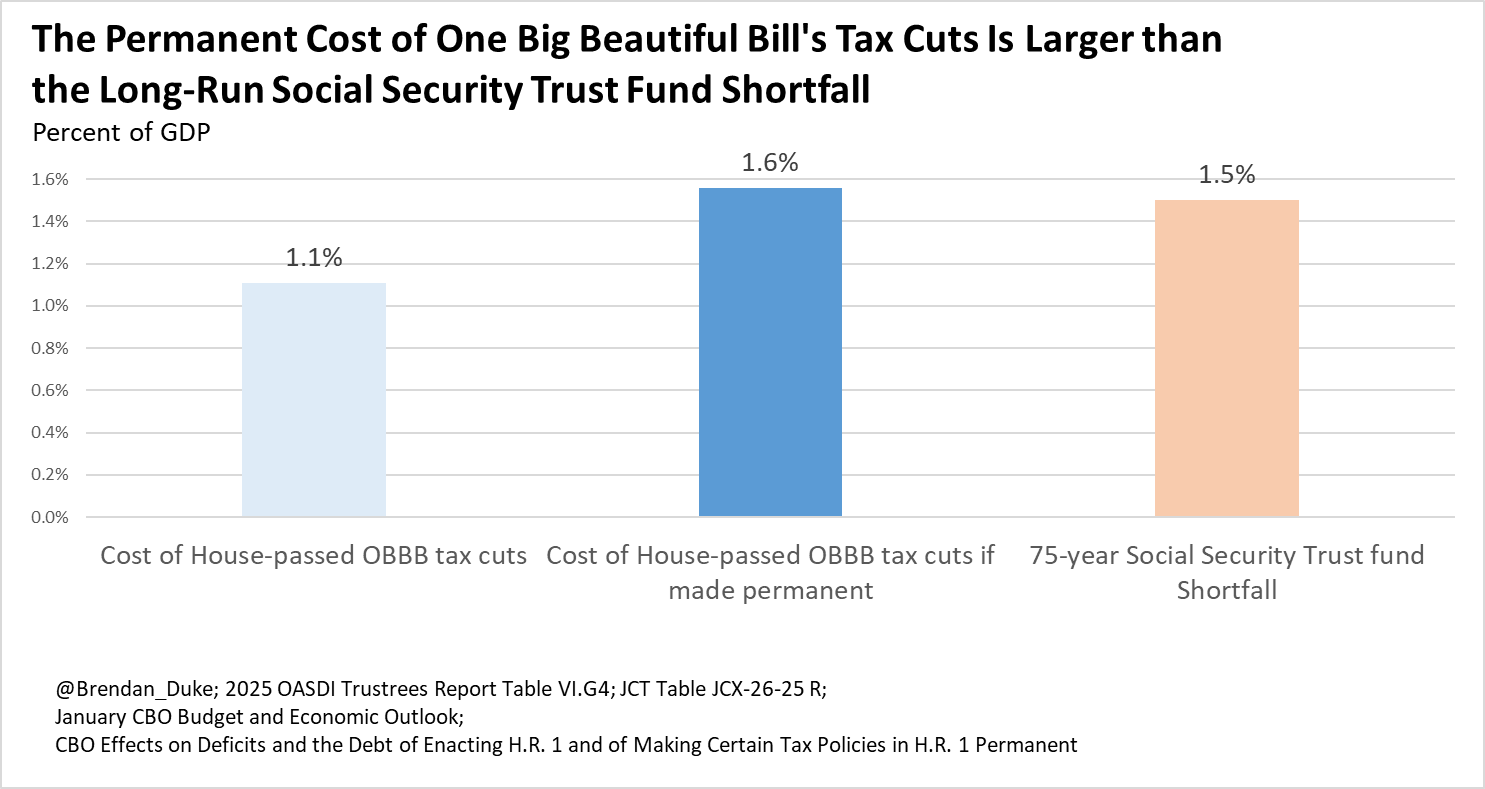
Brendan Duke: The House BBB Would Have A Larger Fiscal Cost Than The Difference Between Social Security’s Obligations And Funding. According to Brendan Duke, “People have been debating and worried about the Social Security Trust Fund shortfall for decades. It’s widely seen as an enormous fiscal challenge. One Big Beautiful Bill’s tax cuts’ permanent cost is actually larger than the Social Security Trust Fund shortfall.” [Brendan Duke, 2025-06-18]
Trade War
In Response To Trump’s Tariffs, Sam’s Club Has Decided What Types Of Goods It Will Raise Prices On First. According to the Wall Street Journal, “Sam’s Club is evaluating which products it will raise prices on to offset higher costs from the Trump administration’s new tariffs, with candidates ranging from small kitchen appliances to outdoor decor such as yard art. Prices matter to Sam’s Club beyond their immediate effect on sales. The warehouse-club chain, owned by Walmart, has long said it aims to keep its prices as low as possible to help boost the paid memberships that are generally required to shop in its stores. And those membership fees generate 80% to 90% of its profit, Sam’s Club has said. But for certain items, higher tariff costs could give it no choice. Sam’s Club will try to focus tariff-related price increases on discretionary products, potentially including air fryers, coffee makers, blenders, microwaves and holiday decorations, in response to tariffs, Chief Financial Officer Todd Sears said in an interview.” [the Wall Street Journal, 2025-06-17]
Individual Businesses Suffering
Toy Company That Won Suit Against Trump’s Tariffs, “We’re Like A Refugee From A War,” Raising Prices As They Frantically Try To Move Production Away From China. According to the Wall Street Journal, “On paper, things are looking up for Rick Woldenberg and his Illinois-based educational-toy business. Tariffs on Chinese imports are down from stratospheric levels. Federal courts have ruled the duties were invalid in the first place. And trade deals could further ease import duties. But on the ground, it is a different story. Crucial equipment has been disassembled, packed and trucked hundreds of miles on mountain roads only to be trucked back on short notice. Staff members are constantly re-evaluating a catalog of more than 2,000 toys and games, deciding which to keep producing and which to put on ice indefinitely. And the business recently had to raise prices. ‘We”re moving at the speed of light here—flying the plane while fixing it,’ said Woldenberg, who runs the family business. Founded by his grandfather in 1916, it now comprises two companies, Learning Resources and hand2mind. […] ‘We”re like a refugee from a war—if the higher ground we sought isn’t safe, we will load everything up in a donkey cart and move again,’ Woldenberg said. ‘It’s a really terrible way to run a business.’” [the Wall Street Journal, 2025-06-22]
Private Markets
Demand For Retail Money
CAIS Survey: 80 Percent Of Alternative Asset Managers Planned On Launching Retail-Focused Product, A Massive Jump From 2022. According to Bloomberg, “Supply is on the rise. A CAIS survey shows 80% of alternative managers plan to launch retail-friendly products and structures, nearly double from three years ago. Morgan Stanley, for instance, just filed to offer a multi-asset vehicle designed to provide exposure to everything from venture capital to private debt, real estate and infrastructure — all in one fund.” [Bloomberg, 2025-06-23]
- With Traditional Alternative Investors Tapped Out, Alternative Asset Managers Have Been Forced To Look To Retail Funding. According to Bloomberg, “One reason that alternatives are being aggressively repackaged for individuals is that traditional buyers — pensions, endowments, insurers — risk being tapped out. Big institutions allocate about one fifth of their portfolios to alternatives, according to Preqin. By contrast, individuals in the BofA survey show an allocation of only 7%.” [Bloomberg, 2025-06-23]
Corruption
Cutting Oversight
John Bresnahan: House Republicans Looked To Cut 48 Percent From The GAO’s Funding. According to John Bresnahan, “House Republicans are seeking a 48% cut in GAO funding as part of their FY2026 Legislative Branch appropriations bill. This is the independent accounting arm of Congress. Democrats are strongly opposed.” [John Bresnahan, 2025-06-22]
The Senate’s Version Of Trump’s BBB Would, In Addition To Folding The Main Regulator Of Accountants Into The SEC, Forbid The SEC From Raising Fees In Response To Its New Responsibilities. According to the Wall Street Journal, “The Republican-led House in May passed the broader tax bill, 215-214, which included the provision to eliminate the PCAOB. The Senate has been compiling its own version of the tax bill, aiming for a vote as soon as next week. That proposed version also would eliminate the PCAOB, but would bar the SEC from raising fees to pay for its expanded duties. The PCAOB, whose budget is nearly $400 million this year, is funded by fees paid by public companies and broker-dealers. The SEC requested to add $100 million to its fiscal 2026 budget if it were to be required to take on the PCAOB’s work, SEC Chair Paul Atkins said at a House hearing in May, adding he would likely seek additional funds.” [the Wall Street Journal, 2025-06-20]
Crypto
June 2025: Days Before The Trump-Linked Crypto Figure Justin Sun Announced Plans To Transform The Money-Losing Toymaker SRM Into A Crypto Treasury Company, The Trump-Linked Bank, Dominari, Helped An Investment Fund Run By One Of Its Senior Executives Buy A Stake In SRM, Netting More Than $120 Million In Paper Gains. According to Bloomberg, “A tiny investment bank where Donald Trump Jr. and Eric Trump work as advisers helped an obscure toymaker pivot into crypto this week, sending its shares up more than 500%. The run-up generated more than $120 million in gains on a stock bet the same bank helped arrange last month. The quick profit is the result of two transactions that the bank, Dominari Holdings Inc., handled within four weeks. First Dominari helped an investment fund run by one of its senior executives buy a stake in money-losing toymaker SRM Entertainment Inc. Then on Monday, SRM unveiled plans to transform into Tron Inc., bringing on cryptocurrency entrepreneur Justin Sun as an adviser and building up a stash of virtual tokens in another transaction handled by Dominari. The toymaker’s stock jumped past $9 on Monday, up from less than $2 at the end of last week. It’s now above $7. The rapid run-up generated steep gains for Dominari, its executive Soo Yu, and most of all the investment fund she runs. The fund acquired its stake in May for $5 million. By Tuesday evening, it was worth $127 million.” [Bloomberg, 2025-06-18]
While It Is Unclear Who The Beneficial Owners Of The Specific Fund Were, It Was Not The First Windfall Paper Profit Generated By People In The Orbit Of The Trump Family. According to Bloomberg, “The rapid run-up generated steep gains for Dominari, its executive Soo Yu, and most of all the investment fund she runs. The fund acquired its stake in May for $5 million. By Tuesday evening, it was worth $127 million. The investment fund Yu manages — American Ventures LLC Series III SRM — ‘has many underlying investors who are the beneficial owners of the securities,’ a spokesperson for Dominari said in an emailed statement. It’s unclear who ultimately will benefit from the investment fund’s lucrative bet. Dominari and Yu were also awarded warrants as compensation for their role in the May deal. Their position went from $230,000 in May to $3.8 million on Tuesday. There’s no sign in regulatory filings that any Trump family members were involved in the transactions. But the quick gain added to the windfalls of executives orbiting the president’s family over the past year. Under an administration that has embraced virtual assets and eased their regulation, speedy fortunes can be made by combining crypto strategies with publicly traded vehicles.” [Bloomberg, 2025-06-18]
Yu And Her Husband Have Moved In The Same Circles As The Trumps, Incorporating The Fund At A Rivera Beach Property Purchased In May. According to Bloomberg, “Yu joined Dominari’s board in 2022 and, like her husband, is among the firm’s largest shareholders. She had a compensation package worth more than $10 million over the past two years, filings show. Wool has described himself as a friend of the Trumps. In May, Wool and Yu bought an almost $5 million house in Riviera Beach, Florida. It’s listed as the address for American Ventures. American Ventures LLC Series III SRM was incorporated this year. The deal with SRM on May 21 gave American Ventures the equivalent of 8.9 million shares through preferred stock, plus warrants to buy an additional 8.9 million shares, a regulatory filing shows.” [Bloomberg, 2025-06-18]