June 2025: In The Region Governed By The Philadelphia Fed, Nonmanufacturing Activity And Employment Declined. According to the Philadelphia Fed, “Nonmanufacturing activity in the region continued to decline overall, according to the firms responding to the June Nonmanufacturing Business Outlook Survey. The indexes for general activity at the firm level and in the region remained negative as did the new orders index. The sales/revenues index turned positive but remained at a low reading. On balance, the firms reported a decrease in full-time employment.” [Philadelphia Fed, 2025-06-24]
June 2025: While 36 Percent Of Firms Reported An Increase In The Prices They Paid For Goods, Only 14 Percent Reported Having Been Able To Raise Prices, Compressing Margins. According to the Philadelphia Fed, “Price indicators suggest more widespread increases in prices for inputs than for firms’ own goods and services overall. The prices paid index remained essentially unchanged at 29.7 (see Chart 2). Almost 36 percent of the firms reported increases in input prices, while 6 percent reported decreases; 43 percent reported steady prices. Regarding prices for the firms’ own goods and services, the prices received index edged down to 2.2. Most of the firms (59 percent) reported no change in prices received, while the share reporting increases (14 percent) exceeded the share reporting decreases (12 percent).” [Philadelphia Fed, 2025-06-24]
Chicago Fed Survey Of Economic Conditions
Hiring
Code
# Set Up Custom Plot Themeinclude("../scripts/oxocarbon-plot.jl")theme(:oxocarbon)# Set Up FRED APIusingFredData, DataFrames, Dateskey =ENV["FRED_API_KEY"]f=Fred(key)# Gather Dataoutlook=get_data(f, "CFSBCOUTLOOK"; observation_start="2024-01-01", observation_end="2025-06-02", ).data# Make The Plotplot(outlook.date, outlook.value; xlabel="Month", ylabel="Diffusion Index (Business Outlook)", title="With Trump's Tariffs, Business Outlook Has Declined", label="", linewidth=2,#=alpha=0.65,=# )hline!([0.0]; label="", linestyle=:dash, linewidth=2,)vline!([Date(2025,1,20)]; label="Inaguration", linestyle=:dash, linewidth=2, )vline!([Date(2025,4,2)]; label="Tariffs", linestyle=:dash, linewidth=2, )
NOTE: This measures the share of firms responding they they have a positive outlook for the next 12 months minus the share of firms with a negative outlook. This run of negative outlook months has been unprecedented since the beginning of 2024.
Consumer Confidence
June 2025: Consumer Confidence Fell Below All Estimates In Bloomberg’s Survey Of Economists. According to Bloomberg, “US consumer confidence unexpectedly declined in June, underscoring lingering anxiety about the potential impacts on the economy and job market from higher US import duties. The Conference Board’s gauge of confidence decreased 5.4 points to 93, data showed Tuesday. The figure was below all estimates in a Bloomberg survey of economists. A measure of consumer expectations for the next six months dropped 4.6 points, as the share of respondents anticipating better business conditions fell by the most in more than two years. The gauge of present conditions fell 6.4 points.” [Bloomberg, 2025-06-24]
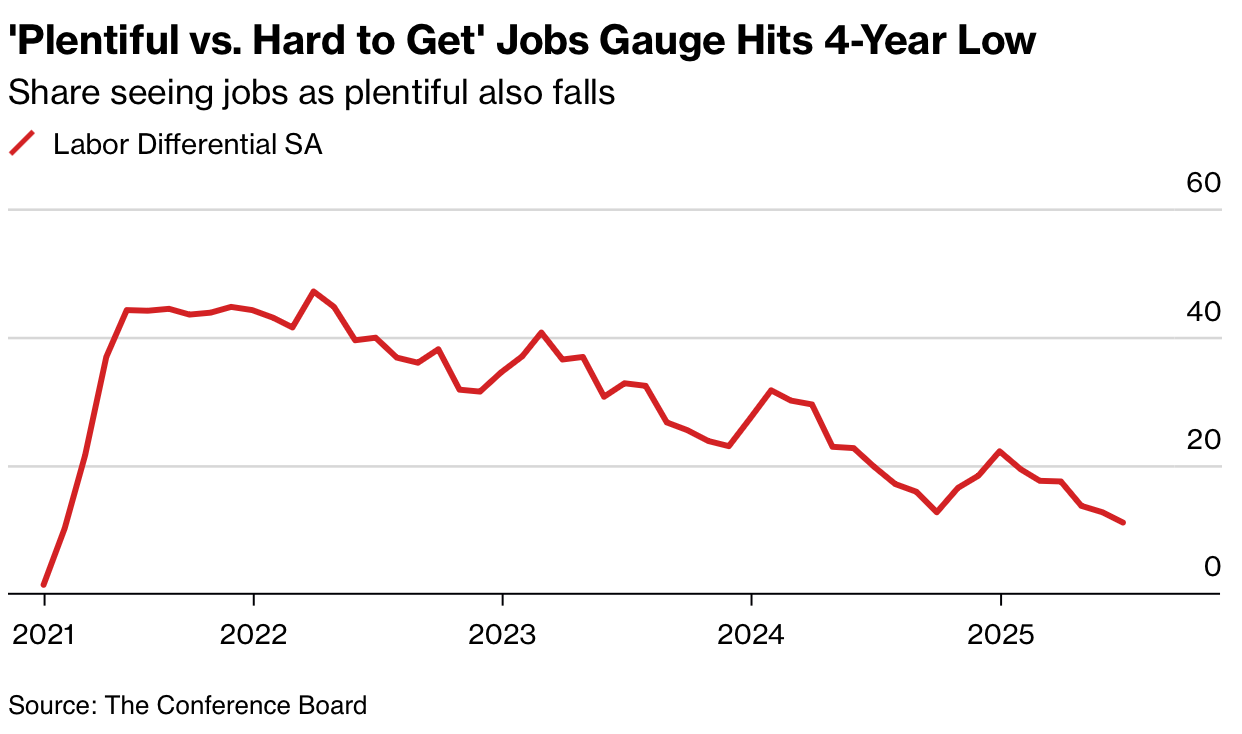
June 2025: A Measure Of The Health Of The Labor Market, The Ratio Between Those Seeing Jobs As “Plentiful” Versus “Hard To Get” Fell To Its Lowest Level Since March 2021. According to Bloomberg, “The share of consumers that said jobs were plentiful dropped to 29.2%, the smallest in more than four years. The share saying jobs were hard to get eased slightly. The difference between these two — a metric closely followed by economists to gauge the job market — fell to 11.1 percentage points, also the lowest since March 2021.” [Bloomberg, 2025-06-24]
Economic Deterioration
Trade War Chaos
Powell: The Fed Would Have Cut If Not For Fear Of Inflation Driven By Trump’s Tariffs. According to the Wall Street Journal, “Federal Reserve Chair Jerome Powell told lawmakers on Tuesday that recent economic data would have likely justified continuing to lower interest rates if not for concerns that higher tariffs might derail the central bank’s yearslong fight to defeat inflation. Powell said little to tee up a rate cut next month without explicitly ruling one out. But his answers to lawmaker queries suggested it was more likely officials would wait until at least their September meeting to see if tariff-driven price increases are milder than expected before resuming rate cuts. ‘If it turns out that inflation pressures do remain contained, we will get to a place where we cut rates sooner rather than later, but I wouldn’t want to point to a particular meeting,’ Powell said at a House Financial Services Committee hearing. Officials broadly expect tariffs to lead price growth to pick up this summer, interrupting an uneven but broad-based inflation slowdown over the past two years. ‘We do expect [inflation] to move [up] in the summer and if we see it not happening, we will learn from that,’ Powell said.” [Wall Street Journal, 2025-06-24]
Investment Cuts
Despite The Fact That Businesses Have Noted That Tariff Uncertainty Makes Investing And Planning Hard, Trump Has Continued To Change Policy Quickly With Little Warning. According to Bloomberg, “Constant changes in US tariff levels have made it hard for automakers to plan and invest, and that in turn has caused pain for the parts and machinery makers they rely on. As long as the tariff outlook remains cloudy, the pain is likely to continue, some industry observers said. Trump said on June 12 that he may raise auto tariffs again. ‘If we know tariffs are high, that’s one thing. If they”re going to be lowered, that’s another,’ said Dan Starkey, an attorney who works with suppliers in the Detroit area. ‘Everything is frozen right now, and no one is hiring.’” [Bloomberg, 2025-06-24]
With Greater Uncertainty, Credit Has Become Harder For Auto Suppliers To Access. According to Bloomberg, “Financing is becoming a problem for some suppliers. When revenue falls, banks start cutting credit lines. Nishant Dixit, the co-founder of a startup that uses artificial-intelligence tools to help suppliers find new business and get paid faster, also has a business that buys receivables. He said he’s getting more inquiries. ‘The banks are drying up,’ Dixit said. ‘They aren’t giving as much credit. Contracts are being delayed so companies are looking for alternative sources.’” [Bloomberg, 2025-06-24]
Q1 2025: Almost Half Of The Fortune 500 Companies Reduced Capital Spending, With Cuts Concentrated Among Industrials, Many Of Which Announced Double Digit Percentage Cuts. According to Bloomberg, “Big companies have been reining in their investment activity while they wait to see what will happen with tariffs and other Trump policies. In the first quarter, 220 Fortune 500 companies reduced capital spending, according to data compiled by Bloomberg. Industrial companies especially pulled back as they confronted higher materials costs and trade uncertainty. GM reported a 33% drop in capital spending in the first quarter, though the company said it expects investment to get back on track this year. Harley-Davidson Inc. cut its comparable outlays by the same amount. Magna International Inc., one of the world’s largest auto-parts suppliers, cut fixed-asset spending by 46%. Giant German parts maker Continental AG cut spending by more than 10% in the quarter.” [Bloomberg, 2025-06-24]
While FedEx Declined To Provide A Full Year Estimate Due To Uncertainty, It Did Add $170 Million In Added Costs Due To Trump’s Tariffs. According to the Wall Street Journal, “The company didn’t provide a full-year outlook, as it has in the past. It is anticipating tariffs will add a $170 million cost in adjusted operating income during the current quarter, Chief Financial Officer John Dietrich said. International demand tracked tariff headlines during the quarter, falling in early April after President Trump’s ‘Liberation Day’ announcements, and remained soft through May. Management expects international challenges will continue into the next fiscal year, particularly in China and across the Pacific. ‘The macroeconomic environment remains uncertain,’ Dietrich said. ‘Our outlook is therefore based on current tariff rates, recent trends we”re seeing, as well as that which we”re hearing from our customers.’” [Wall Street Journal, 2025-06-24]
Layoffs
While Michigan-Based SMT Automation Had Been Building Up A New Assembly Line, Trump’s Tariffs Caused A 40 Percent Drop In Revenue And Forced A 15 Percent Layoff. According to Bloomberg, “Elena Morales, the president of SMT Automation, had been preparing for a big year at the tiny Michigan maker of manufacturing machinery. Morales had purchased a new building and hired staff in anticipation of installing more equipment on automotive assembly lines. Her customers, who are some of the biggest automakers and parts suppliers in the US, had asked her if SMT would have capacity to take on more business. Then, President Donald Trump’s tariffs hit, and everything changed. SMT makes automated equipment for assembly lines for vehicles and parts. Instead of ordering tools that would make components for future new models or build vehicles, many of the company’s customers put off such investments while waiting to see how the Trump administration’s trade maneuvers play out. When automakers delay a new model, companies like SMT get hurt. Morales said revenue dropped by 40% in the first quarter and she had to lay off 8 employees, cutting SMT’s headcount to 45. Most of her firm’s work is for the auto industry, she said. ‘We had forecast to have a lot of work this year,’ Morales said. ‘Now, most companies are pushing back order times. The new building is empty and we have been letting people go.’” [Bloomberg, 2025-06-24]
French Technological Equipment Maker Lacroix Group Announced It Would Exit The North American Market, Filing A WARN Notice Announcing Plans To Shutter Its Grand Rapids, MI Factory, Laying Off All 115 Workers. According to Bloomberg, “Other companies have decided they would rather stop producing in the US than deal with the constant flux. French technological equipment supplier Lacroix Group SA said in May that it will leave the North American market, where it employs more than 1,200 people in the US and Mexico. It plans to shutter a factory in Grand Rapids, Michigan, and lay off 115 workers in July, according to a WARN Act filing with the state.” [Bloomberg, 2025-06-24]
Taxing Chips
Various Manufactuerers Have Objected To Trump’s Proposal To Put A 25 Percent Tax On Imported Chips, “There’s A Large Mismatch Between The Amount Of Chips We Use […] And The Supply Created Here[.]” According to Bloomberg, “Blowback to President Donald Trump’s idea of tariffs on imported semiconductors is proving to be broad and deep, stretching from auto companies and boat makers to the technology industry and crypto enthusiasts, according to a review of more than 150 public comments on the proposal. The possible levy of up to 25% has united rivals like Tesla Inc., General Motors Co. and Ford Motor Co. in voicing reservations. It’s brought together industry lobbies from the Crypto Council for Innovation to the National Marine Manufacturers Association. Even Taiwan and the People’s Republic of China are finding common cause, along with predictable parts of the tech sector including chipmakers and wireless providers. The reason is that chips are now in almost everything: refrigerators and microwaves, tire pressure sensors and navigation systems, electronic bidets and sonar equipment and, of course, smartphones and computers. Tariffs threaten to snarl supply lines and jack up costs for consumers. ‘There’s a large mismatch between the amount of chips we use in this country in various products and the supply created here in the US,’ JoAnne Feeney, a partner and portfolio manager at Advisors Capital Management, said in an interview. ‘Putting a tax on those imports will simply raise the cost, and that’s not a good thing for consumers.’” [Bloomberg, 2025-06-24]
Trump’s BBB
By Using A “Current-Policy” Baseline, Rather Than A “Current-Law” One, Senate Republicans Have Hidden $3.8 Trillion In Extra Costs From Their BBB. According to Bloomberg, “Senate Republicans are aiming to wipe away some $3.8 trillion of federal budget red ink from the GOP’s signature tax-and-spending bill with an unprecedented parliamentary maneuver, stoking concerns about long-term US fiscal policy. Republicans are using a fast-track legislative process known as reconciliation, which will allow them to make President Donald Trump’s 2017 income-tax cuts permanent without Democratic support. The cost of such legislation has long been measured by comparing it to what would otherwise happen to the federal budget under the current law. Senate Republicans want to start with a different assumption: that the current policy remains in place indefinitely. In that case, extending the 2017 tax cuts beyond 2025 wouldn’t add anything to federal deficits — because they”re simply maintaining the status quo. The Joint Committee on Taxation tallied a $3.8 trillion hit to deficits from keeping the 2017 rates in place another decade. If successful, the maneuver would upend decades of precedent by sweeping away rules aimed at making it harder for legislators to do permanent damage to fiscal balances. Economists warn it would set a dangerous precedent for future legislation, by allowing the majority party to enact what appears to be a temporary measure and then later setting it in stone without an official cost. ‘It immediately undercuts a lot of the benefit of reconciliation from the perspective of folks who are worried about deficit-finance changes,’ said Garrett Watson, director of policy analysis at the Tax Foundation, a policy think tank. ‘That’s why there are those limitations that are currently put in place.’” [Bloomberg, 2025-06-24]
TSMC: Tariffs On Chips Would Slow The Process Of Getting $165 Billion Investment In Arizona Up To Speed. According to Bloomberg, “White House spokesman Kush Desai said Trump remains committed to reshoring manufacturing critical to US national security. ‘While the Commerce Department completes its Section 232 investigation, the administration is expanding domestic critical mineral production, slashing regulations, and pushing pro-growth policies,’ Desai said in a statement. The Commerce Department didn’t respond to a request for comment. In its submission, TSMC highlighted plans for six advanced semiconductor fabs and two packaging facilities along with a research center as part of a $165 billion investment in Arizona that’s expected to create thousands of jobs. Yet the company warned import levies would make it harder to deliver those projects on schedule, while slowing US efforts to expand domestic production of chips for 5G wireless, artificial intelligence and autonomous driving. ‘Additional tariffs or other restrictive measures on semiconductors could reduce the profitability of leading US companies by limiting sourcing options, driving up production costs, and reducing product demand,’ TSMC’s Arizona subsidiary wrote.” [Bloomberg, 2025-06-24]
Financial Instability
Bloomberg: Global Sales Of Significant Risk Transfers (SRTs), Where Banks Sell Credit-Linked Notes On Securities They Have Issued, Were On Track To Grow By 11 Percent Annually Through 2027. According to Bloomberg, “SRTs allow banks to insure loans against default by selling credit-linked notes to pension, sovereign wealth and hedge funds, unlocking capital they would otherwise use to meet regulatory requirements. Typically, a lender obtains default protection for between 5% and 15% of the value of the loans, while investors receive yields that frequently top 10% for taking on the risk. Global sales of SRTs are expected to expand 11% annually on average over the next two years, according to a Bloomberg Intelligence survey released earlier this month. Aareal Bank AG, BNP Paribas SA, ING Groep NV and Erste Group Bank AG are among the lenders discussing or finalizing deals.” [Bloomberg, 2025-06-24]
Lack Of Credit Access
Trump Issued An Executive Order Restricting The Community Development Financial Institutions Fund, Making It Harder For Smaller Companies TO Get Funding. According to Bloomberg, “Trump also issued an executive order restricting the Community Development Financial Institutions Fund, which lends cash to small businesses in rural, native and urban communities. That has left smaller suppliers looking for alternative financing, said Bill Grice, executive director of the Michigan Minority Development Council.” [Bloomberg, 2025-06-24]
March 2025: Trump Signed An Executive Order Requiring The Community Development Financial Institutions Fund To “Be Eliminated To The Maximum Extend Consistent With Applicable Law.” According to the White House, “(a) Except as provided in subsection (b) of this section, the non-statutory components and functions of the following governmental entities shall be eliminated to the maximum extent consistent with applicable law, and such entities shall reduce the performance of their statutory functions and associated personnel to the minimum presence and function required by law: (i) the Federal Mediation and Conciliation Service; (ii) the United States Agency for Global Media; (iii) the Woodrow Wilson International Center for Scholars in the Smithsonian Institution; (iv) the Institute of Museum and Library Services; (v) the United States Interagency Council on Homelessness; (vi) the Community Development Financial Institutions Fund; and (vii) the Minority Business Development Agency.” [White House, 2025-03-14]
Stablecoins
BIS: Stablecoins “Preform Badly” On Requirements To Be Useful As Money. According to the Financial Times, “Top central bankers have delivered a scathing assessment of stablecoins, saying they ‘perform badly’ on key requirements for being widely used as money, disavowing US President Donald Trump’s push to make them a pillar of mainstream finance. The Bank for International Settlements said stablecoins fail the three main tests of any money because they are not backed by central banks, lack sufficient guardrails against illicit usage and do not have the flexibility of funding needed to generate loans. Stablecoins are designed to act as a bridge between volatile crypto assets such as Bitcoin and traditional monetary systems by tracking the value of fiat currencies with one-for-one backing in safer assets such as government bonds and money market funds. Their creators boast that by transferring money over the internet, they are more efficient than international bank transfers. However, the fact that they can be held anonymously has made them popular with crypto traders and a conduit for crime including drug trafficking and money laundering. Hyun Song Shin, head of the BIS monetary and economic department, told reporters that stablecoins carried the risk of rapid withdrawals by investors. ‘It’s really asking, if there are such redemptions in the stablecoin space, what would be the consequences,’ he said.” [Financial Times, 2025-06-24]
Retail Funding Private Markets
Morningstar: Retail Funded “Semi-Liquid” Funds That Invest In Private Markets Have Grown To $350 Billion. According to Bloomberg, “Wealthy retail investors in the US piling into private credit are pushing the market for semi-liquid funds to about $350 billion and exposing themselves to new risks, according to a Morningstar Inc. report. The total market for semi-liquid funds has surged 60% since the end of 2022, according to Morningstar, which on Tuesday is unveiling new risk and volatility analytics for financial advisers to assess private markets.” [Bloomberg, 2025-06-24]
Semi-Liquid Funds That Invest In Private Assets Have Shown Fees More Than Three Times Those Of Public-Market Funds. According to Bloomberg, “That growth comes alongside potential sticker shock for investors: fees can be up to three times higher than traditional stock-and-bond funds. The average annual expense ratio for semi-liquid funds was 3.16%, while the comparable figure for active mutual and exchange-traded funds was 0.97%, according to Morningstar. ‘Asset growth comes from investors looking for higher and seemingly smoother returns from private markets than public stocks and bonds, but these funds also court significant risk even if the returns appear to be less volatile,’ Morningstar analysts said. The report focused on funds available to investors with less than $5 million to invest.” [Bloomberg, 2025-06-24]
Corruption
Financial Times: Private Credit Lobbyists Have Pushed To Get The Senate To Restore The Private Credit Tax Break That The House Passed. According to the Financial Times, “Policymakers in Washington are considering a multibillion-dollar tax break for private credit funds as part of President Donald Trump’s flagship spending plan, even as the bill would swell US debt and cut programmes such as indigent medical care. The proposal would limit taxes on dividends paid to investors in so-called business development companies, one of the primary investment vehicles utilised by the private credit industry. The terms were included in Trump’s ‘big, beautiful bill’ that passed the US House of Representatives, Congress” lower chamber, last month. It was left out of the Senate’s draft version, but could be added back in the coming days amid fierce lobbying over amendments to the final version, people familiar with the deliberations told the Financial Times. Congress’s non-partisan Joint Committee on Taxation estimated the private credit tax break would cost $10.7bn through to 2034. The amendments were still in flux and the proposal could ultimately die in the Senate, the people cautioned.” [Financial Times, 2025-06-23]
With The Trump Administration Full Of People Tied To The Wearable Medical Device Industry, Kennedy Touted Them In Congressional Testimony, Sending Stock Prices Soaring. According to the Financial Times, “Shares of glucose-monitoring company DexCom jumped nearly 10 per cent on Tuesday afternoon after US health secretary Robert F Kennedy Jr lauded medical ‘wearables’ and said he would like all Americans to be using the technology within four years. Kennedy said in congressional testimony that the health and human services department would launch a big advertising campaign to encourage Americans to use wearables — medical devices that track blood sugar, heart rate, sleep and other vital signs. ‘We think that wearables are a key to the Maha agenda,’ Kennedy said, referring to his ‘Make America Healthy Again’ campaign. ‘My vision is that every American is wearing a wearable within four years.’ Kennedy’s comments come amid booming interest in wearables and fitness trackers among consumers and investors. The Food Drug Administration last year made its first approvals of certain continuous glucose monitors, including those sold by DexCom, for individuals without a prescription. Shares in Abbott Laboratories, which also makes CGMs, rose almost 4 per cent following Kennedy’s comments. ‘Ozempic is costing $1,300 a month,’ Kennedy said on Tuesday, referring to the weight-loss drug made by Novo Nordisk. ‘If you can achieve the same thing with an $80 wearable it is a lot better for the American people.’ Members of the Trump administration have ties to wearables businesses. President Donald Trump’s pick to be US surgeon general, Casey Means, co-founded health-monitoring company Levels Health, which has partnered with DexCom for glucose tracking. New York-based Levels has raised funds from venture firm Andreessen Horowitz. Means’s brother, Calley Means, is a top adviser to Kennedy. San Diego-based DexCom sells adhesive patches that track glucose in real time. Its products are designed for people with diabetes but have become more popular with people interested in tracking their health. DexCom has partnered with Apple, Garmin and Google to connect their patches with smart devices. Google bought fitness tracker Fitbit in 2019 for $2.1bn. Earlier this month, DexCom hired lobbying firm Continental Strategy, which employs Katie Wiles, the daughter of Trump’s chief of staff, Susie Wiles.” [Financial Times, 2025-06-24]