July 02, 2025
Policy Tools
Interest On Reserves
Powell: Eliminating Interest On Reserves Would Not Save Money, But Would Increase Volatility. According to Bloomberg, “Federal Reserve Chair Jerome Powell said a proposal to eliminate the interest paid to banks that deposit cash at the central bank would not save money, and moving back to a scarce reserves regime would be challenging and risk volatility. ‘There’s an illusion that it would save money, that is not the case,’ Powell said in a Senate Banking Committee hearing on Wednesday. The interest on reserve balances, or IORB, was approved by lawmakers nearly two decades ago to support the financial system and employed during the Global Financial Crisis. This has become an integral part to the Fed’s ability to control short-term interest rates, especially as its policy is focused on having more bank reserves than necessary in the financial system — known as the ample reserves regime. ‘If you were want to go back to scarce reserves, it would be a long and bumpy and volatile road,’ he said. ‘I wouldn’t recommend that we take that road. Having a lot of liquidity which is what goes with ample reserves means banks are able to continue to lend.’” [Bloomberg, 2025-06-26]
Note: How The Fed Sets Interest Rates
Since 2008, the Fed has used what is called an “abundant reserve regime” in which the fed sets a lower bound for interest rates, the rate it pays on reserves, and an upper bound, the rate it will lend at. Therefore, member banks will never take less than the lower bound on a loan, as they can get more by just depositing at the Fed, and will never pay more than the upper bound, as they can borrow from the Fed. Things are slightly more complicated in practice, but for the most part, it is how things work.
Under the previous, “scarce reserve regime,” the Fed could not pay interest on reserves, rather, short term interest rates were set entirely through open-market operations, where the Fed would go out into the market and trade securities until short term interest rates were doing what they wanted. This can be problematic in times of market stress, because markets tighten up.
Economic Degradation
Reduced Investment
Amid Trump And Musk’s DOGE-Driven Cuts, American States Are Seeing Their Credit Ratings Fall. According to Bloomberg, “US states are sounding the alarm over the billions in revenue they stand to lose under the Trump administration’s broadscale government cuts and the impact of his trade policies. In Maryland, the reductions are expected to cost nearly $350 million and led Moody’s Ratings to lower the state’s top-tier credit grade it had held for half a century. California officials say on-again, off-again tariff announcements have dampened the state’s economic outlook. Illinois, already facing fiscal strains, says Trump has made the situation worse. And New Mexico lawmakers are considering a special session to deal with the fallout from DC policy. Even states run by Republicans are bracing for impact. The cuts under Trump’s Department of Government Efficiency come at a time when states were already bracing against flat revenue growth, rising costs from inflation and the end of billions of dollars in pandemic aid. And the $2.8 trillion Republican tax package, which would slash spending on Medicaid, food stamps and other poverty-fighting programs, has governors and lawmakers debating how, or if, they can find money to make up for the loss. Cities, towns and other local governments anticipate they’ll see their funding shrink.” [Bloomberg, 2025-06-23]
BBB’s Blow To American Dominance In Key Industries
McKinsey: While North America Was On Pace To Dominate Clean Hydrogen And Carbon Capture, The Trump Administration’s Policies Would Give China A Chance To Catch Up. According to the Wall Street Journal, “According to a study published last year by consulting firm group McKinsey & Co., North America is set to produce 52% of the world’s clean hydrogen by 2030, while China is on course for 30%. When it comes to carbon capture and storage technology, nearly half of all projects are set to be based in North America by 2030, according to the International Energy Agency, with Europe next highest with 31% of projects. Most of the North American projects are in the U.S., largely in Republican States and counties. But over the past month, the Trump administration has set about rolling back Biden’s incentives, canceling grants and removing tax credits that helped to spur production across the country. ‘On their current course, the administration will again abdicate leadership,’ Friedmann said. Last month, Energy Secretary Chris Wright moved to cut $3.7 billion of grants and subsidies authorized under the previous administration that were designed to get clean-energy projects off the ground. Those included a carbon capture and storage project in Indiana, plastics recycling projects in Texas and a green cement project in California. Under the ‘Big Beautiful Bill’ proposal, hydrogen tax credits are set to end by the end of the year and clean-energy tax credits face a de facto repeal for projects coming online next year and in 2027. The Trump administration said the technologies were costly, burdening ratepayers and consumers, calling the sector a scam.” [Wall Street Journal, 2025-06-20]
- After Reagan Rolled Back Nixon’s Support For The Solar Industry, It Left The United States And Wound Up In China. According to the Wall Street Journal, “Gregory Nemet, author of the book ‘How Solar Energy Became Cheap,’ likened the current rollback to policies that were put in place by President Richard Nixon but rolled back in 1981 by President Ronald Reagan, when subsidies for solar were axed. The U.S. had been the leader in solar technologies, thanks to research from NASA. But withdrawal in government-led support meant the industry moved abroad, he said. ‘That was the end of the line for the U.S. solar industry for quite a while. Japan picked it up, then Germany, then China,’ Nemet said. Currently, China dominates production of solar equipment, making up nearly 75% of modules, 85% of cells and 97% of wafer production, according to data from the International Energy Agency. It is a similar situation in batteries, with 70% of all electric vehicle batteries ever produced coming from China.” [Wall Street Journal, 2025-06-20]
The Trump Administration’s Policies Have Cut $16.7 Billion In Investments, 82 Percent Of Which Were In Republican Districts. According to the Wall Street Journal, “For local policymakers, the move to push back against green energy production has also resulted in thousands of job cuts. So far 45 announced projects have been canceled, closed or downsized resulting in 20,000 jobs being lost and $16.7 billion in investments abandoned according to environmental policy advocacy group E2. Of those, 72% of all jobs and 82% of investments were located in Republican congressional districts, E2 added.” [Wall Street Journal, 2025-06-20]
Trump’s Uncertainty Has Led Engie To Cut Several Billion Dollars In Planned American Investments. According to Bloomberg, “The head of Engie’s North American business says the French energy company is on track to invest less than half its usual $2 billion to $3 billion in the US this year, as uncertainty over tariffs and tax incentives chills spending on renewable power. ‘That’s incredibly small for us,’ said David Carroll, senior vice president for Engie North America. ‘The large investments that we”ve made have really been slowed down quite a bit by what we have in front of us, until we have some regulatory certainty.’” [Bloomberg, 2025-06-25]
Less Information
June 2025: The Trump Administration Closed The NOAA System Used To Predict The Rapid Intensification Of Storms. According to Bloomberg, “A week ago, US National Hurricane Center (NHC) forecasters accurately predicted Hurricane Erick would explode in intensity as it hit Mexico’s Pacific coastline. Now, key tools that helped inform that outlook will go away by the end of this month, and it’s unclear if a replacement will be available as the Atlantic moves deeper into what’s expected to be an unusually active hurricane season. The US Navy and National Oceanic and Atmospheric Administration (NOAA) will no longer accept and distribute readings from the long-running Defense Meteorological Satellite Program after June 30, according to a service notice. One of its top applications is helping forecasters accurately predict whether a storm is going to rapidly intensify — that is, when top wind speeds increase at least 35 miles (56 kilometers) per hour over a 24-hour period. When weak storms suddenly strengthen, they can endanger coastal residents and add stress for emergency managers trying to allocate limited resources.” [Bloomberg, 2025-06-26]
Capital Flight
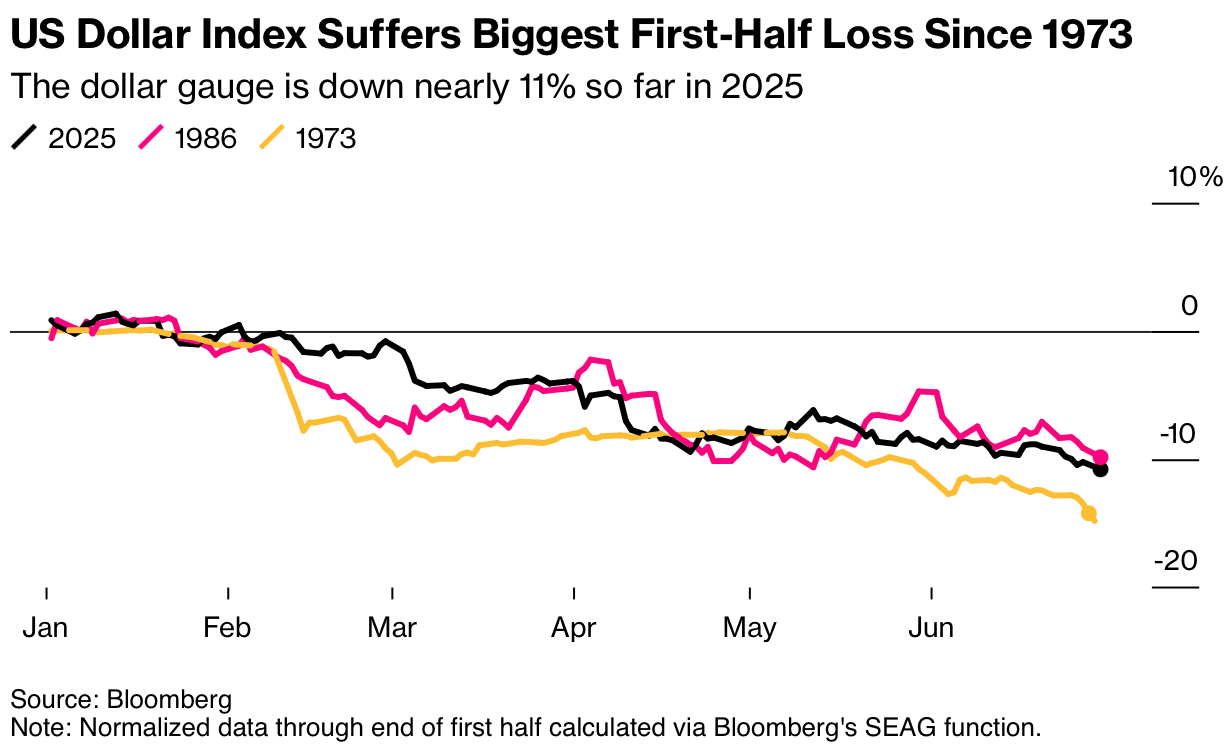
Through June 2025, The Dollar Had The Worst First Half Of A Year Since 1973. According to Bloomberg, “The US dollar index tumbled in the first six months of the year, posting its worst first-half performance since 1973 when Richard Nixon was president. The US Dollar Index has fallen about 10.8% year-to-date, compared with a 14.8% slump in the first half of 1973. Uncertainties associated with President Donald Trump’s trade and tariff policies - on top of his push for Federal Reserve rate cuts - have weighed heavily on the currency.” [Bloomberg, 2025-06-30]
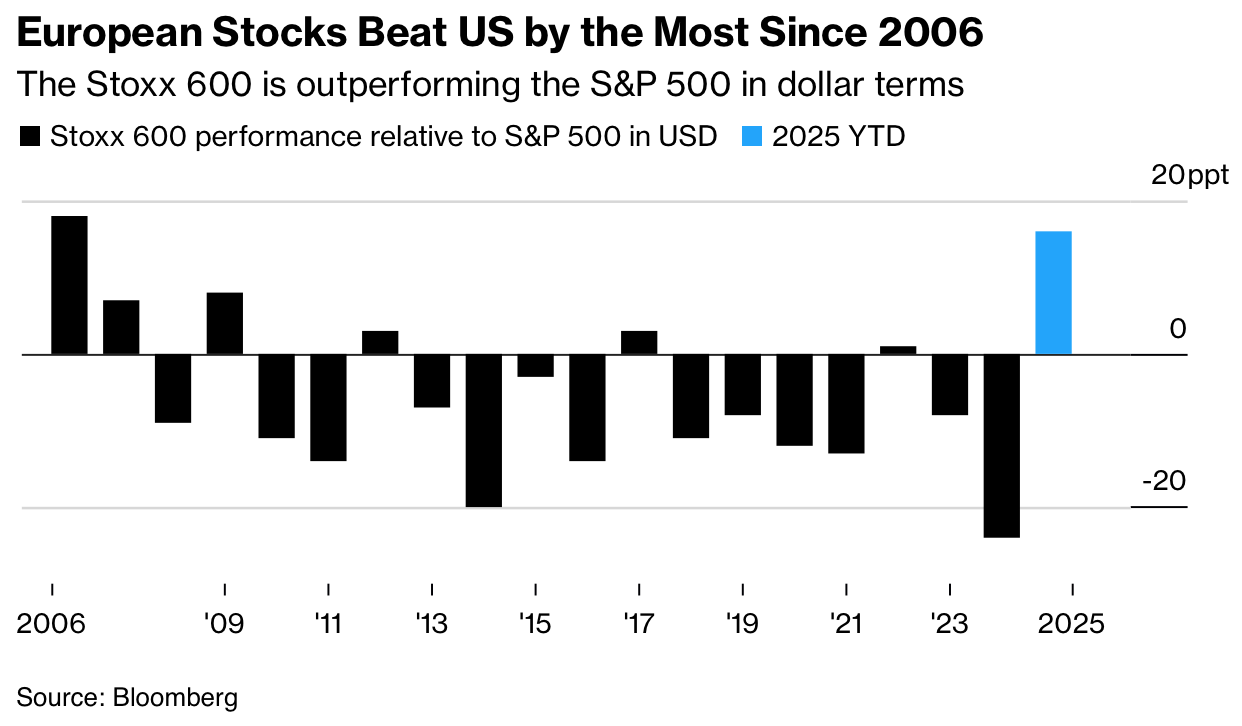
Through June 2025, European Stocks Had Outpreformed American Ones By The Most Since 2006. According to Bloomberg, “It was hard to find fans of European equities at the start of the year, let alone investors betting they would outshine their US peers. Six months on, fears about a sluggish economy and the threat of tariffs have been offset by Germany’s plans to unleash hundreds of billions of euros in defense spending after Trump demanded Europe foots its own military bill instead of relying on the martial heft of the US. As of June 27, the benchmark Stoxx 600 index had trounced the S&P 500 by 16 percentage points in dollar terms, the best relative performance since 2006. The euro has surged to $1.17, bucking widespread forecasts for parity with the dollar in early 2025.” [Bloomberg, 2025-06-29]
Movement To Europe
As Trump’s Policies Have Driven Away Capital, Europe Has Become A More Attractive Place For Companies To Borrow. According to the Financial Times, “Sales of risky European corporate debt surged to their highest ever level in June, as lowly rated companies take advantage of a capital flight out of US markets on fears over the fallout from President Donald Trump’s trade tariffs. Issuance by high-yield, or junk-rated, companies — many of which have previously struggled to access the market — rose to about €23bn in June, according to JPMorgan data. That beats the previous monthly record, set in June 2021, by roughly €5bn. June also saw the greatest number of deals on record at 44, according to PitchBook data. ‘The market is drowning in new deals,’ said an investor at a European credit hedge fund. Junk-rated companies are responding to a fall in borrowing costs due to greater demand from investors, many of whom are shifting allocations away from US assets due to Trump’s erratic trade policy and concerns about the government’s huge borrowing needs. Although the US stock market has rebounded strongly in the second quarter, a broad shift away from dollar bond markets has continued, helping drive the greenback to its weakest start to the year in more than half a century. European high-yield bond funds, meanwhile, have posted seven straight weeks of inflows, according to Bank of America data.” [Financial Times, 2025-07-02]
Exporting Volatility
The Taiwanese Central Bank Has Been Forced To Buy Dollars To Prevent Weakness In The Currency From Rippling Through Its Life Insurance Industry. According to Bloomberg, “The Taiwan dollar surged more than 2% in another day of volatility for the currency, as exporters’ sales of the greenback tested the central bank’s tolerance for local currency strength. The currency jumped as much as 2.5% to 29.16 per US dollar Tuesday in the biggest one-day gain since early May, after sliding over 2% on Monday. The latest move pushed the local currency’s gain this year to 12%, making it the best performer in Asia. Large foreign inflows and significant US dollar selling by local exporters were seen in Tuesday’s morning session, according to two traders, who asked not to be identified as they weren’t authorized to speak publicly. State banks bought the greenback to smooth market liquidity, they said. The local currency has been buffeted by a series of sharp swings since last Friday, as the central bank stepped in to check its gains following the US dollar’s decline. Authorities are eager to prevent a sharp appreciation to ease the pressure on life insurers after a jump in exports amid the trade war triggered a wave of repatriation by Taiwan’s corporates.” [Bloomberg, 2025-07-01]
As Capital Has Flown Out Of The Country, The Weak Dollar Has Made Life More Complicated For European Policymakers. According to Bloomberg, “European Central Bank Vice President Luis de Guindos said an advance in the euro beyond $1.20 could prove tricky for policymakers but current levels aren’t cause for concern. In rare remarks by an ECB official on the common currency’s exchange rate, Guindos told Bloombergg TV that the speed of the euro’s ascent is more worrying than its current level. ‘I think that $1.17, even $1.20, is not something,’ the Spanish official said Tuesday on the sidelines of the ECB’s annual retreat in Sintra, Portugal. ‘We can overlook it a little bit. Something beyond that would be much more complicated. But $1.20 is perfectly acceptable.’” [Bloomberg, 2025-07-01]
- Surging 14 Percent, The Euro Has Nearly Matched Its Longest Winning Streak Against The Dollar. According to Bloomberg, “The euro has benefited from a slump in the dollar as Donald Trump’s tariff blitz dented confidence, gaining about 14% this year to leave it on the verge of its longest winning streak against the US currency in more than two decades. ECB President Christine Lagarde has called that trend ‘counterintuitive, but justified.’ ‘We should try to avoid any sort of overshooting,’ Guindos said.” [Bloomberg, 2025-07-07]
Benefits To Volatility Traders
In The First Third Of 2025, Citi’s Hedge Funds Clients Traded 23 Percent More Currency. According to Bloomberg, “Flavio Figueiredo’s flight had just lifted off the ground in London when President Donald Trump announced sweeping ‘Liberation Day’ tariffs in April, setting off the biggest daily electronic trading volume ever seen by the Citigroup Inc. executive’s global foreign-exchange team. Such unexpected bouts of market turmoil — as well as the bank’s investments in talent and technology — have helped drive a trillion-dollar increase in FX volumes traded by Citigroup’s hedge fund clients. In this year’s first four months, the firm saw such business jump about 23% to a record $6.1 trillion from a year earlier. ‘We’ve moved up in the ranks,’ Figueiredo said in an interview, citing analysis commissioned by Citigroup showing that its growth with hedge funds is outpacing the market average. ‘When volatility hit, we brought the best of our firm to our clients, including increasingly active hedge funds.’” [Bloomberg, 2025-06-26]
Trade War
Q2 2025: Measures Of Auto Sales Declined Following Tariff-Induced “Pull Forwards” Earlier In The Year. According to Bloomberg, “US auto sales are losing momentum after a springtime surge fueled by shoppers racing to buy cars before President Donald Trump’s auto tariffs drove up prices. General Motors Co. said deliveries rose 7.3% in the second quarter, as industrywide demand cooled following a stronger-than-expected April and May. Ford Motor Co.’s second-quarter sales jumped 14%, helped by its employee-pricing-for-everyone discount program, though it saw the pace of growth moderate in June. Toyota Motor Corp.’s sales in April-through-June period rose 7.2%, but volumes were essentially flat last month. ‘We did have a lot of pull-forward business, I think the whole industry did’ from late March into early May, said David Christ, the head of Toyota brand sales in the US. Since then, ‘the sales pace returned to what I call more normal,’ he told reporters in a briefing on Tuesday. Shoppers rushed to showrooms earlier this year as beating tariff-induced price increases became a motivation to buy, pushing up second-quarter sales an estimated 2.5% from the prior-year period, according to industry researcher J.D. Power.” [Bloomberg, 2025-07-01]
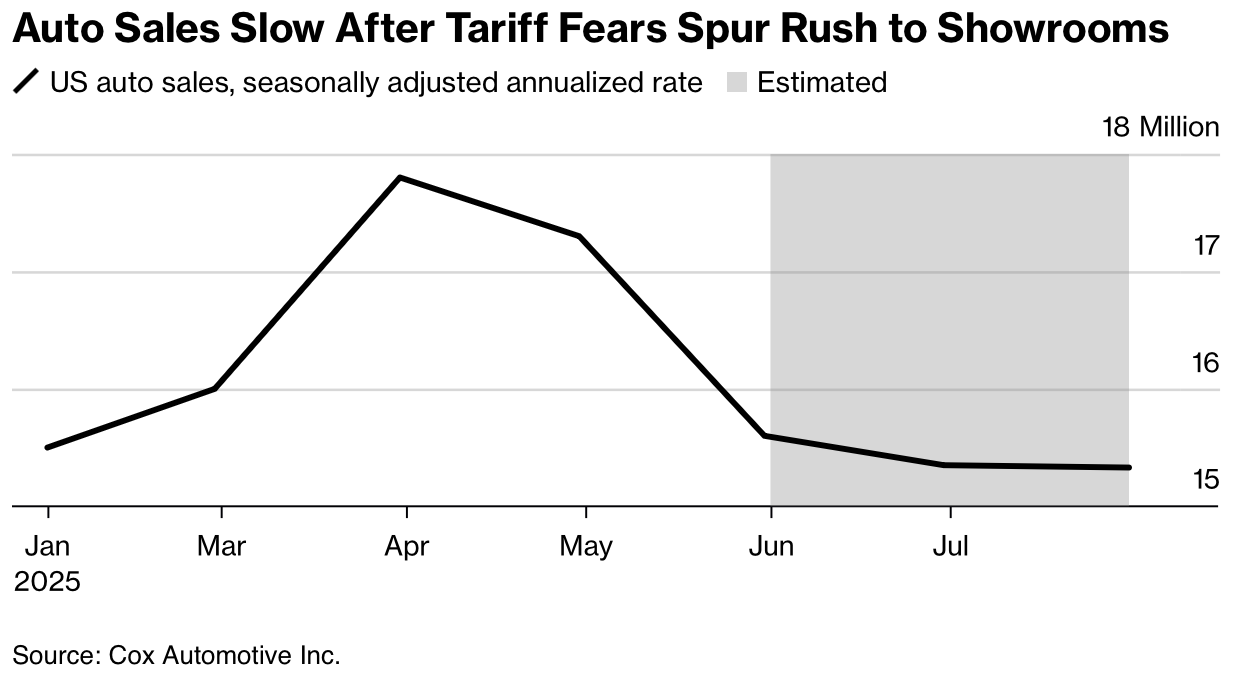
“The Party Is Over” As Cox Noted June Delieveries Were Down To Their Slowest Pace In The Last 12 Months. According to Bloomberg, “The annual automotive selling rate likely fell to 15 million in June — the slowest pace in the last 12 months — from 17.6 million in April as consumers grow cautious about big-ticket purchases over worries about the economy. With already high car prices expected to rise further as automakers manage billions of dollars in tariff costs, it may only get worse from here. ‘The party is over,’ Jonathan Smoke, chief economist for researcher Cox Automotive Inc., said in an interview.” [Bloomberg, 2025-07-01]
Trump’s Capricious Behavior Has Limited The Upside For Other Countries To Make Trade Deals With Him. According to Bloomberg, “Not only is the president likely to fall short of that number, the deals that have been made have included cautionary tales for other negotiating partners. The UK entered its framework expecting duties on metals imports to fall to zero, only to see the US keep 25% levies on steel and aluminum with a promise to broker a future quota systems. Rare earths shipments that Trump said China agreed to resume quickly in a round of talks in London have yet to fully materialize. Some partners, including Japan, India and EU, have balked at signing deals without knowing how badly they’ll be hit by separate levies on exports including chips, drugs and commercial aircraft. The US Commerce Department will announce the results of probes into some of those sectors in the coming weeks, which could lead to levies.” [Bloomberg, 2025-06-29]
Higher Costs
Goldman Sachs: While Companies Will Be Able To Pass On Most Higher Costs To Consumers, Margins Could Also Be Compressed. According to Bloomberg, “US profit margins face a big test in the upcoming reporting season as investors assess the damage from President Donald Trump’s trade war, according to Goldman Sachs Group Inc. strategists. The team led by David Kostin said second-quarter earnings will ‘capture the immediate effects’ of tariffs that have already increased by about 10 percentage points since the start of the year. While most of the added costs are expected to be passed on to customers, ‘corporate margins will be pressured if companies are forced to swallow a larger-than-expected share,’ Kostin wrote in a note dated June 27. Early results from US companies paint a mixed picture. Shares of General Mills Inc. fell 5% last week as the food company issued a glum forecast and warned of a tariff hit on its cost of goods sold. Nike Inc., on the other hand, surged 15% as it said it would mitigate the impact on costs from higher duties.” [Bloomberg, 2025-06-30]
Chinese Control Of Rare Earths
As Rare Earths Have Become Central To Trump’s Trade War, The Chinese Government Has Begun Confiscating Expoerts’ Travel Documents To Make Sure They Do Note Travel Without Permiession. According to the Wall Street Journal, “China has told companies in its rare-earth industry to give the government lists of employees with technical expertise, aiming to ensure they don’t divulge trade secrets to foreigners. The queries point to the growing geopolitical significance of China’s control over the materials, which are widely used in cars, electronics and weapons and stand at the center of the U.S.-China trade war. According to people familiar with the queries, China’s Ministry of Commerce in recent weeks asked rare-earth companies based in China for personnel lists that include specialist employees’ specific expertise, education, research background and personal information. The goal, the people said, is to develop a formal catalog of Chinese nationals with rare earth expertise and keep tabs on these employees to make sure they don’t travel abroad and reveal secrets. The lists include those in upstream roles, such as processing rare earths, and those in downstream roles, such as those using the processed minerals to make rare-earth magnets. The magnets are used in automobiles, wind turbines, drones and jet fighters. One of the people said some experts at Chinese companies have been asked to turn in their passports to their companies or local authorities, to ensure they don’t make any unauthorized trips. China already requires government officials and employees of state-owned companies to turn in travel documents and apply for approval to travel abroad.” [Wall Street Journal, 2025-06-25]
June 2025: Despite Trump’s Assurances That The Situation Had Been Resolved, Ford Was Forced To Idle Factories For The Lack Of Rare Earths From China. According to Bloomberg, “Ford Motor Co. temporarily idled factories in the US over the last three weeks due to a shortage of magnets containing rare earth minerals, key components embroiled in US trade tensions with China. Chief Executive Officer Jim Farley said the situation demonstrates the need to develop a domestic supply chain for critical auto components. China has instituted a new approval process for exports of rare earths that has slowed supply lines. ‘We cannot get any high powered magnets without China,’ Farley said Friday at the Aspen Ideas Festival. ‘We shut down plants for the last three weeks because we cannot get high powered magnets.’ Farley said those magnets are critical to seats, windshield wipers, doors and audio systems. ‘We can’t make that stuff,’ he said of the magnets. Farley has been outspoken about the company’s struggles obtaining the materials, even after US President Donald Trump earlier this month said negotiations with China yielded an agreement for Beijing to swiftly approve export licenses for rare earths.” [Bloomberg, 2025-06-27]
Small Business Destruction
2025: 93 Percent Of American Industrial Firms Had Fewer Than 100 Employees. According to Bloomberg, “The stakes are especially high for manufacturers with fewer than 100 employees, which account for 93% of the roughly 240,000 US industrial firms. Unlike global conglomerates, these companies often lack the cash reserves, lobbying muscle or supply-chain flexibility to absorb steep tariff hikes or pivot production.” [Bloomberg, 2025-07-01]
Guitar-Parts Makers Have Been Devastated
Owner Of Michigan-Based Company: “My Next Step Is To Mortgage The House.” According to Bloomberg, “Jon Cusack, 55, runs a pedal manufacturer in Holland, Michigan, that builds delay, reverb and other stomp boxes for his brands and other firms. He said he spent $200,000 on inventory before tariffs took effect, draining his savings. ‘I”ve gotten to the point where my slush funds are all gone, and I still am facing several tariff bills coming up,’ said Cusack, whose 30-person company had revenue of $3.9 million last year. ‘Can we survive three months, six months, you know, a year? My next step is to mortgage the house, and I really don’t want to do that.’” [Bloomberg, 2025-07-01]
Ohio-Based EarthQuaker Devices Has Considered Moving Production Overseas In Response To Trump’s Tariffs. According to Bloomberg, “The alliance was started by Julie Robbins, 46, chief executive officer of EarthQuaker Devices in Akron, Ohio. To avoid layoffs among her 35 workers, Robbins tapped the company’s credit line. But she fears that strategy won’t hold and is considering moving some production overseas — a painful twist, given the tariffs were meant to bring jobs home.” [Bloomberg, 2025-07-01]
June 2025: Oklahoma-Based 35-Person Keeley Electronics Was Forced To Rely On Amex Rewards To Pay Trump’s Tariff Bills. According to Bloomberg, “When a tariff bill for almost $11,000 arrived without warning, Robert Keeley reached for one of his last financial lifelines and cashed in 1.83 million American Express reward points to pay it. ‘It’s like a needle pin holding back a crack in the dam,’ said Keeley, who runs Keeley Electronics, a guitar-pedal manufacturer with 35 employees in Oklahoma City. Keeley’s scramble is part of a broader reckoning for America’s smaller businesses, which are being whipsawed by volatile trade policies. Another blow could land on July 9, the deadline President Donald Trump has imposed on other countries to secure trade deals with the US to avoid higher tariffs. The stakes are especially high for manufacturers with fewer than 100 employees, which account for 93% of the roughly 240,000 US industrial firms. Unlike global conglomerates, these companies often lack the cash reserves, lobbying muscle or supply-chain flexibility to absorb steep tariff hikes or pivot production. Among those feeling the pressure are a tight-knit group of guitar-pedal manufacturers including Keeley, who run boutique businesses that build the stomp boxes that shape the sound of music. The niche industry offers a window into the economic toll of tariff whiplash on smaller firms.” [Bloomberg, 2025-07-01]
Financial Instability
Rolling Back Cybersecurity Regulations
While The Biden Administration Had Required Federal Agencies And Software Vendors To Provide Proof Of Having Improved Cybersecurity, The Trump Administration Has Rolled Back That Requirement. According to Bloomberg, “A former Biden administration official said the Democrat’s executive orders pushed federal agencies and software vendors to improve cybersecurity. Software vendors were also required to provide proof of having done so, a provision the Trump administration has rolled back, the official said.” [Bloomberg, 2025-06-30]
- Despite Having Experienced At Least Three Major Hacks In The Past Five Years, Trump’s DOGE Pushed Out Treasury Cybersecurity Officials. According to Bloomberg, “Treasury has experienced three major hacks in the past five years, including two that have come to light since December. Meanwhile, its ranks of cybersecurity leaders have been decimated this year by departures pushed by Elon Musk’s Department of Government Efficiency, which the world’s richest person left in May. […] Some fear the impact of DOGE on Treasury’s cyber defenses will make matters worse. Treasury revealed plans to lay off a ‘substantial number’ of its more than 100,000 employees across its different bureaus to comply with Trump’s executive order implementing the DOGE initiative, Bloomberg reported in March, citing a court filing.” [Bloomberg, 2025-06-30]
April 2025: Following An OCC Breach, Some Of The Country’s Largest Bansk Stopped Sharing Mandatory Information. According to Bloomberg, “The disclosure of the OCC attack in April brought the financial sector to a tipping point. In that breach, hackers spied for over a year on more than 100 email accounts, accessing highly sensitive information about federally regulated financial firms. Some of America’s largest banks, including JPMorgan Chase and Co. and Bank of New York Mellon Corp., responded by taking the extraordinary step of pausing electronic sharing of mandatory information with the OCC , which includes confidential data such as the results of cybersecurity audits and vulnerability assessments. They have since resumed.” [Bloomberg, 2025-06-30]
Insurance
As Liability Insurance Payouts Have Risen, Coverage Has Gotten More Expensive And Firms Have Exited The Market. “The Cover Won’t Be Available.” According to the Financial Times, “Part of the US commercial insurance market is on the verge of ‘breakdown’, executives have warned, as insurers withdraw US casualty coverage because of a rise in payouts that industry groups blame on ‘legal system abuse’. The cost of US casualty insurance, which businesses buy to protect themselves against legal claims from employees, customers or others harmed by their operations or products, has climbed for 23 quarters in a row, according to the world’s largest insurance broker Marsh. Prices for the insurance segment rose 8 per cent in the first quarter of this year, despite insurers carving out new exclusions and lowering the total they promise to pay out for any claim. That could soon mean insurers withdraw from the market altogether, the chief executive of one leading insurance carrier said. ‘It won’t be a question of how much you”re willing to pay — the cover won’t be available,’ Everest chief executive Jim Williamson said at the Financial Times” insurance summit last week. ‘No one will offer it at any price. That’s when you start to see a real breakdown.’” [Financial Times, 2025-06-25]
January 2025: Powell And Warren Buffett Separately Warned That Climate Change Was Making Parts Of The Country Uninsurable. According to the Financial Times, “In January, the Financial Stability Board, which was set up to keep an eye on the global financial system after the 2008 crisis, said insurance was becoming more costly and scarce in disaster-prone areas and ‘climate shocks’ could set off wider market turmoil. In early February, US Federal Reserve chair Jay Powell warned that the Fed was also seeing banks and insurers pull out of risky areas. ‘If you fast forward 10 or 15 years, there are going to be regions of the country where you can’t get a mortgage. There won’t be ATMs [and] banks won’t have branches,’ he told Congress. ‘I don’t know that it’s a financial stability issue, but it certainly will have significant economic consequences.’ Less than two weeks later, Warren Buffett told shareholders in his Berkshire Hathaway conglomerate, which includes a string of insurers, that property cover prices had gone up thanks to a major increase in violent storm damage. ‘Climate change may have been announcing its arrival,’ he said. ‘Someday, any day, a truly staggering insurance loss will occur — and there is no guarantee that there will be only one per annum.’” [Financial Times, 2025-06-26]
Crypto
Despite Giving Up Crypto Offerings As A Condition Of Being Granted A Bank Charter, Trump Administration Guidance Has Pushed SoFi To Add Crytpo Offerings Back To Its App. According to Bloomberg, “SoFi Technologies Inc. plans to offer crypto spot trading and global remittances to benefit from an ease-up in regulations under the Trump administration. Customers will be able to buy, sell and hold cryptocurrencies such as Bitcoin and Ethereum in their accounts, SoFi said in a statement Wednesday. The plan is to eventually expand into stablecoin offerings and add the ability to borrow against cryptoassets. SoFi dropped crypto investing in 2023 as a condition of receiving a bank charter under a stricter regulatory environment. The firm said recently published guidance from regulators now makes it permissible for national banks to offer some types of crypto services.” [Bloomberg, 2025-06-25]
Private Assets
Stability Mirage
Private Credit Firms Have Formed A Unified Bloc To Stop The Progress Of Trading Out Of Fears That It Would Make Prices More Volatile. According to Bloomberg, “That even JPMorgan, the largest and most powerful bank on Wall Street, still finds itself on the outside looking in, long after it began the initiative, reveals just how determined the top private credit shops are to maintain their stranglehold on the business. They had created the market, they note, to take advantage of the void left in corporate lending when banks retrenched in the wake of the 2008 crisis and have little intention of sharing the profits with those banks now that private credit is a multitrillion-dollar industry and the talk of the financial world. They have another strong motivation, too: The fear that if JPMorgan, or any of the other banks following in its footsteps, is successful in creating a vibrant trading market for the loans, it could shatter the perception—or mirage, as critics would argue—of price stability that they’ve spent years selling to investors. The value of the loans, the pitch goes, won’t ever get whipsawed around, and dragged down, by the vagaries of the broader markets because they are privately held assets. But if they trade regularly, price levels get marked, day after day, and private credit suddenly doesn’t look all that different than its public market counterparts.” [Bloomberg, 2025-06-24]
Private Credit Sponsors’ Incentives Have Been Aligned With Keeping As Much Information Out Of The Market As Possible. According to Bloomberg, “The owners, known as sponsors, often push back the hardest. For one thing, they like to limit the group of investors who have access to sensitive financial information about their companies, and loan trading would suddenly put those numbers in the hands of more people. More importantly, trades carried out at declining prices could expose stress in their companies and, in extreme cases, drag down the value of their equity stakes. The lenders also have a strong incentive to prevent the debt from being marketed at a discount, especially if a loan is troubled. The firms could be forced to incorporate those price quotes into their valuation process and revise their own marks downward, cutting into returns and fees. ‘Private loans are private for a reason — their owners want it private,’ Blair Jacobson, co-president of Ares Management Corp., said on Bloomberg TV earlier this month.” [Bloomberg, 2025-06-24]
Summer 2024: Lacking Information, JP Morgan Bid More Than 90 Cents On The Dollar For Debt From Pluralsight Inc, Where Creditors Had Marked It Down To 50 Cents On The Dollar. According to Bloomberg, “The trading push has led to some embarrassing moments for JPMorgan. Like last summer, when its traders sent out a run that included price quotes on loans made to educational software company Pluralsight Inc. The run pegged going prices at above 90 cents on the dollar. But Pluralsight, it turns out, was so mired in financial trouble at the time that it was restructuring that debt. Some creditors had marked its value all the way down to 50 cents.” [Bloomberg, 2025-06-24]
Push Into Retail Assets
June 2025: BlackRock Accelerated Its Push To Move Retail Funds Into Private Assets. According to the Wall Street Journal, “BlackRock s accelerating a push into private investments by including them in funds for 401(k) retirement plans. The world’s largest asset manager plans to offer a 401(k) target-date fund with a 5%-to-20% allocation to private investments, depending on an investor’s age, in the first half of 2026, the company said.” [Wall Street Journal, 2025-06-26]
- Claiming Private Assets Could Add 50 Basis Points In Preformance, BlackRock Planned To Offload Some Of Their Own Private Assets Into Retail Investors’ Plans. According to the Wall Street Journal, “Proponents of private investments say they can boost returns over a portfolio of stocks and bonds. BlackRock estimates target-date funds with private investments could earn an extra 0.5% annually on average, before fees. Compounded over 40 years, that would produce a 401(k) balance that is 15% higher than a similar target-date fund without private investments, the company said. In its own coming target-date offering, BlackRock said it plans to use its own private-equity and private-credit investments.” [Wall Street Journal, 2025-06-26]
NOTE: Private Asset Fees are higher than 0.5 percent AUM.
Antitrust
The Trump Administration’s Laxer Approach To Antitrust Issues Has Contributed To A Surge In M&A Activity, Especially Involving Private Firms. According to Bloomberg, “Big money takeovers of private companies helped drive mergers and acquisitions in the first half, as dealmakers got comfortable writing sizable checks in topsy-turvy markets. More than half of the 10 largest deals announced in 2025 have involved a private target, data compiled by Bloomberg show, including the tie-up of Charter Communications Inc. and Cox Communications, Alphabet Inc.’s purchase of cybersecurity firm Wiz Inc. and Constellation Energy Corp.’s acquisition of US power station operator Calpine Corp. All were valued at around $30 billion or more including debt. Transactions like these and Meta Platforms Inc.’s $14 billion-plus investment in data-labeling startup Scale AI have lifted the value of all deals globally by almost a fifth to $1.8 trillion, the data show. […] Companies are also getting a better grasp of the US government’s approach to antitrust issues. Advisers say a return to traditional enforcement practices under Trump is emboldening companies to strike more ambitious mergers. This month, the Federal Trade Commission greenlit Omnicom Group Inc.’s $13.5 billion buyout of rival advertising agency Interpublic Group on the condition it promise not to withhold online ads for political reasons. Krishna Veeraraghavan, global co-head of the M&A group at law firm Paul Weiss Rifkind Wharton & Garrison, told Bloomberg News in a recent interview that the Omnicom-IPG settlement was interesting because it was cleared with remedies tied to conduct that was consistent with the aims of the Trump government.” [Bloomberg, 2025-06-30]