Almost six months into his second term, the negative consequences of Trump’s economic policies have continued to materialize. In Texas this weekend, at least 80 people were killed in a situation that was certainly not made better by the massive layoffs and funding cuts to weather forcasting that his administration has pushed for. A similar vendetta against some of the most cost-effective energy technology has led to almost $25 billion in factory projects being cancelled, while his obsession with oil below the cost American producers can drill for it has further depressed planned American energy production: to the benefit of lower-cost OPEC+.
Meanwhile, his trade war is causing all kinds of problems. While it is providing some businesses with an opportunity to raise prices beyond what his tariffs have caused, most find themselves in a “cage-match” between higher input prices, consumers tired of inflation, and uncertainty. Adding to that uncertainty is the structure of the “deals” he has pushed for: overlapping monstrosities that–in addition to pushing tariffs higher than they have been since they exacerbated the Great Depression–have made the process of actually paying the tariffs harder, while leaving the authority for those tariffs in the hands of someone not exactly known for his stability.
It seems the only part of the American economy that is thriving is the part most closely associated with him: unprofitable companies, crypto specualtors, and pharma companies that got a $5 billion giveaway from his signature Medicaid cuts.
Consequences
July 2025: Trump Claimed That His Staffing Cuts To The National Weather Service Had Nothing To Do With The Failure To Predict The Texas Floods, Ruling Out Rehiring Meteorologists. According to Axios, “The Trump administration pushed back Sunday on criticism of the National Weather Service’s initial forecasting and its staffing levels ahead of Central Texas’ catastrophic flooding. The big picture: The storm that’s killed at least 80 people has brought renewed scrutiny to federal cuts at NOAA’s NWS after it emerged that two Texas NWS offices were missing key staff at the time — including San Antonio, where a veteran warning coordination meteorologist has taken an early retirement buyout in April. Driving the news: Some in the weather community have raised concern about the staffing issues, which Rep. Joaquin Castro (D-Texas) said Sunday should be investigated. ‘I don’t think it’s helpful to have missing key personnel from the National Weather Service not in place to help prevent these tragedies,’ he told CNN. Experts told Axios that forecasting models that failed to predict the severity of rainfall, a lack of an adequate warning system and bad timing in part led to the disaster. Texas Division of Emergency Management chief Nim Kidd noted at a Friday briefing the original forecast ‘did not predict the amount of rain we saw’ and Dalton Rice, the city manager for Kerrville, said the storm system ‘dumped more rain than what was forecast.’ What they’re saying: When a reporter asked President Trump whether his administration would investigate if some of the cuts to the federal government left key vacancies at the NWS, he responded: ‘They did not.’ Trump described the situation as ‘a 100-year catastrophe’ that’s ‘so horrible to watch.’ Asked later if he thought meteorologists should be rehired, Trump said: ‘I would think not. This was the thing that happened in seconds. Nobody expected it. Nobody saw it. Very talented people in there and they didn’t see it.’” [Axios, 2025-07-07]
Trade War
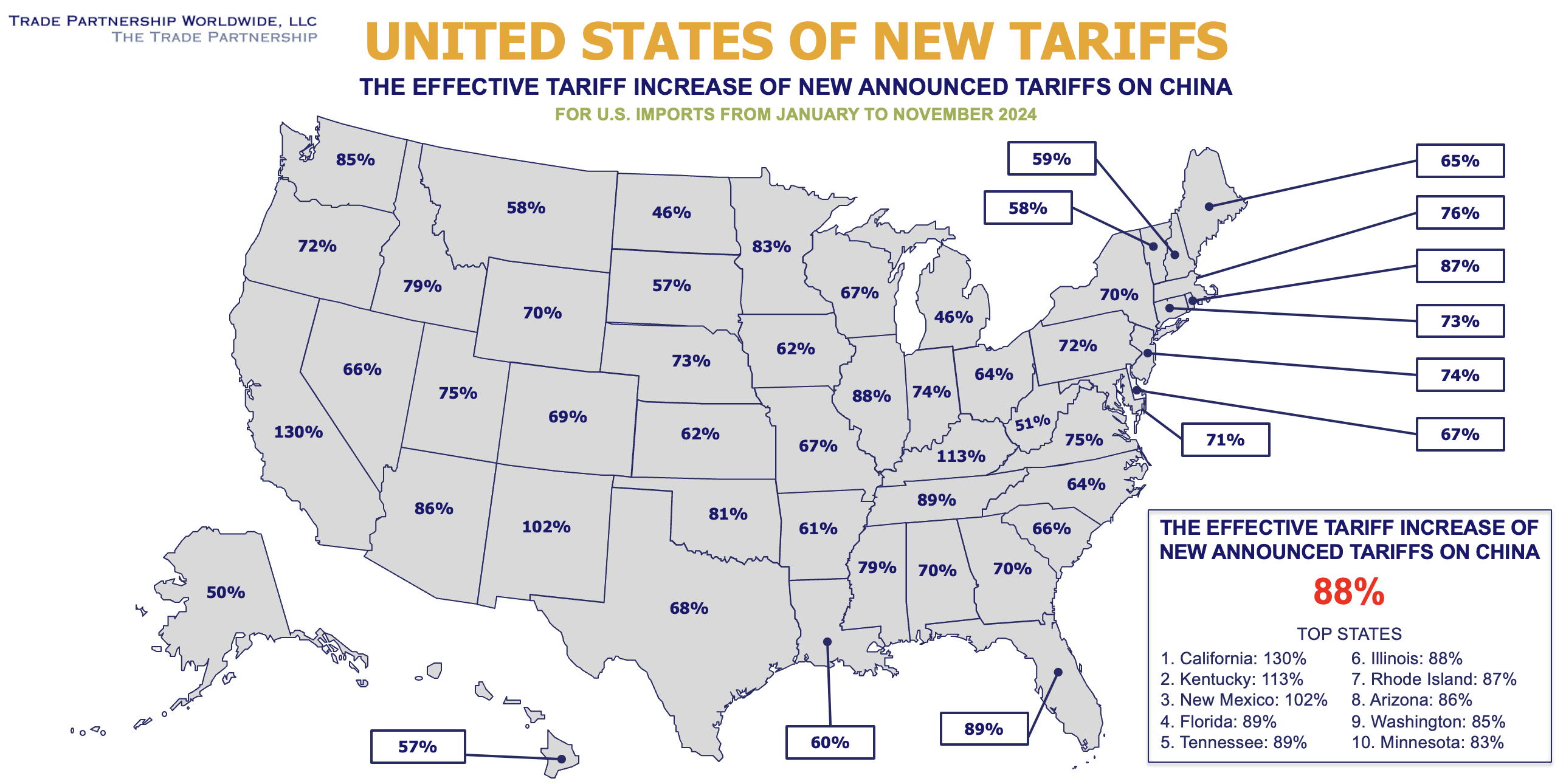
Trade Partnership Worldwide: Trump’s Announced Tariffs Would Raise Rates On Goods Imported To Each State By Between 50 And 130 Percent. According to Trade Partnership Worldwide, [Trade Partnership Worldwide, accessed 2025-07-07]
Based On The “Deals” That Have Been Reached By The Trump Administration, The Plan Would Be To Lock In The Highest Tariffs Since The 1930s. According to Bloomberg, “Once upon a Liberation Day, this was going to be the week by which President Donald Trump would have renegotiated America’s trading relationships with the world. We”re still waiting for the flurry of promised bilateral deals, which Trump telegraphed will start rolling out around noon today in Washington. On Sunday we got an indication the July 9 deadline may effectively be extended to Aug. 1. But we do know more than we did about what Trump wants the US’s economic connections with other countries to look like than we did 90 days ago. What’s clear already is that the threatened new economic order that spooked markets back in April appears well on its way. Even if markets remain convinced Trump will inevitably veer in a more benign direction. That’s not based on Trump’s threats. It’s a view derived from the agreements he’s struck with the UK, his declaration of another with Vietnam, and what we know about the ceasefire with China. Three truths have become apparent from those. The first is that the pacts or frameworks Trump strikes are primarily about cementing in new tariffs. Which also means removing the US from the global trading order that has prevailed since the 1940s. That last bit should be obvious by now. What seems to often get lost is the chaos and complexity involved. These are tariff deals rather than trade pacts. The biggest thing we know so far about the terms agreed with the UK, Vietnam and China is that the minimum duties imports from those countries will face for the foreseeable future will be 10%, 20% and 30% respectively. Even the European Union has, as Bloomberg has reported, grudgingly come to accept a new 10% Trump baseline. The tariff wall Trump is erecting around the US is the largest seen since the 1930s. But he’s also doing it in piecemeal fashion and blowing up the idea at the heart of the system that has prevailed since the Second World War. Which is where chaos and complexity come in.” [Bloomberg, 2025-07-07]
As The Deals Trump Has Struck Are Not Treaties, Either Party Could Withdraw At Any Given Time. According to Bloomberg, “The third takeaway is that everything is temporary. The key clauses in the text of the provisional agreement that the US and UK unveiled in May were that the deal was not legally binding and that either side could withdraw whenever they wanted to.” [Bloomberg, 2025-07-07]
Increased Complexity Of Doing Business
The Overlapping Rules Trump Has Created, Along With A Rigerouse Enforcement Regime Will Likely Make The Process Of Importing Any Goods Much More Complicated, Adding Additional Compliance Costs To His Tariffs. According to Bloomberg, “Under what is known as the ‘most favored nation’ principle, tariffs are assigned to products no matter where they come from. A widget from the UK is treated the same as one from Vietnam or China as long as all three countries sign on to the system and abide by the rules. Trump and his team are promising to instead assign the same widget a different tariff based on its provenance. As they have with cars from the UK, they are also imposing quotas that mean widgets attract different tariffs depending on the volume imported. Layer all the country deals Trump is promising on top of each other and the number of permutations is large. But there’s also sectoral tariffs on autos, aluminum and steel, and the products containing them. Plus, forthcoming duties on pharmaceuticals, semiconductors, lumber, copper and critical minerals. All those tariffs — the burden of complying with them — will eventually have economic consequences.” [Bloomberg, 2025-07-07]
Inflation
WSJ: In Addition To Raising Input Prices, Tariffs Have Also Provided A Narrative Backing To Firms Raising Prices. According to the Wall Street Journal, “Sitting around a table with 15 local business leaders, Tom Barkin peppered them with questions like an economic detective. Are you planning to expand or shrink your workforces? Are you making new investments or pulling back? When the conversation turned to inflation, the Richmond Fed president extracted an uncomfortably honest answer about how President Trump’s tariffs have some firms thinking about their power to raise prices. ‘You can probably appreciate this from your McKinsey background: We”re raising prices where we can,’ said Jim Datin, a Chapel Hill-based life-sciences executive and partner at a private-equity firm. And what convinced Datin his company still had pricing power, Barkin asked, when conventional wisdom said it had evaporated? ‘Some of it’s opportunistic with the supply chain right now,’ Datin offered. ‘In other words, tariffs,’ Barkin said, translating the corporate-speak. Then the management consultant-turned-central banker cut to the chase: Are those price increases for tariff-related costs or are his businesses using ‘tariff noise’ as ‘air cover to raise prices’? ‘It’s both,’ said Datin. ‘And I feel a little guilty saying that.’ A regional banker chimed in: Some of his customers were reporting the same thing.” [Wall Street Journal, 2025-07-04]
Capital Flight
July 2025: Scott Bessent Stealthily Walked Back The Strong Dollar Policy. According to Bloomberg, “Comments from US Treasury Secretary Scott Bessent about the dollar may have been overlooked heading into the long weekend. Steve Barrow of Standard Bank is advising investors to tune in. In a Thursday interview with Bloomberg TV, Bessent said, ‘The price of the dollar has nothing to do with a strong dollar policy. The strong dollar policy is, are we doing the things over the long term to ensure that the US dollar remains the reserve currency of the world.’ This suggests to Barrow that the policy ’no longer means a desire to see the dollar rise”” and the tweak ’could undermine the dollar going forward.”” The dollar just finished its worst first half since 1973, slumping almost 11%.” [Bloomberg, 2025-07-07]
Destroying American Industry
Richmond Fed Chair: Trump’s Tariffs Have Put Firms In A “Cage Match,” Between Higher Input Prices, Consumers Wary Of Inflation, And Uncertainty. According to the Wall Street Journal, “Barkin’s conversations also reveal the limits of on-the-ground intelligence. The more businesses he talks to, the hazier the outlook becomes. Firms are caught in what he calls the ‘cage match’—trying to protect margins squeezed by tariff costs while facing customers fatigued by price hikes. On top of that, businesses are frozen by policy uncertainty. ‘If you”re driving in a fog, you can’t put your foot on the gas because you might run off a cliff, and you can’t put your foot on the brake because someone behind might wreck into you,’ he said. ‘All you can do is pull over and put on the hazards.’” [Wall Street Journal, 2025-07-04]
Canceled Investments In Key Technologies
Atlas Public Policy: Since Trump’s Inauguration, Roughly $24 Billion In Investments In Green Factories Have Been Canceled. According to Bloomberg, “They’re among the dozens of planned green factories that have been cancelled, with more delayed or downsized, all hit by soaring costs, high interest rates and slow-growing EV demand. About 9% of the $261 billion in green factory investment announced since 2021 has been shelved — most of it since President Donald Trump returned to office in January — according to research firm Atlas Public Policy. Energy Secretary Chris Wright has said his agency doesn’t plan to move forward with some of the big-dollar loans that had been made to green manufacturing plants during President Joe Biden’s term.” [Bloomberg, 2025-07-05]
Oil Industry Hurt By Trump-Supported OPEC Production Hikes
July 2025: Following Trump’s Prompts, OPEC+ Put Forward Plans To Boost Oil Production. According to Reuters, “OPEC+ oil producers are set to approve another big output boost for September as they complete both the unwinding of voluntary production cuts by eight members and the United Arab Emirates’ move to a larger quota, five sources said. The group, which pumps about half of the world’s oil, has been curtailing production for several years to support the market. But it has reversed course this year to regain market share and as U.S. President Donald Trump demanded the group pump more to help keep gasoline prices lower.” [Reuters, 2025-07-07]
July 2025: OPEC+’s Announcement Of Higher Production Put Pressure On American Shale Producers, Contributing To Their Expected Decline In Production. According to Bloomberg, “On Saturday, the Organization of the Petroleum Exporting Countries and its partners blindsided energy traders by announcing that they would further speed up a revival in collective oil production next month. The move offers cheer for consumers and a win for Trump, who campaigned on a pledge to cut fuel costs. It also threatens pain for producers, from America’s shale heartlands to OPEC’s own members. […] Yet the rout will take a toll on America’s oil industry, from corporate giants like Exxon Mobil Corp., to the shale explorers who widely backed Trump’s bid to reclaim the White House. Shale executives said in a recent survey they expect to drill significantly fewer wells this year than planned at the start of 2025 as prices falter.” [Bloomberg, 2025-07-06]
May 2025: Goldman Sachs: Trump’s Posts And Actions Revealed An “Inferred Preference For WTI […] Around $40 To $50 A Barrel.” According to Bloomberg, “President Donald Trump appears to prefer US oil prices between $40 and $50 a barrel, according to Goldman Sachs Group Inc., citing an in-house analysis of his social-media posts on the topic. Trump ‘has always been focused on oil and on US energy dominance, having posted nearly 900 times,’ analysts including Daan Struyven said in a report. His ‘inferred preference for WTI appears to be around $40 to $50 a barrel, where his propensity to post about oil prices bottoms,’ they said. Oil prices — both global crude benchmark Brent, as well as US counterpart West Texas Intermediate , or WTI — are often buffeted by the president’s prolific social-media commentary, which can reference everything from OPEC policy and US gasoline prices to sanctions against nations including Iran. His administration has favored increased domestic production, as well as a broad push for cheap energy to help bring down inflation. The US leader ‘tends to call for lower prices (or celebrate falling prices) when WTI is greater than $50,’ the analysts said. ‘In contrast, President Trump has called for higher prices when prices are very low (WTI less than $30) often in the context of supporting US production.’” [Bloomberg, 2025-05-14]
June 2025: Dallas Fed Reported Breakeven Prices For New Wells Needed A WTI Price Between $61 And $70. [Dallas Federal Reserve, 2025-06-20]
Code
include("../scripts/oxocarbon-plot.jl")theme(:oxocarbon)# Load necessary packagesusingDataFrames, Dates, YFinance# Get data from yahoo financewti=get_prices("CL=F"; range="1y", interval="1d") |> DataFrame# Make The Plotplot(Date.(wti.timestamp), wti.adjclose; xlabel="Date", ylabel="Price per Barrel", title="Trump Wants Unprofitable Oil Production", linewidth=2, label="WTI", )hspan!([61,70]; alpha=0.5, label="Breakeven", )vline!([Date(2025,1,20)]; label="Inaguration", linewidth=2, linestyle=:dash,)
Financial Instability
Since Trump’s Liberation Day Tariffs, Unprofitable Stocks In The Russell 3000 Have Outpreformed Profitable Ones. According to the Wall Street Journal, “Forget the Magnificent Seven. Investors are now learning to love the Unprofitable 858. Meme stocks and money-losing companies are now back in favor, and underpinning a rally that has lifted the market to records. Of the 14 companies in the Russell 3000 index that have more than tripled since April 8, when the market bottomed out, 10 don’t generate any profits, according to analysts at Bespoke Investment Group. And through late June, the 858 Russell 3000 stocks with no earnings have since posted average gains of 36%, outperforming their profitable peers.” [Wall Street Journal, 2025-07-05]
July 2025: For The First Time Since The End Of 2021, Goldman Sachs’ Index Of Retail Investor Favorites Hit A New High. According to the Wall Street Journal, “Case in point: A Goldman Sachs index of retail traders’ favorite stocks just set its first record since November 2021, the previous peak for many speculative bets before they wilted under the strain of higher rates.” [Wall Street Journal, 2025-07-05]
Crypto
Assets In Tokenized Money Market Accounts, Which Crypto Derivatives Traders Have Used To Reduce Their Capital Requirements, Have Jumped 80 Percent Through July 2025. According to the Financial Times, “Crypto companies and traders are pouring billions of dollars into tokenised versions of money market and Treasury bond mutual funds, as they look beyond stablecoins to other places to park excess cash that can also give them some yield. Total assets held in tokenised Treasury products — which include funds whose units have been converted into digital tokens as well as some tokenised US government bonds — have jumped 80 per cent so far this year to $7.4bn, according to data group RWA.xyz. Funds run by BlackRock, Franklin Templeton and Janus Henderson have grown particularly rapidly, with combined assets tripling. Inflows have been driven in part by crypto traders, many of whom are finding tokenised funds a more attractive place than stablecoins to park their money. Some investors are also starting to use these funds as an easy-to-trade form of collateral in crypto derivatives transactions. ‘Stablecoins were the place holder, tokenised money market funds are the real deal. Traders are starting to make the switch,’ said Olivier Portenseigne at FundsDLT, which is part of the global post-trade services provider Clearstream. ‘Tokenisation . . . provides a cheaper and easier way to buy mutual funds, and liquidity is enhanced,’ he added. The election of pro-crypto US President Donald Trump has triggered a fresh wave of enthusiasm that blockchain-based technology can modernise the plumbing of financial markets, where the speed at which deals are settled still lags far behind the pace at which trading information is processed. Tokenising money market funds creates a digital version of one of the most conservative asset management products, which can then be held on a ledger. Proponents say tokenisation encourages faster and cheaper trading because Treasuries and money market funds can be accepted as collateral. Settlement times on a blockchain are minutes rather than days — which reduces capital requirements — while risks in meeting margin payments and administration expenses for the asset manager are also lower, they say.” [Financial Times, 2025-07-07]
Corruption
Giveaway To Pharma
Trump’s BBB Would Eliminate Some Medications From Medicare’s Ability To Negotiate, Handing $5 Billion To The Makers Of Those Drugs. According to the New York Times, “The sweeping Republican policy bill that awaits President Trump’s signature on Friday includes a little-noticed victory for the drug industry. The legislation allows more medications to be exempt from Medicare’s price negotiation program, which was created to lower the government’s drug spending. Now, manufacturers will be able to keep those prices higher. The change will cut into the government’s savings from the negotiation program by nearly $5 billion over a decade, according to an estimate by the nonpartisan Congressional Budget Office. ‘This is essentially giving $5 billion back to the pharmaceutical industry,’ said Dr. Benjamin Rome, a health policy researcher at Brigham and Women’s Hospital in Boston. ’It’s done in a way that is designed, on its face, to solve the problem of some misaligned incentives, but I don’t think it solves those problems. Under existing law, costly drugs are exempt from price negotiations if they are approved to treat a single rare disease — one that affects fewer than 200,000 Americans. Drugmakers have complained that this policy discourages them from running studies and seeking approval to treat a second rare disease, and that it ultimately deprives patients of new treatments. In response, the new bill spares drugs that are approved to treat multiple rare diseases. They can still be subject to price negotiations later if they are approved for larger groups of patients, though the change delays those lower prices. This is the most significant change to the Medicare negotiation program since it was created in 2022 by Democrats in Congress. In signing the new bill, Mr. Trump will weaken the program at a time when he is calling for even more drastic cuts to align drug prices in the United States with those in other wealthy countries. Mr. Trump has put forward no real policy for achieving that goal.” [New York Times, 2025-07-03]
 [Trade Partnership Worldwide,