July 09, 2025
False Claims
Announced Investments Were Less Than Half Of What Trump Has Tried To Claim
Reuters: More Than Half Of $2.6 Trillion In Private Investments Claimed By Trump Prexisted His Second Term. According to Reuters, “As of July 2, the website, opens new tab listed more than $2.6 trillion in U.S. investments, well short of the $14 trillion Trump boasts about. But a Reuters review found that just under half of the claimed spending on the website - totaling more than $1.3 trillion - originated under former President Joe Biden or represented routine spending repackaged to promote domestic investments. At least eight of the projects touted by the White House had sought or secured critical local incentive packages before Trump took office while at least a half dozen other projects had already been announced by local officials or the companies themselves, Reuters found. Two of the Trump Effect projects were aided by Biden’s legislative efforts to boost domestic manufacturing, the review found.” [Reuters, 2025-07-08]
- February 2025: Eli Lilly CEO David Ricks Set A Template For Other CEOs, Announcing Routine Planned Investments With Trump. According to Reuters, “Some companies, largely in the pharmaceutical industry, repackaged existing spending that was later touted as new investment by Trump. The pharmaceutical companies also credited Trump’s 2017 tax cuts for spurring domestic investment. Eli Lilly CEO David Ricks created the blueprint, said James Shin, a pharmaceutical analyst at Deutsche Bank Securities. Ricks joined top administration officials in February to announce $27 billion in new U.S. investments over five years. The figure drew praise from Trump who said it’s evidence his tariffs were working to spur domestic manufacturing, but the figure represented a slight increase over the $23 billion the company spent in the U.S. since 2020.” [Reuters, 2025-07-08]
Efforts To Revive Shipbuilding Have Not Been Treated As Seriously As Trump Has Claimed
After Claiming That He Would Revive American Shipbuilding, Trump’s Cancellation Of Major Sources Of Revenue And Employment For The Merchant Marine Have Put The Prospect Of “Laying Up Ships And Laying Off Seafarers” On The Horizon. According to the Wall Street Journal, “In the first major speech to Congress of his second term, President Trump vowed to resurrect American shipbuilding. Four months later, Trump’s ambitious plans to reverse decades of maritime-industry decline are sputtering. […] U.S.-flagged carriers say cuts to food aid programs are hurting the industry. The closure by the Department of Government Efficiency of the U.S. Agency for International Development effectively shut down the Food for Peace program, which provided much-needed cargo—and revenue—for U.S.-flagged ships. Some industry officials warn that if the program isn’t resurrected under another government department soon they will have to start laying up ships and laying off seafarers. The Trump administration has no plans to rescue the program. A senior administration official said the program was wasteful and that the State Department ‘is committed to responsibly winding down’ the program despite efforts in Congress to transfer Food for Peace to the U.S. Department of Agriculture.” [the Wall Street Journal, 2025-07-02]
Trump’s Purge Of The National Security Council Has Led The Shipbuilding Office With Only Two Employees. According to the Wall Street Journal, “Maritime specialists also are concerned about the newly created shipbuilding office at the National Security Council. The office is supposed to coordinate the largest program in decades to resurrect America’s maritime industrial base. Trump told Congress in March that the office ‘will have a huge impact.’ The office is overseeing the implementation of an executive order Trump signed in April that directs officials across the administration to draw up plans to revitalize shipbuilding. The order was designed to work in tandem with a bipartisan bill moving through Congress that provides funding and incentives for the maritime industrial base and increases the size of the U.S.-flagged fleet. The office, however, has shrunk because of broader cuts across the National Security Council following the ouster in May of Mike Waltz, the agency chief who put a journalist on a group text chat in which advisers discussed a sensitive military operation. Five of the shipbuilding office’s seven workers have departed in recent weeks, either because their time assigned to the office ran out or because they moved to another government department. The senior administration official said: ‘The right-sizing of the NSC has made processes more streamlined and efficient.’ Robert Obayda, founder of market research firm Rivertes Group and a former official in the office who co-wrote the shipbuilding executive order, said: ‘If you remove them from the equation or reduce their size to two people, I just don’t see how you accomplish that [maritime] goal.’” [the Wall Street Journal, 2025-07-02]
Trade War
Reduced Investment
Oxford Economics: Investment Spending In G7 Countries Would Be Expected To Have Declined By 0.4 Percent Per Quarter For The Three Quarters Following Trump’s Liberation Day Tariffs, Driven By Uncertainty. According to the Wall Street Journal, “There are signs that the uncertainty is having a significant impact on big investment decisions. The United Nations said some measures of overseas investments hit record lows in the early months of the year as details of the tariff increases were awaited, while financial data company Mergermarket estimated that the worldwide tally of mergers, acquisitions, divestitures, financings and joint ventures in the first half of the year fell to a two-decade low.’What concerns us is the number of businesses that are delaying decisions and only treading water,’ said Sam Ashdown, an underwriter at Coface, which provides insurance to exporters against the risk of non-payment. In a note to clients, Oxford Economics last week said it now expects investment spending in the Group of Seven largest rich economies to decline for the nine months from April, and by an average of 0.4% in each of those three quarters. But while most businesses would like to see an end to uncertainty over the new regime for global trade, that is unlikely to come as soon as August. Talks over the coming weeks may settle the level of so-called ‘reciprocal’ tariffs, but other issues will remain open.” [the Wall Street Journal, 2025-07-08]
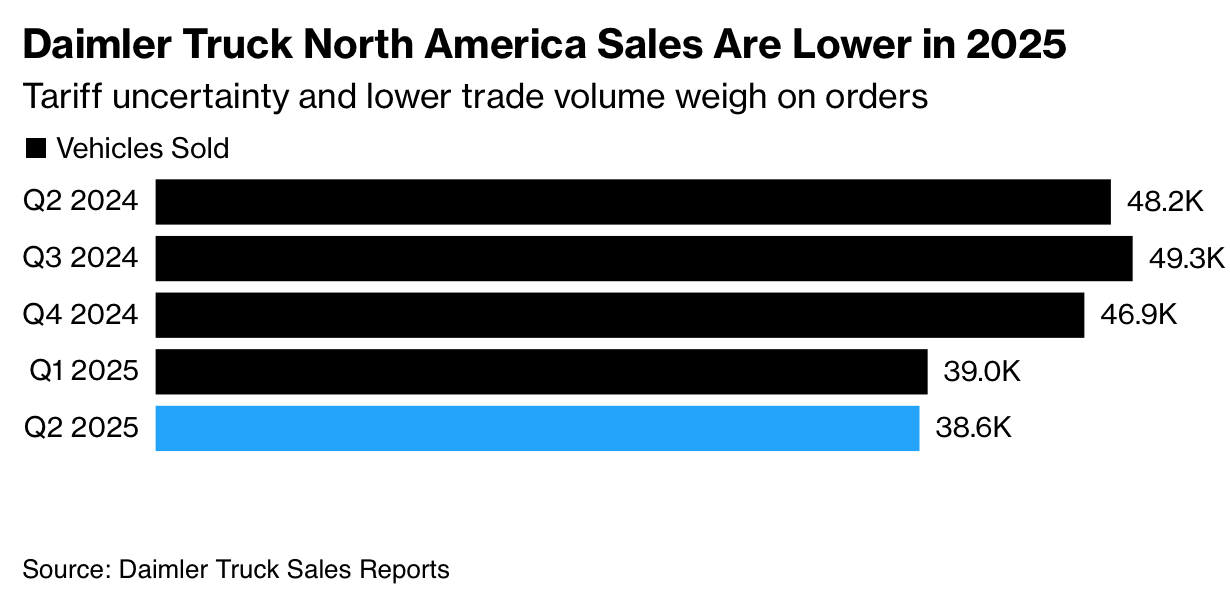
Daimler: Until Some Sense Of Certainty Is Restored, An “Extremely” Low Level Of Trucks Will Be Purchased. According to Bloomberg, “Daimler Truck Holding AG expects US orders to remain at ‘extremely’ low levels until uncertainty over President Donald Trump’s trade policies subsides and freight volumes begin to recover. Chief Financial Officer Eva Scherer said logistics companies have cut back on truck purchases amid a drop in shipments of tariff-hit goods such as steel and aluminum. US imports have fallen sharply since the introduction of the tariffs, according to the Bureau of Economic Analysis. ‘We”re in a situation where it’s very difficult to predict from a CFO perspective,’ Scherer told Bloomberg News. ‘Scenario planning is more important than ever.’ The comments underscore the industry’s struggle in the US as trade disruptions delay investment in new fleets. Daimler Truck’s North America business posted a 20% sales decline in the second quarter.” [Bloomberg, 2025-07-09]
Noting Trump’s Tariffs Increased The Cost Of Oil And Gas Production By Eight To 12 Percent, Rystad Energy Projected $50 Billion In Offshore Energy Production Had Been Deferred Due To Trump’s Tariffs. According to the Wall Street Journal Editorial Board, “The folks at Rystad Energy have examined the impact, and it isn’t pretty. Tariffs and their uncertainty ‘will certainly decrease expected investment activity in the energy sector,’ says the new report. More than $50 billion of offshore investment this year has been deferred ‘with operators looking to wait out current market uncertainty before making significant final investment decisions,’ Rystad notes. Costs for oil and gas producers, utilities and power plants have already surged amid overall inflation. ‘Offshore projects had seen 20-40% cost increases due to market price hikes from 2020 to 4Q24,’ the report notes, adding the ‘industry was looking directly at additional 10-20% increases through 2027.’ Now they face the added wallop of tariffs. Rystad estimates that tariffs will increase costs for offshore oil and gas projects by 8% year-over-year and 12% for onshore. ‘Most steel and raw material exposed cost categories are feeling the majority of the impact from tariffs and thus will take the biggest hit,’ the report says. These estimates don’t account for the new copper duties or Mr. Trump’s doubling of steel tariffs to 50%.” [the Wall Street Journal Editorial Board, 2025-07-08]
Impossibility For Ports
July 2025: American Port Operators Asked The Trump Administration To Restructure Proposed Tariffs On Ship-To-Shore Cranes So As To Not Decimate The Industry. According to the Wall Street Journal, “U.S. port operators are warning that the cost of critical upgrades would balloon by tens of millions of dollars if the Trump administration moves forward with proposed new tariffs on port equipment. The administration is proposing tariffs of up to 100% on Chinese-made cranes and other cargo-handling equipment as part of broader efforts to counter China’s dominance of the maritime industry. Shipping industry officials say the fees would be stacked on top of 25% tariffs on Chinese-made cranes introduced under the Biden administration, and in addition to China duties being considered by Trump’s trade team. Ports and the private companies that operate marine terminals say the fees would penalize cargo gateways that ordered cranes long before the tariffs were being considered, and don’t account for the scarcity of cranes made outside of China.” [the Wall Street Journal, 2025-07-09]
With China Producing 70 Percent Of Ship-To-Shore Cranes, There Is Not Enough Other Supply To Replace Chinese Cranes For American Ports. According to the Wall Street Journal, “China produces more than 70% of the world’s ship-to-shore cranes, according to the U.S. government. Administration officials worry China’s control of critical infrastructure is an economic and a national security threat. They also allege some Chinese-made cranes have been fitted with communications equipment that could be used for espionage. Chinese cranes are popular because they are plentiful and cheap. Shipping industry officials say the average cost of a Chinese ship-to-shore crane is about $15 million, several million dollars less than the lowest-price competitors. They say there are no domestic alternatives and that smaller overseas manufacturers wouldn’t be able to meet demand if U.S. ports pivoted to manufacturers outside of China.” [the Wall Street Journal, 2025-07-09]
Due To The Fact That It Has Historically Taken About Two Years For A Crane Order To Be Filled, Port Operators Have Asked For A Carve Out For Cranes Ordered Before The Tariffs Were Announced. According to the Wall Street Journal, “It can take up to two years to fulfill a crane order. Port operators are asking the administration to provide tariff exemptions for cranes ordered before the end of 2024. They are also asking the USTR’s office to delay imposing levies on new crane orders for three years to give time for crane manufacturing to develop in the U.S., or for manufacturers in allied countries to expand production.” [the Wall Street Journal, 2025-07-09]
Capital Flight
Bank Of England: Since Trump’s Tariffs, Exposure To The American Economy Has Come To Be Seen As A Major Risk. According to Bloomberg, “The BOE report also highlighted: […] Investor appetite for dollar-denominated assets has weakened since April and traders are anticipating a future softening of the dollar as more investors hedge their exposure to US assets.” [Bloomberg, 2025-07-09]
BofA Survey: The Highest Share Of Investors In 20 Years Reported Being Underweight The Dollar. According to Bloomberg, “Trump administration officials publicly support the idea of a strong dollar, but have done little to try to halt its decline. A net 31% of investors who contributed to the BofA survey reported being underweight the dollar, the most negative reading in 20 years. European Central Bank President Christine Lagarde has even talked about a potential ‘global euro’ moment.” [Bloomberg, 2025-07-07]
Higher Prices
June 2025: The Majority Of FOMC Officials Warned That Trump’s Tariffs Would Have “Persistent Effects” On Inflation. According to the Financial Times, “The majority of US Federal Reserve officials warned at its June meeting that President Donald Trump’s tariffs would have ‘persistent effects’ on inflation amid a growing schism over when to cut interest rates. Minutes from the Federal Open Market Committee’s meeting on June 17-18 showed that while some rate setters believed the levies would trigger a one-off price increase, most were concerned the inflationary impacts could be more sustained. ‘While a few participants noted that tariffs would lead to a one-time increase in prices and would not affect longer-term inflation expectations, most participants noted the risk that tariffs could have more persistent effects on inflation,’ according to minutes released on Wednesday. Officials noted tariffs were likely to push up prices to some extent, but ‘there was considerable uncertainty . . . about the timing, size, and duration of these effects’.” [the Financial Times, 2025-07-09]
Copper
July 2025: In An Off The Cuff Comment, Trump Announced His Plan To Place A 50 Percent Tariff On Copper. According to Bloomberg, “President Donald Trump sowed fresh chaos in metals markets by indicating the US would implement a higher-than-expected 50% tariff on copper imports, spurring a record spike in New York futures and a drop in the global benchmark. The plan, announced in an apparently off-the-cuff comment to reporters, marks the latest twist in a tumultuous period for industrial commodities, as the US leader aims to encourage more mining and smelting at home. He’s already raised fees on steel and aluminum imports, while probes into flows of multiple other metals are in train.” [Bloomberg, 2025-07-09]
- Lutnick: Despite Less Than A Month Left Before The Tariffs Would Go Into Place, There Were No Details, Like When They Would Go Into Place. According to Bloomberg, “Elaborating on Trump’s copper comments, Commerce Secretary Howard Lutnick later said the levy would be in place in late July or by Aug. 1. There were no details, including which particular products would be hit by the tariff rate, or whether there could be exemptions for large producers like Chile.” [Bloomberg, 2025-07-09]
As Copper Is An Input To Many Goods, Higher Copper Prices Would Raise Prices “Across A Broad Section Of The U.S. Economy.” According to Bloomberg, “If the tariff takes hold, it will inflict higher costs across a broad section of the US economy due to the myriad of industries and applications that rely on copper — even as Trump piles pressure on the Federal Reserve to lower interest rates.” [Bloomberg, 2025-07-09]
- Jeffries Analysts: The United States Does Not Have Enough Processing Capacity To Be Avoid Higher Costs From These Tariffs. According to Bloomberg, “‘The US does not have nearly enough mine/smelter/refinery capacity to be self-sufficient in copper,’ Jefferies LLC analysts including Christopher LaFemina wrote in a note. ‘As a result, import tariffs are likely to lead to continued significant price premiums in the US relative to other regions.’” [Bloomberg, 2025-07-09]
While Gas Turbines Are Often Made In America, They Import A Large Number Of Parts, Meaning That American Producers Would Be Less Competitive On A Global Stage. According to the Wall Street Journal Editorial Board, “Most gas turbines are made in the U.S. but rely heavily on foreign parts. GE Vernova, which is boosting capacity at a turbine factory in South Carolina, imports more than three-quarters of parts for the plant from China, according to Rystad. These will be hit with a 55% tariff, which will make GE Vernova’s plant less globally competitive versus foreign manufacturers.” [the Wall Street Journal Editorial Board, 2025-07-08]
Tomatoes
April 2025: The Commerce Department Announced It Would Terminate A Long-Running Agreement With Mexico, Unleashing A 17 Percent Tariff On Imported Fruit By July 2025. According to Bloomberg, “The US Commerce Department announced in April it was terminating a long-running agreement with the country’s southern neighbor over tomato prices on July 14, which will unleash a 17% levy on the fruits imported from Mexico. With less than a week left before the mid-July deadline, a deal is unlikely to come together, although several groups are pressing for an extension to buy more time for negotiations, according to public documents. The Commerce Department didn’t respond to a request for comment. Kroger and Albertsons declined to comment.” [Bloomberg, 2025-07-08]
2024: Roughly 65 Percent Of American Fresh Tomatoes Were Imported From Mexico. According to Bloomberg, “The end of the agreement would deal a blow to US companies that grow tomatoes in Mexico and import them into the US, where they dominate the market. Around 72% of US fresh tomatoes were imported in 2024, and about 90% of those came from Mexico, according to the US Agriculture Department.” [Bloomberg, 2025-07-08]
Texas A&M: 47,000 American Jobs Have Been Supported By Importing And Marketing Fresh Tomato Imports. According to Bloomberg, “Reducing tomato imports is likely to have additional repercussions by eliminating jobs tied to that pipeline of produce, said Andrew Muhammad, an agricultural policy professor at the University of Tennessee’s Institute of Agriculture. ‘You”re going to get some lost economic activity in addition to the lost imports,’ he said. ‘The services associated with importing also pays Americans.’ Importing and marketing fresh tomatoes from Mexico supports roughly 47,000 full and part-time jobs in the US, according to an April analysis from Texas A&M University. Elected officials from Arizona and Texas, including Texas Governor Greg Abbott, have urged the administration to leave the agreement in place, while lawmakers from Florida have applauded efforts to end it.” [Bloomberg, 2025-07-08]
Immigration
Abject Nativism
July 2025: Citing The Medicaid Cuts In The BBB, Brooke Rollins Said Replacing The Workers The Trump Administration Is Deporting Would Be Very Easy. According to Politico, “Agriculture Secretary Brooke Rollins said millions of adult Medicaid participants who will face stricter work requirements under the GOP megabill should replace foreign farm workers deported under the Trump administration’s immigration policies. ‘There will be no amnesty,’ Rollins said Tuesday during an event at USDA headquarters highlighting the administration’s efforts to strengthen farm and national security policy. ‘The mass deportations continue, but in a strategic way, and we move the workforce towards automation and 100 percent American participation.’ ‘With 34 million people, able-bodied adults on Medicaid, we should be able to do that fairly quickly,’ she added, referencing Medicaid participants currently in the program who don’t yet meet the reconciliation package’s new work requirements.” [Politico, 2025-07-08]
- July 2025: Ag Secretary Rollins Expressed A Goal Of No Immigrants Working In The American Labor Force. According to Politico, “Agriculture Secretary Brooke Rollins said millions of adult Medicaid participants who will face stricter work requirements under the GOP megabill should replace foreign farm workers deported under the Trump administration’s immigration policies. ‘There will be no amnesty,’ Rollins said Tuesday during an event at USDA headquarters highlighting the administration’s efforts to strengthen farm and national security policy. ‘The mass deportations continue, but in a strategic way, and we move the workforce towards automation and 100 percent American participation.’ ‘With 34 million people, able-bodied adults on Medicaid, we should be able to do that fairly quickly,’ she added, referencing Medicaid participants currently in the program who don’t yet meet the reconciliation package’s new work requirements.” [Politico, 2025-07-08]
Effects
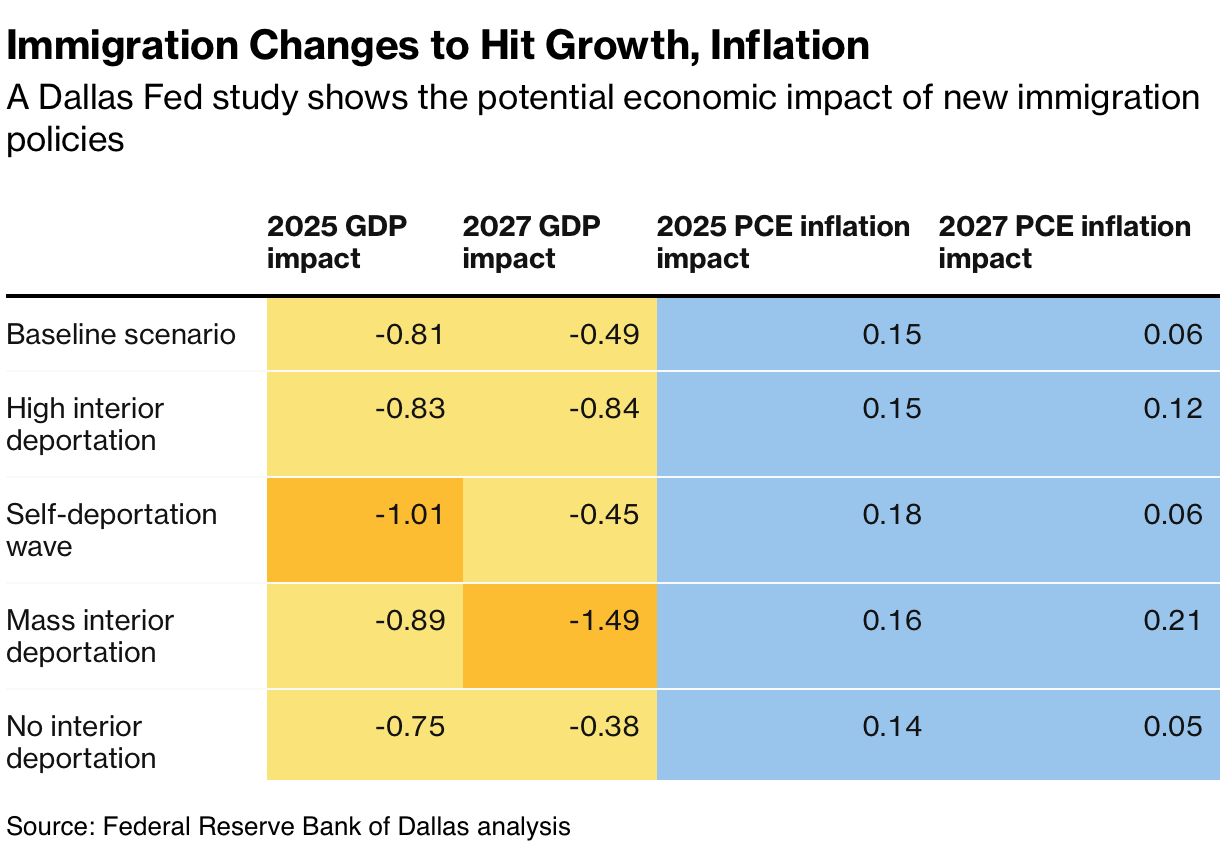
Dallas Fed: Trump’s Immigration Policies Could Be Expected To Cut About 0.8 Percent From Output. According to Bloomberg, “The Trump administration’s curbs on immigration and ramped-up deportations will lower US economic growth by almost a full percentage point this year, according to a study from the Federal Reserve Bank of Dallas. The drastic drop in immigrants across the southern border and increased efforts to deport more foreign-born workers could subtract about 0.8 percentage point from gross domestic product in 2025, according to an analysis by economists including Pia Orrenius.” [Bloomberg, 2025-07-08]
Failure To Grow Wages
Cal Matters: Workplace Immigration Raids Have Shown To Deflate Wages And Have No Impact On The Adoption Of E-Verify. According to Cal Matters, “Worksite raids like the one at Ambiance are an attention-grabbing component of the Trump administration’s immigration crackdown, one that it remains committed to despite a brief reversal in mid-June. They’re unfolding across the state, from Los Angeles’s Fashion District to farm fields in the San Joaquin Valley and a restaurant in San Diego. While one stated purpose of worksite raids is to remove illegal competition from the labor marketplace, the reality is far messier: Studies have found that immigration raids don’t do much to raise wages – and actually deflate them. Even after a raid, employers are no more likely to use federal immigration verification tools like E-Verify during hiring.” [Cal Matters, 2025-07-08]
Corruption
BBB
In Spite Of The Raft Of Last Minute Changes Created To Rally Votes For The BBB, Benefits Allowing Private Equity To Pay Lower Tax Rates Were Preserved (And In Some Cases Expanded). According to the Financial Times, “A blizzard of last-minute changes as the bill moved through Congress by razor-thin margins spared some sectors — such as healthcare — from the most severe cuts, and stripped out some of the controversial provisions affecting investors. One beneficiary is the $13tn private capital industry. Investment firms such as Blackstone and Apollo won big in the bill as lawmakers left its prized carried interest tax loophole untouched — after Trump said he would close it. ‘If you are sitting in a private assets seat, this is a very good bill for you,’ said Michael Pedroni, a former US Treasury official who now runs the consultancy Highland Global Advisors. ‘This bill represents a very big win for private assets.’ The carried interest provision saves buyout groups billions of dollars a year by enabling dealmakers to pay the long-term capital gains tax rate on the performance profits they earn, instead of far higher income tax rates. The legislation will also lead to lower tax rates for many private equity-backed companies by enshrining tax deductions for interest on debt and expanding them to include depreciation and amortisation.” [the Financial Times, 2025-07-09]
Trump’s BBB Cut In Half The Funds For The Consumer Finance Protection Bureau, Limiting What It Could Do. According to the Financial Times, “The bill also almost halved available funds for the Consumer Financial Protection Bureau, a win for banking executives that have accused the watchdog of overstepping its mandate.” [the Financial Times, 2025-07-09]
Crypto
July 2025: Trump Media Filed To Issue Its Third Crypto ETF, Which, If Approved, Would Be The First To Hold Cronos Or XRP. According to Bloomberg, “Trump Media & Technology Group Corp. is plowing deeper into the cryptocurrencies space with a new filing for an exchange-traded fund that would hold a number of digital assets including Bitcoin, Ether, Solana and others. A Tuesday filing showed the social-media firm owned by President Donald Trump seeking to launch the ‘Crypto Blue Chip’ fund, with the paperwork marking its third ETF filing. The fund, should it launch, would hold Bitcoin, Ether, Solana, Cronos and XRP directly, though nearly three-quarters of it would be comprised of Bitcoin, the largest token in the market. Though ETFs holding Bitcoin and Ether already trade in the US, no such funds hold Cronos or XRP directly. It marks Trump Media’s third filing for crypto-based ETFs, with the firm having filed for a Bitcoin-Ether product as well as one tied solely to Bitcoin. Should any of them launch, they”d join a crowded field of crypto-minded offerings, as more than 10 Bitcoin-specific funds already trade in the US, as do many other digital-asset-based products. The Trump Media offerings would also present direct competition for issuers vying to stand out in the space.” [Bloomberg, 2025-07-08]