June 2025: Trump’s Department Of Agriculture’s Trade Data Release Lacked The Customary Comments And Analysis. According to Bloomberg, “Some of the impacts to federal data have been more subtle. The Department of Agriculture released quarterly trade data a few days late in June and without its usual comments and analysis.” [Bloomberg, 2025-07-10]
Bloomberg Economics: While Trump Has Already Raised Tariffs Americans Pay By A Factor Of 5.5, The Tariffs Announced In July Could Raise That Factor To 8.67. According to Bloomberg, “‘The US average tariff rate is already up 10.9 percentage points since Trump’s return to office, at 13.3%. If all the levies that were due to come into force on July 9 — including the 50% threat on the EU — were implemented, it would take the average rate to 20.8%,’ according to a post from Bloomberg Economics” Rana Sajedi, Adam Farrar and Maeva Cousin. ‘That rate is now headed for a slightly lower 20.3%, with the decline mostly driven by the 20% rate announced for Vietnam earlier last week, partly offset by higher rates on Brazil.’” [Bloomberg, 2025-07-10]
Higher Prices
January - June 2025: Power Utilities Pushed For $29 Billion In Rate Increases, A 142 Percent Increase From 2024. According to the Financial Times, “US power providers are seeking to impose big price increases on consumers following booming data centre demand, sparking debate over who should pay for the electricity burden of artificial intelligence. Utilities have sought regulatory approval for $29bn in rate increases in the first half of 2025, a 142 per cent increase over the same period a year ago, according to a new report by PowerLines, an energy affordability advocacy group.” [Financial Times, 2025-07-10]
Higher Cost Of Doing Business
July 2025: Nissan Was Forced To Borrow Money At The Highest Rate Since 1986. According to Bloomberg, “Nissan Motor Co. kicked off a $4.5 billion sale of dollar- and euro-denominated bonds as the embattled automaker was forced to offer a record-high coupon for one of the tranches. One component carried a yield of 8.125%, topping Nissan’s previous record yield of 7.5% for a 10-year dollar bond issued in 1986, data compiled by Bloomberg showed.” [Bloomberg, 2025-07-10]
Undermining Business
Copper Tariffs
Copper Helped To Displace Toxic Chemicals In Quantum Dot Solar Panels. According to the Wall Street Journal, “Meanwhile, quantum dots have come up against their own sustainability concerns. ‘The first generation of quantum dots used heavy metals like cadmium and lead, which came with many toxicity concerns,’ Talapin said, noting that materials could leak into groundwaters after rain and damage to solar cells. UbiQD said its dots—developed in collaboration with the Energy Department’s Los Alamos National Laboratory and the Massachusetts Institute of Technology—swap out cadmium for a nontoxic combination of copper and indium.” [Wall Street Journal, 2025-07-09]
Economic Inefficiency
Worse Data
Trump Proposed 8 Percent Cuts To BLS, Which, On Top Of A 20 Percent Real Cut In Funding Has Caused The Administration To Cut The Data It Collects. According to Bloomberg, “Experts say economic data is mostly still reliable, but the trend is troublesome. At the BLS, which produces some of the nation’s marquee numbers on inflation and employment, funding has slumped about 20% since 2010 in real terms, and Trump’s fiscal 2026 budget proposal would shave an additional 8% from both its purse and personnel. Those reductions will force the BLS to concentrate on data deemed most important by the White House’s Office of Management and Budget. Separately the bureau decided some months ago to stop certain data collection and production for its consumer and producer price indexes. ‘The threats to economic data have accelerated,’ says Jed Kolko, who was undersecretary for economic affairs at the Department of Commerce in the Biden administration. ‘The risk is that these economic statistics that we rely on get worse over time,’ as in less accurate, subject to larger revisions and more reliant on imputations and estimates in place of direct survey data, he says.” [Bloomberg, 2025-07-10]
The Trump Administration Retired NOAA’s Database Of Disasters And Their Costs, Making Work Harder For Insurers. According to Bloomberg, “The National Oceanic and Atmospheric Administration has retired its popular database of climate and weather disasters that caused at least $1 billion in damage. The database had been a key tool for insurance agencies in assessing coverage and reinsurance—something that would have been widely consulted in the coming months as central Texas rebuilds from devastating July flooding. NOAA stopped distributing readings from a meteorological satellite program at the end of June—information that helped forecasters at the US National Hurricane Center predict whether a storm would rapidly intensify. The White House has also removed environmental mapping tools from government websites, which activists used to protect communities vulnerable to pollution and climate change.” [Bloomberg, 2025-07-10]
Immigration
Dallas Fed Study: While Surges In Immigration Tend To Increase Income Growth, Inflation “Shows Almost No Response In The First Few Years But Decreases Slightly At Longer Horizons.” According to the Wall Street Journal Editorial Board, “The loss side of the ledger is that mass deportation of productive employees will drain economic growth and make it harder for Mr. Trump to deliver a return to the prosperity of his pre-Covid first term. Consider an economic paper published Tuesday by the Federal Reserve Bank of Dallas. ‘Our analysis,’ the authors say, ‘raises the concern that a sharp tightening of immigration policies has the potential to substantially reduce output growth.’ The study is based on a model that includes historical data on immigration and the economy from 1955 to 2019. ‘U.S. GDP growth typically increases for two years in response to an unexpected increase in net unauthorized immigration and then gradually reverts to its mean,’ the authors write. ‘Inflation shows almost no response in the first few years but decreases slightly at longer horizons.’” [Wall Street Journal Editorial Board, 2025-07-09]
Inefficient Targeting
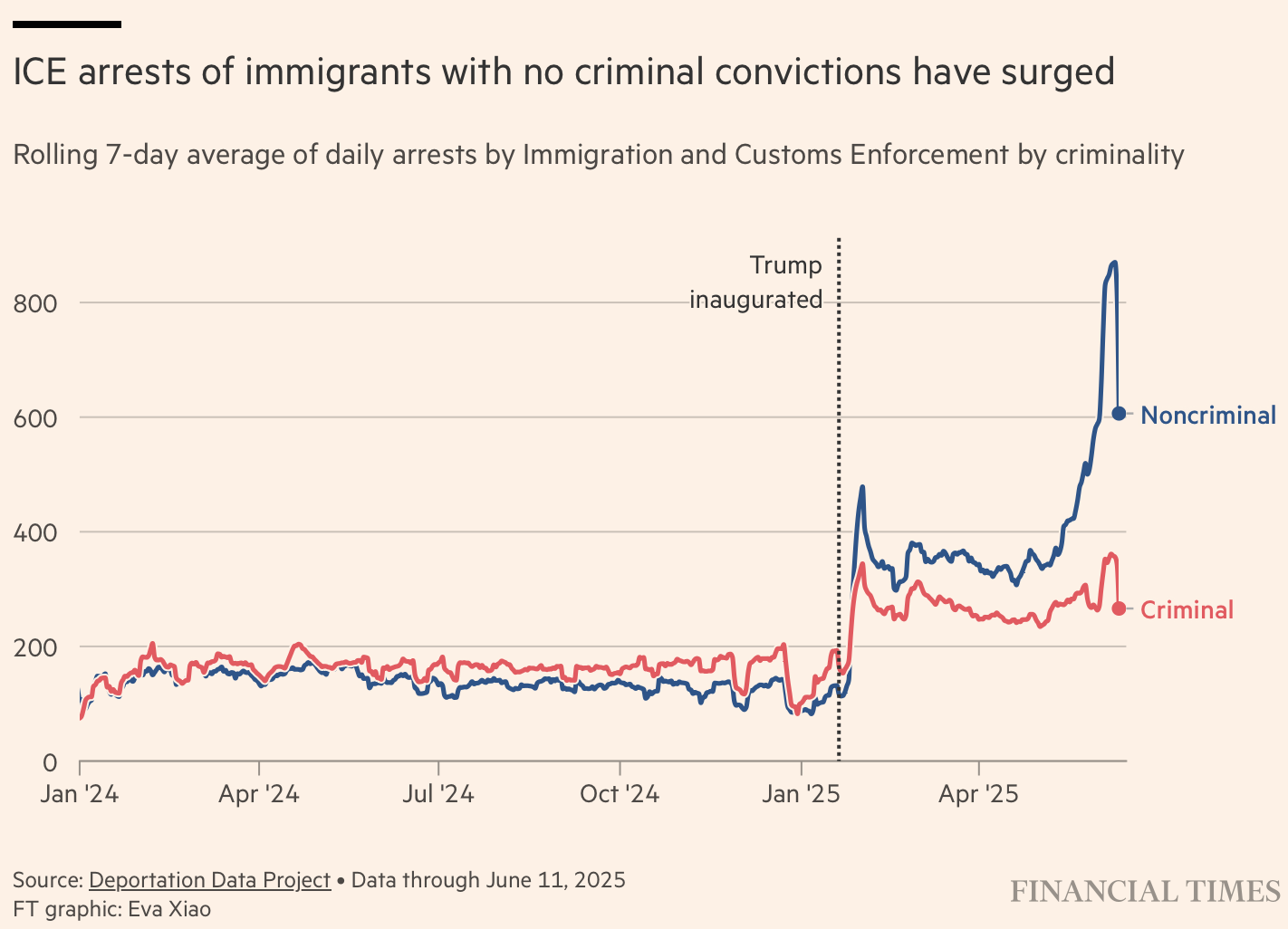
Since Trump’s Inauguration, ICE Has Arrested More Noncriminal Than Criminal Illegal Immigrants, A Reversal From Earlier Trends. According to the Financial Times, “The agency is now arresting four times as many non-criminals as those with criminal convictions each week, according to David Bier of the Cato Institute, a libertarian think-tank. The number of immigrants in detention with no criminal charges or convictions jumped 1,300 per cent from January to mid-June, he wrote in an analysis.” [Financial Times, 2025-07-10]
Financial Instability
Illiquid Markets
Private Credit
2024: As Much As A Third Of Life Insurers’ Assets Were In Private Credit. According to Bloomberg, “As much as a third of the $6 trillion in cash and invested assets held by US life insurers was allocated to various types of private credit investments at the end of 2024, according to Moody’s Ratings estimates, based on a survey of insurers it rates. And this figure is rapidly rising as money managers take more business away from big banks in the latest shift on Wall Street.” [Bloomberg, 2025-07-10]
Potential Market Making Monopoly
July 2025: Citadel Securities, The Largest Market Maker, Acquired Morgan Stanley’s Options Market Making Operation, Thereby Growing Even Bigger. According to Bloomberg, “Citadel Securities bought Morgan Stanley’s unit focused on electronic market-making for US equity options, expanding the firm’s already dominant role in the popular derivatives, according to people familiar with the matter. The trading firm founded by billionaire Ken Griffin acquired Morgan Stanley’s on-exchange options business and took on a large portfolio of equity options positions, the people said. The deal includes specialist posts on venues including Cboe, Nasdaq, NYSE and MIAX, the people said, asking not to be identified discussing private information. The total purchase price couldn’t be immediately learned. Representatives for Miami-based Citadel Securities and New York-based Morgan Stanley declined to comment. The electronic market-making options business, including the specialist positions and portfolio, was transferred from Morgan Stanley to Citadel Securities this month after the bank decided to shut its automated market-making arm, the people said. The move should bolster Citadel Securities as an options market maker, filling orders both electronically and on trading floors. Similar to a designated market maker for stocks, a specialist in options is approved by an exchange and required to quote buy and sell prices beyond the normal requirements of a registered market maker. Morgan Stanley was the last major bank in the market-making business, which is now dominated by high-frequency trading firms. The retreat left some of the bank’s specialist appointments up for transfer, and those were re-allocated to Citadel Securities as of July, according to a trader notice posted last week on Cboe’s website. By one metric, Citadel Securities already commands the biggest share of payments for order flow from retail brokers in the first quarter, representing about a third of the total. Morgan Stanley accounted for around 6% of such payments among market makers in the same period, according to a Bloomberg Intelligence analysis of regulatory filings. Citadel Securities has been expanding its presence across asset classes beyond options, launching into investment-grade corporate bonds in 2023. With elevated trading and volatile swings across markets this year, the firm and its peers have been notching record profits.” [Bloomberg, 2025-07-10]
Corruption
A “Golden Age” For Lobbyists
During The First Six Months Of Trump’s Term, The Top Ten Lobbying Firms Took In More Than 50 Percent More Than During A Comarable Period During Trump’s First Term. According to the Wall Street Journal, “It is boom time in Washington for the influence industry, according to interviews with more than a dozen Republican lobbyists. The top 10 lobbying firms in Washington took in about $123 million in the first quarter of 2025, compared with about $80 million in the same time frame of both Joe Biden’s presidency and Trump’s first term.” [Wall Street Journal, 2025-07-09]
Multiple Cabinet And Other Administration Officials Attended The Opening Of “Executive Branch,” A Club Partially Founded By Trump Jr That Costs Up To $500,000 To Join. According to the Wall Street Journal, “Guests scooped caviar, noshed on lamb lollipops and sipped top-shelf Champagne on a recent Friday at the grand opening of Executive Branch, a new club that President Trump’s son and close friends started in Washington that costs up to $500,000 to join. There was David Sacks, the administration’s unpaid cryptocurrency czar, who had been privately touting the club to associates. Some cabinet members came as guests, including Treasury Secretary Scott Bessent and Homeland Security Secretary Kristi Noem. (Her aide Corey Lewandowski was there, too.) Donald Trump Jr. and senior administration officials mingled in the cavernous space near the Georgetown waterfront.” [Wall Street Journal, 2025-07-09]
The Trump Administration Dismissed A Case Against A Lobbyist Who Had Admitted To Illegally Lobbying For Qatar. According to the Wall Street Journal, “Another firm with longtime Trump allies, Tactic Global, opened an office just down the street from the Executive Branch club. The two aren’t affiliated. One of its partners, Barry Bennett, admitted last year to illegally failing to register an advocacy group he set up on Qatar’s behalf, and agreed in a deal with the Justice Department that he wouldn’t undertake foreign lobbying work until July 1. The Trump administration dismissed the case last week.” [Wall Street Journal, 2025-07-09]
BBB
July 2025: The Washington Post Reported Conservative Groups Have Pushed Trump To Sign An Executive Order, Allowing Capital Gains To Be Adjusted For Inflation. According to the Washington Post, “With that victory newly secured, conservative groups — including Americans for Tax Reform, led by anti-tax crusader Grover Norquist — are already asking the Trump administration to get behind another cut, which would drastically reduce what investors pay on their capital gains. The plan rests on changing how the Treasury Department calculates those taxes.” [Washington Post, 2025-07-10]
1992: The Department Of Justice Found That A Change Of That Kind Would Require An Act Of Congress. According to the Washington Post, “Currently, an investor who bought stock for $1,000 in 1980 and sold it for $10,000 today would owe capital gains taxes on the increase in value of $9,000. But under the proposal pitched by Norquist and others, the calculation would start by adjusting up the value of the original purchase to account for inflation — which would reduce the amount of gain that’s taxable after selling the stock. Although a 1992 Justice Department opinion found that such a change would require an act of Congress, Norquist and other conservatives want the Treasury Department to execute such a policy unilaterally if necessary, providing a major windfall for people selling stocks, art, businesses, homes and other assets.” [Washington Post, 2025-07-10]
During Trump’s First Term, Estimates Of The Effect Of Allowing Inflation To Be Accounted For In Assessing Capital Gains Would Cost Between $100 And $200 Billion, With The Top 1 Percent Getting 86 Percent Of The Benefits. According to the Washington Post, “Nonpartisan economists are sharply critical of the proposed change to the tax code. During Trump’s first term, the Tax Policy Center and Penn Wharton Budget Model found that indexing capital gains to inflation would add roughly $100 billion to $200 billion to the federal deficit over 10 years. The affluent would disproportionately benefit from the change, those nonpartisan estimates have found. The highest-earning 1 percent of Americans would receive 86 percent of the benefits from indexing capital gains to inflation, while the bottom 80 percent of income earners would get just 1 percent of the benefits, Penn Wharton projected in 2018.” [Washington Post, 2025-07-10]
NOTE: Inflation Is Part Of The Reason Long Term Capital Gains Are Taxed At A Lower Rate Than Normal Income Furthermore, if an investment is making less than or at the rate of inflation, it is not really economically beneficial for it to be made, and the tax code should not subsidize unproductive investments like that.
Giveaway To Don Jr. Associated Company
By Changing How Gamblers Can Account For Losses, Trump’s BBB Would Make Professional Gambling Almost Impossible. According to the Athletic, “One sentence of the 940-page bill says gamblers can deduct only 90 percent of their annual losses, instead of 100 percent, which has been the norm. What does that mean? Before now, when gamblers reported their betting income, they would take their gross winnings, subtract their gross losses and then report the net amount as their taxable income. Now, they”re allowed to subtract only 90 percent of those losses, which means they appear to have more income, even though they don’t actually have that money. That 10 percent change amounts to a whole lot if you”re dealing with huge numbers. Andrews told The Athletic that, in a year, he makes between $7 million and $10 million in gross winnings. ‘If it’s $7 million as gross winnings and it’s $6.6 million as net losses, then I have a $400,000 net,’ Andrews said. ‘But if it’s $7 million of gross wins and you can only deduct the $6.6 times 90 percent ($5.94 million), now you have $1 million that the government sees as your net income versus $400,000. I”m looking at probably a 35 percent tax rate, so about $350,000 in tax. So now I”m paying $350,000 in taxes on a $400,000 actual income. And that’s not worth it.’ The bill also means that even in losing years, some gamblers might still owe income tax. For example, if you win $100,000 and lose $100,000, you can deduct only $90,000 of those losses, meaning you will owe taxes on $10,000 of income even though you did not take home any money.” [Athletic, 2025-07-10]
Prediction Markets, Like Kalshi, Would Not Be Effected, As Their Sports Contracrts Are Technically Futures Contracts. According to the Athletic, “Speculation online about the reasons for the provision has run wild, ranging from straightforward accounting explanations to conspiracy theories that sportsbooks were behind the change in an attempt to eliminate sharp bettors or that the provision benefits new prediction market firms such as Kalshi, which are seen as rising competitors to sportsbooks. ‘You can deduct your full losses under this bill if you”re one of these predictive sites because those aren’t technically online betting sites,’ Khanna told The Athletic. Prediction markets are not regulated and operate differently from sportsbooks but allow users to put money on future outcomes, similar to traditional betting. ‘I just think that they were looking for revenue. Who’s going to be for standing up for betting?’” [Athletic, 2025-07-10]
January 2025: Donald Trump Jr. Joined Kalshi As A Strategic Adviser. According to CNBC, “Prediction market company Kalshi is adding Donald Trump Jr., the eldest son of the president-elect, as a strategic advisor, the company announced Monday. Kalshi rose to prominence in the runup to the election last year after a court victory over the Commodity Futures Trading Commission paved the way for legal election betting in the U.S. Kalshi CEO Tarek Mansour told CNBC on Monday that Trump Jr.’s interest in technology and new forms of media made him a good fit with the company. ‘Don has always been at the forefront at these types of spaces and new technologies. He’s always been very in tune with what the American people feel and want,’ Mansour said on ‘Squawk Box.’” [CNBC, 2025-01-13]