In data released this morning, the first inflationary effects of Trump’s tariffs started to make their way into national data, as consumer prices accelerated notably. Slightly more advanced data, from the New York Fed, showed that firms in the state saw sharply higher input prices, and much more constrained access to supply. These price pressures show no signs of slowing down, as Trump’s moves to impose new tariffs on Mexico and Brazil have raised prices for foods like Tomatoes and Orange Juice. His trade war has not accomplished its other goals either, with Chinese exports powering along, and our former allies looking to coordinate with each other against us.
Meanwhile, the effects of his BBB tax cut for the rich are notable. Food banks, already dealing with increased demand, noted that the SNAP cuts will make their job even harder, while immigrants have rushed to increase remittances before the capital controls in the bill take effect.
For Big banks, however, things are great, as they have been able to capitalize on market volatility to ride trading profits to new highs. For regional banks, that rely on real economic activity, however, things have not been so great. Despite the dollar’s precipitous decline in value, they are still worth less than when Trump was inaugurated.
diffusion=get_data(f, "PPCDISA066MSFRBNY"; observation_start="2023-07-01", observation_end="2025-07-02", ).datalower=get_data(f, "PPCDSA156MSFRBNY"; observation_start="2023-07-01", observation_end="2025-07-02", ).datahigher=get_data(f, "PPCISA156MSFRBNY"; observation_start="2023-07-01", observation_end="2025-07-02", ).data# Make The Plotplot(diffusion.date, diffusion.value; linewidth=2, label="Diffusion", xlabel="Month", ylabel="Percent Of Firms", title="July 2025: NY Firms Saw Higher Input Prices")bar!(higher.date, higher.value; alpha=0.65, label="Higher Prices",)bar!(lower.date, lower.value; alpha=0.65, label="Lower Prices",)
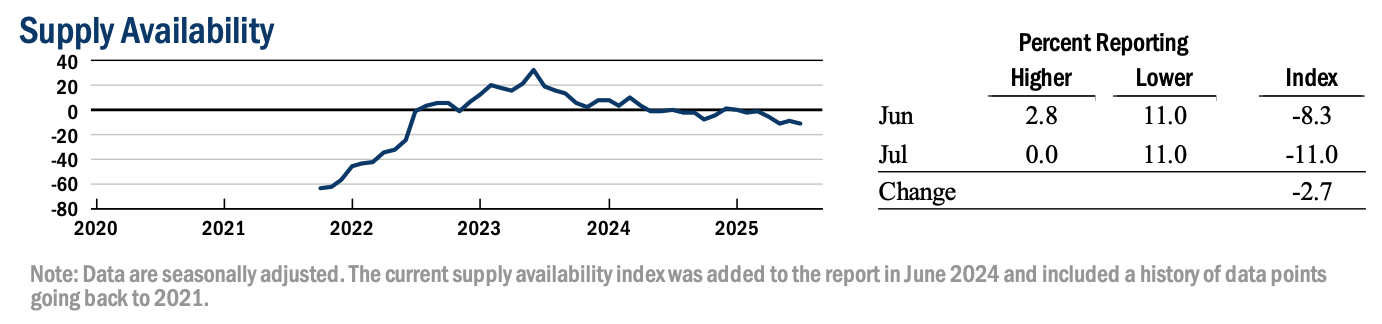
July 2025: No New York Firms Indicated Their Availability Of Supply Was Higher Than The Month Before. [New York Fed, 2025-07-15]
Trade War
In Response To Trump’s Volatile Threats Of Tariffs, Effected Countries Have Stepped Up Coordination On Their Responses. According to Bloomberg, “The European Union is preparing to step up engagement with other countries hit by President Donald Trump’s tariffs following a slew of new threats to the bloc and other US trading partners. While there’s always regular contact with other countries, particularly among the Group of Seven, the risk of wider trade wars means “there is this new sense of urgency,” EU chief trade negotiator Maros Sefcovic told reporters Monday as he entered a meeting of trade ministers. The contacts with nations including Canada and Japan could include the potential for coordination, Bloomberg News reported earlier. European Commission President Ursula von der Leyen plans to speak later Monday with Canadian Prime Minister Mark Carney, an EU official said. The outreach comes as Canada and the EU’s trade talks with the US have dragged on and continue to be stuck on several issues ranging from autos to agriculture.” [Bloomberg, 2025-07-13]
Canadian Official: “While The US Is Becoming Weaker, We Will Become Stronger And We Will Diversify And Turn Ourselves Towards Europe.” According to Bloomberg, “A Canadian official last week said more coordination is needed in the face of ‘a very unpredictable US administration.’ ‘We”re trying to make sure that ultimately, while the US is becoming weaker, we will become stronger and we will diversify and turn ourselves toward Europe,’ Canadian Industry Minister Mélanie Joly told reporters Friday in Ottawa. ‘We need to make sure that we”re in action mode, we”re in solution mode with other countries because we”re not alone.’” [Bloomberg, 2025-07-13]
Chinese Exports Have Surged
Q2 2025: China Ended The First Half Of The Year With A Record Trade Surplus. According to Bloomberg, “China ended the first half of the year with a record trade surplus of about $586 billion after exports to the US began to stabilize, with factories riding out the tariff rollercoaster that upended global commerce. Exports rose 5.8% in June from a year earlier to $325 billion, exceeding the median estimate in a Bloomberg survey of analysts. Imports rose 1.1% to grow for the first time since February, according to data from the General Administration of Customs on Monday.” [Bloomberg, 2025-07-14]
Despite Expectations Of A Decline, China Exported A Record Amount Of Steel During The Second Quarter. According to Bloomberg, “China racked up record steel exports in the second quarter, as flows from the world’s top producer defied expectations for volumes to fade under a barrage of trade measures from Asia to Europe. Shipments of finished steel used in construction to cars and appliances reached 30.7 million tons for the three months from April to June. That’s up 11% from a year earlier and beats the previous quarterly peak during a flood of exports a decade ago. The total first-half tonnage was 9% higher.” [Bloomberg, 2025-07-14]
Higher Prices
July 2025: Withdrawing From A Longstanding Trade Agreement With Mexico, The Trump Administration Placed A 17 Percent Tariff On Mexican Tomatoes. According to Bloomberg, “The US government withdrew from a longstanding trade agreement with Mexico governing tomato imports and will push forward with a new tariff of just over 17%, the US Commerce Department announced Monday. For decades, Mexican farmers have supplied American shoppers with a growing supply of fresh tomatoes, particularly during the winter, even though producers in the US state of Florida have long chafed at the trade flow.” [Bloomberg, 2025-07-14]
July 2025: Orange Juice Rose To Its Highest Price Since March Following Trump’s Imposition Of Tariffs On Brazil. According to Bloomberg, “Orange juice futures rose to a four-month high in New York on mounting worries that President Donald Trump’s threat to slap a 50% tariff on Brazilian goods will curb supplies to the US. The most-active contract rose as much as 8.7% to $3.1385 a pound, the highest intraday level since March 6. Juice futures have rallied since last week, when Trump announced tariffs set to go into effect in August that risk upending trade in commodities ranging from coffee to beef. Brazil is the top supplier of orange juice to the US, with imports for consumption last year nearing $1 billion in value, according to the US Department of Agriculture. Shipments from Mexico, the next biggest supplier, are about a third of Brazil’s volumes. The threat of supply disruption comes at a time when the US has grown increasingly reliant on Brazilian imports amid a decline in production in Florida, according to Craig Elliott, a market analyst at Expana.” [Bloomberg, 2025-07-14]
Trump’s BBB
Trump’s BBB Allowed A Deduction For Food Provided To Employees To Expire, Making Spending On Office Snacks No Longer Deductible. According to Bloomberg, “The SkinnyPop in the break room may not last. Donald Trump is targeting the office snack. The president’s signature tax law allows a long-standing business deduction for the cost of food provided to employees to expire, imperiling a workplace perk popularized during Silicon Valley’s dot-com boom that is now an emblem of modern office culture. A well-stocked pantry is now a staple at Wall Street banks, among other places. US companies that continue to provide office snacks, coffee or on-site lunches will see them taxed after Dec. 31, when the deduction will be eliminated.” [Bloomberg, 2025-07-14]
Decimating Hungry Americans
As Food Banks Were Struggling With Rising Demand, Trump’s BBB Cut SNAP. According to the Wall Street Journal, “Sarah Aragón glanced at the growing line of people snaking down Central Avenue, waiting for their allotment of everything from melons to pinto beans to frozen catfish. She wondered how she’ll keep feeding them all. This year, the federal government has canceled food deliveries and cut hundreds of millions of dollars in annual aid to food banks. For Aragón, the head of programming for Roadrunner Food Bank, New Mexico’s largest charitable food operation, that has meant losing more than seven million pounds of food she had been counting on. President Trump’s megabill, passed earlier this month, includes cuts to food stamps, now known as the Supplemental Nutrition Assistance Program, or SNAP. Food banks across the country were already straining under rising demand. Now, they worry many more Americans will go hungry. Some food banks and pantries are pushing for more state, local and private funding. Others are considering cutting back services and the amount of food they can distribute. ‘It’s getting to the point where we can’t fill every single need in terms of food,’ Aragón said. ‘I don’t know how much more creative we can be to make things stretch.’ Food banks have seen requests for assistance from households—including those with children—jump sharply over the past few years, driven by the end of pandemic aid programs and the impact of inflation on grocery prices. According to a recent survey from Feeding America, a national network of food banks, over half of 162 food banks reported demand rising this past April compared with April 2024.” [Wall Street Journal, 2025-07-14]
Trump’s BBB Raised The Age Limit For SNAP Work Requirements, And Removed The Exemption For Caregivers Of Older Children. According to the Wall Street Journal, “The budget bill expands work requirements for SNAP, raising the upper age limit for able-bodied adults from 54 to 64, meaning those people will typically have to work for 80 hours a month to qualify for food benefits. Caregivers of children ages 14 and older previously didn’t have to work to get SNAP assistance. The new legislation removes that exemption in most cases.” [Wall Street Journal, 2025-07-14]
Capital Flight
Trump’s BBB Established Capital Controls In The Form Of A 1 Percent Tax On Remittances As They Have Been Sent By The Poorest Immigrants. According to the Washington Post, “The tax rate that Trump signed into law this month is lower than an earlier proposed version, down from 5 percent to 1 percent. But it is yet another reason that immigrants across the region say they are moving to increase the size and frequency of their payments ahead of the tax’s implementation on Jan. 1. Orozco said that the tax likely would not apply to about half of immigrants who send remittances because they transfer money through phone apps that would be exempt from the tax. Those who take cash to storefronts, however, are the same people who make less money, particularly an estimated 22 percent of people who do not have bank accounts.” [Washington Post, 2025-07-13]
“People Who’ve Saved Up Money–Who Have Money Left–Don;t Want To Keep It Here.” As The BBB’s Capital Controls Force Accelerated Remitances. According to the Washington Post, “In a tangle of strip-mall hair salons and pupuserias in suburban Maryland, the quiet has become palpable amid the Trump administration’s aggressive deportation efforts. Restaurants in this heavily Central American enclave of Wheaton are emptied out. Grocery stores have come to a standstill. People are working less, going out to eat less and buying less. But at the VM Services money transfer storefront, lines are out the door most weekends — albeit with cash leaving the area instead of boosting the local economy. In what may be an unexpected twist as fears of deportation grip the D.C. region, immigrants from El Salvador, Honduras or Guatemala are sending more money home, transferring their savings away from a country where their hopes for the future are dimming. The trend at storefront operations like VM Services appears to be cutting across people with different immigration statuses, owing to both the heightened arrests of those who entered the United States without authorization as well as the Trump administration’s efforts to wipe out temporary protections that have shielded many Central Americans, the largest group of foreign-born residents in the D.C. area. News of a tax added on those remittances in President Donald Trump’s recently signed One Big Beautiful Bill Act has only added more pressure. ‘People who’ve saved up money — who have that money left — don’t want to keep it here,’ said Javier Guzman, 43, before sending back $125 to his mother at VM Services in Wheaton last week. ‘There’s a fear that they might not be able to access it otherwise.’ Guzman, who arrived from Honduras in 2001 amid gang violence and little economic opportunity there, has been wiring money each payday in hopes he might eventually retire there on a farm. Elsewhere, a Salvadoran man in Northern Virginia is ramping up his remittances to finish building a house back home, where he also might retire. And a Guatemalan woman in D.C. is taking on extra shifts as a restaurant cook to keep sending checks to pay for her father’s medical treatments.” [Washington Post, 2025-07-13]
Human Capital Flight
Trump’s BBB Included Cuts Of Between 40 And 50 Percent For Major Science Funders. According to the Wall Street Journal, “As of May, the National Institutes of Health faced a 40% (or $18 billion) reduction in its budget. And in the Trump administration’s tax-and-spending megabill that the president signed into law on July 4, America’s leaders doubled down on slashing budgets for the country’s key research funding bodies. The National Science Foundation had its budget cut by more than 50%, or about $5 billion, which will wipe out support for 78% of the early-career researchers it supports, according to the agency’s own estimate. The National Aeronautics and Space Administration’s budget for science missions is to be cut almost in half, a loss of $3.4 billion. The list goes on, agency after agency.” [Wall Street Journal, 2025-07-11]
As The Trump Administration Has Pushed For Massive Cuts To Federal Research And Developement Spending, Numberous Other Contries Have Set Up Programs To Attract American Scientists. According to the Wall Street Journal, “The U.S. is also doubling down on policies that make it tougher for skilled immigrants to come to the country—or bar them outright. There have been reductions in the number of H-1B visas handed out and changes to the Optional Practical Training program, which allows some students to work for up to two years after they complete their degrees. That means fewer opportunities for skilled immigrants to stay in the U.S. Google, Amazon and Moderna were founded by immigrants or their children—as were nearly half of all Fortune 500 companies. Many researchers and economists fear that funding cuts and immigration policy changes could keep the world’s brightest minds from coming to America. Currently, only about 40% of international students who receive a degree in the U.S. stay over the long run. That’s not a new phenomenon, but funding cuts and skilled immigration restrictions threatens to worsen the situation, says Arnold. Many countries are eager to capitalize on the U.S.’s science and technology funding cuts. At the Nobel laureate meeting in late June that Arnold was attending when we corresponded, representatives distributed pamphlets touting a program designed to attract researchers to Germany. The flier highlighted the country’s ‘international and welcoming’ climate for both science and business. There are similar programs in Canada, the U.K. and China. Nikos Papandreou, a European Union parliamentarian representing Greece, recently told me that while his governing body typically moves slowly, some members are now trying to figure out how to quickly set up and fund a program to attract U.S. researchers, so that Europe can benefit from a potential ‘brain gain.’” [Wall Street Journal, 2025-07-11]
Financial Instability
July 2025: Following The Slowest Quarter In Terms Of Issuance In Two Years, 19 Leveraged-Loans Were Launched, Worth About $24 Billion, As CLOs Have Noted Strong Demand. According to Bloomberg, “Companies rushed to tap the US leveraged-loan market for debt on Monday, leading to the market’s busiest day since January. The week kicked off with 19 leveraged-loan launches, worth about $24 billion, according to data compiled by Bloomberg. That’s the most since Jan. 21, when more than 30 firms tapped the market for $48 billion of debt. The flurry comes on the heels of the slowest quarter in terms of new issuance since 2023, as tariff-related turmoil weighed on activity in April. But there’s been a resurgence of deals in recent weeks, with June marking the busiest month since February. […] Attraction to collateralized loan obligations, the largest buyers of leveraged loans, has contributed to the rally in leveraged loan prices. Both large and small banks have been buying up AAA rated CLO securities in bulk, which is helping keep issuance of such securities high.” [Bloomberg, 2025-07-14]
Trading Domination of Big Banks
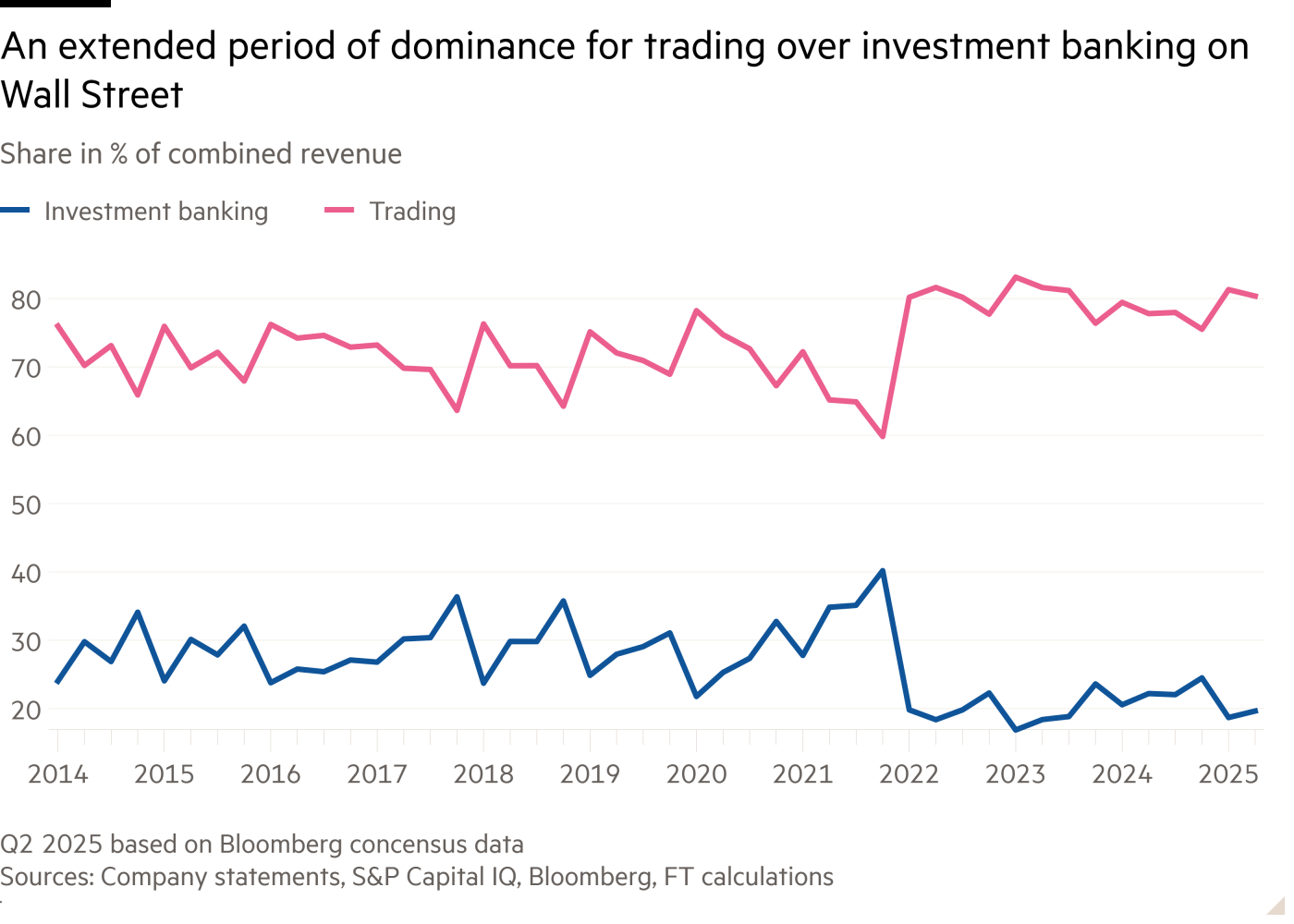
Since 2022, Traders’ Profits Have Topped 75 Percent Of Big Banks’ Revenues. According to the Financial Times, “Investment banking is on course to extend a record streak of underperformance, supplying less than a quarter of Wall Street revenues at the biggest US banks for the 14th quarter in a row. Traders are due to come to the rescue of their advisory colleagues once again when the banks report second-quarter results this week, with total trading revenues at the five largest Wall Street banks forecast to be $31bn — more than four times the figure for investment banking. Analysts expect trading revenues at JPMorgan Chase, Bank of America, Citigroup, Goldman Sachs and Morgan Stanley will be almost 10 per cent higher than a year ago. They forecast that revenues from investment banking, the other part of the banks’ Wall Street operations, will fall almost 10 per cent to $7.5bn, according to consensus data compiled by Bloomberg. If the earnings match estimates when the groups report results on Tuesday and Wednesday, investment bankers will have contributed less than 25 per cent of Wall Street revenues — distinct from money earned from retail banking and money management activities — since the start of 2022. This would be the longest period in which they have failed to breach that threshold since at least 2014.” [Financial Times, 2025-07-13]
Banks’ Trading Operations Have Benefited From Higher Volatility And Activity. According to the Financial Times, “Banks facilitate and finance trades. They benefit when activity levels are high and prices are volatile. ‘This is a normal environment, whereas the low [volatility] environment of the 2010s was the abnormal part,’ said Chris Kotowski, research analyst at Oppenheimer & Co. In the past three years, financial markets have grappled with rising interest rates, conflicts in Ukraine and the Middle East, and protectionist policies after Donald Trump’s return to the White House.” [Financial Times, 2025-07-13]
Big Banks’ Trading Operations Have Masked Poor Banking Activity
Code
usingYFinance# Get The Databig=get_prices("^BKX"; interval="1d", startdt="2025-01-20", enddt="2025-07-14") |> DataFrameregional=get_prices("^KRX"; interval="1d", startdt="2025-01-20", enddt="2025-07-14") |> DataFrame# Create The Plotplot(Date.(big.timestamp), 100.0.* big.adjclose ./ big.adjclose[1]; label="Big Banks", linewidth=2, xlabel="Date", ylabel="Preformance Since Inaguration", title="Big Banks' Stocks Have Recovered, Not Small Ones")plot!(Date.(regional.timestamp), 100.0.* regional.adjclose ./ regional.adjclose[1]; linewidth=2, label="Regional Banks")hline!([100.0]; linewidth=2, linestyle=:dash, label="",)vline!([Date(2025,4,2)]; label="Tariffs", linewidth=2, linestyle=:dash)
Crypto
Crypto Companies Have Pushed The Trump Administration For Access To National Bank Trust Charters, Thereby Allowing Them To Escape Some State-Level Regulations. According to the Financial Times, “Cryptocurrency companies are racing to expand into traditional banking in the US, as they seek to capitalise on a friendlier regulatory environment under President Donald Trump and become more embedded in the financial system. Crypto payments group Ripple, stablecoin company Circle and custodian BitGo have applied for national trust bank charters that will allow them to offer some banking services, while crypto exchange Kraken plans to launch bank cards in the next month. ‘It’s a natural convergence,’ Arjun Sethi, co-chief executive of Kraken, told the Financial Times, adding the company plans to launch debit and credit cards by roughly the end of the month. The moves underscore how crypto companies are seeking to broaden their activities from just offering digital asset services. Executives” confidence has soared because of the Trump White House’s openness to digital assets, whereas his predecessor Joe Biden was perceived to be hostile to the industry. […] While national trust banks can take custody of assets and process payments, they cannot provide loans or take direct deposits from customers. Gaining national trust status would remove the need for a company to get licences from individual states and improve its access to the financial system.” [Financial Times, 2025-07-13]
July 2025: Trump Administration Regulators Gave Banks New Guidance On Providing Crypto Custody, Replacing Earlier Guidance. According to Bloomberg, “US regulators gave fresh guidelines for how banks can offer crypto custody services and not run afoul of rules, the latest move from Trump-era watchdogs as they weigh how traditional lenders can engage with digital assets. Banks that contemplate providing safekeeping for crypto-assets should consider the evolving nature of the crypto market, including the technology underlying the cryptoassets, regulators said in a Monday statement. The Federal Reserve, Federal Deposit Insurance Corp. and Office of the Comptroller of the Currency said firms must also implement a risk-governance framework that appropriately adapts to relevant risks. Regulators in April withdrew previous guidance on risks tied to the crypto sector, giving lenders a freer hand to provide products and services to customers dealing in digital assets.” [Bloomberg, 2025-07-14]
Private Credit
Due To The Fast Growth Of The Private Credit Industry, And The Lack Of Visability It Has Provided, The Risk To Financial Stability Has Not Been Well Understood. According to the Wall Street Journal, “Fabio Natalucci, head of the Andersen Institute, a think tank, said many of these private-markets companies are imitating banks but don’t face the same regulations. Natalucci, who studied financial stability for the Federal Reserve for 16 years, added their systemic risk to the economy isn’t fundamentally understood because of how fast they have grown. ‘We have not seen this sector, at this size, go through a meaningful slowdown,’ he said. ‘It has grown fast over the past decade and that could be a vulnerability.’ Dimon, too, told Congress in 2023 that private credit was pushing economic activity out of the sight of regulators. At a conference in 2024, he said there could ‘be hell to pay’ if enough loans sour and everyday investors are left holding the bag. ‘I think credit today is a bad risk’ because its ‘happy-go-lucky’ growth hasn’t been tested in a downturn, Dimon said in May at the bank’s investor day. But he added, ‘there will be a huge opportunity for this company, too.’” [Wall Street Journal, 2025-07-13]
Push For Retail Investors
Wall Street Journal: Trump Expected To Sign An Executive Order Easing The Inclusion Of Private Investments In 401(k) Plans. According to the Wall Street Journal, “Meanwhile, the White House is expected to sign an executive order in the coming weeks that would instruct the Labor Department and Securities and Exchange Commission to provide guidance easing the inclusion of private investments in 401(k) plans, according to people familiar with the matter.” [Wall Street Journal, 2025-07-14]
Jamie Dimon Expressed Disapproval Of Efforts To Put Retail Funds Into Private Credit. According to the Wall Street Journal, “Dimon still says he doesn’t like how some private-credit firms are increasingly using funds from mom-and-pop savers to fuel their rapid expansion, a shift from the longstanding practice of taking risks only with big investors’ money. Blackstone, KKR and Apollo have all recently developed private-credit investment products aimed at individuals. Many of the firms are also accessing mom-and-pop savings by working with insurance companies and using annuities to grow their lending businesses faster.” [Wall Street Journal, 2025-07-13]
Economic Degradation
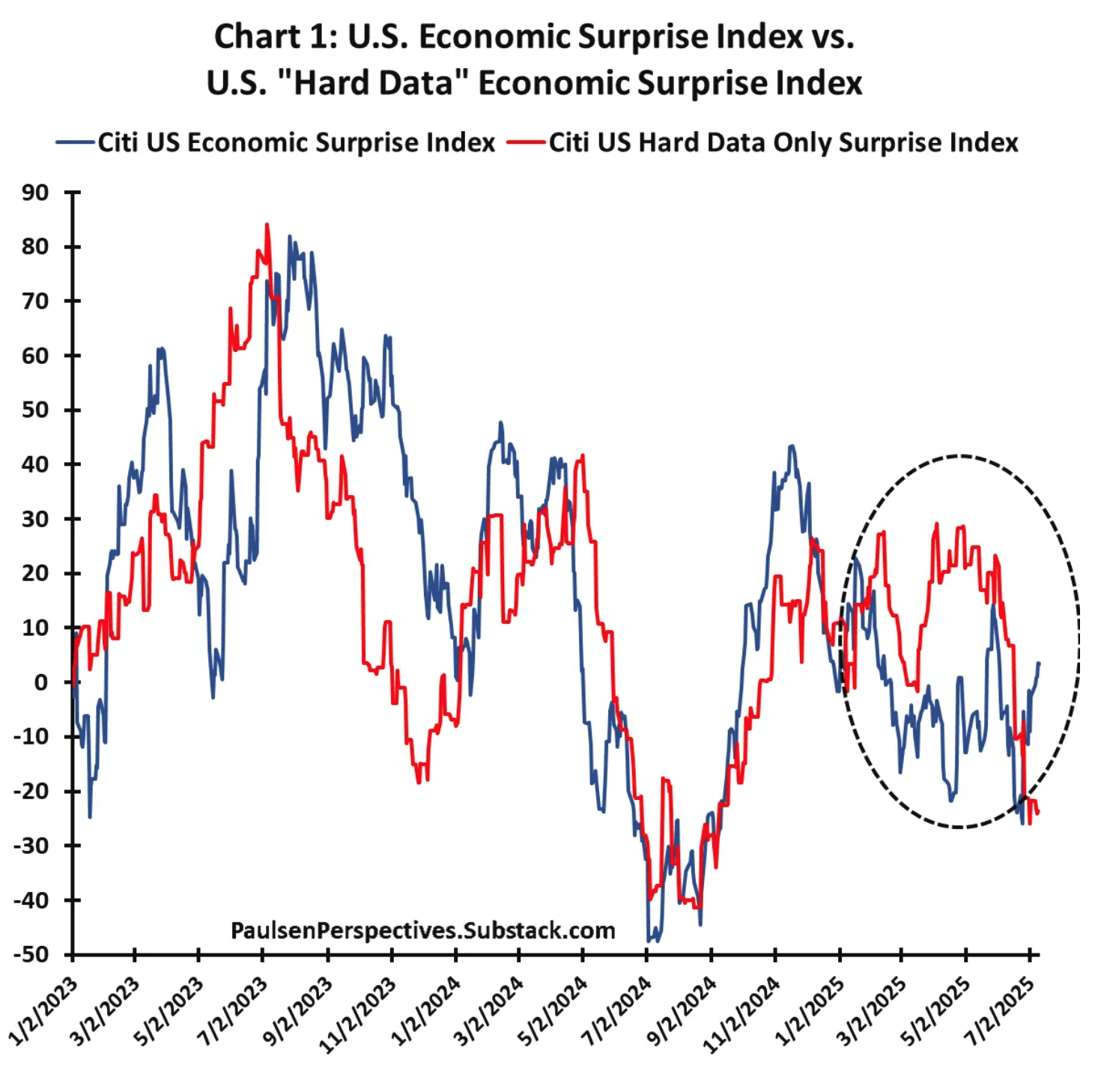
May 2025 - July 2025: While Soft Economic Data Has Recovered, Hard Data Has Begun To Under preform Economists’ Expectations. According to Paulsen Perspectives, “The overall Citi U.S. Economic Surprise Index measures data surprises relative to market expectations. When the index rises, it implies that economic reports are stronger than expected while declines in the index suggest reports are worse than expected. When the index is highly positive, U.S. economic momentum has been strong whereas negative readings suggest economic growth has been slowing. All year long, the Federal Reserve has been saying that although economic reports had been disappointing, the economic data that turned south was primarily ‘soft data’ based only on surveys. ‘Hard economic reports’ – those derived from actually counting the number of widgets being produced in the factory rather than on opinions or feelings – continued to remain healthy. The Fed told us there was no reason to ease monetary policy simply because pessimism had increased when hard data was still showing strength. However, as shown in chart 1, since the end of May, ‘hard data’ economic reports have also collapsed. Chart 1 overlays the Citi U.S. economic surprise index (blue line, left scale) with the components of the U.S. surprise index which are based solely on hard economic data reports (red line, right scale). The overall U.S. surprise index peaked last November near +50 and proceeded to decline to as low as -26 in late June. However, until early June, the ‘hard data’ surprise index remained fairly strong. Indeed, it was still above +20 at the start of June. However, the hard data index has declined significantly during the last month.” [Paulsen Perspectives, 2025-07-14]
Corruption
Reprivatized GSEs
WSJ Editorial Board: Trump And His Allies’ Plans For Fannie And Freddie Would Raise Risk Of A Future Bailout To Benefit Trump-Aligned Financiers. According to the Wall Street Journal Editorial Board, “Fannie and Freddie back $7.7 trillion in loans and account for half of the single-family mortgage market. Loans they’ve guaranteed in recent years have become increasingly risky, though at least the Biden FHFA last year nixed a Freddie plan to guarantee second mortgages, which are effectively consumer loans. Yet hedge funds that own common shares in Fan and Fred are pressuring the Trump Administration to release them, and you can see why. Their profits will be private but the risks will be socialized on taxpayers. FHFA Director Bill Pulte has floated letting the firms have public stock offerings and use them ‘for what they are, which are assets for the American people.’ That sounds ominous. Is the idea for the government to keep its preferred shares (currently valued at $355 billion) while using the dividends to finance Mr. Trump’s mooted sovereign wealth fund or strategic crypto reserve? Such a plan could spur regulators to ease up on the firms so they can mint bigger profits for the government even while increasing the risk for taxpayers. Bill Ackman, whose Pershing Square Capital manages funds that own shares in Fannie and Freddie, has pitched a plan that involves the government taking the two firms public, canceling its preferred shares, and easing their capital requirements. This would be a $355 billion gift to current shareholders and increase the risk of a future bailout.” [Wall Street Journal Editorial Board, 2025-07-13]
Trump Green-Lit Nvidia’s Sale Of Advanced AI Chips To China
Trump Administration Officials Told Nvidia That They Could Resume Selling h20 AI Accelerator Chips To China After Their CEO Met With Trump. According to Bloomberg, “Nvidia Corp. plans to resume sales of its H20 artificial intelligence accelerator to China based on assurances from Washington that such shipments would be approved, a dramatic reversal from the Trump administration’s earlier stance. US government officials have told Nvidia that they would green-light export licenses for the H20, the company said in a blog post on Monday. That China-specific variant of Nvidia’s AI chips was created to comply with earlier trade curbs, but has since April also been blocked from sale in China. A spokesperson for the Commerce Department, which oversees semiconductor export controls, did not immediately respond to a request for comment. Chief Executive Officer Jensen Huang met with US President Donald Trump last week and is in Beijing this week to attend a large supply chain expo. Huang has told Nvidia customers that he expects new China licenses to be granted and hopes to resume H20 deliveries soon. Nvidia also plans to debut a new China-focused chip — the RTX PRO — that the company described as ‘fully compliant,’ meaning that it falls below the technical thresholds that would necessitate Washington’s approval in the first place.” [Bloomberg, 2025-07-15]
 [New York Fed,