Indicators that the real economy is deteriorating continued to accumulate, with real wages declining and the sustained inventory accumulation from before Trump announced his tariffs winding down. Things were not all bad, however, with wall street capitalizing on the volatility Trump has unleashed to score record trading profits, a contrast with the real economy so stark the WSJ editorial board noticed it.
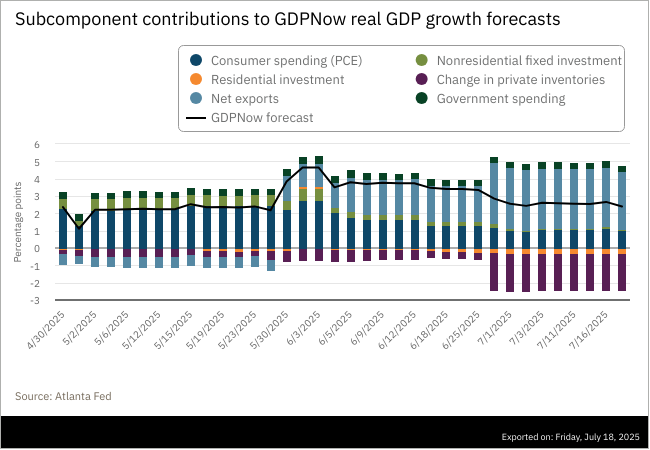
Due To Lower Forecasts Of Consumer Spending And Net Exports, The Atlanta Fed Revised Their Growth Forecast For The Second Quarter Down. [Atlanta Fed, 2025-07-17]
Trade War
WSJ Editorial Board: Trump’s Tariffs Have Helped Wall Street And Hurt Main Street. According to the Wall Street Journal Editorial Board, “Trump advisers say the President’s trade agenda is focused on helping Main Street, not Wall Street. But the irony is that the tariffs hurt Main Street while the market volatility caused by his whipsawing tariff threats has been a boon to Wall Street. JPMorgan’s equity trading revenue hit a second-quarter record on Tuesday.” [Wall Street Journal Editorial Board, 2025-07-15]
Q2 2025: Trump’s Trade War And The Volatility It Has Spurred Led To Goldman Sachs’ Traders’ Largest Ever Revenue. According to Bloomberg, “Goldman Sachs Group Inc.’s stock traders posted the largest revenue haul in Wall Street history, as volatility sparked by the Trump administration’s trade war spurred a second straight record quarter for the unit. At $4.3 billion, equity-trading revenue for the second quarter was about $600 million more than what analysts were expecting and $100 million above the first-quarter total, according to a statement Wednesday. That also pushed profit above expectations for the period.” [Bloomberg, 2025-07-16]
Q2 2025: Morgan Stanley Traders Had Their Second Best Quarter On Record, Benefiting From The Volatility Of Trump’s Policy Choices. According to Bloomberg, “Morgan Stanley’s stock traders scored their best second quarter on record as the biggest US banks continue to reap the benefits of market volatility tied to President Donald Trump’s policy moves. The firm earned $3.72 billion in equity-trading revenue, a 23% jump from a year ago and ahead of analyst expectations, according to a statement Wednesday. The firm’s closely-watched wealth management unit reeled in $59.2 billion of net new assets in the period, also surpassing predictions.” [Bloomberg, 2025-07-16]
Q2 2025: Led By Traders’ Record Profits, Bank Of America Was Able To Top Analyst Expectations. According to Bloomberg, “Bank of America Corp.’s traders posted a record second quarter as the company reaped the benefits of volatile markets and net interest income topped analysts’ estimates. Revenue from fixed income, currencies and commodities trading jumped 19% to $3.25 billion in the three months through June, the company said in a statement Wednesday. That helped Bank of America top analysts’ estimates for per-share earnings. Equity trading rose 9.6% to $2.13 billion, also topping expectations.” [Bloomberg, 2025-07-16]
Higher Prices
CEO Of Made-In-America Lucid Motors: “For The American Consumers, Vehicles Are Going To Be More Expensive Under The Tariff Regime.” According to Bloomberg, “The head of Lucid Group Inc. warned that President Donald Trump’s tariffs will drive up costs to build automobiles — even in the US. The industry’s global supply chain means domestic manufacturers still have to import raw materials and some parts from other countries, interim Chief Executive Officer Marc Winterhoff said in an interview with Bloomberg Television on Monday. ‘For the American consumers, vehicles are going to be more expensive under the tariff regime. There’s no other way around it,’ Winterhoff said. ‘There’s a reason the supply chain is so global.’” [Bloomberg, 2025-07-14]
WSJ Editorial Board: “Trump Tariffs Hit Consumer Prices.” [Wall Street Journal Editorial Board, 2025-07-15]
WSJ Editorial Board: Prices Across Imported Goods Rose Notably In June. According to the Wall Street Journal Editorial Board, “And that’s what they’re seeing in the June inflation report. Price increases were broad-based, and especially in goods that the U.S. imports. Think toys (1.8%), paper products (1.4%) and appliances (1.9%). The latter was the biggest increase since August 2020. Food prices rose 0.3% despite a 7.4% decline in egg prices. One culprit was fresh fruit and vegetables (1%), the biggest increase in more than a year. About 60% of fresh fruit and 35% of fresh vegetables are imported. Slapping tariffs on cherries from Chile and bananas from Guatemala won’t cause more of them to be grown stateside, especially when farmers can’t find workers. Prices for coffee—almost all of which is imported—rose 2.2%. Your cup of Joe will get even more expensive if Mr. Trump follows through on his threat to impose a 50% tariff on Brazil. Carbonated drink prices notably rose 1.7%. Coca-Cola warned in February that it imports aluminum for cans from Canada, which would be subject to 25% tariffs (now 50%). While the company said it might shift to using more plastic bottles, this strategy has limits. The U.S. also imports large amounts of plastic.” [Wall Street Journal Editorial Board, 2025-07-15]
June 2025: Against Consumer Prices, Hourly And Weekly Wages Fell, Exacerbated By Shortening Workweeks. According to the Wall Street Journal Editorial Board, “The Labor Department’s consumer-price report Tuesday showed inflation ticked up in June to 0.3% or 2.7% in the last year. Real average hourly earnings fell 0.1% as inflation eroded wage gains. Real average weekly earnings fell 0.4% and 0.6% for production-level workers as hours of work declined, perhaps because of a slowing economy and labor market.” [Wall Street Journal Editorial Board, 2025-07-15]
Capital Flight
Oxford Economics: A 10 Percent Weakening In The Dollar (Less Than That Seen This Year) Would Boost American Inflation By 0.5 Percent This Year, And 1 Percent Next Year. According to Bloomberg, “Tuesday’s US consumer price index for June will be keenly watched for any signs that tariff hikes are passing through to inflation. But there’s another factor to look for later out in the year, Oxford Economics says: dollar depreciation. ‘A weaker dollar has big implications for the economic outlook, most notably by adding to the upside risks to inflation this year,’ Michael Pearce, deputy chief US economist at the research group, wrote in a note Monday. If the dollar, weighted against the currencies of major trading partners, stabilizes at current levels after its biggest first-half loss since 1973, that implies upward pressure on import prices in the second half of 2025, he wrote. A 10% depreciation boosts the US inflation rate by almost 0.5 percentage points this year and by 1 point in 2026, the Oxford Economics model suggests. (The Dollar Index tumbled more than 10% in the first half). ‘The upside risks increase the value of the Fed remaining patient as it waits for more data, and point to a prolonged hold in policy rates,’ Pearce wrote.” [Bloomberg, 2025-07-15]
Capitulation For Nothing
July 15, 2025: Trump Administration Officials Told Nvidia That They Would Reverse Course And Allow The Export Of AI Accelerator Hardware. According to Bloomberg, “Nvidia Corp. and Advanced Micro Devices Inc. plan to resume sales of some AI chips in China after securing Washington’s assurances that such shipments would get approved, a dramatic reversal from the Trump administration’s earlier stance on measures designed to limit Beijing’s AI ambitions. US government officials told Nvidia they would green-light export licenses for its H20 artificial intelligence accelerator, the company said in a blog post on Monday — a move that may add billions to Nvidia’s revenue this year, restoring its ability to fulfill orders it had written off as lost due to government restrictions. Nvidia designed the less-advanced H20 chip to comply with earlier China trade curbs from Washington, which Trump’s team tightened in April to block H20 sales to the Asian country without a US permit.” [Bloomberg, 2025-07-15]
July 15, 2025: China Imposed Export Controls To Protect Advanced battery Technology. According to the Wall Street Journal, “China is seeking to further consolidate its global lead over the U.S. in certain industrial areas by making sure crucial technologies won’t easily fall into the hands of foreign rivals. Its latest target: electric-vehicle batteries. China on Tuesday added technologies for producing materials used in EV batteries onto its list of export restrictions. Those include technology linked to battery-cathode materials production as well as nonferrous metal-processing technology, associated with raw materials in batteries. The move comes on top of China’s domination of the EV battery supply chain, from lithium processing to battery production. Now, Beijing is taking the next step to ensure other countries can’t easily catch up by raising the bar for foreign companies to acquire leading Chinese technologies.” [Wall Street Journal, 2025-07-15]
Uncertainty
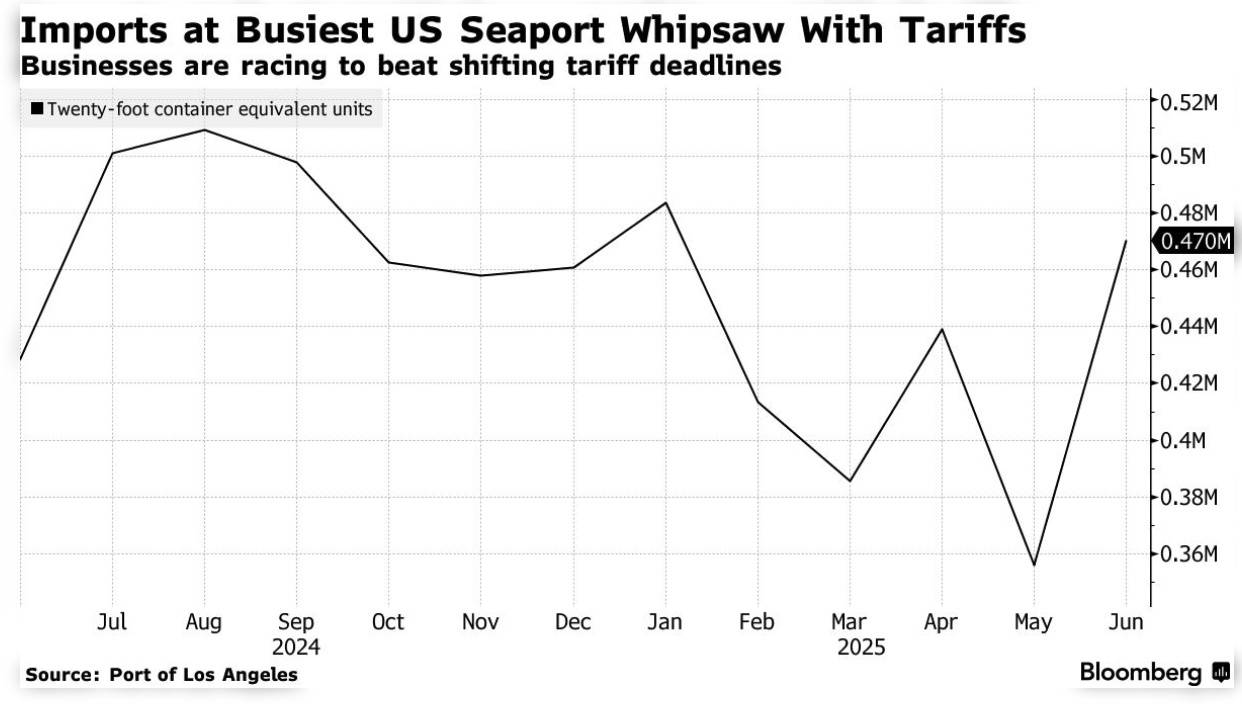
May 2025 - June 2025: Volume At The Port Of Los Angeles Shot Up 32 Percent In An Example Of “The Tariff Whipsaw Effect.” According to Bloomberg, “The busiest trade hub in the US saw container traffic rebound last month after a slump in May, as importers grapple with volatility driven by President Donald Trump’s trade war. The Port of Los Angeles processed some 892,000 twenty-foot-equivalent units or TEUs, according to executive director Gene Seroka. That’s a record for June and up 32% from the previous month. Overall, volumes in the first half of the year were up 5% from 2024. ‘While record-setting volume is welcome news, it also highlights the tariff whipsaw effect,’ Seroka told reporters on Monday.” [Bloomberg, 2025-07-14]
Economic Degradation
Dismantling Shipbuilding Support
In Response To Pressure From Existing Shipbuilding Prime Contractors, Trump Closed The NSC Shipbuilding Office And Rejected Candidates For Senior Positions Within The Merchant Marine. According to John \(\Lambda\) Konrad V, “Massive shipbuilding changes in DC. None of them good. @gCaptain has confirmed from a White House source that Trump has closed the shipbuilding office at the NSC. Reuters reports that Ian Bennitt, the President’s Special Assistant for Shipbuilding at the White House, has been fired. Favored candidates for Provost and Superintendent positions at the U.S. Merchant Marine Academy have received denial notices. At a recent USNI shipbuilding conference, it became clear: major shipbuilding primes are actively fighting plans to expand commercial shipbuilding.” [John \(\Lambda\) Konrad V, 2025-07-15]
Financial Instability
June 2025: “Wall Street Executives Notched A Victory,” As The Trump Administration Proposed Easing Borrowing Limits. According to the Wall Street Journal, “And Wall Street executives notched a victory last month, when U.S. regulators proposed changes to ease borrowing limits imposed after the financial crisis, via a measure known as the supplementary leverage ratio.” [Wall Street Journal, 2025-07-14]
Private Asset Bailout
As Private Markets Have Been Tapped For Funding, Private Asset Managers Have Pushed The Trump Administration To Provide Encouragement To Include Their Products In 401(k)s. According to the Wall Street Journal, “President Trump is expected to sign an executive order in the coming days designed to help make private-market investments more available to U.S. retirement plans, according to people familiar with the matter. The order would instruct the Labor Department and the Securities and Exchange Commission to provide guidance to employers and plan administrators on including investments like private assets in 401(k) plans, the people said. The details of the order aren’t yet final and are still subject to review, the people said. An order could help pave the way for big managers of private assets such as Apollo Global Management and Blackstone to access the vast sums of retirement savings held by workers who don’t have a traditional pension. Institutional investors such as pension funds have largely maxed out on private markets, leading firms to look to individual investors for new sources of growth. In theory, retirement plan sponsors can already put some of their investments in private funds and some already do in small quantities. But many companies remain concerned they would be sued by their employees over the higher fees associated with private-market investment products.” [Wall Street Journal, 2025-07-15]
Corruption
July 2024: Trump’s DOJ And CFTC Dropped Probes Into The Crypto-Betting Platform Polymarket. According to Bloomberg, “A pair of US investigations into crypto-betting platform Polymarket that went full-throttle in the waning days of the Biden administration are now being shut down just as Donald Trump’s White House seeks to give the industry a boost. The predictions exchange received formal notice earlier this month from the US Justice Department and Commodity Futures Trading Commission that the probes had ended, according to a person with direct knowledge of the matter, who asked not to be identified discussing the confidential inquiries.” [Bloomberg, 2025-07-15]
 [Atlanta Fed,