July 18, 2025
Summary
What came out today really was just more evidence that the economic costs of Trumpism have begun to add up for the American people. The cuts in federal employment he has been so focused on have notably degraded the quality of American data, including the CPI inflation data that goes into calculating social security adjustments and TIPS payments. Furthermore, his opposition to FEMA has blocked numberous states from making the investments they need to to make sure they are resilient against natural disasters, while the macroeconomic uncertainty he has caused pushed Sandisk to stop progress on a multi-billion dollar investment in Michigan.
Meanwhile, his continued agression in pushing his trade war would, in addition to making cars notably more expensive, have pushed the Europeans to turn away from buying American weapons and towards drastic anti-coercion trade mechanisms. At the same time, his push to create giveaways to his donors in private equity and private credit risk increasing financial volatility, and pushing crypto-like instability into the American housing market.
Trumpism And Its Costs
Increased Macroeconomic Instability
Employ America: By Shifting Administrative (And Potentially Some Food Costs) Of SNAP Onto States, Trump’s BBB Could Lead To A 15-30 Percent Cut To SNAP Benefits. According to Employ America, “The OBBBA significantly increases the financial burden on state governments by shifting more responsibility for SNAP and Medicaid onto the states. Under current law, states do not pay for SNAP food benefits and split administrative costs with the federal government, but the OBBBA will require states to cover a majority of administrative expenses and, in some cases, contribute to food benefit costs. This change would increase state spending on SNAP by 15% to 30%, depending on how accurately a state administers SNAP.” [Employ America, 2025-07-16]
Employ America: By Cutting Benefits For The Poorest Americans, Trump’s BBB Would Reduce The Level Of Countercyclical Support That Helps To Stabilize The Economy In Downturns. According to Employ America, “In addition to jeopardizing the well-being of low-income individuals, this sharp reduction in access to essential benefits also undermines the macroeconomic stabilizing role of social safety net programs. These programs are specifically designed to support low-income households with food assistance and healthcare, especially during economic downturns when spending in grocery stores increases and many people lose access to employer-sponsored health insurance. As a result, enrollment in these programs naturally rises during recessions. The impact is not just support for individuals and households during economic hardship, but also automatic countercyclical support for broader aggregate demand during recessions. Programs like Medicaid and SNAP are especially important from a macroeconomic perspective because they support the household budgets of those with the highest marginal propensity to consume, i.e., those whose consumption is most sensitive to changes in income. The OBBBA does more than remove support for those who rely on public assistance; gutting social safety nets weakens the ability of these programs to provide countercyclical fiscal support during recessions.” [Employ America, 2025-07-16]
Worse Data
Since Trump’s Inauguration, The Share Of CPI Prices Calculated Through Imputation Rather Than Direct Observation Has Jumped From 10 Percent To 35 Percent. 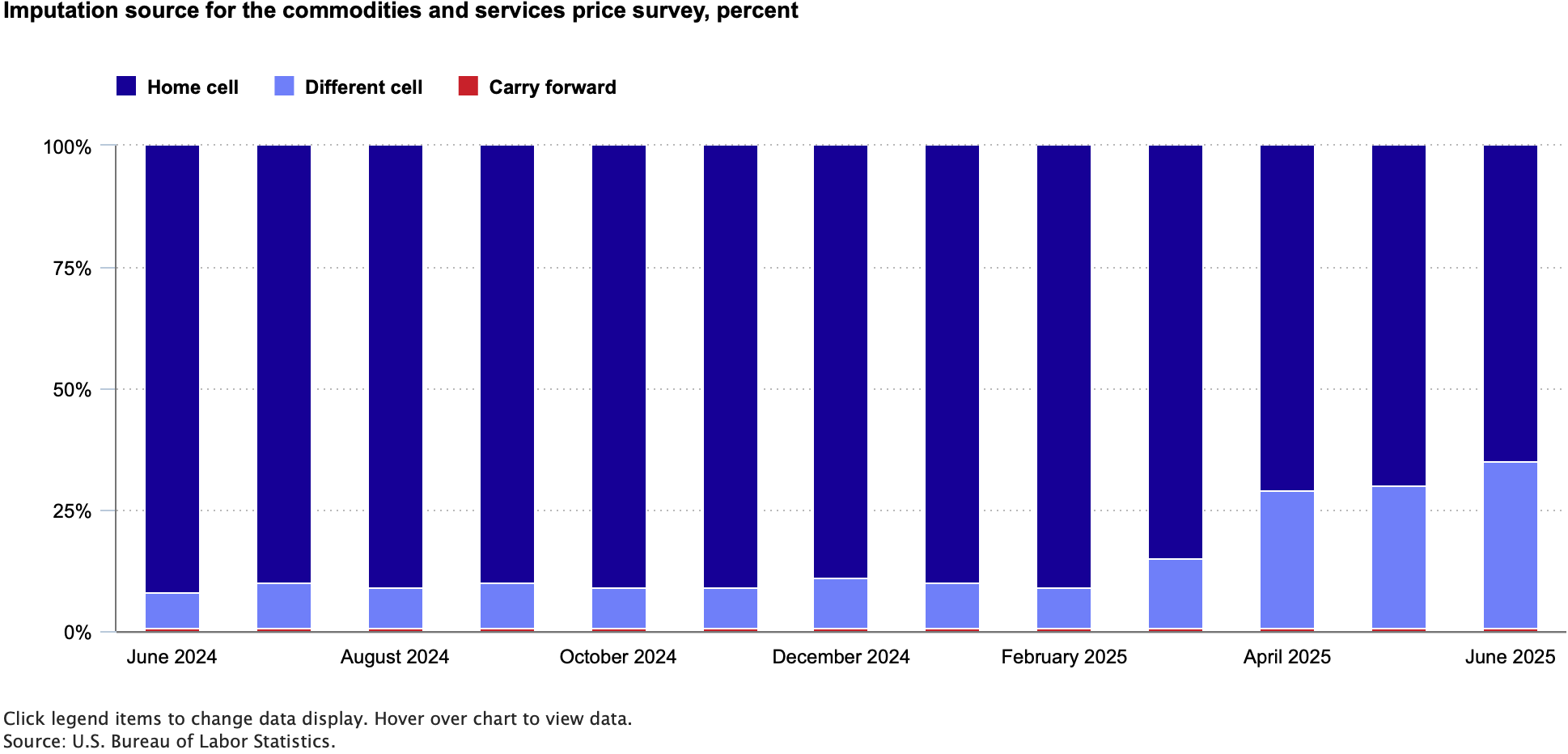 [the Bureau of Labor Statistics, accessed 2025-07-18]
- Trump’s Hiring Freeze Has Likely Made The Data Collection Work Of The BLS Harder. According to Bloomberg, “Of course, US data quality has arguably been deteriorating for some time now, as we talked about in an episode earlier this year with former BLS Commissioner Bill Beach. Response rates to economic surveys have been going down, which again is a big deal for CPI since a portion of rental data is based on the CPI Housing Survey, and shelter weightings are also calculated via the Consumer Expenditure Survey. Responses to surveys also seem to be more politicized. But the recent spike in different-cell imputation is, per the BLS, more about declining resources and the Trump administration’s federal hiring freeze begun in January. Fewer BLS workers means fewer people available to conduct surveys and actually go out and directly observe prices. Hence the need for imputation.” [Bloomberg, 2025-07-16]
Reduced Investment
July 2025: A Planned Sandisk Plant In Flint Michigan Was Canceled, With State Officials Citing ‘Massive Economic Uncertainty At The National Level.’ According to the Detroit Free Press, “Gov. Gretchen Whitmer’s goal to land a semiconductor plant in Michigan before she leaves office will have to wait after a company that had its eye on a site near Flint changed course, according to the governor. Whitmer blamed the setback on national economic conditions in a July 16 statement. ‘Because of massive economic uncertainty at the national level, an advanced manufacturing company we were working with to bring a huge project to Michigan has decided not to move forward with plans to construct a semiconductor plant anywhere in the United States,’ Whitmer said. ‘Their board came to this decision amid national economic turmoil, which is at risk of worsening amid threats of even higher tariffs.’ The company was looking at Genesee County’s Mundy Township for the project, according to Whitmer. The location near Flint is the state’s last large available site of more than 1,000 acres and one of the last so-called megasites in the United States, according to the Michigan Economic Development Corporation. Sandisk had its eye on the site and agreed not to pursue other locations while working with the Michigan Economic Development Corporation to come to Michigan, according to documents related to the project provided by MEDC. The company declined to comment.” [the Detroit Free Press, 2025-07-16]
Blocking Natural Disaster Preparation
July 2025: Arizona Led 20 States In Suing The Trump Administration Over The Cancelation Of A Program Funding Investment In Improved Resiliancy To Natural Disasters. According to the Arizona Republic, “The Trump administration’s April move to end a funding program that helps communities prepare for natural disasters violated several federal laws and should be reversed, according to the latest lawsuit filed by a coalition of states including Arizona. Attorney General Kris Mayes announced the lawsuit, filed by Democratic leaders in 20 states, on July 16. She made plain the stakes of ending the Federal Emergency Management Agency’s Building Resilient Infrastructure and Communities program. ‘The Trump Administration has demonstrated outright hostility toward helping states with disaster relief in attempts to slash FEMA,’ Mayes, a Democrat, said in a statement. ‘Support for our states and our ability to fight disasters, like those that we see during wildfire season, is incredibly important.’ Buckeye was slated to receive $4.6 million for a project to divert floodwaters from its historic downtown by connecting its drains to irrigation canals, according to Mayes’ office. Camp Verde had been planning on receiving about $860,000 to shore up a road often used by emergency responders that is subject to flooding and can delay their response.” [the Arizona Republic, 2025-07-16]
Trade War
Trump’s Commerce Department Imposed Preliminary Charges On Imports Of Chinese Graphite, Raising The Effective Rate To 160 Percent. According to Bloomberg, “The US Commerce Department will impose preliminary anti-dumping duties on imports of Chinese graphite, a key battery component, after concluding that the materials had been unfairly subsidized. A trade association representing US graphite producers in December filed petitions with two federal agencies, asking for investigations into whether Chinese companies were violating anti-dumping laws. The new duties will add to existing rates, making the effective tariff 160%, according to the American Active Anode Material Producers, the trade group that filed the complaint. The Commerce Department issued the preliminary determination on the 93.5% anti-dumping duties in a document Thursday, and said a final decision should be announced by Dec. 5.” [Bloomberg, 2025-07-17]
- This Measure Would Make It Much More Expensive To Manufacture Electric Vehicles, Adding About $7 Per Kilowatt-Hour To Battery Costs. According to Bloomberg, “The tariff would be a blow to manufacturers, said Sam Adham, head of battery materials at consultancy CRU Group. A 160% tariff equates to $7 per kilowatt-hour added cost to an average EV battery cell, or one fifth of the manufacturing tax credits that originated in the Inflation Reduction Act and survived President Donald Trump’s budget bill, he said. ‘That basically wipes out profits for one or two entire quarters for the Korean battery makers,’ Adham said. Tesla Inc. and its key battery supplier, Japan’s Panasonic Inc., were among companies pushing to block the new tariffs, arguing that they rely on Chinese graphite imports because the domestic industry hasn’t developed enough to meet the quality standards and volume that the carmaker requires. Tesla shares fell as much as 0.7% Thursday.” [Bloomberg, 2025-07-17]
Dire Consequences
July 2025: More Than Half Of EU Countries Backed The Use Of Its “Anti-Coercion” Measures. According to Bloomberg, “A growing number of European Union member states want the bloc to activate its most powerful trade tool against the US should the two sides fail to reach an acceptable agreement by Aug. 1 and Donald Trump carries out his threat of 30% tariffs on the US’s largest trading partner. A French-led charge to deploy the EU’s so-called anti-coercion instrument is backed by more than half a dozen European capitals, according to people familiar with the matter. Several member states are more cautious, while others have yet to express a position, said the people, who spoke on condition of anonymity to discuss private deliberations.” [Bloomberg, 2025-07-16]
- Those Rules Could Allow The EU To Impose A Broad Range Of Retaliatory Actions, Including Investment Restrictions, Or Limiting Access To The EU For American Firms. According to Bloomberg, “Benjamin Haddad, France’s minister for European affairs, said earlier this week that the response from Brussels should include the option of using the tool which gives officials broad powers to take retaliatory action against EU trading partners. Those measures could include new taxes on US tech giants, for instance, or targeted curbs on US investments in the EU. They could also involve limiting access to certain parts of the EU market or restricting US firms from bidding for public contracts in Europe.” [Bloomberg, 2025-07-16]
Diminishing American Defense Industry
Trump’s Alarming Behavior Has Pushed Staunch Allies To Look For Other Arms Suppliers. According to Bloomberg, “Several nations have already hit the brakes this year on major US arms purchases or are looking to alternatives made in Europe or elsewhere. After Trump’s trade threats and his jabs about turning Canada into the 51st US state, Canada announced in March that Prime Minister Mark Carney is reevaluating a $13 billion agreement to buy 88 Lockheed Martin Corp. F-35 fighter jets. His defense minister said the government would consider switching to fighters made by companies outside the US. ‘We should no longer send three-quarters of our defense capital spending to America,’ Carney said in a June speech outlining the nation’s defense plans. Poland, another regular buyer of US arms, negotiated a $6 billion deal for a fleet of K2 tanks from South Korea’s Hyundai Rotem Co. They’ll be deployed alongside US-manufactured M1A2 Abrams tanks that Poland purchased from General Dynamics Corp. And Denmark is weighing whether to choose a missile defense system developed in France and Italy over the US-made Patriot system from RTX Corp. ‘Europeans are very reliant on the US defense industry. But I think because of the tariffs, because of President Trump’s attitudes toward NATO and his less-than-eager willingness to embrace the defense of NATO countries, European countries are increasingly going to prioritize investing in European defense firms,’ says Todd Harrison, a senior fellow at the American Enterprise Institute, a conservative think tank in Washington. Harrison says a push to develop defense manufacturing in Europe would also help justify NATO’s lofty spending levels to a wary public—‘by showing that the money is going to build industrial capabilities and create jobs in their own country rather than creating jobs in the US.’” [Bloomberg, 2025-07-16]
Financial Instability
With The Trump Administration’s Efforts To Allow For Cryptocurrency Holdings To Count Towards Mortgage Eligibility, The Wealth-Effect Channel Could Be Exposed To Crypto-Level Volatility. According to Bloomberg, “Under the traditional process, borrowers whose wealth sat in crypto had to convert it into cash, often months in advance, to “season” the funds and ensure legitimacy. That prevented digital assets from functioning as a stable input in mortgage underwriting. The new Federal Housing Finance Agency directive doesn’t alter the current rules, but by prompting formal review, it sets in motion a process that could reshape them. If crypto is eventually allowed to count toward mortgage eligibility without being liquidated, borrowers could retain their tokens instead of converting them to meet reserve requirements. That turns it into a wealth-effect channel, opening up an avenue for online currencies to play a role in a vital sector of the US economy.” [Bloomberg, 2025-07-15]
Private Credit
Moodys: As Stress On Commercial Real Estate Grows, Private Credit Could Make Up A Larger Share Of Lending, Adding Risk Due To Higher Leverage. According to the Wall Street Journal, “Private credit’s growth is adding liquidity—and risk—to the U.S. commercial real-estate market, according to a report from Moody’s Ratings. Interest rates staying higher for longer and recent declines in property values are expected to drive more CRE borrowing to nonbank lenders in the coming years. Against market headwinds, private credit has stepped in to fund borrowers that may not meet traditional banking standards, according to Moody’s. Recent moves into private credit include alternative asset manager Blackstone’s purchase last month of $2 billion in commercial real-estate loans from Atlantic Union Bankshares, a Richmond, Va.-based bank. The transaction marked a nearly 7% discount because the loans were made before interest rates increased and have lost value. Giant asset manager BlackRock last week said it is acquiring ElmTree Funds, a real-estate-focused private-equity firm. ElmTree will be added to an internal BlackRock group that includes private-credit firm HPS Investment Partners, which the New York firm bought recently for roughly $12 billion in stock. As more commercial property lending shifts to nonbank financing, risk gets added to the system, according to Moody’s, which provides debt-security ratings widely used by investors. Credit shops frequently originate loans with higher financing levels than banks use, which translates to greater risk of default and loss, according to Moody’s. The sector is also lightly regulated and many private-credit firms have relatively short track records. Many didn’t exist when the 2007 subprime mortgage market meltdown triggered the global financial crisis that extended into 2009.” [the Wall Street Journal, 2025-07-15]
- While Private-Credit Loans Typically Run At Loan To Value Rates 10 Percentage Points Higher, The Decline In Commercial Real Estate Values Has Pushed LTVs In The Sector Higher. According to the Wall Street Journal, “The typical loan-to-value ratio for the average bank loan backing a commercial property ranges from 50% to 65%, Friedman said. But the average ratio for private-credit loans runs from 60% to 75%, he said. A decline in the market for commercial properties such as office buildings and shopping malls has undermined values, pushing up loan-to-value ratios to an average of 74% in the 100 largest loans issued by 41 banks in the U.S. and Europe, notably higher than the 55% in the original loans or under recent appraisals, according to Moody’s. Private-credit firms stepped in when banks weeded out their riskier assets.” [the Wall Street Journal, 2025-07-15]
Crypto
2025: American Crypto Companies Have Introduced Tokenized Securities, Allowing Non-U.S. Individuals To Trade American Assets More Easily. These Tokens Have “Deviated Wildly” From The Price Of The Underlying Securities. According to the Wall Street Journal, “Crypto companies have grand plans to reinvent the stock market using blockchain technology. They are off to a bumpy start. Digital tokens designed to track popular stocks such as Amazon.com and Apple have deviated wildly from the price of the underlying shares since their launch two weeks ago. Robinhood Markets is facing scrutiny from its European regulator after it launched a token designed to let investors bet on OpenAI—without getting permission from the artificial-intelligence startup. And even some industry insiders fret that such ‘tokenized’ stocks create opportunities for bad actors to engage in insider trading and market manipulation without getting caught. In a flurry of announcements in late June, companies including Robinhood, Kraken, Gemini and Bybit unveiled blockchain-based versions of U.S. stocks and exchange-traded funds for non-U.S. customers. Crypto executives hailed them as a way to let people worldwide invest in Tesla, Nvidia, the SPDR S&P 500 ETF and other buzzy securities, especially in countries where it is difficult to buy U.S. stocks through a local brokerage. ‘By tokenizing equities, we believe we can export U.S. capital markets anywhere in the world,’ said Gemini co-founder Cameron Winklevoss. Tokenized stocks are part of a broader effort to rebuild traditional markets on the technology that underpins bitcoin and other digital assets. Investors can now buy tokens to bet on assets ranging from U.S. Treasurys to private-credit funds to shares of Elon Musk’s SpaceX. Such experiments have proliferated in recent months as President Trump has installed crypto-friendly regulators and ended the Biden administration’s enforcement-heavy approach to the industry.” [the Wall Street Journal, 2025-07-15]
July 2025: At One Point, A Token Linked To Amazon Shares Traded T More Than 100 Times The Price Of The Underlying Shares. According to the Wall Street Journal, “On July 3, for instance, the price of AAPLX—a token tracking Apple—briefly jumped to $236.72, a 12% premium to where the stock was trading at the time, according to data provider CoinGecko. A similar token tracking Amazon surged to $891.58 on July 5, four times the stock’s previous closing price, CoinGecko data shows. The same token, AMZNX, suffered an even wilder dislocation on Jupiter, a peer-to-peer platform for crypto trading, early on July 3. Blockchain data shows that an unknown user trying to buy about $500 worth of the token briefly sent its price to $23,781.22, more than 100 times Amazon’s closing price the previous day. Such tokens, marketed as ‘xStocks,’ are issued by Backed Finance, a Switzerland-based company that partnered with Kraken and Bybit to debut dozens of stock-tracking tokens on June 30. Backed aims to keep xStocks in line with the underlying stocks by buying shares and creating new tokens, or redeeming the tokens and selling shares.” [the Wall Street Journal, 2025-07-15]
“Permissionless” Movement Would Allow Relatively Easy Movement Of Tokenized Shares To Anonymous Platforms, Thereby Increasing The Liklihood Of Illegal Financial Activities. According to the Wall Street Journal, “But such controls don’t necessarily exist with tokenized stocks. Backed’s xStocks, for instance, are ‘permissionless,’ meaning they can be moved freely between different users and trading platforms. Some platforms, such as Kraken, maintain records on their customers, but xStocks can also be traded on anonymous platforms like Jupiter. Backed says transactions on public blockchains are more transparent than those in traditional finance, making it possible to monitor and detect illegal activity. Still, other industry players worry that tokenized stocks being traded on anonymous platforms is a recipe for trouble. Such arrangements could facilitate abuses such as insider trading, said Carlos Domingo, CEO of tokenization startup Securitize. ‘It’s a can of worms and it is going to explode at some point, because people will find ways to do something illegal with these tokens,’ Domingo said.” [the Wall Street Journal, 2025-07-15]
Corruption
Crypto
July 2025: Cantor Fitzgerald, Led By Commerce Secretary Lutnick’s Son, Neared A $4 Billion Deal To Bring A Pot Of Bitcoins Public, Bringing The Total In SPAC To Crypto Treasury Companies Since Lutnick’s Appointment To $10 Billion. According to the Financial Times, “Brandon Lutnick, son of US commerce secretary Howard Lutnick, is nearing a roughly $4bn deal with an early bitcoin supporter to buy billions of dollars in the digital tokens using a vehicle backed by Cantor Fitzgerald. Cantor Equity Partners 1, a blank cheque vehicle that raised $200mn in cash in an initial public offering in January, is in late-stage talks with Adam Back, founder of crypto trading group Blockstream Capital, to buy more than $3bn in the digital currency, according to two people briefed on the talks. The deal, which mirrors a $3.6bn crypto buying venture Brandon Lutnick struck with SoftBank and Tether in April, would advance Cantor Fitzgerald’s strategy of using publicly listed shell companies to buy bitcoin as it aims to take advantage of a surge in digital currency prices amid US President Donald Trump’s deregulatory push. Howard Lutnick handed control of Cantor Fitzgerald to his children in May. Back is in discussions to contribute as much as 30,000 bitcoin to Cantor Equity Partners 1, worth more than $3bn. It would be part of a broader deal with the blank cheque company in which it would raise as much $800mn in outside capital to make further purchases of the digital currency, putting the overall deal at more than $4bn. Back and Blockstream Capital would contribute their bitcoin in exchange for shares in the Cantor vehicle, which would be renamed BSTR Holdings. A deal could come as early as this week, said the people, who cautioned that terms could still change. If completed in the coming days, it would come during what Republican lawmakers have dubbed “crypto week” as they debate legislation tied to digital currencies. The deal would make Cantor one of the world’s most active crypto buyers. It is using blank cheque vehicles led by the younger Lutnick, 27, who was named chair of the brokerage in February when his father was confirmed to be Trump’s top trade official. Cantor’s combined crypto purchases between its two vehicles, BSTR Holdings and Twenty One Capital, could reach nearly $10bn this year.” [the Financial Times, 2025-07-15]
FHFA Director Pulte, Who Orders The Policy Review To Allow Consideration Of Cryptocurrency Assets In Mortgage Eligibility, Disclosed Many Financial Attachments To Crypto. According to Bloomberg, “FHFA Director Bill Pulte, who ordered the review, has publicly advocated for Bitcoin and disclosed personal ownership in the digital currency, as well as shares of Mara Holdings Inc, a US crypto-mining firm. The move aligns with a wider Republican effort to deepen crypto’s integration into federal finance. And with Pulte — an ardent backer of President Donald Trump who called on Congress to investigate Federal Reserve Chair Jerome Powell — at the helm, the proposal might advance at a brisk pace.” [Bloomberg, 2025-07-15]