Economic Degradation
Bloomberg Economics: Trump’s Tariffs Will Reduce Output Over The Rest Of His Term By More Than 1.5 Percent, While Raising Prices By Almost One Percent. According to Bloomberg, “All told, the current tariff rates will leave the US economy some 1.6% smaller over the next two to three years, compared to a scenario without the levies, Bloomberg Economics estimates. Consumer prices will end up 0.9% higher, the economists say.” [Bloomberg, 2025-07-20]
Weak Labor Market
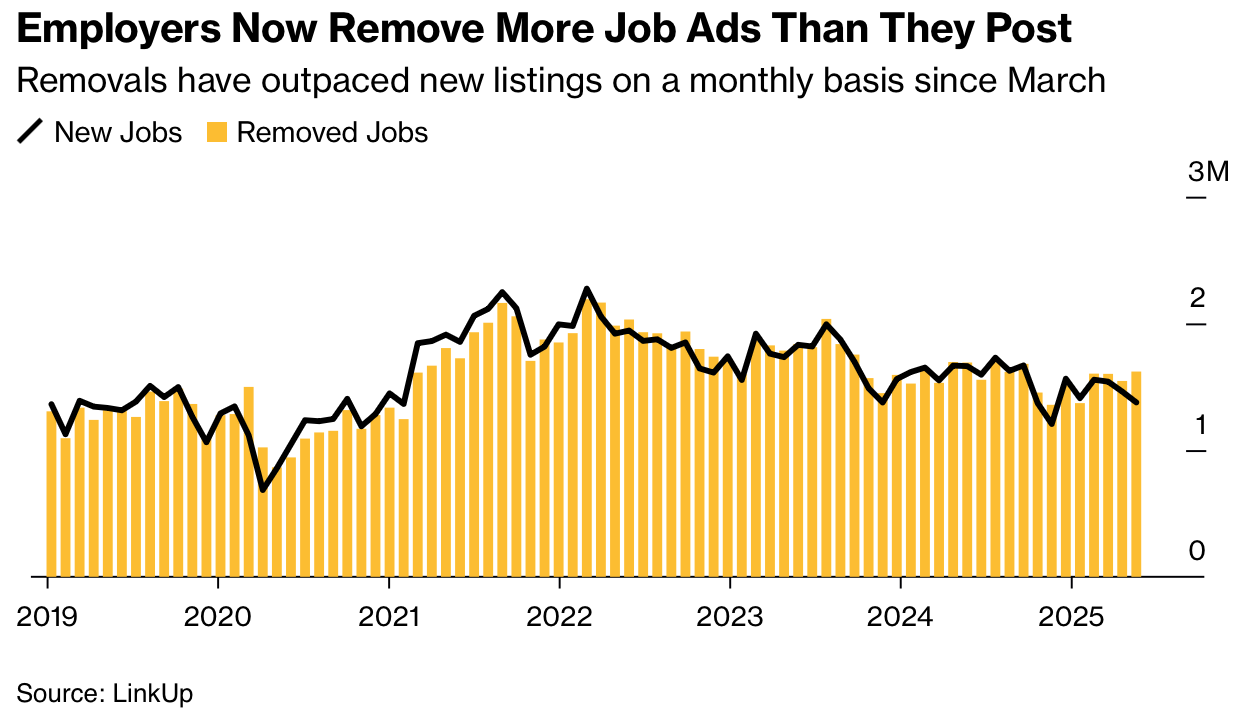
July 2025: Two Companies Focused On Helping People Find Work Went Bankrupt. According to Bloomberg, “Corporate America’s hiring slowdown isn’t just hurting job seekers, it’s also crushing some companies meant to help people find work. Two such companies have filed for bankruptcy in recent weeks. First came CareerBuilder and Monster, a job-board joint venture whose 2024 merger failed to revive the struggling brands. They were outpaced by more innovative competitors and saw demand plummet partly due to advances in artificial intelligence, according to its bankruptcy filing. Shortly after, My Job Matcher — known as Job.com — which helps employers recruit talent, filed for Chapter 11 protection following a rapid expansion period and mismanagement in its senior ranks. While these businesses had their own unique problems, both faced an unfriendly backdrop: a US job market slowdown, and fast developments in AI that have cut into demand for their services. ‘Firms have really cut back on hiring, people are quitting less, and that’s creating a feedback loop,’ said Guy Berger, senior fellow at the Burning Glass Institute. Companies ‘are not going to pay for job openings if they are not hiring,’ he said.” [Bloomberg, 2025-07-19]
- July 2025: Moodys Downgraded ZipRecruiter’s Debt. According to Bloomberg, “The tough times are weighing on other platforms as well. Earlier this month, Moody’s downgraded ZipRecruiter Inc.’s corporate family rating to B2 from B1, and saw a higher probability of default. The rating agency cited ‘continued difficult conditions facing the online job marketplace sector, driven by a prolonged decline in hiring activity across the broader economy.’” [Bloomberg, 2025-07-19]
Capital Flight
As The Appeal Of The American Market Has Waned, Emerging-Market Borrowers Have Turned To Borrowing In Europe In Record Numbers, With Year-To-Date Issuance Exceeding The Previous Recorded Record Annual Amount. According to Bloomberg, “Emerging-market borrowers are tapping the euro bond market at the fastest pace in over a decade, capitalizing on the rising demand for diversification away from the US dollar. The surge is being fueled by robust demand for developing debt, with non-dedicated investors playing a bigger role as credit quality improves. While euro-denominated bonds still account for a small share of total emerging-market supply, their volume is expected to remain high — both in absolute terms and relative to dollar-denominated deals. ‘If you have an ambition to issue in euros, this is the time to do it,’ said Stefan Weiler, the head of debt capital markets for Central Europe, the Middle East and Africa at JPMorgan Chase & Co. in London. ‘Borrowers have been noticeably more active in diversifying and exploring also some niche markets.’ The dollar index has fallen about 8% this year, with money managers rethinking years of heavy exposure to US assets as Donald Trump’s tariff policies and jabs at the Federal Reserve roil markets. Signs of waning demand for the greenback are building, and low hedge ratios — protection against currency volatility — suggest there’s room for additional declines. Companies and governments from developing economies have sold €89 billion of euro-denominated debt this year through July 18 — the highest amount for this period since at least 2014, according to data compiled by Bloomberg. Government issuance alone has already exceeded the full-year total for 2024.” [Bloomberg, 2025-07-20]
- Goldman Sachs: The Diminished Appeal Of Borrowing In American Markets Could Exacerbate Weak Growth And Dollar Depriciation. According to Bloomberg, “Strategists at Goldman Sachs Group Inc. compared euro- and dollar-denominated bonds sold by the same sovereign on the same day this year. They found that euro bonds slightly outperformed their benchmarks more than their dollar counterparts one week after issuance. ‘The increase in euro-denominated bond issuance has generally been well absorbed by the market,’ the bank’s strategists including Kamakshya Trivedi wrote in a report earlier this month. The pickup in euro debt sales ‘is likely to extend given our outlook for less exceptional US growth and for further dollar depreciation,’ they added. Emerging-market debt in euros has handed investors a 0.4% gain so far this month, versus a 0.1% loss for a gauge of developing bonds in dollars, according to Bloomberg indices.” [Bloomberg, 2025-07-20]
Less Investment
Six Months After It Was Announced At The White House As A $500 Billion Project With $100 Billion To Be “Immediately” Deployed, Project Stargate Looks To Just Be A Small Datacenter Project In Ohio. According to the Wall Street Journal, “A $500 billion effort unveiled at the White House to supercharge the U.S.’s artificial-intelligence ambitions has struggled to get off the ground and has sharply scaled back its near-term plans. Six months after Japanese billionaire Masayoshi Son stood shoulder to shoulder with Sam Altman and President Trump to announce the Stargate project, the newly formed company charged with making it happen has yet to complete a single deal for a data center. Son’s SoftBank and Altman’s OpenAI, which jointly lead Stargate, have been at odds over crucial terms of the partnership, including where to build the sites, according to people familiar with the matter. While the companies pledged at the January announcement to invest $100 billion ‘immediately,’ the project is now setting the more modest goal of building a small data center by the end of this year, likely in Ohio, the people said. Stargate’s lethargic launch is a setback to the vast ambitions of Son, who despite spending billions of dollars over the years, has been playing catch-up in the fast-evolving AI sector.” [Wall Street Journal, 2025-07-21]
Even “Protected” Industries Have Suffered
Despite Seeming To Be The Beneficiary Of Trump’s Tariffs On Coffee, Hawaii’s Coffee Farmers Have Said The Costs Will Be At Least As High As Any Benefit They Recieve. According to Bloomberg, “Hawaiian coffee farmers have a message for President Donald Trump: Steep tariffs on major exporters such as Brazil will end up hurting them, too. Hawaii at first glance might seem the obvious beneficiary of tariffs on coffee. It is the only state in the country where the tropical goods grow, with the vast majority of java imbibed by Americans imported from South America and Vietnam. Higher priced foreign imports should, in theory, make the island state’s products comparatively more affordable. But growers say the opposite is true: rising prices across the board will hit consumers already struggling with inflation, curbing demand on everything from popular everyday roasts available at grocery stores to luxury Kona beans. While the discourse around trade and Trump’s ‘Buy American’ mantra could draw attention to Hawaiian goods, the upshot for the state’s farmers is that ‘tariffs will probably will hurt us as much as it would hurt the mainland roasters,’ said Suzanne Shriner, the vice president of the Kona Coffee Farmers Association and the president of Lions Gate Farms.” [Bloomberg, 2025-07-19]
With Hawaii Producing \(\frac{1}{4001}^{th}\) The Chocolate Americans Eat Each Year, It Would Take A Tariff In The “Hundreds Of Percent” Range To Make American Produced Coffee Competitive For The Mass Market. According to Bloomberg, “The chocolate industry has also been pushing for an exemption from tariffs. Hawaii’s cocoa production is barely existent, not even topping 50 tons of dry beans in 2022. The US imported nearly 200,000 tons of cocoa beans last year — and that’s already after a significant drop due to lower global production, according to the US Department of Agriculture. Hershey Co. said in May that it would seek an exemption, citing as much as $20 million in tariff costs during the second quarter. Unmitigated impacts could rise to $100 million later in the year after working through existing inventories, the company said. A tariff would have to be “so high, like hundreds of percent, to make it start to be competitive — and then there’d be no chocolate,” said Mānoa Chocolate founder Dylan Butterbaugh. The company uses both Hawaiian and imported beans to produce about 50 tons of chocolate each year.” [Bloomberg, 2025-07-19]
Less Construction
Fastener Maker YKK: Trump’s Tariff Slowed Building Materials Market. According to Bloomberg, “Another concern is that Trump damages consumer confidence badly enough to cut demand for the products YKK helps make. In some divisions, there are signs this is already happening. ‘The tariff initiatives from the new administration have most certainly had an impact on our business,’ Oliver Stepe, CEO of YKK of America’s architectural products division, told me in March, citing the aluminum, steel and Canada tariffs in particular. ‘We are already seeing a slowdown in business activity in our building materials markets.’” [Bloomberg, 2025-07-21]
Undermining Exports
Trump’s BBB Imposed A $250 Fee On All Visitors Who Need A Nonimmigrant Visa. According to CNBC, “Visitors to the United States will need to pay a ‘visa integrity fee,’ according to a provision of the Trump administration’s recently enacted One Big Beautiful Bill Act. The fee applies to all visitors who need nonimmigrant visas to enter, and cannot be waived. However travelers may also be able to get the fees reimbursed, according to the provision. Details about the new requirement are scant, which has resulted in ‘significant challenges and unanswered questions regarding implementation,’ a spokesperson from the U.S. Travel Association told CNBC Travel.” [CNBC, 2025-07-18]
Making It Harder To Get Skilled Workers In
Trump’s BBB And Its “Visa Integrity Fee” Would Raise The Cost Of An H1-B Visa By Almost 122 Percent. According to CNBC, “No, the provision states that the new fee is ‘in addition to’ other fees, including regular visa fees. ‘For example, an H-1B worker already paying a $205 application fee may now expect to pay a total of $455 once this fee is in place,’ Steven A. Brown, a partner at the Houston-based immigration law firm Reddy Neumann Brown PC, wrote in a post on his firm’s website. Additionally, the fee must be paid on top of a ‘Form I-94 fee,’ which the One Big Beautiful Bill Act increased from $6 to $24. That fee must be paid by anyone who is required to submit a Form I-94 arrival and departure record, which applies to most travelers.” [CNBC, 2025-07-18]
Penalties For Earnings Misses
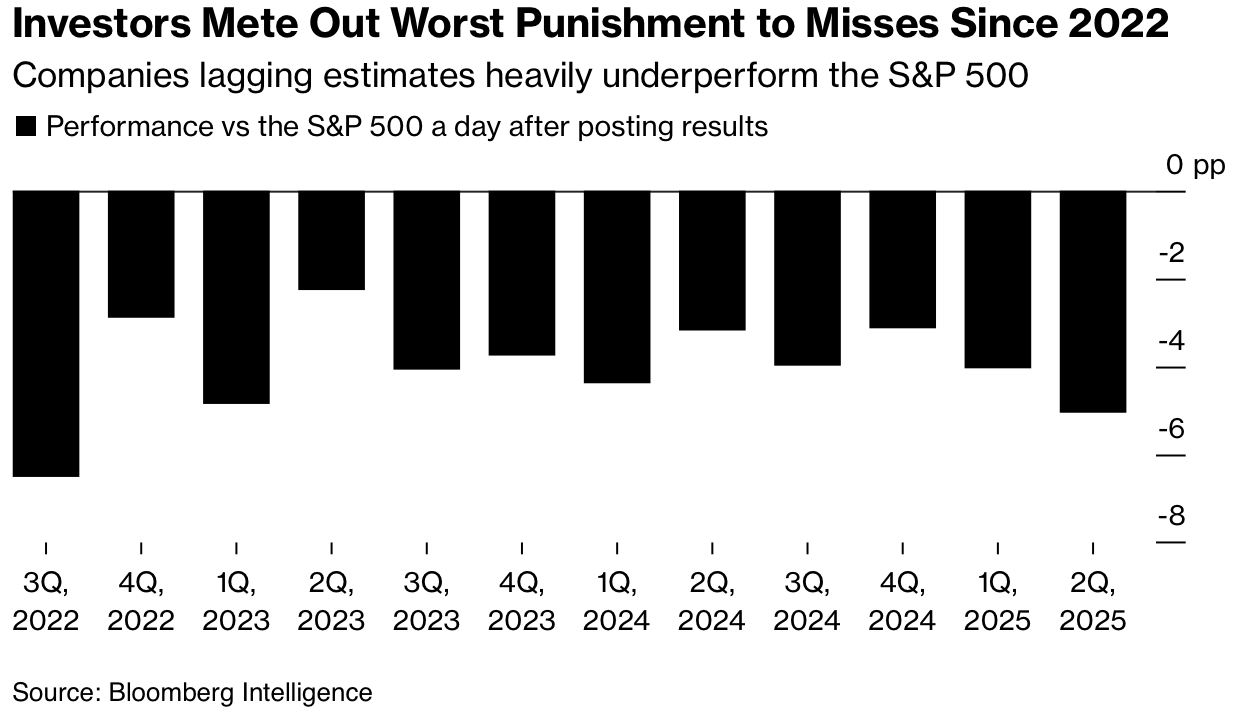
Q2 2025: With High Valuations, Public Companies Have Faced The Highest Penalty For Failing To Meet Earnings Expecations Since 2022. According to Bloomberg, “‘With stock valuations where they are, all the good news is priced into the market now,’ said Greg Taylor, chief investment officer at PenderFund Capital Management Ltd. What’s more, the market is penalizing results that fall short of expectations by the most in nearly three years, data compiled by Bloomberg Intelligence shows. ‘The margin of error here is small,’ said Michael Arone, chief investment strategist at State Street Investment Management. ‘When the valuations are high and you miss, the punishment is more severe.’” [Bloomberg, 2025-07-19]
Trade War Responses
In Response To Trump’s Threatened Tariff, The Brazilian Government Has Looked At Imposing A Digital Service Tax, And Ending Licensing Of American Drug Patents. According to Bloomberg, “The government intends to continue diplomatic negotiations with the Trump administration, O Estado de S. Paulo said, adding that any retaliatory measures may be adopted after Aug. 2. The US government has announced a 50% tariff on Brazil that will take effect on Aug. 1, which Trump has tied to the charges against Bolsonaro. The government is studying a tax on digital services offered by big tech companies, with different rates depending their revenues, O Globo reported, saying the measure is being analyzed by Finance Ministry. It’s also considering ending the licensing of US drug patents, according to O Estado de S. Paulo.” [Bloomberg, 2025-07-19]