More and more signs accumulated that Trump’s economic stewardship is not up to snuff. Signs of weakness in the energy sector, fewer imports, and a population whose debt is at a higher interest rate failed to push back on the press of higher prices, particularly in food and beverages.
Meanwhile, the Chinese have seen an opening in Trump’s withdrawl from the international community, and the only people benefiting seem to be his cronies, who are pushing highly risky crypto products, advocating for similarly regressive rent-seeking practices in other countries they have interests in, or looking for new ways to avoid paying what meager taxes they could still owe.
Releases
Financial Conditions
Code
include("../scripts/oxocarbon-plot.jl")theme(:oxocarbon)usingFredData, DataFrames, Dates, Statistics, Distributionskey=ENV["FRED_API_KEY"]f=Fred(key)# Set up the datacfnfci=get_data(f, "NFCINONFINLEVERAGE"; observation_start="2024-07-18", observation_end="2025-07-19", ).data# Make A Plotplot(cfnfci.date, cfnfci.value; label="", legend=:topright, yflip=true, linewidth=2, xlabel="Date", ylabel="Index", title="Nonfinancial Leverage Conditions Tightened",)vline!([Date(2024,11,5)], linewidth=2, linestyle=:dash, label="Election Day",)
Economic Degradation
BMO Capital Markets: American Energy Producers’ Earnings Expected To Drop 30 Percent From The First Quarter. According to Bloomberg, “Of course, it’s understandable why investors may be skeptical about Wall Street’s bullish take. US crude prices have dropped about 7% this year, hurt by the fallout from Trump’s trade war and a drive by OPEC+ to restore curbed supplies. Also, the sector doesn’t have much momentum: Energy stocks have underperformed the market for four of the last five quarters. BMO Capital Markets expects US energy producers’ second-quarter earnings to fall 30% compared to the first three months of the year, and for cash flows to drop 15% in the same period because of weaker crude prices, according to analyst Phillip Jungwirth.” [Bloomberg, 2025-07-22]
June 2025: Inbound Container Volume Declined For The Second Month In A Row. According to Bloomberg, “The number of shipping containers carrying US imports fell for a second straight month, a private gauge showed, putting the economic indicator on course for one of the sharpest year-on-year reversals on record as President Donald Trump’s tariffs disrupt purchases of goods from abroad. Inbound container volume fell 7.9% in June from a year before, after a 6.6% drop in May, veteran industry analyst John McCown wrote in a monthly report Sunday based on the 10 largest US ports. The declines more than wiped out a nearly 10% increase tied to inventory front-loading in April, and left the second quarter down 1.8% from a year earlier.” [Bloomberg, 2025-07-21]
Higher Prices
Food And Beverages
Taking Into Account Trump’s Tariffs, Parmesan Cheese Produced In Italy Has Increased By More Than Two Percent In The Last Three Months. According to the Wall Street Journal, “Retailers of Parmigiano-Reggiano, the Parmesan cheese produced in a designated area of northern Italy, increased prices in the U.S. to around $43 to $45 per kilogram from $42 this year, partly offsetting an additional 10% tariff applied since April. Sales have continued to surge in the U.S., rising by 9% in the first four months of this year, in line with previous months.” [the Wall Street Journal, 2025-07-21]
Soda
July 2025: Trump Pushed For Coke To Use Real Sugar, Despite The Fact That The Country Hasn’t Produced Enough To Meet Current Needs. According to the Wall Street Journal, “President Trump says he has the winning formula for Coca-Cola: cane sugar instead of high-fructose corn syrup. Making it happen, though, means confronting the U.S. sugar deficit. Each year, America consumes about 12.5 million tons of sugar, but produces only 4 million tons of cane sugar. The rest is made up by imports and sugar sourced from sugar beets. Right now, the beverage industry relies heavily on high-fructose corn syrup as its sweetener of choice. Each year, more than 7 million tons are produced by mills that grind up corn to make sweeteners and other products. The U.S. Diet Coke drinker-in-chief put cane sugar front and center for U.S. soda manufacturers last week. ‘I have been speaking to Coca-Cola about using REAL Cane Sugar in Coke in the United States, and they have agreed to do so,’ Trump said on Truth Social. ‘This will be a very good move by them—You’ll see. It’s just better!’ Coca-Cola said it appreciated Trump’s enthusiasm and pledged to share details on new Coke offerings soon. Executives are scheduled to take the mic on Tuesday to discuss quarterly results.” [the Wall Street Journal, 2025-07-20]
To Make The Switch, American Companies Would Have To Increase Imports Trump Imposed New Taxes On. According to the Wall Street Journal, “Supplying the U.S. beverage industry, Ruffolo said, would mean drastically boosting imports from countries such as Brazil and Mexico—countries that face Trump administration tariffs of 50% and 30%, respectively, on Aug. 1.” [the Wall Street Journal, 2025-07-20]
Department Of Agriculture: Cane Sugar Has Cost Around Twice As Much As Corn Syrup. According to the Wall Street Journal, “‘I believe sugar is a cleaner, sweeter product. When you make the soda, the sweet smell fills up the room,’ said Crouch, and he’s willing to pay more for that taste. High-fructose corn syrup tends to run about half of the per-pound price of refined cane sugar, according to the Agriculture Department.” [the Wall Street Journal, 2025-07-20]
Weaker Balance Sheets
2022 - 2025: The Share Of Mortgage Debt With An Interest Rate Over Six Percent Jumped From 7 Percent To Almost 20 Percent. According to Bloomberg, “Why? In part because “the labor market has lost its luster,” Charlie Dougherty, Jackie Benson and Ali Hajibeigi wrote. “Reduced demand for labor has made finding a new job more challenging, which could be leading to both weaker buyer demand and increased forced sales.” Among other factors, the trio pointed to an easing effect of homeowners being locked in to ultra-low rates and unwilling to sell. The share of mortgage debt with a rate over 6% is near 20% now, versus 7% in 2022.” [Bloomberg, 2025-07-22]
Weaker National Power
Chinese Influence On International Institutions
As Trump Has Pulled The United States Back From International Engagement, China Has Pushed Its Influence Further Into Organizations Like The International Telecommunication Union. According to the Financial Times, “China is making a concerted effort to expand its influence throughout the UN, taking advantage of Donald Trump’s disdain for multilateralism to place officials and push Beijing’s agenda more aggressively, according to western diplomats. After cuts to US foreign aid prompted what could be the UN’s most radical restructuring in decades, China has stepped up attempts to fill the vacuum, particularly in the Swiss diplomatic hub of Geneva, multiple officials and diplomats told the Financial Times. This has included increasing its personnel footprint, building voting coalitions, and in some cases, financial contributions to entrench its position in a city called the ‘kitchen of global diplomacy’, with more than 450 international bodies. Agencies of particular interest to China include the International Telecommunication Union (ITU), which sets global communications standards, and the World Health Organization (WHO), according to western officials.” [the Financial Times, 2025-07-22]
China Has Been Especially Active In The Effort To Reform The U.N. In The Wake Of Trump’s Funding Cuts. According to the Financial Times, “A study by Shing-hon Lam of the University of California and Courtney J Fung of Macquarie University found China had nearly 1,600 UN staff in 2022 compared with more than 5,000 for the US, though it is building new staff pipelines through internships. Western officials said they had observed a fresh push since the Trump administration began pulling the US away from the UN, triggering a financial squeeze that has pushed the UN towards deep reforms. China has been particularly proactive around the overhaul, known as the UN80 Initiative, which could include department mergers and significant streamlining of operations. One senior western official briefed on internal UN discussions said China was expanding its presence in ‘the institutions of the multilateral world order . . . and then using that influence to slowly turn them to their own world view’.” [the Financial Times, 2025-07-22]
Financial Instability
Crypto Perpetual Futures
July 2025: Coinbase Announced It Was Offering “Perpetual” (Five Year) Futures On Bitcoin And Ether. According to Coinbase, “For years, U.S. crypto traders have looked on as their international counterparts utilized one of the most popular tools in the digital asset marketplace: perpetual futures. These innovative derivatives, offering higher leverage while eliminating the need to navigate monthly expiration dates, dominate 90% of global crypto derivatives trading volumes. Due to a complex regulatory landscape, they remained just out of reach for traders in the United States. Until now. We are thrilled to announce that U.S. customers, starting July 21, 2025, can trade CFTC-regulated perpetual futures via Coinbase Financial Markets (CFM), bringing one of the world’s most traded derivatives to a secure and trusted crypto platform. Two (2) perpetual futures contracts are currently available to trade: nano Bitcoin Perpetual Futures (BTC-PERP), nano Ether Perpetual Futures (ETH-PERP) How does it work? By trading perpetuals through Coinbase Financial Markets, you are operating in a CFTC-regulated environment with unique features designed for retail traders. This is a highly-anticipated product specifically developed to meet the needs of the U.S. market with: No monthly expirations: Unlike traditional futures that have a set monthly or quarterly expiration date, perpetual futures on Coinbase are long-dated with expiration dates of 5 years. This allows you to maintain your market exposure for as long as you choose without the complexity of rolling over contracts on a monthly basis, enabling more flexible, long-term trading strategies. Up to 10x leverage: U.S. traders can now access enhanced capital efficiency and amplify their market positions within a secure, regulated framework. For our newly launched crypto perpetual futures, you can trade with up to 10x intraday leverage. For metals futures, such as silver and gold, you can trade with up to 20x intraday leverage.” [Coinbase, 2025-07-21]
A Reversal From Coinbase’s Post-FTX Claims Of “There Can’t Be A ‘Run On The Bank’ At Coinbase”
November 2022: Following The Collapse Of FTX, Coinbase Touted Their 1:1 Backing Of Customer Assets As Protection From The Type Of Crash That Brought Down FTX. According to Coinbase, “Given how much conversation there has been in the past few days around liquidity struggles, we thought it important to provide clarity around these challenges and reiterate how Coinbase’s business is different. First, from day one Coinbase has sought to be the most secure and compliant crypto exchange. And today, Coinbase and our customers are not in any direct danger of liquidity or credit risk. Regardless of whether the Binance/FTX transaction completes, we have very little exposure to FTX and we have no exposure to its token, FTT. Currently we have $15 million worth of deposits on FTX to facilitate business operations and client trades. We have no exposure to Alameda Research, and we have no loans to FTX. Second, as a publicly traded company in the US, we’ve also built our business in a way that allows us to be transparent about our track record, balance sheet strength, and effectively and prudently manage risk for our customers and ourselves. Here’s how we are different: There can’t be a ‘run on the bank’ at Coinbase. As you can review in our publicly filed, audited financial statements, we hold customer assets 1:1. Any institutional lending activity at Coinbase is at the discretion of the customer and backed by collateral. We have no gating for client loan recalls or withdrawals.” [Coinbase, 2022-11-22]
10x Levered Perpetual Future Vs 90% LTV Bitcoin Backed Loan
With a 10x five year bitcoin future, as offered by coinbase, a 10 percent move in bitcoin in the opposite direction would completely wipe out the individual exposed to the future. To give an idea of how silly that is, if someone with x dollars in bitcoin took out a 90% LTV loan against that bitcoin, they would be significantly better off.
In fact, even as bitcoin has gotten slightly less volatile over the last five years, the probability of a total loss on a future as offered by coinbase just dropped to 99.95 percent, or roughly one in 2,000. Admittedly, this is with a Black-Scholes model with zero drift, which is a simple, but not great model. Still, this is not financial advice, it is just a bonkers offering.
Code
btc=get_data(f, "CBBTCUSD"; observation_end="2025-07-23", ).data# Calculate rolling 5Y volatility over the sample"""rolling_vol(df::DataFrame, window::Int64=1825)Calculates the volatility of a price data series over a window,defaulting to 1825 days, which is about five years (365*5)"""functionrolling_vol(df::DataFrame, window::Int64=1825) df.log_returns=[missing; diff(log.(df.value))] df.rolling_vol_5y=Vector{Union{Missing, Float64}}(missing, nrow(df))for i in window:nrow(df) returns=df.log_returns[(i-window+1):i] clean_returns=filter(x -> !ismissing(x) && !isnan(x), returns) daily_vol=std(clean_returns) df.rolling_vol_5y[i]=daily_vol *sqrt(length(clean_returns))endreturn dfend# Use a simple black-scholes model to calculate the loss probability"""loss_probability(volatility::Float64, time_horizon::Float64=5.0, leverage::Float64=10.0)Calculate the total loss probability of a future over the five year time horizon,assuming a risk-neutral drift."""functionloss_probability(volatility::Float64, time_horizon::Float64=5.0, leverage::Float64=10.0)@assert(leverage >0.0, "Leverage has to be positive")@assert(time_horizon >0.0, "Needs to be a positive amount of time") mu=0 sigma=volatility loss_thrshold=log(1.0- (1.0/leverage)) drift_adjusted=(mu - sigma^2/2) * time_horizon vol_term = sigma prob_loss=cdf(Normal(drift_adjusted, vol_term), loss_thrshold)return prob_lossend# Calculate the loss threshold over the termbtc=rolling_vol(btc)btc.prob_loss=[ismissing(volatility) ? missing:loss_probability(volatility) for volatility in btc.rolling_vol_5y]# Create a clean df for plottingclean_df=btc[.!ismissing.(btc.prob_loss), :]# Create a plotplot(clean_df.date, 100.0.*clean_df.prob_loss; linewidth=2, title="Long BTC Futures Are A Bad Idea", xlabel="Date", ylabel="Probability of Total Loss (%)", label="",)right_axis=twinx()plot!(right_axis, clean_df.date, 100.0.*clean_df.rolling_vol_5y; linewidth=2, label="5y Vol", ylabel="Trailing 5 Year Volatility (%)", color=colorant"#525252",)
Corruption
Rent-Seeking
July 2025: The Trump-Supporting Cleveland-Cliffs CEO Called For The Canadian Government To Impose Steel Tariffs, In Part To Protect The Candian Steel Company CLF Owns. According to Bloomberg, “Cleveland-Cliffs Inc.’s chief executive Lourenco Goncalves is calling on Canadian Prime Minister Mark Carney to implement punishing steel import tariffs to protect the nation’s industry. The notoriously combative US executive and vocal public supporter of President Donald Trump said on Monday that Carney and his cabinet should enact ‘significant’ trade protections for the nation’s steel industry. Goncalves, who bought one of Canada’s biggest steelmakers last year, blamed foreign imports for hurting the Canadian market, though he didn’t point at American steel imports for the trouble. ‘That was the main reason why I bought Stelco, because I believe in Canada. The problem is that apparently the Canadians, particularly the Canadian politicians, they don’t believe in Canada,’ Goncalves said Monday in an earnings call. ‘Let’s see how Prime Minister Carney will react. He’s not a central banker anymore. I don’t like central bankers, but now he’s a prime minister, so time to step up and do what’s necessary for Canada.’ The call for stringent levies on steel comes as Canada pushes to relax tariff levels imposed by the US while carving out as many exceptions as possible. The country last week said it will reduce the amount of foreign steel importers can bring into the country tariff-free, a move to help Canadian producers suffering from Trump’s levies on the sector. ‘Canada can fix themselves. They import an amount of steel into Canada that’s equivalent to the size of the Canadian market,’ Goncalves said. ‘The very first thing they need to tell foreigners, get out of my market.’ Canada is the largest foreign supplier of steel to the US, according to US Commerce Department data.” [Bloomberg, 2025-07-21]
July 2025: Goncalves Cited The Financial Benefits Of Trump’s Tariffs To Cleveland-Cliffs’ Business. According to Marketwatch, “The steelmaker is also starting to see the positive impact of Trump’s tariffs on domestic manufacturing, Goncalves said. ‘The Trump administration continues to show strong support to both the domestic steel and the domestic automotive sectors,’ he said. ‘We expect this trend to continue.’” [Marketwatch, 2025-07-21]
July 2025: The WSJ Editorial Board Called Out Goncalves For Rent-Seeking
WSJ Editorial Board: Trump’s Tariffs Seem To Have Benefited “Corporate Rent-Seekers.” According to the Wall Street Journal Editorial Board, “President Trump says his tariffs will help workers, but the biggest beneficiaries to date appear to be corporate rent-seekers. Consider Lourenco Goncalves, the Cleveland-Cliffs CEO who tried but failed to block Nippon Steel’s acquisition of U.S. Steel. Now he’s using tariffs to pitch his steel plants to foreign buyers. Cleveland-Cliffs, one of the largest U.S. steelmakers, on Monday reported a $247 million loss in the second quarter. That’s nothing to celebrate. But the company’s stock price surged 12% because the company said U.S. tariffs have led to record shipments and buoyant prices, which cut the company’s first-quarter loss by half. Political intervention to limit competition tends to do that. Mr. Trump in February eliminated steel tariff exemptions for trading partners like Canada. Last month he doubled the steel tariffs to 50% when he blessed the Nippon-U.S. Steel deal, ostensibly to please the United Steelworkers union. Cleveland-Cliffs is “uniquely positioned to benefit from this new reality,” Mr. Goncalves said.” [the Wall Street Journal Editorial Board, 2025-07-22]
Tax Avoidance
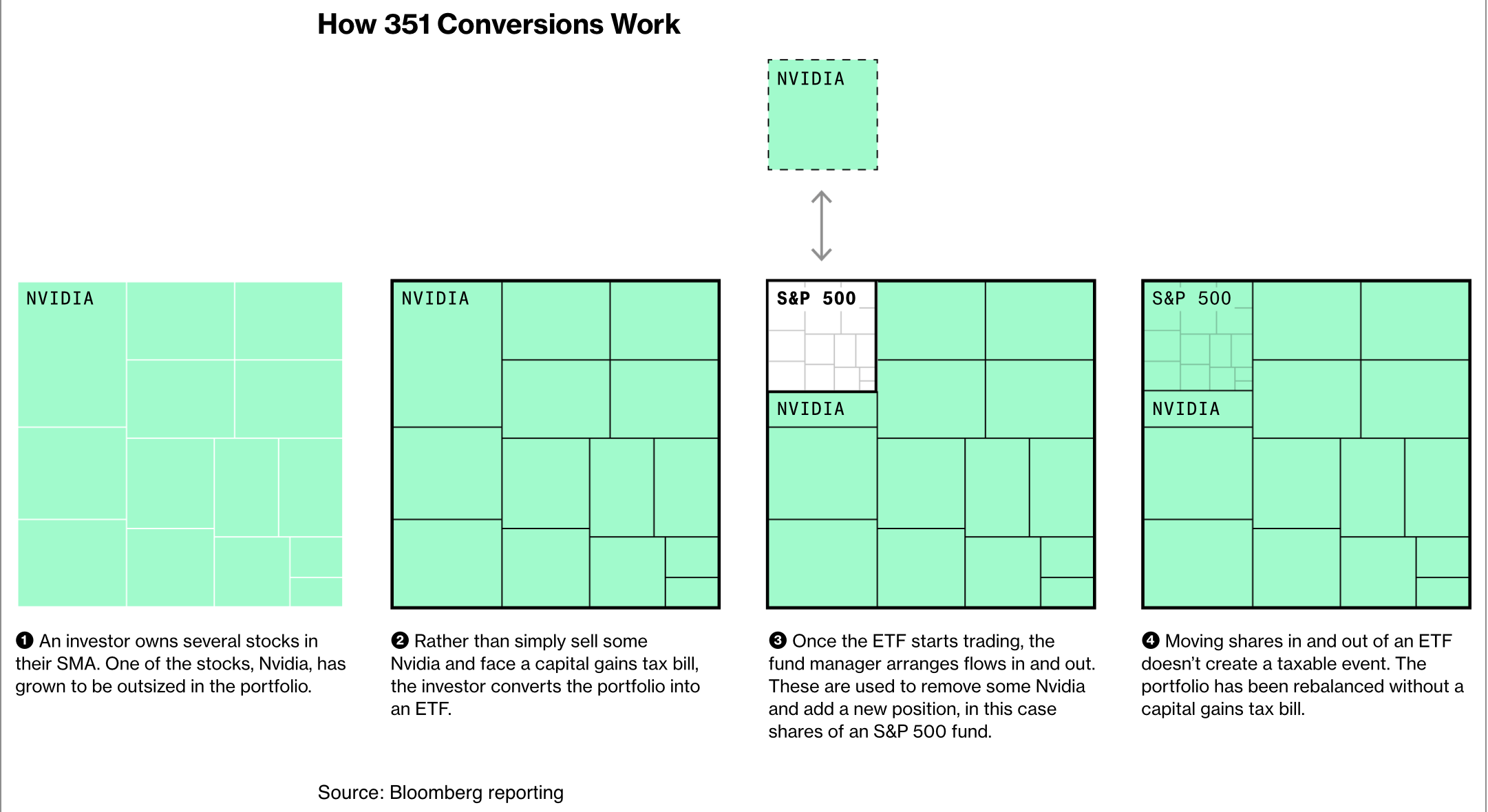
February 2025: Twin Oaks Active Opportunity ETF, Without Any Marketing, Acquired More Than $500 Million In Assets. According to Bloomberg, “Officially, the Twin Oak Active Opportunities ETF exists to seek ‘long-term capital appreciation.’ Unofficially it has a second, more cunning, purpose. TSPX, to use the fund’s ticker, debuted in February without much marketing. Yet it launched with nearly $450 million in assets and almost immediately received a $99 million inflow — amazing numbers for a virtually unknown ETF. The day after that big inflow, there was an almost identical outflow. A similar pattern repeated in the next two trading days, and then again in the two days after that. And as all that capital rushed in and out, a change took place within TSPX that offers a vital clue as to its true nature. Having launched with just five positions — around $245 million across three fixed-income ETFs, a $99 million stake in Snowflake Inc. and $92 million in Datadog Inc. — TSPX swiftly replaced its two equity holdings with a roughly equivalent slice of a simple S&P 500-tracking fund. Why did TSPX launch with such a large and concentrated portfolio, only to change about 40% of it in the space of a couple of days? Why were there such big flows in and out of an unknown ETF? And why did they abruptly stop?” [Bloomberg, 2025-07-21]
With A 351 Conversion, The ETF Was Able To Help Individuals Holding Almost $200 Million In Individual Company’s Shares To Broad Market ETFs, Without Causing A Taxable Event. According to Bloomberg, “Having launched with just five positions — around $245 million across three fixed-income ETFs, a $99 million stake in Snowflake Inc. and $92 million in Datadog Inc. — TSPX swiftly replaced its two equity holdings with a roughly equivalent slice of a simple S&P 500-tracking fund. Why did TSPX launch with such a large and concentrated portfolio, only to change about 40% of it in the space of a couple of days? Why were there such big flows in and out of an unknown ETF? And why did they abruptly stop? TSPX is one of a breed of exchange-traded funds created via what’s known as a 351 conversion. It’s a tactic to help rich investors minimize capital gains tax liabilities — one of a plethora of strategies that form Wall Street’s flourishing tax-optimization complex. In a 351, a fund is seeded with appreciated assets before launch so that after listing it can use an infamous ETF industry loophole to rebalance without realizing a taxable gain, usually harnessing artificial flows to do so. While they’ll often retain their original strategy afterwards, some — like TSPX — use the process to significantly alter the portfolio without incurring taxes. It’s creative, clever, and completely legal — and although 351 ETFs are not labeled in any way, there are signs they”re proliferating. ‘The last three years have seen a significant uptake’ in 351 conversions, says Robert Elwood, a Truro, Massachusetts-based lawyer at Practus LLP who estimates he has worked on close to 100. ‘As we’ve been in a bull market generally for the last 10 years or so, there are a lot of people sitting on built-in gains that would like to change their portfolio.’” [Bloomberg, 2025-07-21]
Extrapolating From The Last Two Decades, ETFs Could Be Expected To Have Deferred Between $1.4 And $2.5 Trillion In Capital Gains Tax Revenue. According to Bloomberg, “In the two decades through 2023, ETFs realized capital gains worth on average 4.1% of its assets every year, but distributed just 0.12% in taxes, according to an academic paper. Meanwhile, passive and active mutual funds distributed 2.1% and 3.7% respectively. Extrapolating from that, the authors estimated between $1.4 trillion to $2.5 trillion in capital-gains tax would be deferred over the next decade on the existing stock of US equity ETFs. ‘Everybody expects to use ETFs for the “benefit” of taxable investors, so it’s part of why ETFs are appealing,’ says Rabih Moussawi, a finance professor at Villanova University and one of the co-authors of the research. ‘Who’s going to fund all this deficit that we are seeing and all the debt that we are having if we don’t collect these legitimate sources of revenues? These questions have to be dealt with.’” [Bloomberg, 2025-07-21]