July 24, 2025
Summary
Trump’s corrupt, incompetent, and sometimes incoherent economic management has continued to cost the American people. Beef and electricty prices have surged, while even measures of import costs excluding tariffs, which would be expected to have decreased, have increased slightly. Trump has, however, stayed committed to the bit, announcing negotiating framework after negotiating framework, many of which impose higher taxes on Americans than foreigners, the one with Japan mechanically requires a half trillion dollar increase in the trade deficit.
Trump’s immigration policies, meanwhile, continue to put Social Security in immediate peril, with the worst case scenario considered by the trustees, a scenario far better than that envisioned by Trump and his ilk, raising the 75 year funding shortfall by 46 basis points of payroll income. Economic growth won’t make up for this shortfall with indicators of the aggregate macroeconomy, labor market, investment demand, and demand for the dollar in general all looking pretty negative. In fact, an econometric analysis by Apollo, not exactly an administration opponent, showing Trump’s tariff announcements may have structurally weakened the dollar.
And if that isn’t enough, the tech industry has been getting good value for its money, with Trump abandoning plans to investigate Nvidia’s antitrust status, and crafting an AI-related executive order that would give his administration more flexibility in how it chooses its AI partners.
Higher Prices
January - July 2025: Beef Prices Surged 9 Percent. According to CNN, “First it was eggs, now it’s beef. The last time Americans likely noticed spiking prices at the grocery store was when eggs reached record-highs. Since then, egg prices have fallen after the deadly avian flu outbreak was contained and producers built back supply. Now, beef prices are hitting records, rising almost 9% since January, according to the Department of Agriculture, and retailing for $9.26 a pound. June’s consumer price index showed steak and ground beef prices are up 12.4% and 10.3%, respectively, over the last year.” [CNN, 2025-07-21]
July 2025: Grid Operator PJM Reported Electricity Prices 22 Percent Higher Than During The Same Period In 2024. According to the Financial Times, “The cost of providing electricity in America’s largest power market will hit a record high owing to soaring demand from artificial intelligence data centres and delays in building new power plants, raising energy prices for consumers. Grid operator PJM, which covers 13 states and Washington DC, said on Tuesday it procured energy supplies for $329.17 per megawatt day, a 22 per cent increase compared with the previous year. The organisation will pay power producers $16.1bn to meet its energy needs from June 2026 to May 2027, a 10 per cent increase compared with the previous year.” [the Financial Times, 2025-07-23]
Paul Krugman: Since The Imposition Of Trump’s Tariffs, Measures Of Import Pricing Excluding Tariffs Have Increased. According to Paul Krugman, “If foreigners were eating the tariffs, we”d expect to see a large decline in the prices America is paying for imports. And the BLS does, in fact, measure import prices; its index specifically does not include tariffs. So let’s compare the increase in average tariffs from a year ago with the change in nonfuel import prices: Have import prices fallen by enough to offset the tariff hikes? No, they’ve gone up slightly.” [Paul Krugman, 2025-07-23]
Higher Costs For Businesses
Energy Star: The Program Has Saved American Households And Businesses $350 For Every Dollar It Spent. According to ENERGY STAR, “Over the lifetime of the program, every dollar EPA has spent on ENERGY STAR resulted in nearly $350 in energy cost savings for American business and households.” [ENERGY STAR, accessed 2025-07-23]
One Energy Star Program, Portfolio Manager, Has Saved Businesses About $14 Billion In Costs. According to Bloomberg, “Energy Star — best known for its bright blue-and-white logo — saves homeowners billions of dollars every year in energy costs. But it includes another key feature widely used by commercial real estate to gauge energy use from buildings, a main source of greenhouse gas emissions in cities. Property owners and advocates are fretting over its possible demise under the Trump administration. Over 330,000 buildings across the country, representing nearly 25% of commercial building space, use Portfolio Manager — a software tool within the federal government’s Energy Star program. It allows owners to tally energy consumption across properties and spot inefficient buildings in need of upgrades. In the last year, Portfolio Manager helped businesses and organizations avoid $14 billion in energy costs.” [Bloomberg, 2025-07-23]
Trump’s Budget Proposal Eliminated Funding For The EPA Office That Runs Energy Star. According to Bloomberg, “A preliminary version of the 2026 federal budget proposal released in May doesn’t call out Energy Star and its portfolio manager software program by name, but it suggests eliminating funding for the EPA’s Office of Atmospheric Protection, which Energy Star falls under.” [Bloomberg, 2025-07-23]
Brad Sester: Different Tariff Rates For Every Country Could Make Importing “An Administrative Nightmare.” According to Brad Sester, “And it sort should go without saying that a world where the same product faces a different tariff depending on whether it is produced in the UK, Japan, Indonesia, Vietnam or China is going to be an administrative nightmare.” [Brad Sester, 2025-07-22]
Trade War
Importantly, The Trade Deals Trump Has Announced Could, According To The Washington Post, Be Better Described As “Road Maps For Further Negotiations.” According to the Washington Post, “Indeed, unlike the trade liberalization agreements of the 1990s and 2000s, Trump’s deals are really road maps for further negotiations. Trade deals like the 2020 United States-Mexico-Canada Agreement are phonebook-thick, while the agreements that the president has hailed this year run to just a few pages.” [the Washington Post, 2025-07-22]
July 2025: Trump Claimed Credit For An Agreement With The Phillipines In Which American Taxpayers Would Pay A 19 Percent Tariff On Goods We Import, But Phillipinos Will Not Have To Pay A Tariff On Goods They Import From The United States. According to the Washington Post, “In another Truth Social post, Trump said the Philippines would agree to a deal with a 19 percent rate, down from 20 percent. Philippine President Ferdinand Marcos Jr. confirmed the 19 percent rate in a briefing to reporters after meeting Trump in Washington, calling the reduction ‘a significant achievement.’ Though Trump said the Philippines would impose zero tariffs on American products, Marcos said this would apply only to specific sectors, such as automobiles. The Philippines also plans to import more goods from the U.S., including pharmaceutical products, said Marcos.” [the Washington Post, 2025-07-22]
Q2 2025: Trump’s Tariffs Cost General Motors $1.1 Billion In Profits, A 35 Percent Cut To Net Income. According to the Wall Street Journal, “General Motors said Tuesday that new tariffs on imported cars and auto parts took a $1.1 billion bite out of its bottom line. The company reported net income shrank 35% in the second quarter as President Trump’s automotive tariffs weighed on the company. GM, the largest automaker in the U.S. by sales, had already lowered its earlier profit guidance for 2025. Now the company says greater impacts from tariffs are expected to hit the carmaker in the third quarter, though it is maintaining its profit guidance for the full year.” [the Wall Street Journal, 2025-07-22]
Strange Deal With Japan
July 2025: Trump Announced A Deal With Japan, Where American Taxpayers Would Pay A 15 Percent Tariff On Imports From The Archipelago. According to the Wall Street Journal, “The U.S. and Japan have reached a trade agreement, President Trump wrote in a social-media post Tuesday evening, saying he would set his so-called reciprocal tariffs at 15% for the country.” [the Wall Street Journal, 2025-07-23]
- By The Wording Of Trump’s Arrangement, Americans Will Pay Tariffs Almost Ten Times Higher Than Before He Started Imposing Them. According to Paul Krugman, “Finally, a 15 percent tariff is still really, really high — much higher than the 1.6 percent tariff Japanese non-agricultural exports faced before Trump began his trade war.” [Paul Krugman, 2025-07-23]
$550 Billion Directed From Japan Into The United States
Trump Claimed His Deal With Japan Included A $550 Billion Investment In The United States, With The Government Taking A 90 Percent Cut Of Any Tariffs Generated. According to the Wall Street Journal, “Under the deal, Japan will invest $550 billion in the U.S., Trump said in his post on Truth Social. The U.S. will receive 90% of the profits from the investments, he added, without providing further details. Japan will also open to trade, Trump said, listing goods including cars and trucks, rice and other agricultural products.” [the Wall Street Journal, 2025-07-23]
Japanese Prime Minister Ishiba: Japanese Government-Affiliated Financial Institutions Would Provide Support To Japanese Companies Looking To Invest In The United States. According to the Washington Post, “Financial institutions affiliated with the Japanese government, including the Japan Bank for International Cooperation, will provide up to $550 billion in equity investment, loans and loan guarantees to Japanese companies looking to invest in the United States, Ishiba said.” [the Washington Post, 2025-07-22]
Paul Krugman: By Definition, A $550 Billion Investment From Japan Into The United States Would Raise The Trade Deficit With Japan By $550 Billion. According to Paul Krugman, “The deal, as reported, involves imposing a tariff of ‘only’ 15 percent on imports from Japan, mainly in return for a promise by the Japanese government to invest $550 billion in the United States. It appears that Japan will create a sovereign wealth fund for that purpose, and that Trump will have a say in how it invests. So, first, the impact on the trade deficit. As I and others have repeatedly pointed out, there’s some basic arithmetic linking international investment and the trade balance. A few technical details aside, U.S. trade deficit = Net foreign investment in the United States This isn’t a theory, it’s just accounting. So if the deal leads to more investment in the U.S., it must, necessarily, lead to a bigger trade deficit. How, exactly, would that work? The most likely channel is that capital inflow from Japan will lead to a stronger dollar than we would have had otherwise, making U.S. goods less competitive across the board. It has been clear for a while that Trump and co. don’t understand or believe in balance of payments accounting, that they want both a smaller trade deficit and more foreign investment in America. Now their basic lack of understanding is embodied in a specific deal.” [Paul Krugman, 2025-07-23]
Prompting Investment Outside Of The United States
Bloomberg: Trump’s Trade War Has Prompted Chinese Companies To Invest In Other Countries. According to Bloomberg, “The Atlantic coastal town of Sines is best known as the birthplace of Vasco da Gama, the Portuguese explorer who forged the first maritime trade route from Europe to Asia. Centuries later, Sines is now an example of the shift in Europe’s engagement with Beijing as the continent adapts to a world dominated by US-China rivalry. Where Chinese entities once focused on buying European infrastructure like ports and power grids, they’re now building their own factories with the help of local state subsidies. In Sines, lithium battery maker CALB has become the latest Chinese company to locate in Portugal, breaking ground in May on a $2.2 billion plant with promises of creating 1,800 jobs.” [Bloomberg, 2025-07-22]
Economic Degradation
Employ America: Real-Time Evaluations Of Economic Data Have Declined Since Trump Announced His Tariffs According to Employ America, 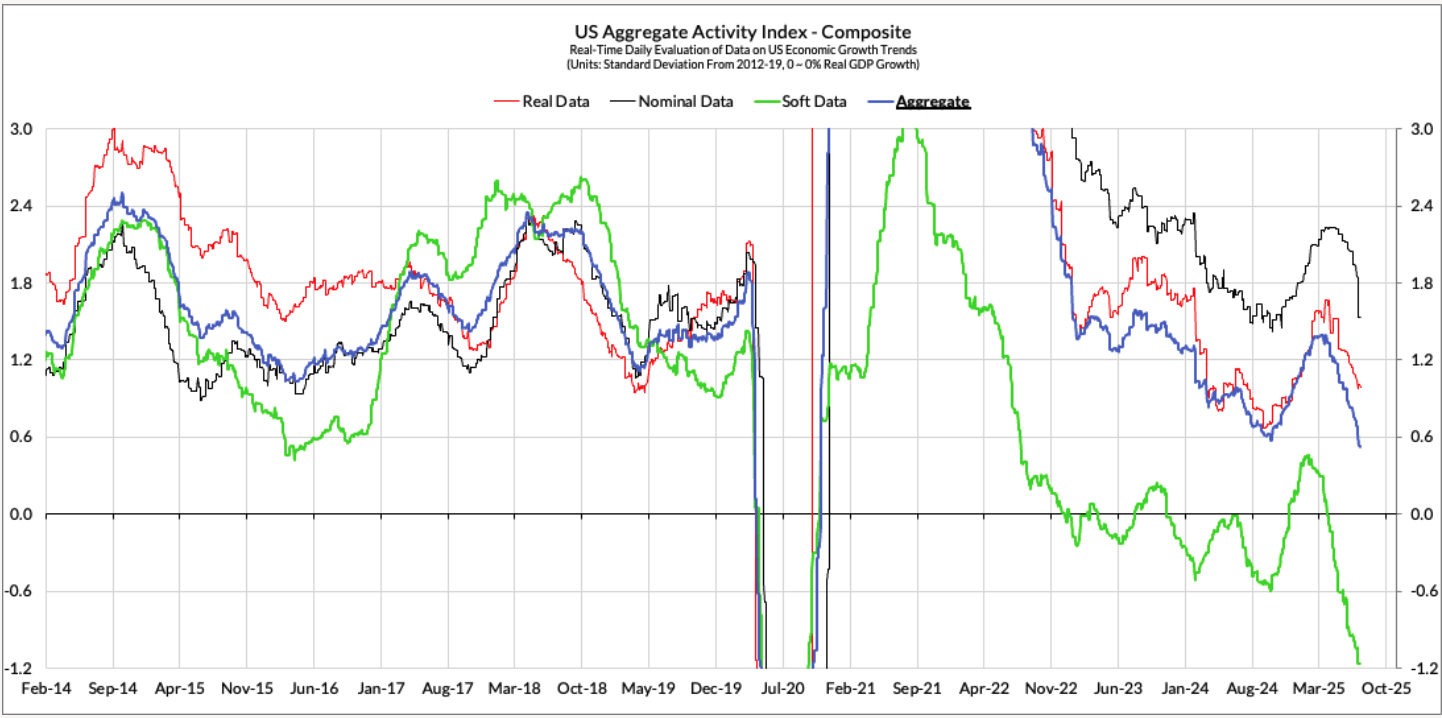 [Employ America, 2025-07-21]
Weaker Labor Market
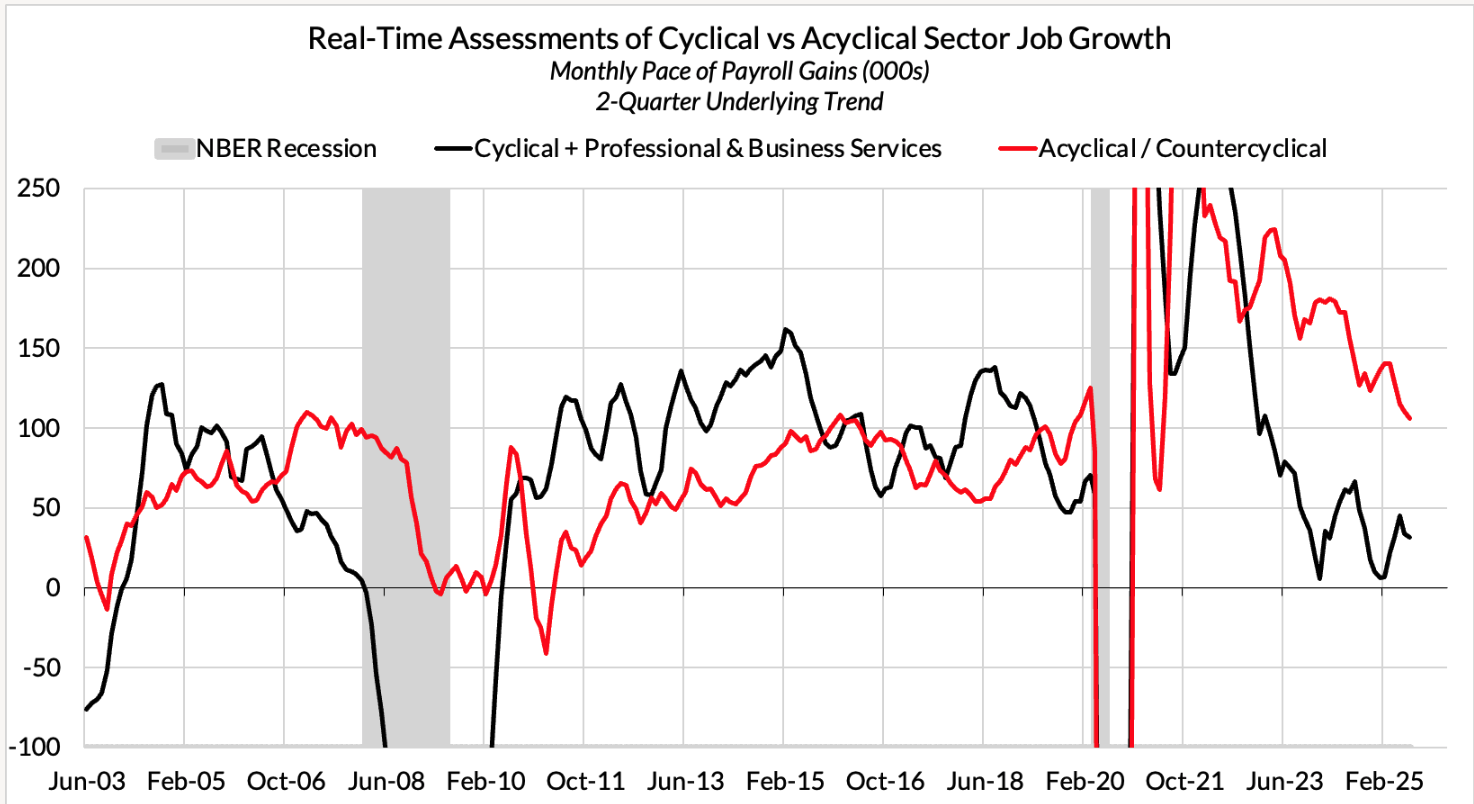
Employ America: Labor Market Growth Has Been Proped Up By Acylical Sectors, While Quits And Hire Rates Have Dropped. According to Employ America, “On the surface, the labor market looks quite healthy, with nonfarm payroll gains averaging ~130k per month for 2025H1, the unemployment rate still in the low 4s, and the prime-age (25-54) employment rate still slightly above pre-pandemic peak. Looking under the hood of the data, the labor market is softer than what the headline numbers imply. We have noted over the past year that job growth over the last two years has been dominated by acyclical sectors (e.g. healthcare, state and local government, private education), with construction being the lone cyclical sector showing strength (though fading). Acylical sectors now face headwinds as post-pandemic catch up dynamics are dissipating. Quits and hires rates–two of the best indicators for assessing labor market tightness–signal more sluggish labor market momentum and potential for widening slack. As Senior Economist Preston Mui laid out in April, this slowdown in hiring can pose a threat to the labor market even without layoffs.” [Employ America, 2025-07-23]
Reduced Investment
Q2 2025: ASML Orders Fell Four Percent From A Year Earlier, Even Adjusted For The Dollar’s Fall. According to Bloomberg, “ASM International NV shares fell after its second-quarter orders missed expectations, after some chipmakers’ struggles undermined demand for the Dutch company’s semiconductor equipment. Orders fell 4% from a year earlier at constant currency to €702 million ($824 million), ASM said in a statement Tuesday. That compares with the average analyst estimate of €837 million, according to data compiled by Bloomberg.” [Bloomberg, 2025-07-22]
Clean Energy
While Trump Directed The IRS To Enforce BBB Provisions Within 45 Days, The Complicated Nature Of The Legislation Could Make Things Complicated, Further Limiting The Decisions That Can Be Made. According to Bloomberg, “The Treasury and IRS must soon detail how it will wind down Biden administration energy tax incentives by complying with a July 7 executive order requiring strict enforcement of the new restrictions within 45 days. The political compromise over wind and solar credits created a complex series of deadlines for phasing out the tax credit. In general, projects must be put into service by the end of 2027 to qualify for credits but there’s an exemption for projects that begin construction by next July. The terms involved need to be defined by the Treasury. ‘What does it mean to begin construction, is clearing a field enough?’ Sepp said. At the same time, there’s not a lot of existing Treasury and IRS guidance to implement the tougher restrictions on supply chains — particularly those crossing adversarial countries. ‘These are pretty complicated new rules that Congress has just created,’ EY’s Abraham said. ‘What kind of guidance can we really expect on such a short turnaround?’” [Bloomberg, 2025-07-23]
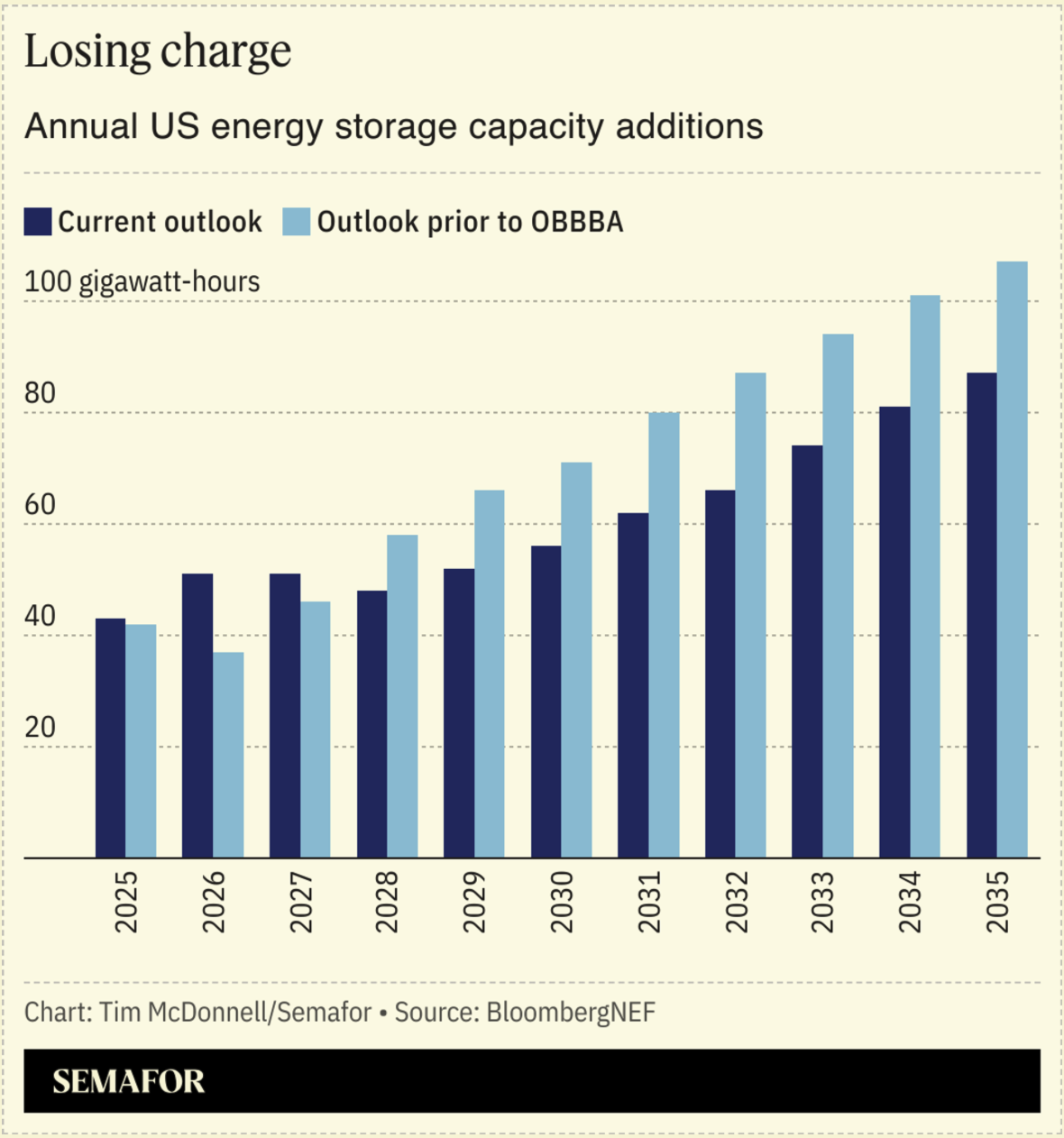
Bloomberg NEF: Trump’s BBB Would Be Expected To Lead To 23 Percent Less Solar And 50 Percent Less Onshore Wind As Projected Before Its Passage Over The Next Five Years. According to Semafor, “The rapid phaseout of renewable energy tax credits enshrined in the OBBBA is a big setback for that industry: About 23% less solar will be built in the US between now and 2030 than was previously expected, and half as much onshore wind, according to a new BloombergNEF analysis.” [Semafor, 2025-07-22]
- Following The Passage Of Trump’s BBB, Enphase ENergy Projected A 20 Percent Decline In Residential Solar Power In 2026. According to Bloomberg, “Enphase Energy Inc., a major US solar equipment company, sees the nation’s residential market shrinking 20% next year as tax credits for homeowners end under President Donald Trump’s sweeping economic legislation. While some analysts have predicted even steeper declines, the estimate from Enphase marks one of the first big projections from an industry player since Trump’s spending bill was passed. The company is among the first US solar companies to report earnings this quarter.” [Bloomberg, 2025-07-22]
Bloomberg NEF: Greater Restrictions, Combined With Trump’s Adversarial Approach To Key Sources Of Inputs Have Reduced The Outlook For Domestic Battery Deployment. According to Semafor, “While significantly less affected than renewables and EVs, battery deployment will still take a hit because of the OBBBA, BloombergNEF projects. Even though the main tax credit is preserved, the law imposed tighter restrictions on how much of each battery must be manufactured domestically in order to qualify for a bonus tax reduction. And separately from the OBBBA, the Trump administration’s tariffs and trade antagonism with China are making it harder for US companies to import critical battery minerals, components, and manufacturing equipment.” [Semafor, 2025-07-22]
Capital Flight
Since March 2025, The Dollar Has Weaned More Than Would Be Expected Based On The Rate Differential. 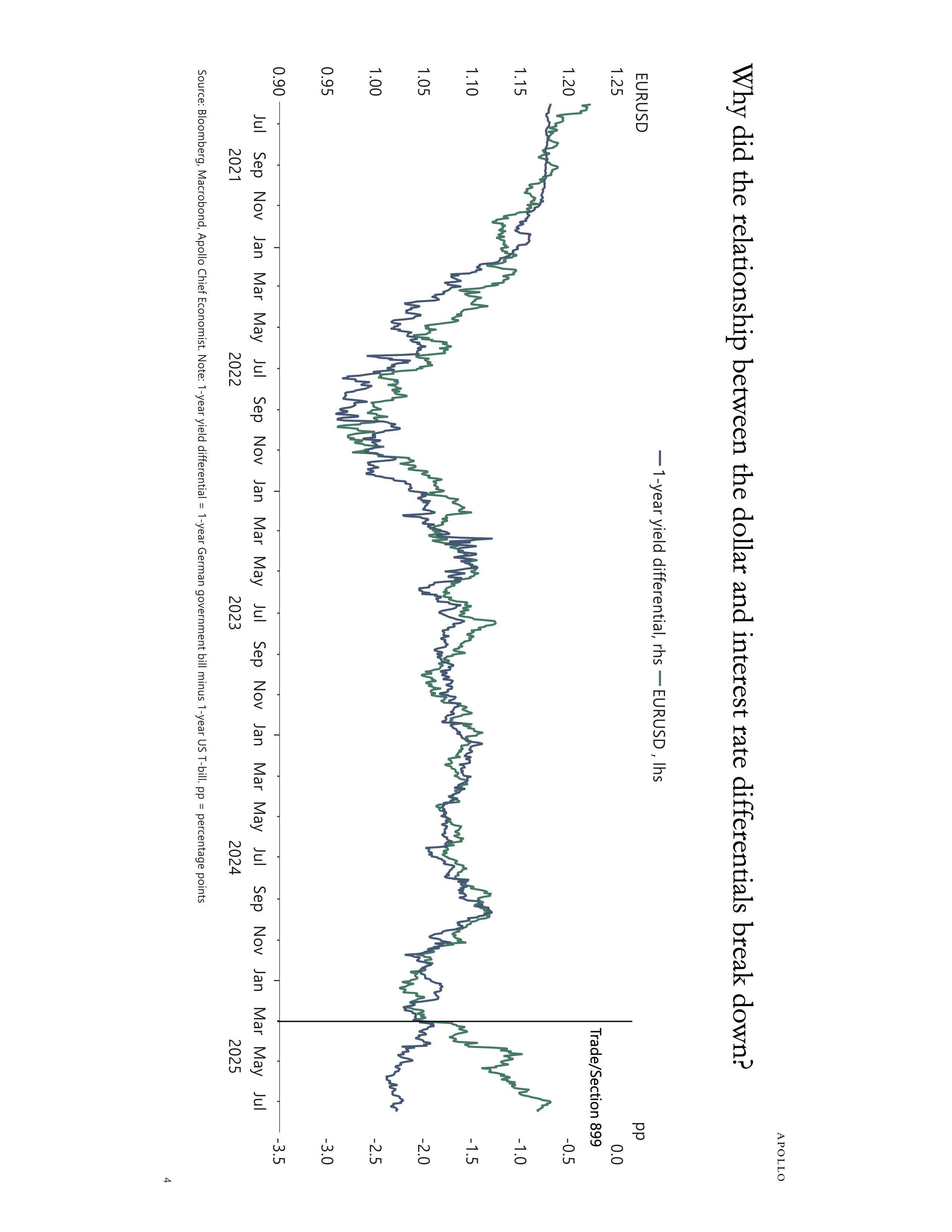 [Apollo, July 2025]
Adding A Binary For Trump’s Liberation Day Explains Most Of The Divergence. 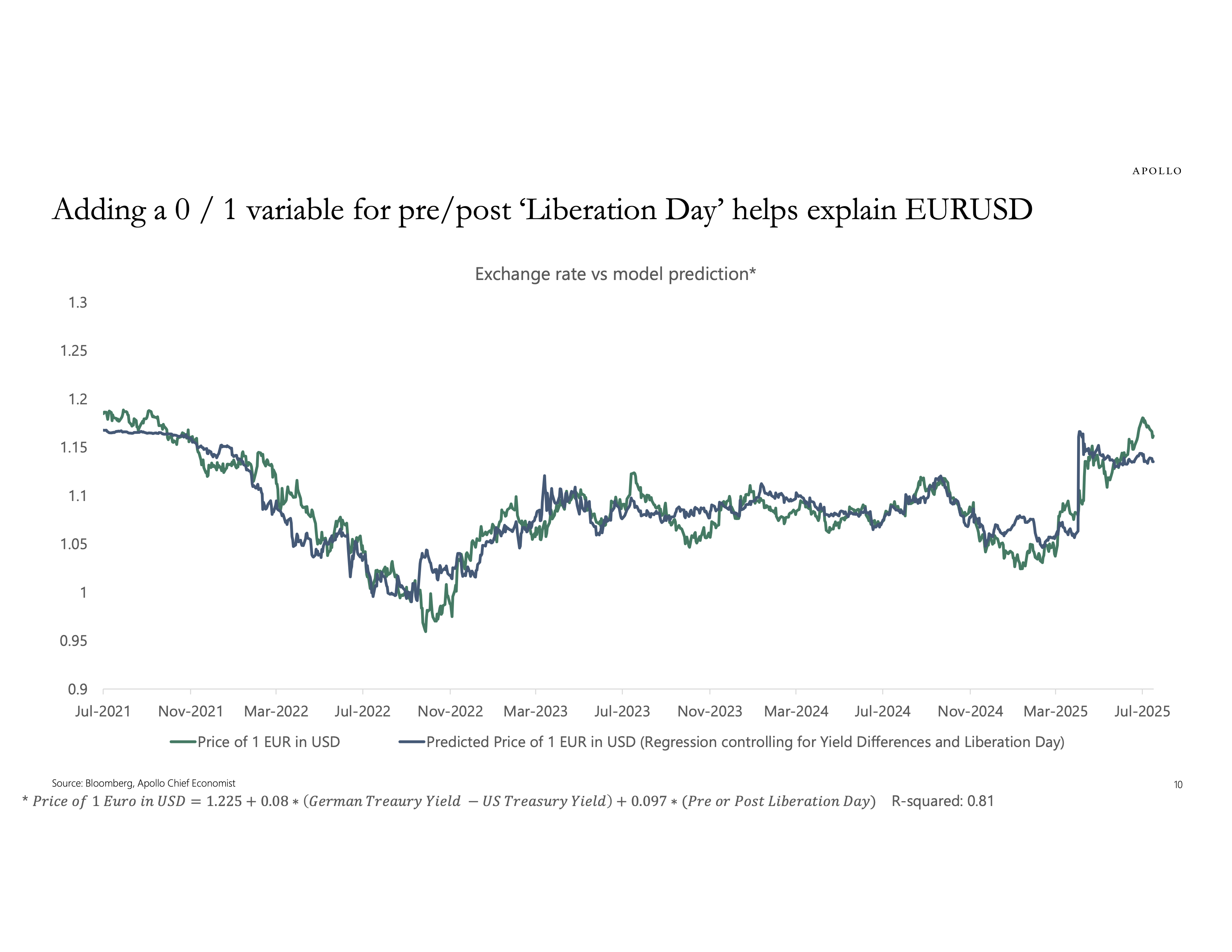 [Apollo, July 20225]
The econometric implication of this result is that, in the behavior Trump–and by implication, the country–has exhibited in announcing his “Liberation Day” tariffs and everything else around them, the equilibrium strength of the dollar declined.
Financial Instability
During The First Half Of 2025, The Use Of Continuation Funds By Private Equity Firms Jumped By 60 Percent, To 19 Percent Of All Transactions. According to the Financial Times, “Private equity firms made record use of a controversial tactic to cash out their clients by selling assets to themselves in the first half of the year, as they struggle to find external buyers or list holdings. Buyout groups used so-called continuation funds — in which a private equity group sells assets from one of the funds they manage to a fresher fund also managed by the firm — to exit $41bn of investments in the first six months of 2025, according to a report by investment bank Jefferies. That was equal to a record 19 per cent of all sales by the industry, and 60 per cent higher than a year ago.” [the Financial Times, 2025-07-23]
Corruption
Selective Anti-Trust Enforcement
July 2025: Trump Said That He Abandoned Plans To Look Into Breaking Up Nvidia, Before Meeting With Its CEO, And Instead Letting Them Send AI Chips To China. According to Bloomberg, “President Donald Trump said he considered attempting to break up Nvidia Corp. to increase competition in artificial intelligence chips before finding out ‘it’s not easy in that business.’ ‘I said, “Look, we’ll break this guy up,” before I learned the facts here,’ Trump said Wednesday at an AI summit in Washington. Trump said he was told by aides that doing so was ‘very hard’ and that the company held a substantial advantage over all competitors that would take years to overcome. ‘I figured we could go in and we could sort of break them up a little bit, get them a little competition, and I found out it’s not easy in that business,’ Trump added. Nvidia declined to comment. Trump went on to praise Nvidia Chief Executive Officer Jensen Huang, who was in the audience for his event. Huang met earlier this month with the president at the White House, and last week the company announced it would be allowed to resume selling its H20 artificial intelligence chips to China as part of a recent trade truce with Beijing. The Trump administration had previously frozen the sale of those chips to China.” [Bloomberg, 2025-07-23]
Big Tech
January - June 2025: More Than 500 Organizations Lobbied The White House And Congress On AI, More Than Twice As Many In The Same Period In 2023. According to the Financial Times, “Companies and business groups are rushing to influence Washington’s artificial intelligence policies as the industry booms and Donald Trump’s administration seeks to encourage the powerful technology in the US. More than 500 organisations lobbied the White House and Congress on AI between January and June, according to a Financial Times analysis of federal disclosures released this week. The figure is on a par with the first half of last year but has nearly doubled since 2023. The lobbying boom over the past two years highlights how the AI industry, which is backed by Big Tech companies and deep-pocketed investors, is looking to shape policy at a time of intense debate about the technology. ‘The US government is not only a gigantic potential customer but also a public validator of new technology approaches,’ said Tony Samp, head of AI policy at law firm DLA Piper and a lobbyist for OpenAI, Boston Dynamics and other companies. ‘Unlike in years past when the government was often viewed as a hindrance, the business community increasingly views the US government as a key partner.’” [the Financial Times, 2025-07-23]
2023 - 2025: OpenAI’s Lobbying Has More Than Quadroupled Its Lobbying Spending Since 2023. According to the Financial Times, “OpenAI began to lobby in 2023, spending $380,000, as Washington began to seriously consider ways to regulate the industry. The company has already more than quadrupled its lobbying effort, spending $1.8mn in the first half of 2025 to influence the White House and Congress.” [the Financial Times, 2025-07-23]
Administration Flexibility In Discriminating In Purchases
Trump’s AI Plan, With A Vague Reference To “Woke” AI, Could Be Used To Prevent The Government From Contracting With Technology Providers. According to the Washington Post, “Trump has flaunted his administration’s connections to the industry as a display of innovation and economic power. But consumer advocates warn that industries should not be able to write their own rules, amid concerns that AI could kill jobs, harm the environment and exacerbate existing social biases. Among the actions Trump took Wednesday was signing an executive order targeting “woke” artificial intelligence, an answer to Trump’s Silicon Valley supporters who allege companies have built tools and chatbots that show a liberal political bias. Those moves could benefit some tech companies that have tweaked their models to address these allegations, but they could limit the ability of other companies to contract with the federal government.” [the Washington Post, 2025-07-23]
Social Security
July 2025: The Annual Report Of The Social Security Trustees Reported Slightly Worse Metrics. According to the Center for Retirement Research, “Compared to last year’s report, the metrics are somewhat worse. The projected 75-year deficit rose to 3.82 percent of taxable payroll, compared to 3.50 percent in 2024. The reasons were predictable: 1) the Social Security Fairness Act, enacted in January, raised benefits for some state and local workers; 2) the period of recovery from current low fertility rates was extended by 10 years to 2050; 3) the projection period moved forward, which replaces a low-deficit year with a high-deficit year; and 4) the share of GDP going to workers was revised downward, which reduces payroll tax revenues.” [the Center for Retirement Research, 2025-07-08]
Immigration’s Vital Role In Saving Social Security
Immigrants Benefit Social Security In Three Ways: Lowering The Ratio Of Retirees To Workers, Illigal And Temporary Immigrants Pay Payroll Taxes But Are Not Eligible For Benefits, And Immigrants Tend To Have More Children. According to the Center for Retirement Research, “Future patterns of immigration are notoriously difficult to predict; flows depend on economic and political conditions in both the emigrant country and the United States. The task here, however, is much simpler – assessing how the projected patterns could be affected by both current and future Administrations’ attitude towards immigrants and immigration. Social Security’s immigration projections involve estimating net flows for two types of immigrants – lawful permanent residents and those present temporarily or unlawfully. Temporary/unlawful immigrants include those who entered legally but were only granted temporary authorization (such as students and foreign workers on visas) and those who overstayed their visas, as well as those who entered illegally. In the 2025 Report, total annual immigration for the two groups – under the intermediate assumptions – averages 1,253,000 for the period 2035 through 2099. Of the total, 788,000 are lawful permanent residents and 465,000 are temporary/unlawful immigrants. The ultimate level of immigration assumptions remained unchanged from last year’s Report. The Social Security projections are fairly consistent with those from other federal agencies.8 As with other assumptions, the Trustees present both a more optimistic (lower cost) and more pessimistic (higher cost) projection for immigration (see Table 4). Additional immigration helps Social Security finances in several ways. First, the cost rate decreases because immigration occurs at relatively young ages, thereby – at least in the short run – lowering the ratio of retirees to workers. Second, temporary/illegal immigrants often contribute to Social Security, but do not qualify for benefits.9 Third, immigrants tend to have more babies than native-born Americans, thereby raising the domestic fertility rate, which further improves the outlook.” [the Center for Retirement Research, 2025-07-08]
2025: Despite The Fact That Lower Fertility Rates Worsened The Projected 75 Year Social Security Deficit, The High Levels Of Immigration In 2022-5 Reduced The Projected Surplus. According to the Center for Retirement Research, “This category is also of note because one component – extending the period of recovery from current low fertility rates by 10 years (from 2040 to 2050) – worsened the 75-year deficit by 0.11 between 2024 and 2025. This large negative effect, however, was largely offset by other positive changes, such as higher levels of immigration in the period 2022-2025, resulting in a modest net increase in the deficit of 0.02 percent of taxable payrolls.” [the Center for Retirement Research, 2025-07-08]