July 2025: Texas Manufacturers Saw Continued Price Pressure. According to the Texas Federal Reserve, “Elevated input price pressures continued in July, while selling price growth eased. The raw materials prices index held fairly steady at 41.7, well above its average reading of 27.4.” [Texas Federal Reserve, 2025-07-28]
Code
include("../scripts/oxocarbon-plot.jl")theme(:oxocarbon)usingFredData, DataFrames, Dateskey=ENV["FRED_API_KEY"]f=Fred(key)future_price=get_data(f, "FPRMISAMFRBDAL"; observation_start="2023-07-01", observation_end="2025-07-02", ).datacurrent_prices=get_data(f, "PRMIUAMFRBDAL"; observation_start="2023-07-01", observation_end="2025-07-02", ).data# Make the Plotplot(current_prices.date, current_prices.value; linewidth=2, label="Current Prices", xlabel="Month", ylabel="Percentage of Firms Increasing Increases", title="More Texas Manufacturers' Input Price Are Rising",)plot!(future_price.date, future_price.value; linewidth=2, label="Future Prices",)vline!([Date(2024,11,5)]; linewidth=2, linestyle=:dash, label="Election Day",)
Trade War
With Trump’s Trade Deal With Japan, Japanese Imports Will Face Lower Tariffs Than Imports From Canada And Mexico, Despite Canadian And Mexican Cars Using Many More American Inputs. According to Paul Krugman, “This is clearest in the case of automobiles and automotive products. Trump has imposed a 25 percent tariff on all automotive imports, supposedly on national security grounds. This includes imports from Canada and Mexico. And here’s the thing: Canadian and Mexican auto products generally have substantial U.S. ‘content’ — that is, they contain parts made in America. Japanese cars generally don”t. But now cars from Japan will pay only a 15 percent tariff, that is, less than cars from Canada and Mexico. OK, it’s not quite that straightforward, because imports from Canada and Mexico receive a partial exemption based on the share of their value that comes from the United States. Yes, it’s getting complicated. But we may nonetheless now be in a situation where cars whose production doesn’t create U.S. manufacturing jobs will pay a lower tariff rate than cars whose production does.” [Paul Krugman, 2025-07-25]
Strange Claim
While The Trump Administration Has Claimed It Will Have Direction Over Japanese Investments In The United States, The Japanese Government Has Said It Would Support Japanese Companies. According to Bloomberg, “The two countries’ leaders seem at times to be talking at cross purposes. The White House said over $550 billion will be invested under the direction of the US, and Trump said on social media that 90% of the profits will be given to America. Prime Minister Shigeru Ishiba, on the other hand, said Japan would offer a mixture of investment, loans, and loan guarantees up to a maximum of $550 billion.” [Bloomberg, 2025-07-24]
While The Trump Administration Claimed It Spurred Billions Of Dollars In Purchases, Those Seem To Have Been Already Planned. According to Bloomberg, “The White House factsheet on the trade deal mentions that Japan will also buy 100 Boeing Co. planes as well as US defense equipment worth additional billions of dollars annually. Akazawa said both these pledges were based on existing plans by Japanese airlines and the government, respectively.” [Bloomberg, 2025-07-24]
Economic Degradation
Farm Bankruptcies
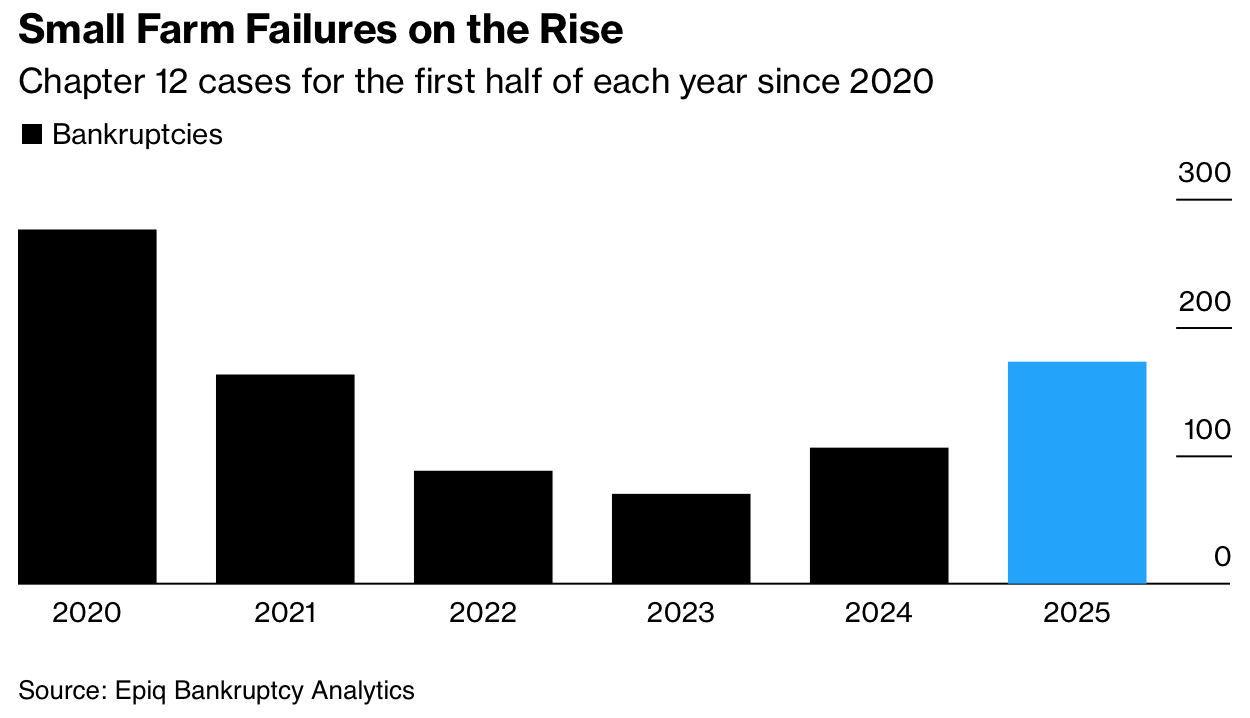
Pressed By Trump’s Trade War Cutting Off Export Markets, The Number Of Small Farmers Filing For Bankruptcy Has Hit The Highest Level Since 2020. According to Bloomberg, “After years of low crop prices and rising costs, America’s small farmers are facing a crisis brought on by higher interest rates, Trump’s trade war and dramatically reduced demand from China. In the first half of the year, small-business bankruptcies filed by farmers and fisherman hit the highest number since 2020, which was the tail end of a similar cycle of low-prices. Farm debt is expected to hit $561.8 billion in this year, a record high, according to the US Department of Agriculture. ‘We’ve had three years of tough sledding here where breakevens are at or below cost,’ said Brett Bruggeman, the chief operating officer at Land O”Lakes Inc., one of the biggest farmer-owned cooperatives in the US.” [Bloomberg, 2025-07-23]
Wisconsin Dairy Farmers Have Struggled To Find Workers Amid Trump’s Immigration Crackdowns. According to Bloomberg, “In Wisconsin, dairy farmers have had trouble hiring workers because of Trump’s push to round up undocumented workers, said Mark Harring, a court-approved trustee who oversees small-farm bankruptcy cases.” [Bloomberg, 2025-07-23]
China Looking For Alternative Sources For Agricultural Goods
“Once You Lose A Customer, It’s Awful Hard To Get Them Back,” Soybean, Corn, And Pork Producers Still Have Not Recovered From The Loss Of China As A Customer During Trump’s First Trade War. According to Bloomberg, “Soybean, corn and pork producers have been among the hardest hit farmers in recent years as China began buying more from competitors in Brazil and other parts of Latin America. Before President Donald Trump’s first term in office in 2017, US farmers dominated the Chinese import market, said Joseph A. Peiffer, with the Iowa-based law firm Ag & Business Legal Strategies. Today Brazil occupies that position, he said. ‘Once you lose a customer it’s awful hard to get them back,’ he said. Firms that specialize in restructuring farm debt have seen an increase in business, lawyers said.” [Bloomberg, 2025-07-23]
July 2025: China Struck Multiple Angolan Agriculture Deals In A Week, Looking To Invest Hundreds Of Millions On Grains, Soybeans, And Corn. According to Bloomberg, “Sinohydro Group of China will invest more than $100 million in Angola to develop new sources of grain imports — the second agriculture-related deal agreed between the two countries this week. Angola granted Sinohydro a 25-year, tax-free land concession to develop 30,000 hectares across six eastern provinces in an agreement signed late Thursday in Luanda, the capital. Four days ago, a unit of Chinese state-owned conglomerate Citic Ltd. announced it will spend $250 million developing large-scale soybean and corn farms in Angola.” [Bloomberg, 2025-07-25]
Higher Prices
Due To High Coca Costs, Hershey’s Raised Its Prices By A Double-Digit Percentage. According to Bloomberg, “Hershey Co. is raising prices on its candy due to historically high cocoa costs. The Pennsylvania-based maker of Hershey’s chocolates and Reese’s Peanut Butter Cups told its retailers last week that it would be implementing a roughly double-digit price increase, company officials said Tuesday. That increase reflects a higher list price as well as adjustments to the weight and number of candies in a bag, a practice known as shrinkflation.” [Bloomberg, 2025-07-22]
Credit Tightening
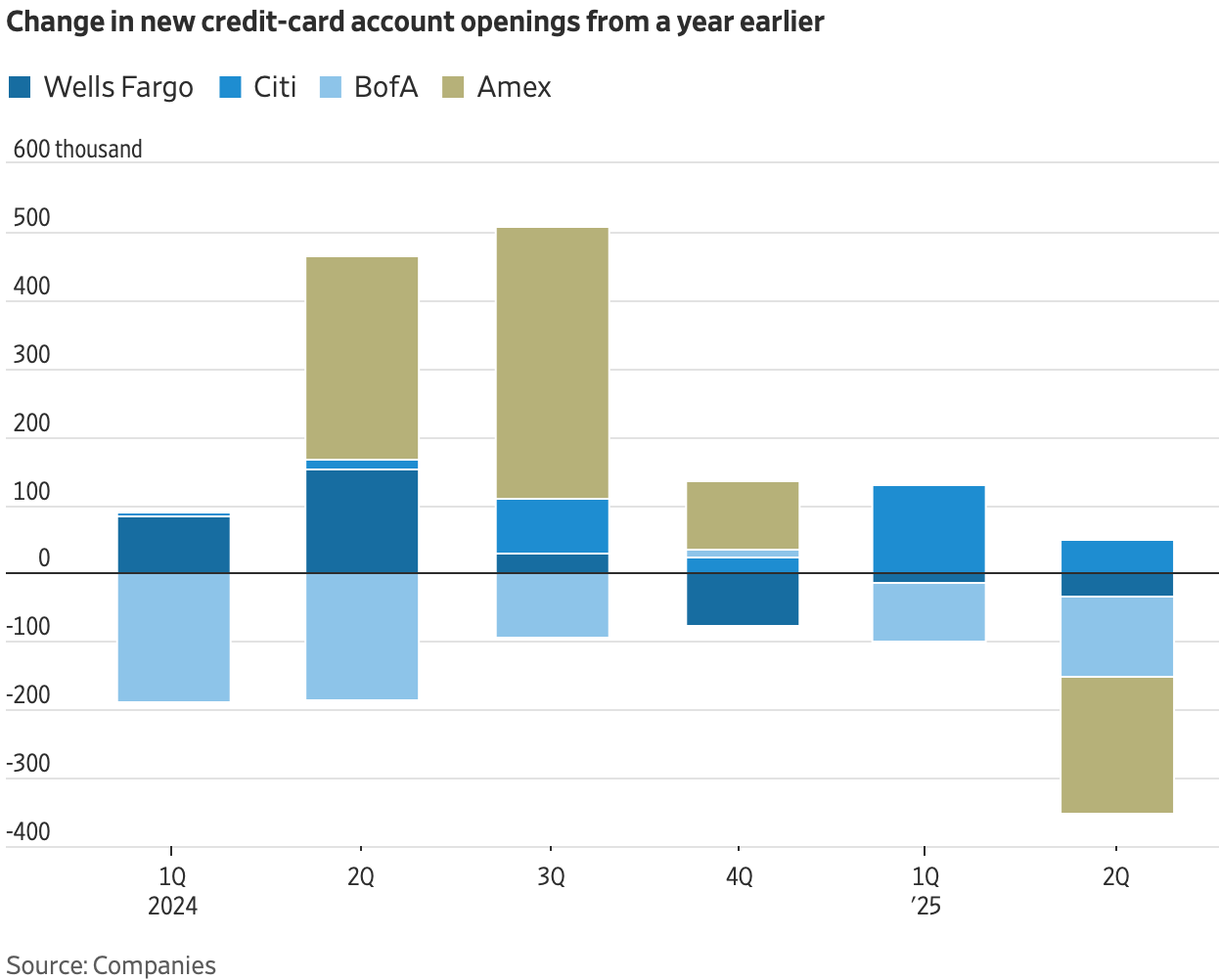
Q2 2025: Credit Card Issuers Made It More Difficult For Americans With Worse Credit To Open Credit Cards. According to the Wall Street Journal, “Banks are making credit cards harder to get—for some customers. Lenders opened fewer cards in the second quarter, according to earnings reports from major issuers. They raised qualification requirements for lower-end customers that tend to be at greater risk of missing payments.” [Wall Street Journal, 2025-07-25]
Q2 2025: Credit Card Balances Rose, While Interest Rates Increased. According to the Wall Street Journal, “Lower-end consumers, meanwhile, are struggling to keep up: Card balances are rising—a sign that many households are spending beyond their means. Those balances also have been getting more expensive this year. The average interest rate on credit cards rose to 24.35% this month, according to LendingTree.” [Wall Street Journal, 2025-07-25]
Reduced Domestic Investment
Through June 2025, Trump Caused $22 Billion In Cancelled Planned Investments, 17 Percent Of Proposed Clean Projects, Representing Around 16,500 Jobs. According to Bloomberg, “Companies canceled, closed or scaled back more than $22 billion worth of investments in clean-energy projects during the first half of this year ahead of President Donald Trump’s signing of a tax bill that rolls back Biden-era green tax breaks. That represents about 17% of the $133 billion worth of green projects announced since the start of 2022, many of which are based in Republican-led states, according to E2, a research group that advocates for environmental policies. In June alone, roughly $6.7 billion of projects were canceled, affecting five battery, storage and electric vehicle factories in Colorado, Indiana and Michigan, E2 reported. The cuts resulted in more than 5,000 job losses, increasing this year’s total from abandoned projects to 16,500.” [Bloomberg, 2025-07-24]
Trump’s Stalling Of An Energy Construction Project In New York Cost The Company Running It Almost A Billion Dollars. According to the Wall Street Journal, “Norwegian energy giant Equinor said it booked a nearly $1 billion impairment related to regulatory changes in the U.S. offshore wind industry and exposure to tariffs. Equinor said that the stalling of construction of its massive Empire Wind project off the coast of New York earlier this year and an issue with a lease cost the company $955 million. Interior Secretary Doug Burgum halted the project in April, sending chills through the renewable energy industry. The project had already been approved by the Biden administration and construction was well underway. At the time Equinor said the halt-work order was ‘unprecedented and in our view unlawful.’ For now, the project is back on. However President Trump has railed against clean energy, especially offshore wind, since his return to the Oval Office and has suspended offshore wind leases. In its earnings report on Wednesday, Equinor said that tariffs were driving up costs, with projects like the Empire Wind project using large amounts of steel and other key materials now subject to higher tariffs.” [Wall Street Journal, 2025-07-23]
Financial Instability
Jamie Dimon Compared Private Credit To Mortgages Before The GFC, Even As JP Morgan Raised Its Allocation To Private Credit To $50 Billion. According to the Financial Times, “It is a mantra that might haunt Jamie Dimon, head of JPMorgan, right now. In recent months, Dimon has repeatedly warned about risks lurking in private credit, which has recently had such a ‘meteoric rise’, to cite the Boston Federal Reserve, that it has been one of the fastest-growing finance sectors. Dimon has noted that while there are plenty of good deals, bad ones exist too — and credit ratings are so unreliable that the sector is creating a potential ‘recipe for a financial crisis’. ‘I’ve seen a couple of these deals that were rated by a rating agency. And . . . it shocked me what they got rated,’ he observed. ‘It reminds me a little bit of mortgages [before the GFC].’ Then this month he doubled down, suggesting we ‘may have seen peak private credit’. But this year JPMorgan has also raised its allocation to private credit from $10bn to $50bn. The reason? Its rivals are rushing into this space, as US President Donald Trump seeks to open the asset class to pension funds and retail investors. The financial ‘dancing’ is intensifying.” [Financial Times, 2025-07-25]
Worse Services
Echoing Trump’s Questionably Legal Declaration That English Is The Official Language, His IRS Considered Eliminating Providing Multi-Language Services. According to the Washington Post, “Trump administration officials are considering eliminating multi-language services at the IRS, according to records obtained by The Washington Post and two people familiar with the situation, a move that would make it dramatically more difficult for non-English-speaking individuals to file their taxes. The people said the IRS is evaluating how to comply with President Donald Trump’s executive order declaring English the official language of the United States — a power that some legal scholars say the president does not have. Both people spoke on the condition of anonymity for fear of professional reprisal. Attorney General Pam Bondi issued guidance to federal agencies on July 14 on how to implement that order. It requires officials to release department-wide plans ‘to phase out unnecessary multilingual offerings’ and ‘consider redirecting these funds towards research and programs that would expedite English-language acquisition and increase English-language proficiency and assimilation.’” [Washington Post, 2025-07-24]
Trump’s IRS’ Decision To Cooperate With ICE Has Already Led To Steep Drops In Tax Compliance. According to the Washington Post, “The tax service eliminated its civil rights division in April. Separately, fears among Spanish-speaking taxpayers about the IRS’s collaboration with immigration enforcement officials led to steep drops in tax compliance among immigrant communities in certain parts of the country.” [Washington Post, 2025-07-24]
Corruption
Private Market Bail Out
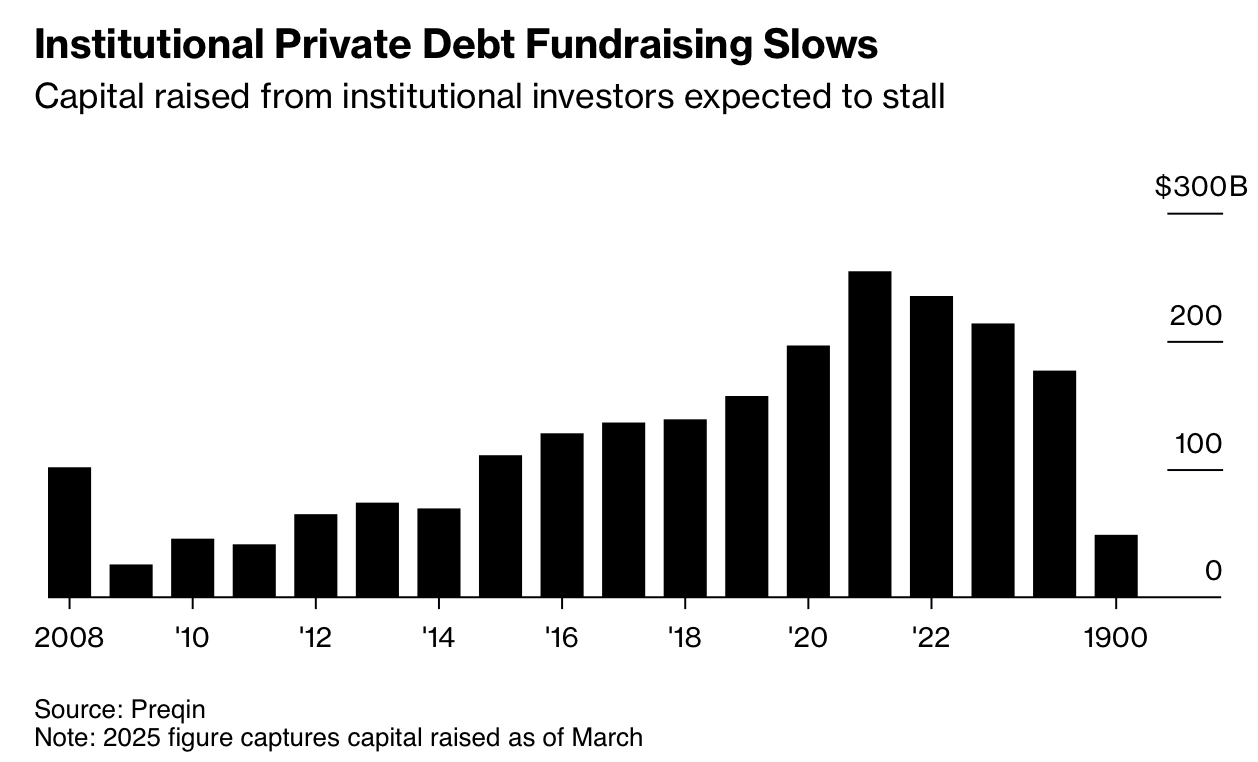
Since The Pandemic, Private Debt Fundraising Has Softened. According to Bloomberg, [Bloomberg, 2025-07-24]
In Anticipation Of Trump Pushing Their Products Into Americans’ 401(k)s, Private Asset Firms Have Set Up Partnerships With Providers. According to Bloomberg, “When word spread last week that President Donald Trump is keen to spur more private assets into retirement funds, the biggest direct lenders were more than prepared. In fact, the industry has been laying the groundwork for quite some time. Firms including KKR & Co., Blackstone Inc. and Blue Owl Capital Inc. had already set up partnerships with 401(k) managers. Trade groups and industry executives have also been lobbying officials in Washington and making their case to the public — all part of a long-running effort to expand private credit’s reach.” [Bloomberg, 2025-07-24]
 [Bloomberg,