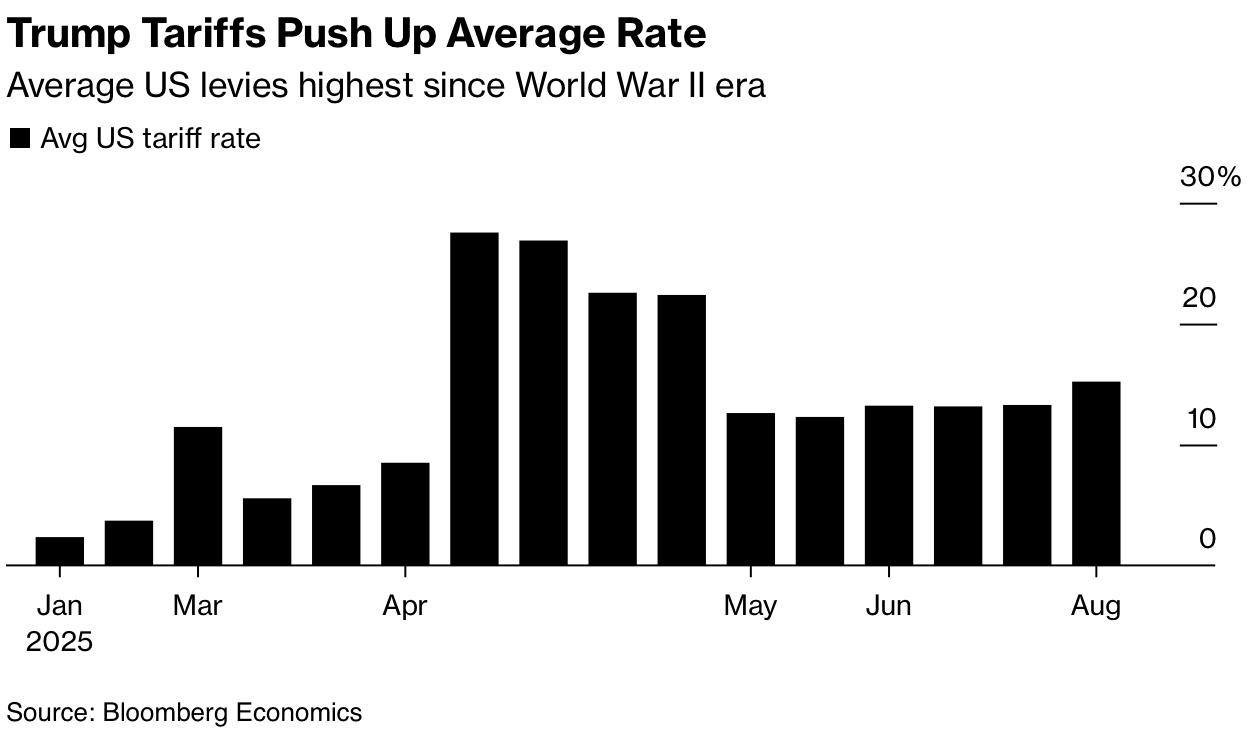
The fallout from Trump’s hissy fit over the jobs numbers continued, as more and more figures who would not typically criticise the administration raised alarms about his decision to fire the head of the BLS. Meanwhile, the data that did come out fit with the picture that was painted by last week’s GDP and labor force data: a worsening economy. The main cause of this economic weakness: Trump’s trade war continued unabated, as the levies he put in place to end last week brought the taxes Americans pay on imported goods up to 6.6 times what they were when he was inaugurated less than eight months ago.
Banana Republic Behavior
August 2025: Trump Announced He Was Firing The Head Of The BLS After The Weak July 2025 Employment Report. According to Bloomberg, “President Donald Trump fired the head of the Bureau of Labor Statistics hours after a report showed weak job growth, prompting outcries from economists to lawmakers and raising concerns over the integrity of the data going forward. In a social media post Friday, Trump said he directed his team to fire Erika McEntarfer — who was appointed by Joe Biden — ‘IMMEDIATELY.’ He went on to say that ‘important numbers like this must be fair and accurate, they can’t be manipulated for political purposes.’” [Bloomberg, 2025-08-01]
Trump’s Appointee To Be BLS Head In His First Term And The Director Of The Conservative AEI Criticised The Move As Groundless And Dangerous. According to Bloomberg, “Trump’s directive to fire McEntarfer garnered swift criticism from Democrats including Senators Elizabeth Warren and Chuck Schumer. Her predecessor, William Beach, who was appointed during the first Trump administration, called the firing ‘totally groundless’ and that it sets a ‘dangerous precedent.’ Beach co-chairs the advocacy group, Friends of BLS, which released a statement Friday saying they ‘stand firmly behind the BLS, Commissioner McEntarfer, and the data they work hard to produce.’ ‘To politicize the work of the agency and its workers does a great disservice not only to BLS but to the entire federal statistical system which this country has relied on for almost 150 years,’ the group said in a statement. Michael Strain, director of economic policy studies at the conservative-leaning American Enterprise Institute, was resolute in McEntarfer’s defense, saying ‘there’s just absolutely no evidence’ that she had any desire to fake the number, and to do so would have been ‘impossible.’” [Bloomberg, 2025-08-01]
After Having Cheered Data Showing Tame Inflation, Trump Lashed Out At McEntarfer Without Proof After Data Showed The Worst Three Months Of Job Growth Since The Pandemic. According to Kathryn Anne Edwards in Bloomberg, “The commissioner President Donald Trump fired via a social media post is Erika McEntarfer, who was nominated to head the agency by former President Joe Biden in 2023. She was confirmed by the Senate in January 2024 by a vote of 86-8. To be clear, the problem is not that she was fired, but rather that she was slandered. After all, this is the same agency that produced data in recent months showing that inflation was tame and which the White House cheered. And yet, Trump took to social media to charge, without evidence, that the monthly employment report for July that was released earlier Friday was ‘RIGGED’ because it showed a rapidly weakening labor market. In the last three months, the economy added just 106,000 jobs, with May and June revised lower by a combined 258,000. That three-month stretch was the worst for job growth since the pandemic, and it happens to come as Trump’s chaotic tariff strategy paralyzes businesses, which are finding it impossible to plan ahead.” [Kathryn Anne Edwards in Bloomberg, 2025-08-02]
JP Morgan Called The Firing “Concerning News” Presenting Risks To “Financial Stability, And To The Economic Outlook.” According to James Pethokoukis, “Friday’s presidential removal of Bureau of Labor Statistics (BLS) Commissioner McEntarfer presents risk to the conduct of monetary policy, to fiscal stability, and to the economic outlook. Potential politicization of the Fed has been much discussed over the past several months, but the risk of politicizing the data collection process should not be overlooked. To borrow from the soft-landing analogy, having a flawed instrument panel can be just as dangerous as having an obediently partisan pilot. Moreover, one should not be under the illusion that the proliferation of private sector ‘big data’ indicators over the past decade can substitute for high quality federal data. In almost all cases these indicators are benchmarked to the federal data, as private sector data are very rarely nationally representative. And, as users of those data sets know, even small changes in the market share of private data providers can distort the signal on the national economy (a non-issue for federal data).” [James Pethokoukis, ]
Precedent
In Argentina, After The Government Manipulated Inflation Data, The Country’s Borrowing Costs Surged, Exacerbating A Debt Crisis. According to the New York Times, “When political leaders meddle in government data, it rarely ends well. […] Perhaps most famously, there is the case of Argentina, which in the 2000s and 2010s systematically understated inflation figures to such a degree that the international community eventually stopped relying on the government’s data. That loss of faith drove up the country’s borrowing costs, worsening a debt crisis that ultimately led to it defaulting on its international obligations. It is too soon to know whether the United States is on a similar path. But economists and other experts said that Mr. Trump’s decision on Friday to fire Erika McEntarfer, the Senate-confirmed head of the Bureau of Labor Statistics, was a troubling step in that direction. Janet L. Yellen, the former Treasury secretary and chair of the Federal Reserve, said the firing was not what is expected from the most advanced economy in the world. ‘This is the kind of thing you would only expect to see in a banana republic,’ Ms. Yellen said.” [New York Times, 2025-08-03]
Releases
Brave-Butters-Kelly Indices
The Brave-Butters-Kelly Indices Construct Monthly Estimates Of Real Economic Activity. According to Indiana University’s Business Research Center, “The Brave-Butters-Kelley Indexes (BBKI) are the byproduct of research originally conducted by the Federal Reserve Bank of Chicago. Currently, the BBKI are maintained and produced by the Indiana Business Research Center at the Kelley School of Business at Indiana University. The BBK Coincident and Leading Indexes and Monthly GDP Growth for the U.S. are constructed from a collapsed dynamic factor analysis of a panel of 490 monthly measures of real economic activity and quarterly real GDP growth. The BBK Monthly GDP Growth is indexed to the quarterly estimates of real GDP growth from the U.S. Bureau of Economic Analysis and consists of three components: cycle, trend, and irregular components.” [Indiana University’s Business Research Center, accessed 2025-08-04]
┌ Warning: Metadata 'notes' not returned from server.
└ @ FredData ~/.julia/packages/FredData/5M7x4/src/get_data.jl:77
Trade War
Bloomberg Economics: Using A Model Calibrated By Trump’s Last Trade War, His Tariffs Would Be Expected To Cut Americans’ Incomes By 1.8 Percent And Raise Core Prices By 1.1 Percent Over The Rest Of His Term. According to Bloomberg, “Applying model results used by the Federal Reserve in the first trade war, Bloomberg Economics calculates the 12.8-percentage-point hike in the average tariff since Trump came back into office could cut US GDP by 1.8% and lift core prices by 1.1% over a period of two to three years.” [Bloomberg, 2025-08-01]
To End July, Trump Announced Tariffs Raising The Average Rate From 5.7 Times What They Were When He Was Inaugurated To 6.6 Times. According to Bloomberg, “President Donald Trump unveiled a slew of new tariffs that boosted the average US rate on goods from across the world, forging ahead with his turbulent effort to reshape international commerce. The baseline rates for many trading partners remain unchanged at 10% from the duties Trump imposed in April, easing the worst fears of investors after the president had previously said they could double. Yet his move to raise tariffs on some Canadian goods to 35% threatens to inject fresh tensions into an already strained relationship, while countries like Switzerland and New Zealand also saw increased rates. Taken together, the average US tariff rate will rise to 15.2% if rates are implemented as announced, according to Bloomberg Economics. That’s up from 13.3% earlier and significantly higher than the 2.3% in 2024 before Trump took office. Most of the tariffs will take effect after midnight on Aug. 7, to allow time for US Customs and Border Protection to make necessary changes to collect the levies. Trump signed the directive just hours before his prior Aug. 1 deadline for higher tariffs to kick in on scores of trading partners.” [Bloomberg, 2025-07-31]
Higher Prices
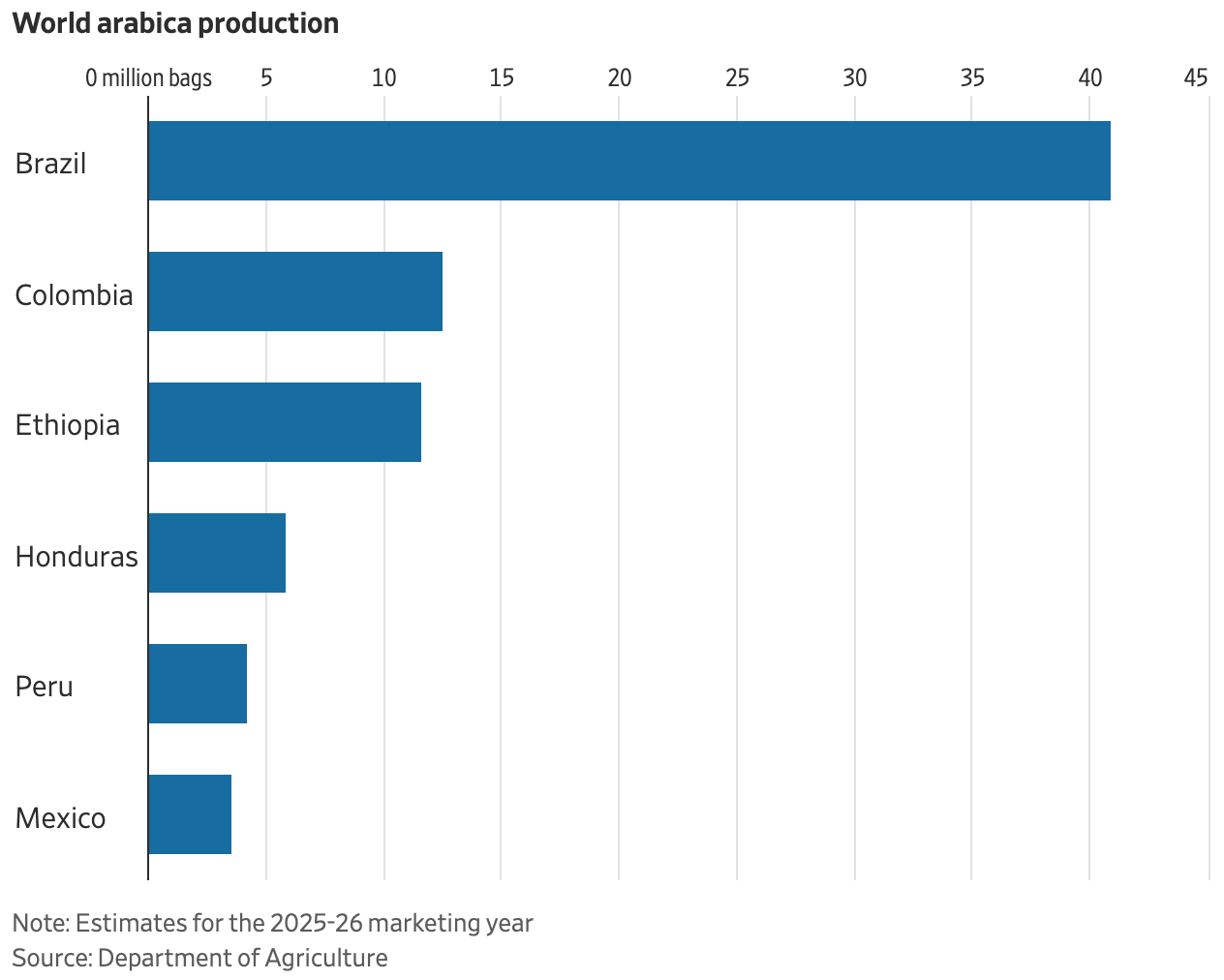
“We Don’t Have An Easy Ability To Replace Brazilian Coffee,” As Trump’s 50 Percent Tariffs Loom. According to the Wall Street Journal, “President Trump’s 50% tariff on Brazilian goods is likely to lift the price of the preferred coffee for most U.S. consumers. Brazilian arabica beans are the source for roughly 35% to 40% of the coffee consumed in the U.S. A levy on imports starting Aug. 6 would increase the price of coffee in cafes and grocery stores alike. Brazil is by far the leading producer of coffee worldwide. It is expected to produce a total of 65 million bags of beans in the 2025-26 marketing year—more than double the next-largest producer, Vietnam—the Department of Agriculture estimates. At more than 40 million bags, Brazil produces more arabica coffee than the next five leading producers in the world combined. This includes such countries as Colombia and Honduras, where U.S. coffee makers already buy a large portion of their output. ‘We don’t have an easy ability to replace Brazilian coffee,’ said James Watson, senior beverage analyst with Rabobank. ‘For the most part, most of what you drink is all arabica.’” [Wall Street Journal, 2025-07-30]
2024: The United States Imported 90 Percent Of Its Coffee Needs. According to the Wall Street Journal, “The ability of U.S. roasters to switch out Brazilian coffee for a different exporter is limited. Some are owned by such companies as JM Smucker and Kraft Heinz. Domestic production is small, with the U.S. importing 99% of its coffee needs through 2024. Hawaii, California and Puerto Rico are the only places in the U.S. that produce any amount of coffee.” [Wall Street Journal, 2025-07-30]
Contradictory Outcomes
As Of July 2025, The Automaker With The Most America-Intensive Production Suffered The Most From Trump’s Tariffs. According to the Wall Street Journal, “There is an irony in Detroit right now: The automaker most reliant on U.S. manufacturing is among the hardest hit by tariffs. Ford Motor, the second-largest American carmaker, prides itself on making most of its vehicles in the U.S. Some 80% of the cars Ford sells in the U.S. are built there, and it makes more vehicles in the U.S. than any other automaker. But the Dearborn, Mich., company said the Trump administration’s latest trade deals with Japan, the European Union and South Korea put it at a disadvantage with foreign rivals. Those deals now set a 15% tariff rate, which is lower than the 25% auto tariff that went into effect this spring. Ford faces steeper tariffs on many parts as well as higher costs for imported aluminum, which is subject to 50% duties. Ford, one of the industry’s biggest users of aluminum, buys the material from U.S. suppliers who pass on a chunk of their tariff costs. Treasury Secretary Scott Bessent said in a CNBC interview that Ford’s predicament is due to ‘idiosyncratic’ factors, as the company’s F-series pickups are made with aluminum, which isn’t readily available in the U.S. Bessent said the administration hopes to cut a deal with Canada to address aluminum costs in particular. ‘I admire Ford,’ he said.” [Wall Street Journal, 2025-07-31]
Q2 2025: The Big Three Paid More Than $2 Billion In Tariff Costs. According to the Wall Street Journal, “All three companies have reported big tariff costs. Ford said it paid $800 million in the second quarter. GM put its tab at $1.1 billion. Stellantis, which makes the U.S. brands Chrysler, Ram and Jeep, said tariffs shaved $350 million from its bottom line.” [Wall Street Journal, 2025-07-31]
Lazy Behavior
Late July 2025: Too Lazy To Negotiate With “A Wide Range Of Smaller-And Medium-Sized Countries,” Trump Tariffs On Goods Imported From Them. According to Bloomberg, “The lower 10% and 15% rates are expected to apply to a wide range of mostly smaller- and medium-sized economies that Trump showed little interest in bargaining with one-on-one. He had signaled in recent days there were simply too many countries to cut individualized deals with all of them.” [Bloomberg, 2025-07-31]
Benefiting Financial Traders
Following Trump’s Decision Not To Tariff The Main Traded Form Of Copper, Traders Have Rushed To Export Copper Stockpiled In American Ports. According to Bloomberg, “Copper traders are rushing to book up storage space in a bet that US President Donald Trump’s shock decision not to tariff the main traded form of the metal will prompt a wave of copper into warehouses on the London Metal Exchange. For months, traders had fallen over one another to ship copper to the US to capture sharply higher prices. They rapidly built up a stockpile worth more than $5 billion spread across US ports — particularly New Orleans, which has improbably become host to the world’s largest exchange copper inventory. Now the same traders are looking for new homes for some of that metal, while the aftermath of the frenzied race has left them with stashes in awkward locations from California to Hawaii. The race for LME storage space underscores how the announcement from the White House has marked a dramatic end to an arbitrage trade that copper industry veterans said was the most profitable of their careers. It’s also the latest example of how Trump’s tariff drive has upended the $250 billion market for a metal crucial to the energy transition and viewed as increasingly strategic for governments around the world. On Wednesday, Trump sent shockwaves through the industry with the announcement that import tariffs of 50% would apply only to processed forms of copper, not to refined metal. As New York prices collapsed in a matter of minutes, warehousing companies were already fielding calls from traders looking to redirect copper that had been destined for the US market to LME warehouses instead. (While they are located in ports like New Orleans, LME facilities sit outside of US customs.)” [Bloomberg, 2025-08-01]
Despite Copper Being Fungible, Price Behavior Was Not Consistent In And Outside Of The United States. According to Bloomberg, “The shifts have prompted a reassessment of the outlook for the copper price, at least in the short term. While US prices tumbled over 20% in a day as the threat of hefty import tariffs was removed, prices on the LME were also 0.9% lower on Thursday, with traders saying they expected prices to retreat further.” [Bloomberg, 2025-08-01]
Weakening Economy
Concentrated Growth
While Big Tech And Finance Have Reported Record Profits, A Majority Of S&P 500 Companies Reported Declining Profit Margins As The Overall Economy Has Weakened. According to the Financial Times, “A divide is widening in the US economy as the biggest banks and technology groups shrug off Donald Trump’s tariffs to post huge earnings gains while consumer-facing companies struggle with rising costs. Blockbuster second-quarter results from the tech groups, including Apple, Meta and Microsoft, and lenders JPMorgan and Goldman Sachs that dominate the S&P 500, paint a picture of a booming economy, supporting the president’s assertion this week that America ‘is the hottest country anywhere in the world’. Below the surface, however, large parts of corporate America are grappling with slowing profits and the extreme uncertainty generated by Trump’s aggressive trade war. With almost two-thirds of S&P 500 companies having reported second-quarter results, earnings for consumer staples and materials companies are down 0.1 per cent and 5 per cent year on year, according to FactSet data. In total, 52 per cent of the S&P 500 companies to have posted results have reported declining profit margins, according to Société Générale. Andrew Lapthorne, the bank’s global head of quantitative research, said companies were reporting margin pressure even as their sales rose. ‘That divergence suggests that their costs are going up but that companies aren’t yet passing this on [to consumers].’” [Financial Times, 2025-08-03]
Indicator Earnings
Amid Slumping Demand For Personal Computers And Smartphones, Semiconductor Equipment Maker Tokyo Electron Reported Lower Current And Expected Future Earnings. According to Bloomberg, “Tokyo Electron Ltd. shares dived 18% — the most in nearly a year — after the chip tool maker slashed its full-year earnings outlook to below estimates, highlighting weakness among some logic manufacturers. The Japanese chip equipment supplier, which competes most directly with Applied Materials Inc., said it now sees slower-than-expected recovery in demand from logic chipmakers. It warned that it may not be able to hit a midterm revenue goal of ¥3 trillion ($20 billion) in the next fiscal year and that the timing of reaching that target may ‘shift slightly.’[…] Tokyo Electron had benefited from a rush by Chinese chipmaking companies to stockpile equipment in the face of US export curbs. It had been banking on momentum for servers that power artificial intelligence to make up for a widely expected lull from new makers of legacy chips in China. But consumer demand for personal computers and smartphones is not recovering at a pace that the company had hoped, it said.” [Bloomberg, 2025-07-31]
Financial Instability
August 2025: The Spread On An Investment Grade Index Rose By The Most Since May As Fears Of An Economic Slowdown Mounted. According to Bloomberg, “Gauges of credit risk rose sharply on Friday after payroll data signaled that the labor market is weakening more than expected, jolting debt investors from their recent complacency. The spread on the Markit CDX North American Investment Grade Index, which rises as perceived risk climbs, increased as much as 2.92 basis points to 54.26 during the morning in New York, the biggest intraday jump since late May. An index of credit default swaps for European investment-grade credits rose the most since June 13.” [Bloomberg, 2025-08-01]
Moodys: Private Equity-Owned Companies Drove A 40 Percent Increase In The Number Of Defaults, And An 80 Percent Rise In The Amount Of Debt Defaulted On. According to Bloomberg, “Private equity-owned companies drove an increase in defaults and continue to turn to distressed debt exchanges after credit conditions deteriorated in the wake of US tariff announcements, according to Moody’s Ratings. In the three months through June, 21 companies defaulted on more than $27 billion of debt, the firm said in a Tuesday report. That’s up from the 15 companies that defaulted on about $15 billion of debt in the prior quarter.” [Bloomberg, 2025-07-29]
Social Security
July 2025: Bessent Talked About Elements Of Trump’s BBB As “A Backdoor For Privatizing Social Security.” According to Bloomberg, “Treasury Secretary Scott Bessent is coming under fire for remarks about so-called ‘Trump accounts’ being a ‘backdoor for privatizing Social Security,’ with Democrats characterizing his comments as representing a secret plan to gut the program. ‘In a way, it is a backdoor for privatizing Social Security,’ Bessent said of the tax-advantaged investment accounts created by President Donald Trump’s signature domestic policy initiative, the One Big Beautiful Bill Act, which was signed into law on July 4. ‘Social Security is a defined benefit plan paid out,’ Bessent said at a Breitbart News event Wednesday in Washington. ‘To the extent that if all of a sudden these accounts grow, and you have in the hundreds of thousands of dollars for your retirement, then that’s a game-changer.’” [Bloomberg, 2025-07-30]
Corruption
GSE Privatization
Trump Has Brought In The Heads Of Major Investment Banks, Who Could Profit Greatly From Privatization Of GSEs, To Talk About Privatization Plans. According to Bloomberg, “President Donald Trump is bringing in bank leaders to meet with him one by one at the White House. Beyond the economic discussion, there’s a chance at a big payday for their firms. Trump is asking chief executive officers for their pitches on monetizing mortgage giants Fannie Mae and Freddie Mac, including a major public offering of stock, according to people familiar with the matter. Last week, Trump invited JPMorgan Chase & Co. CEO Jamie Dimon to meet him at the White House. Goldman Sachs Group Inc. CEO David Solomon was set to meet with Trump on Thursday afternoon, and Bank of America Corp. CEO Brian Moynihan is also expected to meet the president in coming days. Talks are likely to include other banks as well, the people said. Officially named the Federal National Mortgage Association and Federal Home Loan Mortgage Corp., the two entities are massive financial organs of the US housing system. The companies have been under government conservatorship since the 2008 financial crisis. Fannie and Freddie have both returned to steady profitability, with earnings being retained.” [Bloomberg, 2025-07-31]
Social Security
July 2025: Bessent Talked About Elements Of Trump’s BBB As “A Backdoor For Privatizing Social Security.” According to Bloomberg, “Treasury Secretary Scott Bessent is coming under fire for remarks about so-called ‘Trump accounts’ being a ‘backdoor for privatizing Social Security,’ with Democrats characterizing his comments as representing a secret plan to gut the program. ‘In a way, it is a backdoor for privatizing Social Security,’ Bessent said of the tax-advantaged investment accounts created by President Donald Trump’s signature domestic policy initiative, the One Big Beautiful Bill Act, which was signed into law on July 4. ‘Social Security is a defined benefit plan paid out,’ Bessent said at a Breitbart News event Wednesday in Washington. ‘To the extent that if all of a sudden these accounts grow, and you have in the hundreds of thousands of dollars for your retirement, then that’s a game-changer.’” [Bloomberg, 2025-07-30]