The Chicago Fed’s National Financial Conditions index provides a weekly update on financial conditions, with positive values indicating tighter than average conditions. The plot above shows the week-to-week change in two indices: overall leverage, and non-financial leverage. Their positive values indicate that achieving leverage in business operations has been getting harder.
The story told by this plot is as follows: around Trump’s election, the rate of overall leverage conditions tightening slowed to the point where those conditions began to loosen, before that loosening weakened in the days and weeks after his inauguration in the lead up to his announcement of “reciprocal” tariffs, before that tightening slowed and became loosening again, which diminished and has now come back to tightening.
Importantly, however, financial flows dominate the overall leverage story, so looking at non-financial leverage conditions, those have been continuously tightening since before his election.
Economic Degradation
Reduced Investment
OECD: A One Standard Deviation Increase In Economic Policy Uncertainty Is Associated With A One Percent Decrease In Business Investment Growth. According to the Financial Times, “Trump’s chaotic tariff rollout had added a fresh reason for corporations to hold back from big spending decisions, the OECD said, adding that business investment had fallen across all major industries. ‘Uncertainty has been very pervasive since the financial crisis and we have had a lot of big crises,’ Pereira said. ‘Sooner or later if we don’t have more investment you will not be able to sustain growth — it is absolutely vital.’ A one standard deviation increase in economic policy uncertainty reduces business investment growth by a percentage point after a year, the OECD analysis found. This is because firms become more reluctant to splash out on long-term projects when they are unclear about the outlook for global demand, regulation or trade policy.” [Financial Times, 2025-08-05]
Bloomberg: Uncertainty Driven By Trump’s Policy Choices Led To Volatility, Which Could Lead To A Double Digit Percentage Increase In Traders’ Year-End Bonuses. According to Bloomberg, “The outlook for Wall Street bonuses is improving, with payouts now set to rise across most sectors of the finance industry as the market rebounds. After a tepid start to the year, investment bankers, hedge-fund employees and asset-management professionals are now poised to see higher year-end incentive pay in 2025, according to the latest report Tuesday from compensation consultant Johnson Associates Inc. That marks a turnaround from expectations set earlier in the year, when payouts were projected to decline in the wake of muted business activity amid a US trade war and geopolitical tensions. ‘The year will end up broadly positive, which is a big change from what we were thinking three or four months ago,’ Alan Johnson, managing director of Johnson Associates, said in an interview. ‘Financial services have fared pretty well, and benefited in some cases from the volatility, and the up markets.’ The new forecast follows an upbeat second quarter on Wall Street, where traders saw record revenue as uncertainty around tariffs and tax policy drove a surge of activity across the stock market. That volatility has fueled demand for trading, potentially driving bonuses for equity traders up as much as 30% this year. Their fixed-income counterparts could also see an increase, though more modest at 10% to 20%, according to the report.” [Bloomberg, 2025-08-05]
Higher Prices
HBS Professor: Since Trump’s Tariffs, Prices Of Imported Goods Have Increased (To Consumers) By About Three Percent. According to the Wall Street Journal, “Alberto Cavallo, a professor at Harvard Business School who is tracking prices at four major retailers, found that prices of imported goods are up around 3% since tariffs started rising. Prices of household goods, furniture and electronics have risen especially quickly. ‘The magnitude of the increases is not particularly large relative to the tariff rates’ because U.S. importers have been shouldering much of the burden, he said. If tariffs on most major trading partners end up between 10% and 15%, Cavallo expects prices of imported goods to gradually rise another 3% to 4% by the end of the year.” [Wall Street Journal, 2025-08-06]
WSJ: Trump’s BBB Would Delay Medicare’s Ability To Negotiate On Prices For Some Of The Best Selling Drugs, While Excluding Other Drugs From Price Negotiations Entirely. According to the Wall Street Journal, “Thousands of Medicare recipients will have to wait longer to get some price relief on the expensive cancer drugs they depend on for treatment, while others might not get any reprieve at all. Two little-known provisions in the One Big Beautiful Bill Act signed by President Trump in July will delay Medicare price negotiations for some of the biggest-selling drugs in the world, including Merck’s Keytruda, which is used to treat cancer and had $17.9 billion in U.S. sales in 2024. Other drugs, such as Johnson & Johnson’s Darzalex, will be excluded entirely. Medicare gained the power to negotiate prices on a handful of prescription drugs each year under the Inflation Reduction Act in 2022. The Big Beautiful Bill now puts new restrictions on when and which types of drugs can be negotiated. The drug industry had long been pushing to include the provisions in the new law that would affect those negotiations. Dozens of companies, including Merck and AstraZeneca, as well as industry groups such as the Pharmaceutical Research and Manufacturers of America and the Biotechnology Innovation Organization, lobbied lawmakers on the provisions in the first half of the year, according to data from OpenSecrets.org, a nonprofit that tracks lobbying and campaign finance.” [Wall Street Journal, 2025-08-03]
Banking Consolidation
As The Trump Administration Has Rolled Back Banking Regulations, Many Smaller Banks Have Exhibited Behavior Indicating A Merger Could Be Coming Soon. According to Bloomberg, “Now the change in the Oval Office is set to potentially break the logjam. Signaling a much friendlier stance on consolidation, regulators under President Donald Trump cleared the way in April for Capital One Financial Corp.’s blockbuster acquisition of Discover Financial Services. With other Biden-era merger guidelines expected to be rolled back—and the Federal Reserve indicating an openness to deregulation—banking analysts and investors are eyeing a major reshuffle. ‘It’s not going to be getting any better than this from a regulatory perspective,’ Lyons says. Plot banks on a chart by their assets, and you’ll spot what looks like a crowd milling around a closed airport gate, waiting for boarding announcements. Multiple US banks are now idling below key asset thresholds. As of the first quarter of this year, five regional banks are within $50 billion dollars of the $250 billion threshold.” [Bloomberg, 2025-08-05]
Inefficiency
Making It Costly For Tourists To Come Spend Their Money Here
August 2025: Trump’s State Department Set To Roll Out A Requirement For Tourists To Post $15,000 In A Bond Before Attaining A Visa. According to CBS News, “The State Department is set to roll out a pilot program that may require foreign nationals from certain countries seeking business or tourism visas to post a bond of up to $15,000, according to a public notice set to be published Tuesday. The notice lays out the details of a 12-month”visa bond pilot program” that would allow consular officers to require visa bonds. Under the program, the bonds may be required for travelers from countries that the State Department says have high rates of visa overstays, or where screening and vetting information is considered deficient, according to the document. The notice does not specify the countries covered by the pilot program, but said the State Department will announce the list at least 15 days before it takes effect. The agency will also provide an explanation of why the bonds are required, according to the listing, which will be published in the Federal Register on Tuesday.” [CBS News, 2025-08-05]
Cato Vice President For Economic And Social Policy: This Policy Would “Convince Most Foreigners Not To Bother Coming,” Decimating The Tourism Industry. According to CBS News, “Alex Nowrasteh, vice president for economic and social policy studies at the Cato Institute, said the latest measures from the Trump administration will deter travel to the U.S. from foreign countries. ‘Bonds on tourist and business visas will convince most foreigners not to bother coming,’ Nowrasteh said in a statement to CBS News. ‘The result will be a decimated tourist industry. Tourists spend over $200 billion annually in the U.S., spending that counts as exports. The administration’s proposal will not only undermine much of the tourist industry, but it will counteract the administration’s goals to reduce the trade deficit. The Trump administration’s talent is proposing and enacting the most punitive, expensive, and unnecessary migration restrictions imaginable.’” [CBS News, 2025-08-05]
Forcing Replication Of Now-Unreliable Service
Since Trump’s Hissy Fit Over July’s Jobs Report, Wall Street Firms Have Started To Worry About The Reliability Of Government Data Going Forward. According to the Wall Street Journal, “Wall Street’s love affair with government data looks headed for splitsville. Investors have long parsed economic reports on the labor market or inflation to help determine prices for stocks and bonds. But after weak jobs data on Friday prompted President Trump to fire Erika McEntarfer, the top Bureau of Labor Statistics official, the sacrosanct importance of U.S. government data to investors suddenly came into doubt. Banks have fielded calls from clients, anxious that they may need to rethink how they invest if inflation and employment statistics tied to U.S. investments can’t be trusted. Comments over the weekend from the White House’s chief economist Kevin Hassett, suggesting that more shakeups could be coming to the bureau, only stoked those fears further. For many investors, the quality of U.S. economic data and the transparency of the collection process have driven the outperformance of American markets relative to its peers over the past century. Some worry that the firing marks the latest threat to that American exceptionalism and, over the long run, could exacerbate pressure on U.S. assets, already elevated because of the trade war and Trump’s attacks on the Federal Reserve. ‘Your initial thought is, “Are we heading toward what you see in Latin America or Turkey, where if the data doesn’t look good, you fire someone, and then eventually stop reporting it?”’ said Alejandra Grindal, chief economist at Ned Davis Research.” [Wall Street Journal, 2025-08-04]
Corruption
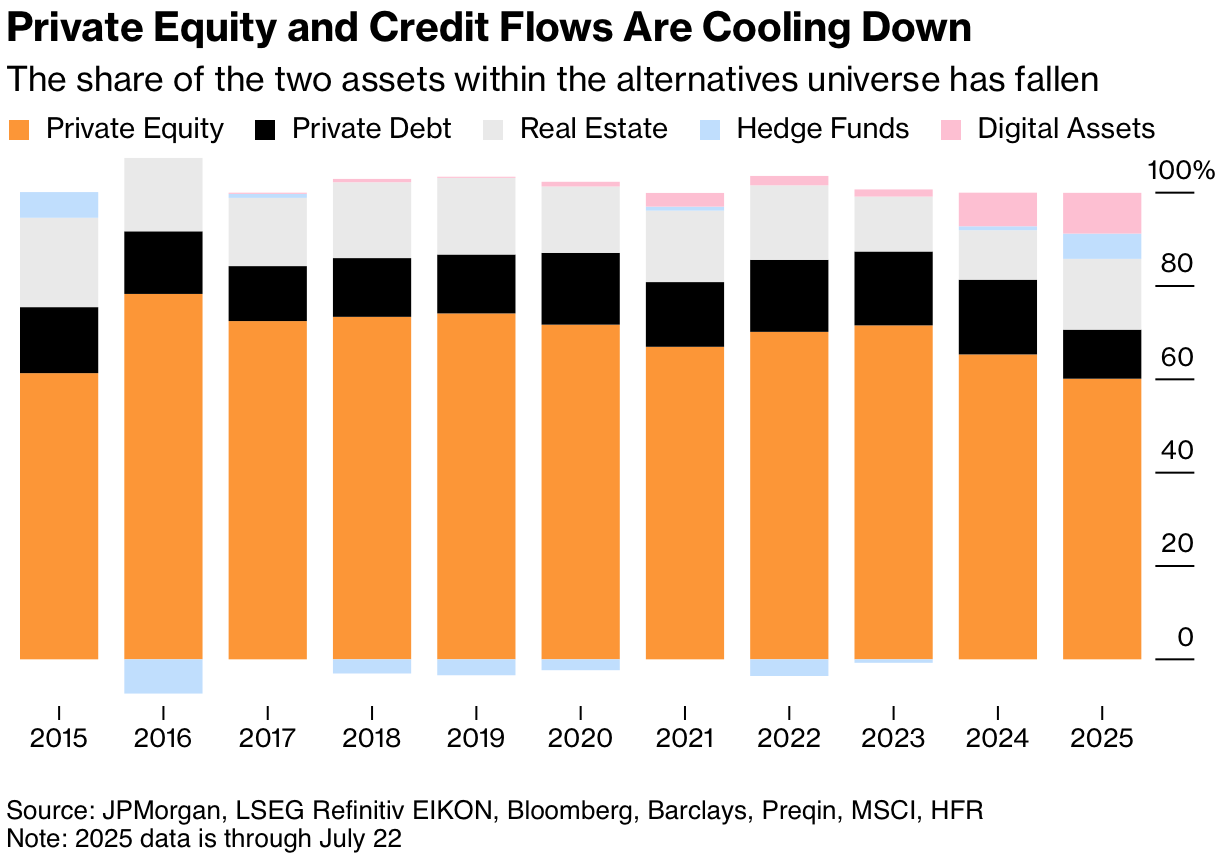
As Fundraising For Private Asset Funds Has Dried Up, The Push To Access Americans’ 401(k) Assets Has Accelerated. According to Bloomberg, “Fundraising for private equity and credit — once Wall Street’s most reliable cash magnets — is slowing, while hedge funds and crypto strategies are gaining momentum in the world of alternative investments. For years, private markets of all stripes absorbed vast sums of cash, with funds closing in record time and little debate over where the next dollar would go. That grip has loosened over the past year — small wonder, then, that industry executives are pressing for 401(k) access, a campaign that could eventually draw billions from US retirement savings.” [Bloomberg, 2025-08-04]
As Private Asset Managers Have Struggled To Return Assets To Investors, Investors Have Been Reticent To Give Them More. According to Bloomberg, “To Panigirtzoglou, this is a ‘circle that appears to be bottlenecked’ amid lower distributions, a slower pace of initial public offerings and capital calls exceeding distributions. Fundraising for private credit has also seen a slowdown this year to $70 billion in the period through July 22 accounting for just a tenth of the alternative asset inflows, according to JPMorgan, the smallest share since at least 2015. Panigirtzoglou attributes this trend to competition from public credit, given appetite for leveraged loans and banks making riskier loans. To be sure, capital is still being committed, but until distributions start to flow again, hedge funds and even crypto have become the places where money can move — not necessarily with less risk, but with fewer handcuffs.” [Bloomberg, 2025-08-04]
Crypto
Trump’s SEC Chair Gave A Speech Emphasizing His Goal To Have Crypto Products Play A Larger Role In Companies’ Capital Formation. Outside Of The Structure Of A Security. According to Paul Atkins, “In line with the PWG Report, a key priority of mine will be to establish—as swiftly as we can—a regulatory framework for distributions of crypto assets in America. Capital formation is at the heart of the SEC’s mission, yet for too long the SEC ignored market demands for choice and disincentivized crypto-based capital raising.[12] As a result, crypto markets pivoted away from offering crypto assets and deprived investors of the opportunity to use this technology to contribute to productive economic enterprises. The SEC’s head-in-the-sand posture—as well as its shoot first, ask questions later approach—are days of the past.” [Paul Atkins, 2025-07-31]