August 2025: Consumer Sentiment Fell As Concerns About Inflation And High Prices Drove Down Buying Conditions And Personal Finances. According to the University of Michigan Survey of Consumers, “Consumer sentiment fell back about 5% in August, declining for the first time in four months. This deterioration largely stems from rising worries about inflation. Buying conditions for durables plunged 14%, its lowest reading in a year, on the basis of high prices. Current personal finances declined modestly amid growing concerns about purchasing power.” [University of Michigan Survey of Consumers, 2025-08-15]
Code
include("../scripts/oxocarbon-plot.jl")theme(:oxocarbon)usingFredData, DataFrames, Dateskey=ENV["FRED_API_KEY"]f=Fred(key)empire_current=get_data(f, "PPCISA156MSFRBNY"; observation_start="2023-07-01", observation_end="2025-07-02", ).dataempire_future=get_data(f, "PPFISA156MSFRBNY"; observation_start="2023-07-01", observation_end="2025-07-02", ).data# Make the Plotplot(empire_current.date, empire_current.value; linewidth=2, xlabel="Month", ylabel="Percent of Firms", label="Reporting Higher Prices", title="A Majority of Firms Seeing Higher Prices")plot!(empire_future.date, empire_future.value; linewidth=2, label="Expecting Higher Prices",)
WSJ Headline: Nobody’s Buying Homes, Nobody’s Switching Jobs–And America’s Mobility Is Stalling. [Wall Street Journal, 2025-08-14]
Higher Prices
July 2025: Airfares Rose 4 Percent From June. According to the Wall Street Journal, “Airfares rose 4% on average in July from the prior month, according to seasonally adjusted federal data, the first such increase since January. Fares in July were also higher than the same month a year earlier.” [Wall Street Journal, 2025-08-15]
Department Of Agriculture: Beef Supply Expected To Decline To Lowest Level Since 2019. According to Bloomberg, “American beef lovers may face even leaner plates and higher prices next year as US production shrinks to a decade low and tariffs limit imports, according to a US government projection. Total beef supply in the US is expected to drop 2.5% in 2026 to 31.1 billion pounds — the lowest since 2019 — the US Department of Agriculture said in a monthly report. The decline threatens to push record beef prices even higher, with tariffs limiting importers’ ability to soften the blow. US beef supplies have been constrained by a shrinking herd. For years, ranchers have been culling cows due to a combination of persistent drought and high costs, reducing the domestic inventory to its lowest level in several decades.” [Bloomberg, 2025-08-12]
The Trump Administration’s Tariffs On The World’s Largest Beef Exporter Could Add To Price Pressures. According to Bloomberg, “Meanwhile, the Trump administration has slapped hefty tariffs on shipments from Brazil, making supplies from the world’s largest beef exporter more costly. US beef production is expected to fall 1.8% to 25.5 billion pounds next year, the lowest since 2016, while imports are projected to decline 6.1% to 4.95 billion pounds, according to the USDA. Both forecasts were revised lower from last month.” [Bloomberg, 2025-08-12]
Trump’s Aluminum Tariffs Have Contributed To American Companies Paying Almost 60 Percent More For The Metal Than The Global Standard Price. According to the Wall Street Journal, “The import tax has lifted U.S. aluminum prices to a record relative to the global price set in London’s trading pits. The benchmark Midwest premium has about tripled this year, reaching 72 cents a pound in August, according to S&P Global Commodity Insights. U.S. buyers pay that on top of the London Metal Exchange price, which was recently $1.18 a pound.” [Wall Street Journal, 2025-08-11]
Worse Data
AEI Senior Fellow: “EJ Antoni Is Really The Opposite” Of What Trump Needed At BLS, “Even The People WHo May Be SOmewhat Sympathetic To His Econoic Policy Views Dont’t Think He’s Qualified.” According to the Financial Times, “Donald Trump’s sacking of the Bureau of Labor Statistics” boss after a grim jobs report this month sparked investor fears that he was politicising the world’s most closely watched economic data. Trump’s pick to lead the BLS, EJ Antoni, a fierce loyalist and cheerleader for the president’s tariffs and economic strategy, has only deepened the anxiety. ‘The hope was that he would pick someone . . . who people would have trust in and could lead the BLS in an appropriate way, with relevant experience and, ideally, not hyper-partisan,’ said Stan Veuger, senior fellow at the right-leaning American Enterprise Institute think-tank. ‘EJ Antoni is really the opposite of that.’ ‘Even the people who may be somewhat sympathetic to his economic policy views don’t think he’s qualified,’ added Veuger.” [Financial Times, 2025-08-12]
Debt Problems
July 2025: Despite Trump’s Tariffs Leading To A 273 Percent Year Over Year Increase In Monthly Tariff Revenue, The Monthly Deficit Increased 10 Percent Year Over Year. According to Bloomberg, “US tariff revenue reached a fresh monthly record in July, though the increase wasn’t enough to prevent a widening in the monthly budget deficit — pointing to the federal government’s continuing fiscal challenges. Customs duties climbed to $28 billion last month, marking a 273% surge over July last year, a Treasury Department release showed on Tuesday. At the same time, the monthly budget deficit came in at $291 billion, or 10% more than the same month a year before, after accounting for calendar differences.” [Bloomberg, 2025-08-12]
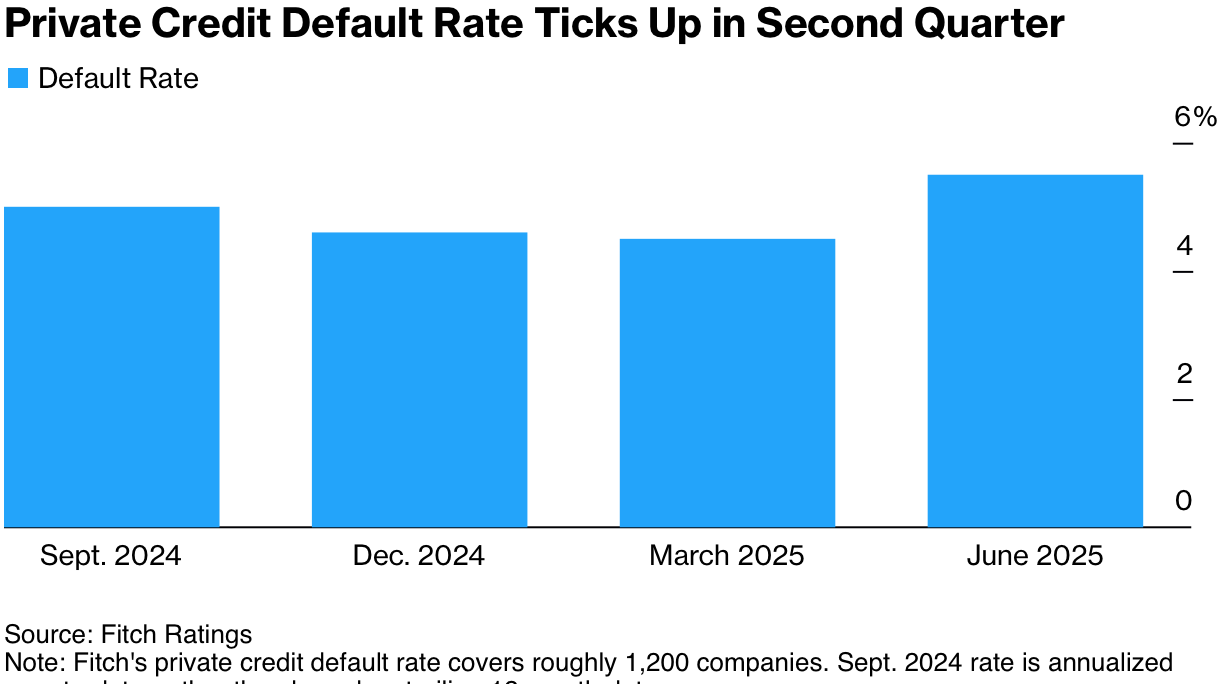
Q2 2025: Private Credit Defaults Rose Dramatically. According to Bloomberg, “Private credit defaults in the second quarter rose to 5.5% from 4.5% the prior period, according to a report from Fitch Ratings, which analyzes about 1,200 corporate private credit borrowers, Rene Ismail and Bella Farr write. For a subset of 300 companies that sit within Fitch’s privately monitored portfolio, the default rate jumped to 9.5% in the second quarter from 7.8%. That’s the highest level since 2019, when Fitch noted the first default within the portfolio. Eight of those 300 companies reported new defaults in the second quarter. Four were caused by maturity extensions for financially troubled companies. ‘Smaller, private issuers remain particularly vulnerable to economic swings, GDP slowdowns, and persistent elevated interest rates, especially given their floating-rate structures,’ Lyle Margolis, Fitch’s head of private credit for corporates, said in the report.” [Bloomberg, 2025-08-12]
Trade War
WSJ Editorial Board: American Companies Have Borne The Costs Of Trump’s Tariffs, Making Investment Harder. According to the Wall Street Journal Editorial Board, “President Trump knows the public is skeptical about his tariffs, which is why Administration officials are anxious to convince voters someone somewhere else in the world will pay for them instead of American households. Inflation data released Thursday tell a different story. The producer-price index (PPI) in July rose 0.9% in the month and 3.3% over the last year. Consumer-price data released Tuesday (0.2% monthly and 2.7% for the last 12 months) implied households weren’t experiencing tariff-induced price increases, except in some services such as medical care. The PPI numbers tell us this is partly because companies are paying higher prices but haven’t passed them on to customers—yet. The producer-price data get worse the closer you look. Goods and services both experienced substantial inflation, of 0.7% and 1.1% month-on-month respectively. Goods and services related to business investment in particular are becoming pricier, with the cost of manufacturing equipment rising 0.4% in one month and related services 4.5%. Prices for intermediate goods—components and raw materials—are also on the rise. Prices for materials used in durable-goods manufacturing increased 1.3% in a single month, and components for manufacturing increased 0.4% in the month. This hasn’t shown up in consumer prices so far because many companies entered the Trump tariff era with large cash reserves or wider margins, so they can absorb these costs for the time being. But these companies can’t do this forever. Meanwhile, cash lost to paying tariffs or paying tariff-induced higher prices isn’t available for reinvestment in the business, or to return to shareholders.” [Wall Street Journal Editorial Board, 2025-08-14]
Strengthening American Power
August 2025: India And China Begun Restoring Economic Links After Trump Imposed New Tariffs On Indian Exports. According to Bloomberg, “India and China are restoring economic links strained by a deadly 2020 border clash, the latest sign Prime Minister Narendra Modi is drawing closer to the BRICS countries after US President Donald Trump hit the South Asian nation with a 50% tariff. Modi’s latest move is to resume direct flights with China as soon as next month, said people familiar with the negotiations who asked for anonymity to discuss private matters. The deal could be formally announced when Modi is expected to head to China for the first time in seven years and meet leader Xi Jinping at the Shanghai Cooperation Organisation held in Tianjin from Aug. 31, the people said. Flights were suspended during the Covid-19 pandemic, which coincided with a sharp decline in relations between the nuclear-armed neighbors after border clashes in the Himalayas killed 20 Indian soldiers and an unknown number of Chinese troops. Modi’s economic calculus was fundamentally altered this month when Trump doubled tariffs on Indian goods to 50% as a penalty for its purchases of Russian oil. The US president’s remarks that India’s economy was ‘dead’ and its tariff barriers ‘obnoxious’ further strained relations. The blow from India’s largest trading partner hit hard, especially after Modi had lavished praise on Trump and was among the first foreign leaders to visit after his return to the White House.” [Bloomberg, 2025-08-13]
Corruption
Private Equity Bailout
Trump’s CEA Published A Claim Of Economic Benefits From Putting Retirement Assets Into 401(k)s, Cherrypicking Data That Ended In 2014. According to Axios, “It’s been a week since President Trump issued an executive order to encourage 401(k) investment in private equity, and the biggest surprise so far is how quickly the rest of his administration has activated. Why it matters: There will be a steep learning curve for all participants, but it can’t really begin until the White House does its foundational work. Driving the news: The Labor Department on Tuesday rescinded a Biden-era statement that cautioned retirement plan fiduciaries against including private equity in 401(k) plans. According to DOL, that statement ‘had a chilling effect on the market and took a dismissive view of alternative assets and the capabilities of plan fiduciaries.’ But wait, there’s more: Also on Tuesday, the Council of Economic Advisors published a 31-slide presentation on the implications of 401(k) plans including alt asset options. Not surprisingly, it finds there to be ‘significant benefits.’ Not only for retail investors and PE fund managers, but also for the broader economy. Per the report: ‘We estimate that a full loosening of the cap would lead retirement plans to allocate around 20% of their portfolio to private equity, which translates into an extra $35 billion in aggregate output, or around 0.12% of GDP.’ One big caveat is that much of the CEA’s underlying data is based on PE funds with vintages running through 2014, which may not fully capture the more recent DPI disappearance.” [Axios, 2025-08-15]