August 2024: Trump Promised Electricity Prices Would Fall By Half Within 12 Months Of His Inaguration. According to the Kleinman Center for Energy Policy, “At a campaign rally in August 2024, then-candidate President Donald Trump promised that ‘under my administration, we will be slashing energy and electricity prices by half within 12 months.’” [Kleinman Center for Energy Policy, 2025-08-11]
┌ Warning: Metadata 'notes' not returned from server.
└ @ FredData ~/.julia/packages/FredData/5M7x4/src/get_data.jl:77┌ Warning: Metadata 'notes' not returned from server.
└ @ FredData ~/.julia/packages/FredData/5M7x4/src/get_data.jl:77
Social Security on the Brink
August 2025: Despite Trump’s Claims That He Made Social Security “More Resilient Than Ever,” His Policies Have Accelerated The Program Running Out Of Money. According to the Washington Post, “President Donald Trump marked the 90th anniversary of Social Security on Thursday with an Oval Office signing of a proclamation that the safety net was ‘more resilient than ever before,’ thanks to him. He claimed improvements to the program’s customer service. He also misleadingly declared that he had checked off his campaign promise to eliminate taxes on benefits for seniors. But Social Security is barreling toward insolvency faster than before because of Trump’s tax bill and immigration policies, according to experts. The agency has faced tumult since the U.S. DOGE Service came in with a grand scheme to root out fraud and overhaul the program, causing disruptions and frustrations within the agency.” [Washington Post, 2025-08-14]
In Addition To Social Security’s Chief Actuary Saying Trump’s BBB Would “Hasten Social Security’s Insolvency Date,” His Immigration Crackdown Has Reduced Payments Into The Program. According to the Washington Post, “The trust fund will be insolvent by 2033, the program’s trustees said in June, if Congress doesn’t act. And after the passage of Trump’s One Big Beautiful Bill, the chief actuary said the law could hasten Social Security’s insolvency date. In addition, experts have warned that Trump’s efforts to deport undocumented immigrants — who pay into the system but are barred from receiving benefits — will further deplete the program. Penn Wharton’s budget model has projected that if the government deports 10 percent of undocumented immigrants annually over the next 10 years, Social Security will lose $133 billion in funds over that period of time.” [Washington Post, 2025-08-14]
Upward Redistribution
CBO: Trump’s BBB Would See The Bottom Decile Of Earners Lose $1,200 A Year, While The Top Decile Would Gain $13,600. According to the Associated Press, “President Donald Trump”stax and spending law will result in less income for the poorest Americans while sending money to the richest, the nonpartisan Congressional Budget Office reported Monday. The CBO estimates that the 10% of poorest Americans will lose roughly $1,200 a year as they experience restrictions on government programs like Medicaid and food assistance, while the richest 10% of Americans will see their income increase by $13,600 from tax cuts.” [Associated Press, 2025-08-11]
August 2025: Trump Revoked A Biden Executive Order Promoting Competition “In Sectors From Agriculture To Drugs.” According to Reuters, “U.S. President Donald Trump on Wednesday revoked a 2021 executive order on promoting competition in the U.S. economy issued by his predecessor Joe Biden, the White House said. The move by Republican Trump further unwinds a signature initiative by Biden, a Democrat, to crack down on anti-competitive practices in sectors from agriculture to drugs and labor.” [Reuters, 2025-08-13]
Weaker Demand
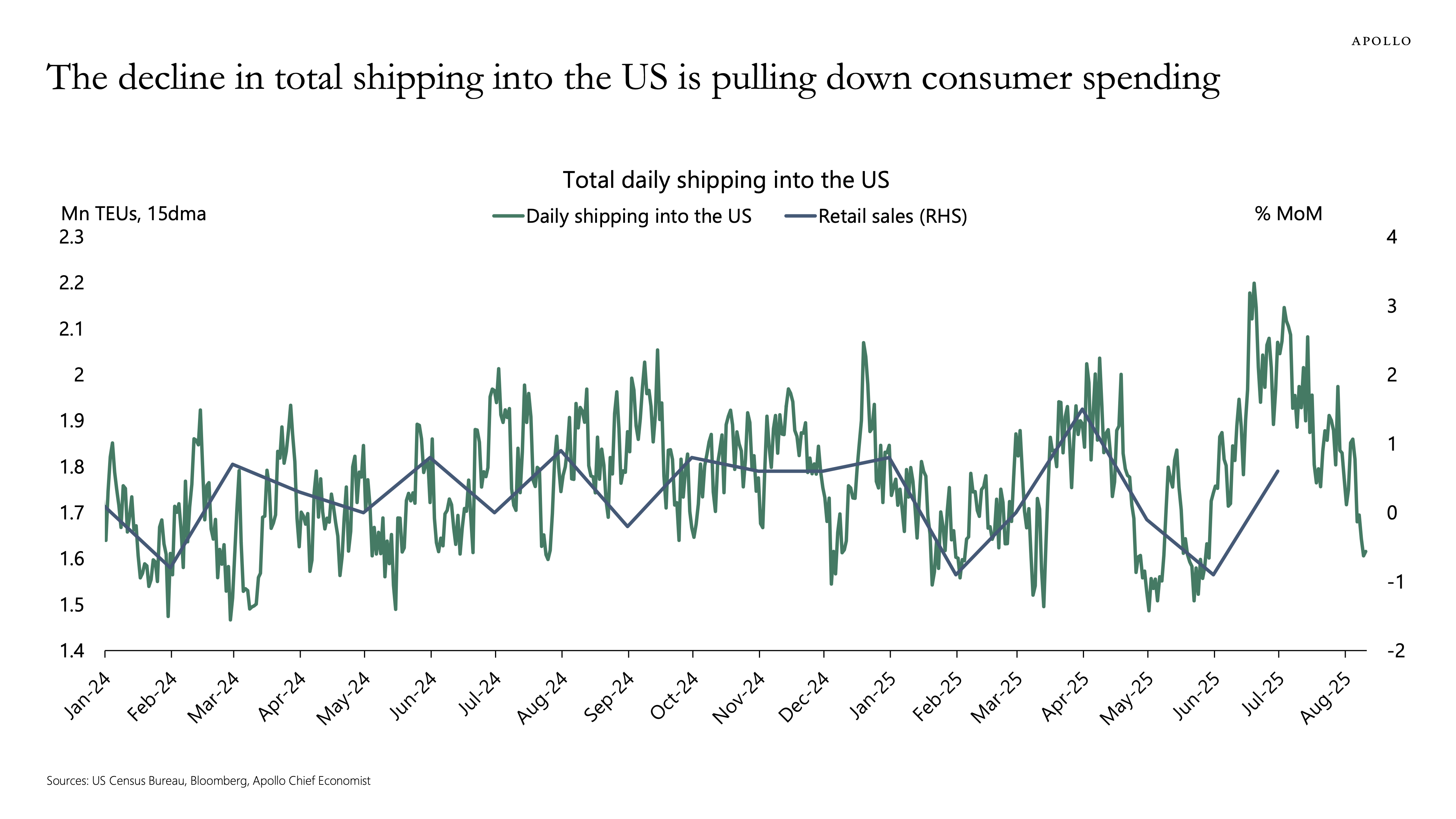
Q2 2025: Box Shipments Fell To Their Lowest Level Since 2015. According to Bloomberg, “US box shipments—that is, volumes of empty packaging materials sold to retailers, which in turn use them to ship orders to warehouses, storefronts and Americans” doorsteps—fell to the lowest second-quarter reading since 2015, according to data from Fibre Box Association, a trade group. (Corrugated cardboard also goes into other items, such as 3D advertising displays, but since the vast majority is used for packaging, the industry tends to use ‘box shipments’ and ‘corrugated cardboard shipments’ interchangeably.)” [Bloomberg, 2025-08-14]
Major Box Makers Reported Falls In Sales Of Around 4 Percent. According to Bloomberg, “Memphis-based International Paper Co., one of the world’s largest pulp and paper companies, reported a 5% drop in daily US box shipments in the quarter from the same period a year ago, while packaging giant Smurfit Westrock Plc, based in Dublin, saw a 4.5% slide in North American corrugated cardboard volumes, the biggest drop across all of the regions it operates. ‘If volume picked up in the United States, that would give us more confidence, but we haven’t seen that yet,’ Chief Executive Officer Anthony Smurfit said on a recent earnings call.” [Bloomberg, 2025-08-14]
August 2025: Trump Floated Semiconductor Tariffs At Multiples Of 100 Percent. According to Bloomberg, “The president has repeatedly promised that levies on chips and pharmaceuticals are coming within weeks, but no formal announcements have yet been made. Both sectors have been under Commerce Department investigation since April, a prerequisite for Trump to impose tariffs on national security grounds. That process can prove complicated and probes can take months or longer to resolve. Manufacturers and artificial intelligence firms have been eager for more clarity about his plans for semiconductor rates, since chips are included in a wide range of modern consumer products. Last week, Trump said during an event with Apple Inc. Chief Executive Officer Tim Cook that he planned a 100% tariff on semiconductors, while exempting products from companies that are moving manufacturing to the US. The White House hasn’t offered a subsequent explanation for how that exemption would work, but Trump implied that Apple — which has pledged a $600 billion domestic manufacturing initiative — could be exempt. On Friday, Trump suggested the charge on imported semiconductors could be even higher. ‘I”m going to have a rate that is going to be 200%, 300%?’ Trump said.” [Bloomberg, 2025-08-15]
Corruption
Tariffs
Former CBO Chief Economist: Tariffs Encourage Lobbying. According to the Washington Post, “‘Where you have tariffs, you likely have exceptions. Where you have exceptions, you have lobbyists trying to get them,’ said Wendy Edelberg, former chief economist at the Congressional Budget Office. ‘That can be quite profitable for the politician on the other side of the table. So you have a steady stream of people coming in and wanting exceptions and being willing to give something in return.’” [Washington Post, 2025-08-12]
State Capitalism
Trump Has Broached An Unprecedented Level Of Goverment Interfearance In Private Enterprise. According to Bloomberg, “If a deal is reached, it would be part of a growing pattern. The administration secured an agreement to receive a 15% cut of certain semiconductor sales to China and took a so-called golden share in United States Steel Corp. as part of a deal to clear its sale to a Japanese rival.” [Bloomberg, 2025-08-15]
August 2025: Bloomberg Reported The Trump Administration Was Looking At Taking A Stake In Intel. According to Bloomberg, “The Trump administration is considering using funds from the US Chips Act to take a stake in Intel Corp., according to people familiar with the discussions, part of efforts to rescue the embattled chipmaker and shore up domestic semiconductor manufacturing. The government’s talks focus on using Chips Act funding to at least partially finance an equity stake in Intel, the people said, while emphasizing that discussions are in early stages and other options could be under consideration. It’s unclear if the approach would involve converting some or all of Intel’s existing Chips Act grants into equity, allocating new funding from a broader pool or combining Chips Act money with other financing streams.” [Bloomberg, 2025-08-15]
Unintended Consequences
After Trump’s Allies Successfully Pushed For The Near-Destruction Of The CFPB, Crypto And FinTech Firms Have Been Pushing For A Reversal After The Big Banks Took Advantage. According to Bits about Money, “The Consumer Financial Protection Bureau finalized its rule for Section 1033 in late 2024. As you can tell by the lag between 2010 (when the Dodd-Frank Act was passed) and 2024, it was something of an involved process. Relevantly, the CFPB which passed this rule was the Biden administration CFPB. I try to be non-partisan in professional spaces but will need to neutrally observe how partisan players have seen the CFPB. […] As I mentioned last December in discussing the debanking discourse, influential supporters of the second Trump campaign, including fintech and crypto investors, wanted the CFPB’s scalp. They essentially got what they wanted. The CFPB was hollowed out early in the new administration. In a swift and ironic turn of events, a policy promoted by the crypto industry due to their frustration with the decisions of large banks (regarding their industry’s supportability) was quickly used by large banks for commercial advantage, catching the crypto industry in the crossfire. Prior to the election, the Bank Policy Institute, a banking industry trade group, and the Kentucky Bankers Association sued to prevent the CFPB’s rulemaking from taking effect. I think an informed person would understand that their legal arguments are pretextural. Their policy arguments, against the normative intent of Open Banking, I’ll return to below. The CFPB initially defended the suit vigorously, but the newly hollowed out CFPB in June announced its intention to surrender. This has caused a bit of chaos in Washington, as Section 1033 is administered by the CFPB but is part of the financial regulatory apparatus that crypto companies actually like. Exchanges largely monetize by charging a vig on crypto purchases, and the so-called ‘onramp’ (transfering money from the traditional financial system to the crypto ecosystem) enables the rest of their revenue (such as e.g. receiving a cut of interest earned by stablecoin issuers or staking the coins owned by customers). Exchanges want to accomplish the onramp at the lowest possible cost, which is through ACH debits. Their desired outcome is the new user uses an aggregator to authorize a debit from their bank account. Then, the debit is very close to free, both for the first transaction and also for subsequent transactions using the same banking details. (The exchange bears a bit of credit risk, since the debit is not known to settle successfully until about two business days later and it can be reversed long after that if it was fraudulent. These issues cost Coinbase about $20 million last quarter. It dries its tears on money.) […] Politics legendarily creates strange bedfellows. Crypto companies are now asking the CFPB to revive a regulation protecting a business the first Trump administration kneecapped, after which the second Trump administration hollowed out that same agency, despite campaigning against kneecapping tech and crypto—leaving the CFPB, long a sworn enemy of big banks, in Chase’s corner dismantling the crypto industry and suppressing competing payment methods, because the administration apparently thinks that’s what its backers want.” [Bits about Money, 2025-08-13]
 [Apollo,
Social Security on the Brink
August 2025: Despite Trump’s Claims That He Made Social Security “More Resilient Than Ever,” His Policies Have Accelerated The Program Running Out Of Money. According to the Washington Post, “President Donald Trump marked the 90th anniversary of Social Security on Thursday with an Oval Office signing of a proclamation that the safety net was ‘more resilient than ever before,’ thanks to him. He claimed improvements to the program’s customer service. He also misleadingly declared that he had checked off his campaign promise to eliminate taxes on benefits for seniors. But Social Security is barreling toward insolvency faster than before because of Trump’s tax bill and immigration policies, according to experts. The agency has faced tumult since the U.S. DOGE Service came in with a grand scheme to root out fraud and overhaul the program, causing disruptions and frustrations within the agency.” [Washington Post, 2025-08-14]