March 2025: For A Fourth Consecutive Month, The Conference Board’s Measure Of The Outlook For The U.S. Economy Fell, “Amid A Combination Of Souring Consumer Expectations, Falling Stock Markets, And Softening New Orders In Manufacturing.” According to Dow Jones Newswires, “The outlook for the U.S. economy weakened more than expected and for a fourth consecutive month in March, amid a combination of souring consumer expectations, falling stock markets and softening new orders in manufacturing. The Leading Economic Index, or LEI, published Monday by research group The Conference Board, fell 0.7%, to 100.5, in March, following an upwardly revised 0.2% decline in February. Economists polled by The Wall Street Journal had expected a 0.5% decline for March.” [Dow Jones Newswires, 2025-04-21]
March 2025: The Decline In The LEI Was Larger Than Forecast. According to Dow Jones Newswires, “The outlook for the U.S. economy weakened more than expected and for a fourth consecutive month in March, amid a combination of souring consumer expectations, falling stock markets and softening new orders in manufacturing. The Leading Economic Index, or LEI, published Monday by research group The Conference Board, fell 0.7%, to 100.5, in March, following an upwardly revised 0.2% decline in February. Economists polled by The Wall Street Journal had expected a 0.5% decline for March.” [Dow Jones Newswires, 2025-04-21]
April 2025: The Conference Board Lowered Its Forecast For Output Growth In 2025, To A Rate “Below The Economy’s Potential.” According to Dow Jones Newswires, “The Conference Board revised its forecast for 2025 U.S. gross domestic product to 1.6%, down from 2% forecast last month, she said, adding that the new prevision is”somewhat below the economy’s potential.”” [Dow Jones Newswires, 2025-04-21]
Capital Flight
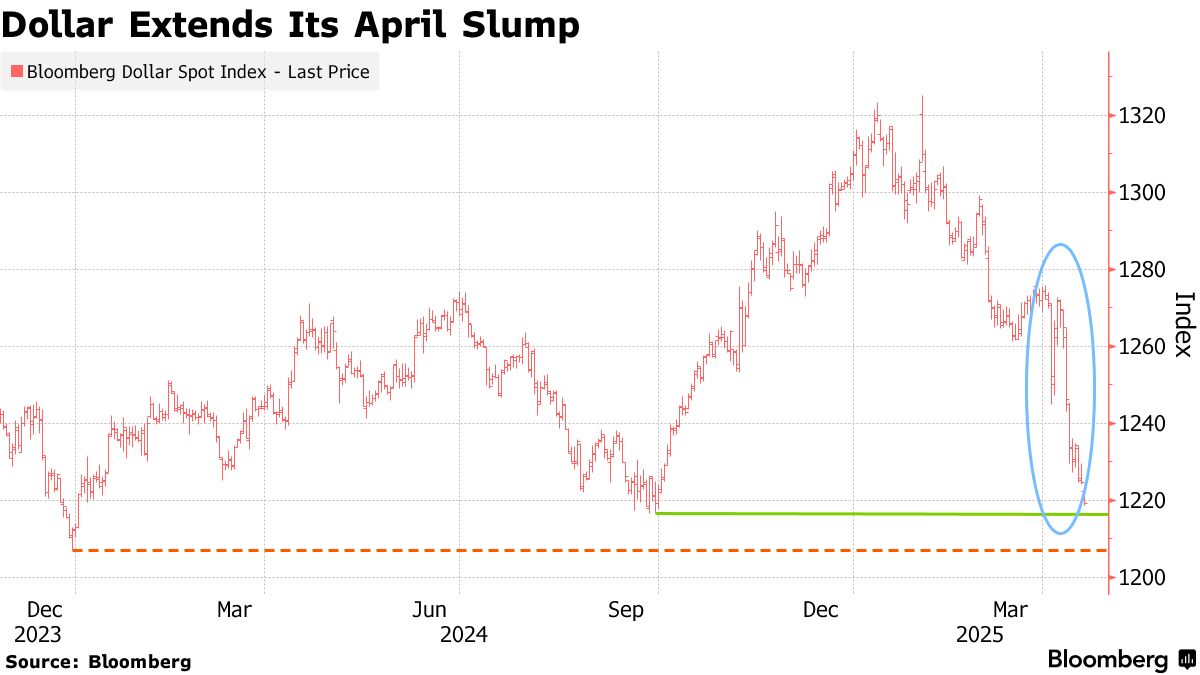
April 2025: Trump’s Threats To Impose On The Independence Of The Federal Reserve Drove The Dollar To A 15-Month Low. According to Bloomberg, “US stock futures and the dollar weakened sharply as traders reacted to the possibility that President Donald Trump will try to remove Federal Reserve Chairman Jerome Powell. S&P 500 futures sank 1.3% and the dollar index weakened to a 15-month low with Wall Street set to re-open after the Easter break. Treasuries fell, pushing the 10-year yield close to 4.4%. Gold jumped above $3,390 an ounce. Oil slumped 2%.” [Bloomberg, 2025-04-20]
Every Group Of Ten Currency Gained Against The Dollar. According to Bloomberg, “Every Group-of-10 currency gained against the greenback.” [Bloomberg, 2025-04-20]
Deutche Bank: Chinese Clients Reduced Some Of Their Treasury Holdings In Response To Trump’s Tariffs. According to Bloomberg, “Chinese clients have reduced some of their Treasuries holdings in favor of European debt as President Donald Trump’s tariff deluge fuels an exodus from US assets, according to Deutsche Bank AG. ‘We have observed some diversification away from US dollar in Chinese investors” portfolios,’ while their interest in other markets picked up, particularly in Europe, Lillian Tao, head of China macro and global emerging market sales, said in an interview. European high-quality bonds, Japanese government bonds and gold are likely to be the potential choices for investors as alternatives to Treasuries, she said, speaking of Chinese commercial clients” investments in overseas markets. Dollar-denominated assets have taken a beating in recent weeks, with their status as haven assets increasingly coming into question following Trump’s all-out assault on global trade.” [Bloomberg, 2025-04-21]
March 2025: Foreign Buyers Were A Smaller Share of Buyers At Treasury Auctions. According to the Wall Street Journal, “Bond market volatility and higher yields don’t necessarily have to reflect foreign selling of Treasuries but rather how capital inflows aren’t keeping pace with an expanding trade deficit. Foreign investors accounted for a smaller share of buyers at Treasury auctions in March, according to Bank of America.” [Wall Street Journal, 2025-04-20]
TS Lombard Economist Steven Blitz: “The Idea That You Can Break Trade, ANd Not Breka The Capital Flow Side, Is A Fantasy.” According to the Wall Street Journal, “Financial markets have flashed an ominous message this month about President Trump’s ambitious and improvisational bid to reshape global trade: Be careful what you wish for. Volatility in Treasury markets and unexpected weakness in the dollar suggest that what began as a trade conflict could morph into a more dangerous ‘capital war.’ The clash threatens to raise U.S. borrowing costs by undermining Washington’s long-standing financial primacy, which for years has drawn trillions of dollars of foreign funds into the country. ‘This idea that you can break trade, and not break the capital flow side, is a fantasy,’ said Steven Blitz, chief U.S. economist at GlobalData TS Lombard.” [Wall Street Journal, 2025-04-20]
AEI Economist Steven Kamin: “The Behavior Of Investors Changed.” As “The Trump Administration Appears To Be Hellbent On Diminishing The Dominance Of The Dollar.” According to the Wall Street Journal, “A brutal bond-market selloff unfolded, with 30-year yields notching their largest weekly increase since 1987 despite decent bond auctions. The selloff occurred against the backdrop of a weakening dollar, which normally strengthens during bouts of stress. The abnormal combination prompted some analysts to warn about the whiff of capital flight from the U.S. […] Bessent cautioned against rushing to judgment over one week’s worth of market moves and reaffirmed Washington’s long-standing support for a strong dollar. ‘We are still a global reserve currency,’ he said. ‘The dollar can go up and down.’ But other analysts, economists, and former government officials warned that strained trading conditions might also reflect more fundamental concerns. ‘The behavior of investors changed. Ordinarily they would”ve bought the dollar in this crisis time, and instead they sold the dollar,’ said Steven Kamin, a former senior Fed economist who is now at the American Enterprise Institute. ‘It suggests that maybe investors are getting “hinky” about the safety of Treasurys or the desirability of dollar assets.’ Trump administration officials have previously argued that consumers wouldn’t bear the cost of tariff hikes because the dollar would strengthen. A weaker dollar makes it more likely that U.S. importers and retailers will have to pass along price hikes. ‘The Trump administration appears to be hellbent on diminishing the dominance of the dollar. I don’t think it’s being done consciously,’ said Kamin.” [Wall Street Journal, 2025-04-20]
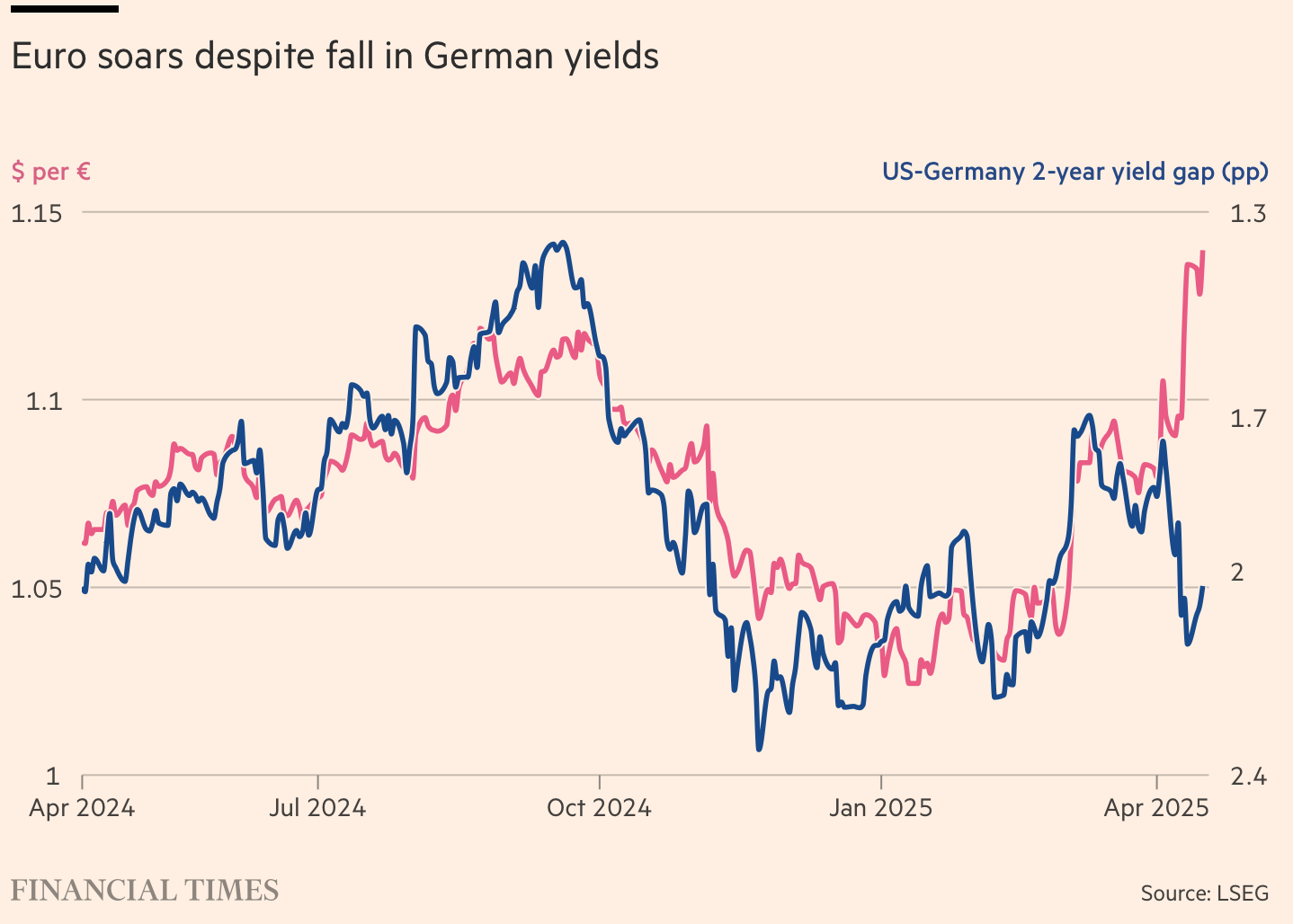
Breaking A Historical Correlation, The Euro Surged Against The Dollar Even As German Yields Fell Relative To American Ones, As “Currency Markets No Longer Care About Interest Rate Dynamics.” According to the Financial Times, “The simultaneous surge in the euro and German government bonds this month suggests a ‘capital flight’ to Eurozone’s benchmark debt as a haven from trade war turmoil, say investors. German bonds and the euro typically move in opposite directions, because optimism about the economy — which boosts the currency — hurts demand for the debt that is the euro bloc’s de facto safe asset. That pattern held after the country’s historic spending deal last month, which saw the euro surge and Bunds sell off. But this month the euro has jumped about 5 per cent against the dollar, even as a transatlantic gap in bond yields widened, increasing the additional rate provided by Treasuries. Two-year US borrowing costs are now about 2 percentage points above those of Germany, up from about 1.7 percentage points in early March. The usual correlation between euro and relative rates has ‘completely broken down in the past two weeks, as Bunds and the euro have both benefited from US policy-induced market concerns’, said Mike Riddell, a bond fund manager at Fidelity International. This was ‘symptomatic of capital flight’, he added. The simultaneous slump in US Treasuries and the dollar, which normally move in opposite directions, jangled nerves on Wall Street. But in Europe investors have been similarly struck by the surge in German Bund prices and the euro. ‘Currency markets no longer care about interest rate dynamics,’ said Benoit Anne, a strategist at MFS Investment Management, adding that a big relative rise in US market interest rates ‘traditionally would trigger a strongly bullish signal [for the dollar]’.” [Financial Times, 2025-04-19]
While The Stock Market Has Recovered Somewhat From The Peak Of The Selloff, Investors Have Preferred Safer Names. According to Bloomberg, “The stock market has clawed back from the depths of this month’s selloff, but a look under the hood shows traders are adding a healthy dose of safe haven to their positions. After an initial rush into the riskiest parts of the market unlocked by US President Donald Trump’s announcement of a 90-day pause on most tariffs, investors who piled into safer sectors have fared better. On days the broader market gained, a basket of defensive stocks tracked by Barclays Plc mostly outperformed the stocks of companies whose fortunes are closely tied to the ups and down of the economy. And on days when sentiment soured, a defensive corner of the market still beat cyclical names.” [Bloomberg, 2025-04-21]
Code
include("../scripts/oxocarbon-plot.jl")usingDates, DataFrames, YFinancetheme(:oxocarbon)staples =get_prices("^SP500-30"; interval="1d", startdt=Date(2024,11,5), enddt=Date(2025,4,18)) |> DataFramediscretionary =get_prices("^SP500-25"; interval="1d", startdt=Date(2024,11,5), enddt=Date(2025,4,18)) |> DataFrame# Build a combined dataframe of the two datasets with only the adjusted close prices and the datedf =DataFrame(; date =Date.(staples.timestamp), staples = staples.adjclose, discretionary = discretionary.adjclose )# Normalize both to 100 at election daydf.staples =100.0.* (df.staples ./ df.staples[1])df.discretionary =100.0.* (df.discretionary ./ df.discretionary[1])# Plot the series against each other plot(df.date, df.staples, label="Staples", title="Reversal of Investor Behavior", xlabel="Date", ylabel="Preformance since Election Day")plot!(df.date, df.discretionary, label="Discretionary")vline!([Date(2025,4,2)], label="Tariffs", linestyle=:dash)hline!([100], label="Flat", linestyle=:dash)
While consumer staples are up since election day, consumer discretionary stocks are far down. That is because, during an economic downturn, consumers will still need to buy food, but they will be able to push back on discretionary purchases.
Thrift Stores’ Prospects Have Surged
Code
tdup =get_prices("TDUP"; interval="1d", startdt=Date(2025,4,1), enddt=Date(2025,4,18)) |> DataFramesvv =get_prices("SVV"; interval="1d", startdt=Date(2025,4,1), enddt=Date(2025,4,18)) |> DataFramespx =get_prices("^GSPC"; interval="1d", startdt=Date(2025,4,1), enddt=Date(2025,4,18)) |> DataFramedf =DataFrame(; date =Date.(tdup.timestamp), tdup = tdup.adjclose, svv = svv.adjclose, spx = spx.adjclose, )# Normalize all to 100 at liberation day (the second day in the series)df.tdup =100.0.* (df.tdup ./ df.tdup[2])df.svv =100.0.* (df.svv ./ df.svv[2])df.spx =100.0.* (df.spx ./ df.spx[2])# Make the plot plot(df.date, df.tdup, label="ThredUp", title="Thrift Store Stocks", xlabel="Date", ylabel="Preformance since Liberation Day", legend=:topleft)plot!(df.date, df.svv, label="Savers Value Village")plot!(df.date, df.spx, label="S&P 500")hline!([100], label="Flat", linestyle=:dash)vline!([Date(2025,4,2)], label="Tariffs", linestyle=:dash)
National Association Of Resale Professionals Executive Director Adele Meyer: Resale “Always Flourishes During Any Kind Of Economic Downturn.” According to the Financial Times, “Analysts warned that costs for clothing and toys, in particular, could increase sharply in the coming months due to the US fashion and merchandise industry’s heavy reliance on imports from China. Resale, however, allows companies to ‘sidestep tariffs,’ said Simeon Siegel, a retail analyst at BMO Capital Markets. He added that the second-hand market, already popular among younger consumers, would be ‘doubly attractive’ in the event of a recession, as more prospective buyers begin to hunt for discounts. ‘If tariffs meaningfully affect the availability or price of certain goods like apparel, cars and electronics, we expect to see buyer activity spike in those categories,’ said Ken Murphy, chief innovation officer at OfferUp, a peer-to-peer online resale marketplace. Adele Meyer, executive director of NARTS: The Association of Resale Professionals, a trade group, said she was ‘cautiously optimistic’ that tariffs would boost the second-hand industry because resale ‘always flourishes during any kind of economic downturn’.” [Financial Times, 2025-04-20]
Surge In Currency Hedging
Amid The Uncertainty Caused By Trump’s Trade War, Multinational Companies Have Increased The Portion Of Their Foreign Earnings That They Hedge Against Currency Moves. According to the Financial Times, “The uncertainty around Trump’s tariffs has created more demand for FX hedging products to offset sudden fluctuations in exchange rates that are hitting businesses with global operations, according to banks and executives at multinational companies. Nathan Venkat Swami, head of Asia-Pacific FX trading at Citigroup, said demand for hedging products had accelerated since November, when Trump was elected, on the back of uncertainty over his administration’s trade policies. ‘February saw a slowdown in activity due to the lunar new year holidays across a lot of Asia, but we saw volumes pick up again in March, with strong activity from corporate hedgers,’ said Swami. Most multinationals hedge a portion of their earnings and raise or lower that level depending on the perceived risk of currency fluctuations. The heightened trade uncertainty has led companies to increase their hedging exposure. ‘As we became more risk-averse, we wanted to hedge more,’ said a senior executive at a European healthcare company that manufactures and exports medical equipment from Europe to Asia.” [Financial Times, 2025-04-17]
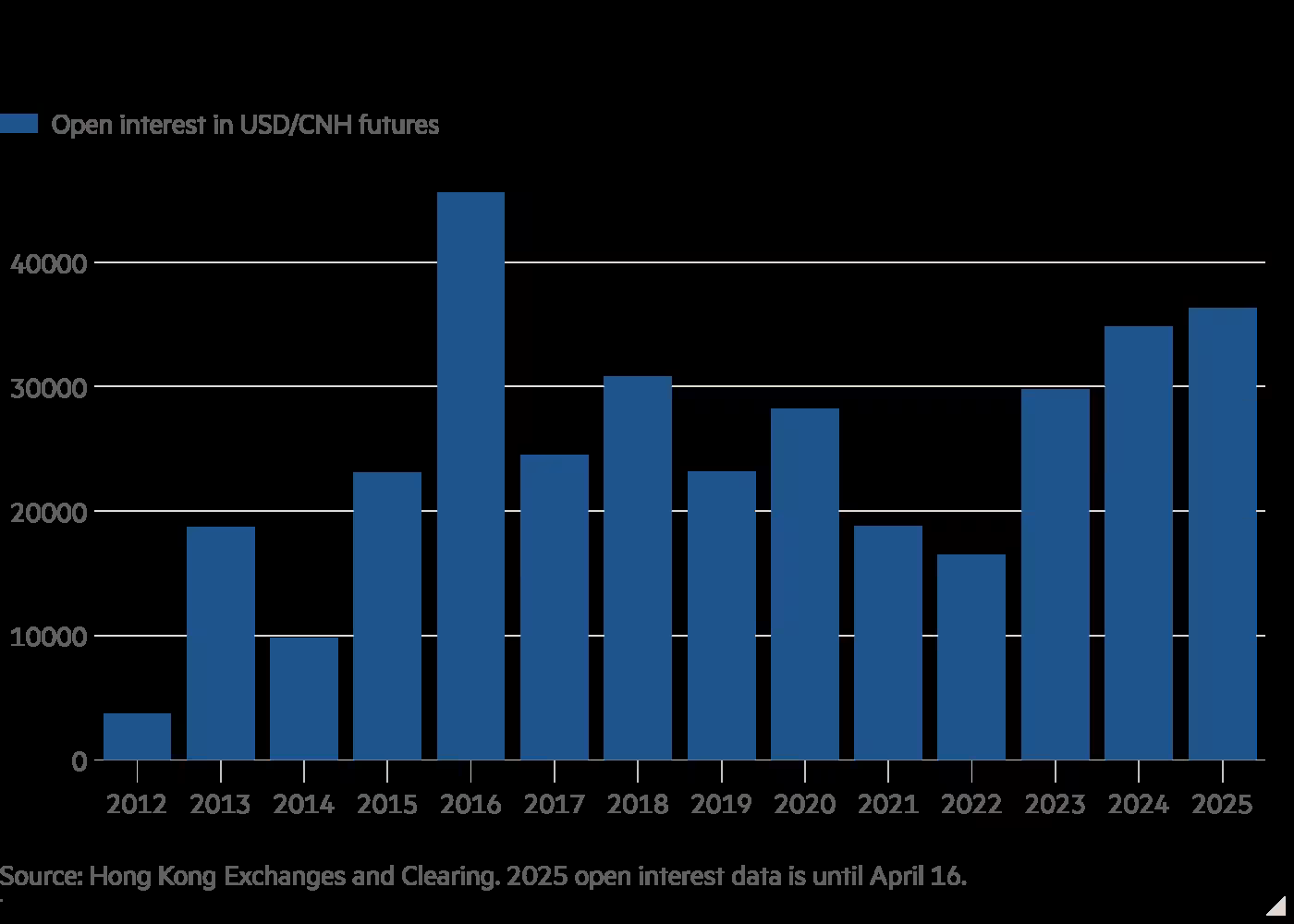
April 2025: Different Measures of Currency Hedging Activity Have Surged. According to the Financial Times, “In Hong Kong, open interest in renminbi futures — a measure of market activity — has risen to its highest levels since 2016, the year after a currency devaluation increased demand for hedging against the renminbi. On the Singapore stock exchange, FX futures volumes are on track to hit a record high this year. ‘Global investors are increasingly using SGX FX futures as effective and cost-efficient hedging instruments to manage heightened market and currency volatility,’ SGX said in a statement to the Financial Times.” [Financial Times, 2025-04-17]
Bill Dudley: Trump’s Attacks On Fed Independence Could Keep Rates Higher For Longer. According to Bill Dudley in Bloomberg Opinion, “Fourth, the need for patience is also higher given President Donald Trump’s attacks on the Fed’s independence. If Fed officials were to cut rates and this was interpreted as caving to the White House pressure, confidence in the Fed’s ability to contain inflation would diminish, pushing up inflation expectations. Because of this, Trump’s pressure on the Fed is counterproductive. Not only does it increase the motivation for the Fed to wait, but it also makes households and businesses more concerned about the inflation consequences should the Fed’s independence come to an end. A central bank under attack creates more uncertainty about the central bank’s motivations. If the Fed were to cut rates later this year, market participants might wonder whether that was warranted by changes in the economic outlook or undertaken under duress in response to pressure from the administration.” [Bill Dudley in Bloomberg Opinion, 2025-04-21]
While Thrift Stores Aren’t Subject To Tariffs Directly, A Downturn Could Weaken Their Supply, And Squeeze Their Demand. According to the Financial Times, “‘Resale is a rare industry that benefits from the administration’s global tariffs,’ said Alon Rotem, chief strategy officer at online consignment and thrift store ThredUp. ‘Everything we sell comes from the closets of Americans, so everything we sell is immune.’ […] But some analysts warned that second-hand sellers were not necessarily immune to a supply shock, even if their goods came from within the US. In a climate of increased uncertainty and rising fears of unemployment, consumers might decide to buy less in the first place, or opt to hold on to their existing items for longer, leaving resellers with a smaller pool — and potentially worse quality — of inventory. ‘You have to fill up these resale suppliers with items that people buy at regular stores,’ said Shawn Carter, an associate professor at the Fashion Institute of Technology. ‘That’s why the best environment for resale is also the best environment for regular sale.’” [Financial Times, 2025-04-20]
Context
On Friday, I noted that Europe cutting while the Fed keeps rates the same would be expected to attract capital here. While that has not been the case due to so much else, if the Fed cut as well, that could exacerbate the flow of capital out of the US.
Trade War
In Justifying His “Reciprocal” Tariffs, Trump Cited What He Called “Japan’s Bowling Ball Test.” According to truth social user @realDonaldTrump, “NON-TARIFF CHEATING: 1. Currency Manipulation 2. VATs which act as tariffs and export subsidies 3. Dumping Below Cost 4. Export Subsidies and Other Govt. Subsidies 5. Protective Agricultural Standards (e.g., no genetically engineered corn in EU) 6. Protective Technical Standards (Japan’s bowling ball test) 7. Counterfeiting, Piracy, and IP Theft (Over $1 trillion a year) 8. Transshipping to EVADE Tariffs!!!” [truth social user @realDonaldTrump, 2025-04-20]
2018: Trump’s Claims About A Bowling Ball Test For Japanese Imports Of American Cars Was Rated “False” By Politifact. [Politifact, 2018-03-15]
April 1 - April 20, 2025: South Korean Car Exports Fell 6.5 Percent From A Year Earlier, But Imports Plunged Even More. According to the Wall Street Journal, “The effects of President Trump’s new tariffs are starting to be felt across the world, preliminary South Korean trade data suggest, as Seoul prepares to begin negotiations with Washington. Exports from Asia’s fourth-largest economy fell 5.2% from a year earlier in the first 20 days of April, according to data from South Korea’s customs office released Monday ahead of full monthly trade figures due next week. Imports plunged 12%, leading to a trade deficit, the preliminary numbers showed.” [Wall Street Journal, 2025-04-21]
Retaliation
Q1 2025: U.S. Shipments Of Liquid Natural Gas To China Plunged 70 Percent, As The Country Moved To Replace U.S. Supply. According to Bloomberg, “China’s purchases of US liquefied natural gas plunged to zero in March after a sharp decline in the previous two months, as the trade war between the two biggest economies alters shipping routes. Overall delivery of US LNG shipments in the first quarter of 2025 fell by 70%, according to Chinese official custom data released on Sunday. The hiatus is the longest since the last trade war triggered during US President Trump’s first tenure, when China didn’t receive cargoes for about 400 days. The geopolitical conflict is once again decoupling the world’s largest LNG buyer and seller. An escalation in mutual tariffs has led China to impose a 125% tariff on all US goods, turning to Indonesia and Qatar for supplies.” [Bloomberg, 2025-04-21]
The Financial Sector: A Driver Of American Exports, Could Be A Target For Retaliation
Brad Sester, Senior Fellow At The CFR: “There Could Be A Chilling Effect” Among Foreign Businesses About Using American Banks, Especially As “Foreign Firms Don’t Generally Have To Use The Global Arms Of U.S. Banks.” According to the Wall Street Journal, “The longer a trade war goes on, though, the greater the threat to U.S. banks is likely to become. ‘Foreign firms don’t generally have to use the global arms of U.S. banks for high-fee transactions,’ said Brad Setser, senior fellow at the Council on Foreign Relations. Amid trade tensions and other cross-border spats, ‘there could be a chilling effect—in much the same way as Canadians are reconsidering whether they want to take a vacation in the U.S.’” [Wall Street Journal, 2025-04-21]
2024: The U.S. Had A $130 Billion Financial Services Trade Surplus, Which Was Still $10 Billion When Adjusting For Capital Flows. According to the Wall Street Journal, “America is the China of banking. While the U.S. may import more manufactured goods than it exports, it runs a large trade surplus in one notable business: financial services. The overall U.S. trade surplus for financial services in 2024 was about $130 billion, according to data from the U.S. Bureau of Economic Analysis. Some of that reflects quirks of global money flows, like U.S. firms managing offshore funds. But it also includes things such as trading commissions, underwriting and mergers-and-acquisitions advice. Categories including those services collectively represented a nearly $10 billion surplus last year. This plays out in practice in global league tables for advising on deals and fundraising. The rankings have tilted sharply toward American banks in the period since the 2008 financial crisis. Last year, U.S. banks occupied the top five spots for investment-banking revenue worldwide, and were seven of the top 10, according to Dealogic. So when it comes to a global trade war, U.S. megabanks could become collateral damage. Many of Europe’s champions retrenched over the past 15 years, while Chinese and Asian powerhouses have limited heft beyond their region. A long-lasting trade war could begin to change the playing field.” [Wall Street Journal, 2025-04-21]
On Top Of The Dealmaking Slowdown Caused By Trade Uncertainty, American Banks Have Warned Of The Danger Of A Declining National Reputation. According to the Wall Street Journal, “Already, U.S. banks have reported a slowdown in dealmaking activity, with clients on pause as they wait for clarity on trade policy. The risk is that they lose even the deals that are getting done to foreign rivals they previously bested. ‘We will be in the crosshairs. That’s what’s going to happen,’ JPMorgan Chase Chief Executive Jamie Dimon acknowledged on the bank’s first-quarter earnings call. ‘And it’s OK. We”re deeply embedded in these other countries, people like us,’ he added. ‘But I do think some clients or some countries will feel differently about American banks, and we”ll just have to deal with that.’” [Wall Street Journal, 2025-04-21]
Bill Dudley: Trump’s Trade War Will Slow U.S. Productivity Growth
Bill Dudley: Trump’s “Shift In Trade Policy Will Undermine Productivity Growth.” According to Bill Dudley in Bloomberg Opinion, “Second, the growth potential of the US has fallen abruptly and sharply. The shift in trade policy will undermine productivity growth. In the short run, productivity will be hurt by the rise in import prices, which will provoke US manufacturers to readjust their supply chains to find lower cost alternatives. In the longer run, productivity will be hurt because the tariffs will skew activity toward more production in protected markets, where the US has less comparative advantage, and away from exports to countries such as China that have enacted retaliatory tariffs.” [Bill Dudley in Bloomberg Opinion, 2025-04-21]
Weaker Negotiating Position
Former World Bank Policy Director For China Bert Hofman: Erratic U.S. Policymaking Has Made Putting Together An Anti-China Coaliation Harder. According to Bloomberg, “Beijing shouldn’t be too worried about the Trump administration putting together an anti-China coalition given ‘the US is hardly in a position to do so thanks to its erratic style of policymaking,’ said Bert Hofman, a former World Bank country director for the country. Still, Hofman said China does run big trade surpluses with certain nations and ‘the best way to resolve this tension is to boost domestic demand to reduce surpluses and coordinate with other countries to avoid knock-on tariffs in response to Trump’s tariff war.’” [Bloomberg, 2025-04-21]
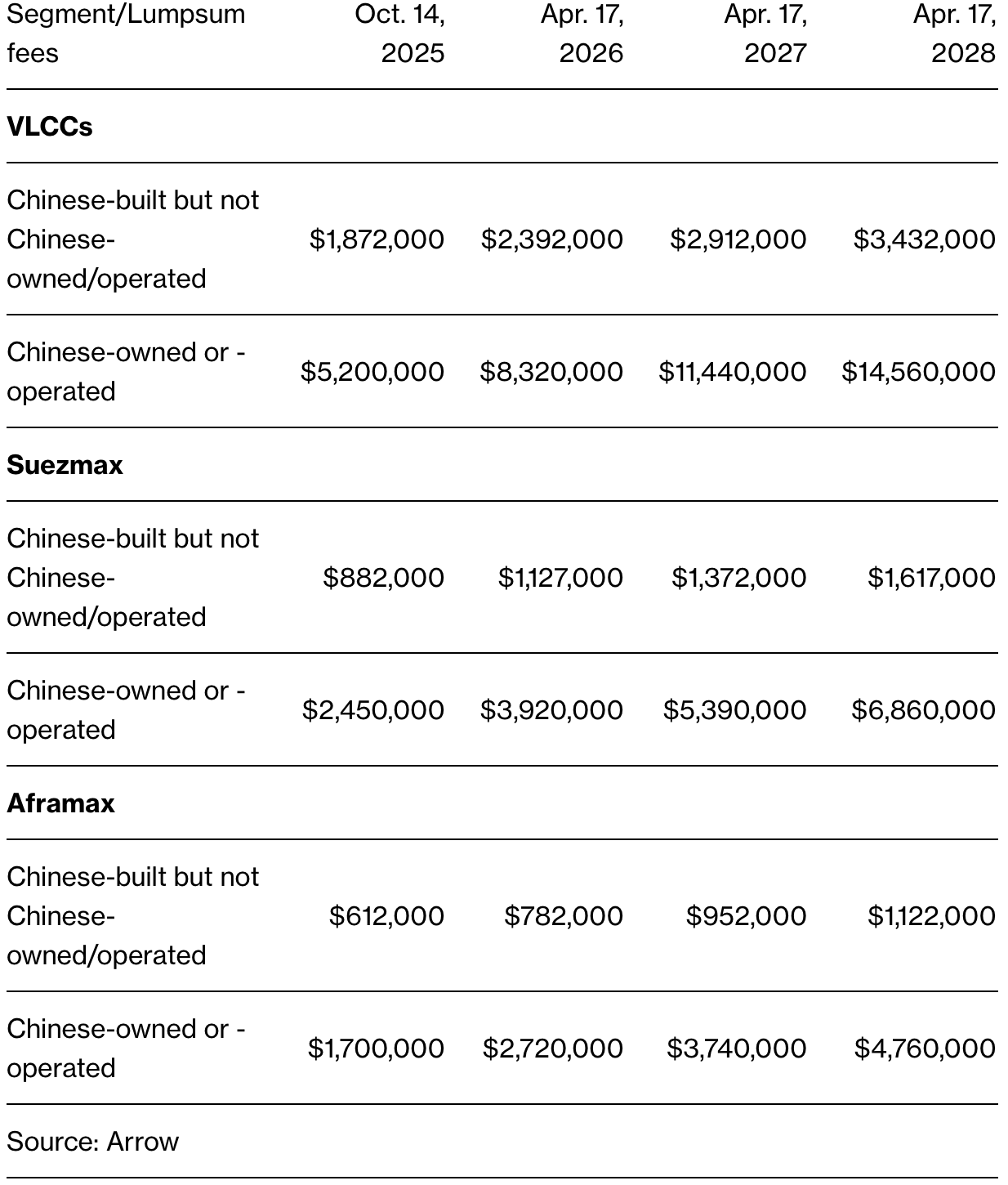
October 2025: Fees On Tankers Not Built In The United States Will Range From $1 per Barrel To $3 per Barrel
American Refineries Are Built For Heavier Crude Than Is Produced Domestically. According to the American Fuel and Petrochemical Manufacturers Association, “Many refineries need heavier crude oil to maximize flexibility of gasoline, diesel and jet fuel production. Today, most crude oil produced in the United States is light, including much of what’s produced in the Permian and Bakken. Light crudes are not good replacements for the heavy crude oil we get from Canada and Mexico. Re-tooling refineries to process solely U.S. crude oil (light crude) would cost billions — a risky investment that would take decades to permit, construct and eventually pay off. We lack the infrastructure (like pipelines) needed to cost effectively supply U.S crude oil and refined products to every region. Even if the economics of re-tooling our facilities worked, it can take close to a decade to permit and build pipelines in the United States.” [American Fuel and Petrochemical Manufacturers Association, accessed 2025-04-21]
Q1 2025: Insiders Who Publicly Backed Trump’s Policies Sold Hundreds Of Millions In Stock
January And February 2025: Entities Controlled By Mark Zuckerberg Sold More Than $700 Million In Shares. According to Bloomberg, “Zuckerberg sold 1.1 million shares worth $733 million in the first quarter through his Chan Zuckerberg Initiative and its related foundation, according to an analysis by the Washington Service, which tracks insider buying and selling. All of the sales were in January and February when Meta’s stock was still trading above $600, hitting a peak of more than $736 on Valentine’s Day. The social-media company’s share price has since slid by 32% amid the broader market selloff.” [Bloomberg, 2025-04-20]
January 2025: Zuckerberg Started Meta’s Earnings Call Praising The Trump Administration. According to CNBC, “Meta CEO Mark Zuckerberg praised the Trump administration for backing Silicon Valley on a call with investors, adding that 2025 will be big for ‘redefining’ the company’s relationships with governments. ‘We now have a U.S. administration that is proud of our leading companies, prioritizes American technology winning and that will defend our values and interests abroad,’ Zuckerberg said Wednesday. ‘I am optimistic about the progress and innovation that this can unlock, so this is going to be a big year.’” [CNBC, 2025-01-29]
February 2025: Jamie Dimon Sold More Than $200 Million In JP Morgan Shares. His First Such Sale In Almost A Year. According to Bloomberg, “Dimon sold shares worth more than $233 million on Feb. 20, two days after the bank’s stock hit a 2025 high. The sales were his first in almost a year, though he has continued to sell in the second quarter. On April 14, Dimon sold an additional 133,639 shares worth $31.5 million, bringing the total value of stock he’s disposed of this year to more than a quarter-billion dollars.” [Bloomberg, 2025-04-20]
January 2025: “Get Over It,” Jamie Dimon Dismissed Fears Of The Negative Effects Of Tariffs. According to CNBC, “JPMorgan Chase CEO Jamie Dimon said Wednesday that the looming tariffs that President Donald Trump is expected to slap on U.S. trading partners could be viewed positively. Despite fears that the duties could spark a global trade war and reignite inflation domestically, the head of the largest U.S. bank by assets said they could protect American interests and bring trading partners back to the table for better deals for the country, if used correctly. ‘If it’s a little inflationary, but it’s good for national security, so be it. I mean, get over it,’ Dimon told CNBC’s Andrew Ross Sorkin during an interview at the World Economic Forum in Davos, Switzerland. ‘National security trumps a little bit more inflation.’ Since taking office, Trump has been saber-rattling on tariffs, threatening Monday to impose levies on Mexico and Canada, then expanding the scope Tuesday to China and the European Union. The president told reporters that the EU is treating the U.S. ‘very, very badly’ due to its large annual trade surplus. The U.S. last year ran a $214 billion deficit with the EU through November 2024. Among the considerations are a 10% tariff on China and 25% on Canada and Mexico as the U.S. looks forward to a review on the tri-party agreement Trump negotiated during his first term. The U.S.-Mexico-Canada Agreement is up for review in July 2026. Dimon did not get into the details of Trump’s plans, but said it depends on how the duties are implemented. Trump has indicated the tariffs could take effect Feb. 1. ‘I look at tariffs, they”re an economic tool, That’s it,’ Dimon said. ‘They”re an economic weapon, depending on how you use it, why you use it, stuff like that. Tariffs are inflationary and not inflationary.’” [CNBC, 2025-01-22]
“We Will Be In The Crosshairs.” JP Morgan CEO Jamie Dimon Warned Shareholders. According to the Wall Street Journal, “Already, U.S. banks have reported a slowdown in dealmaking activity, with clients on pause as they wait for clarity on trade policy. The risk is that they lose even the deals that are getting done to foreign rivals they previously bested. ‘We will be in the crosshairs. That’s what’s going to happen,’ JPMorgan Chase Chief Executive Jamie Dimon acknowledged on the bank’s first-quarter earnings call.” [Wall Street Journal, 2025-04-21]
Context
While the United States does not build many tankers, it does import and export a lot of oil. The tanker fees imposed will raise prices for domestic consumers, and make American oil exports less competitive. Provided the revenue from the fees is used to build up a domestic shipbuilding industry, that could be worth it, but given the way that the Trump administration has managed industrial policy, that may not be the expected outcome.
Labor Market
Bill Dudley: Trump’s Immigration Policies Will Hurt Productivity Growth And Lower Potential Growth, Preventing “More Monetary Support.” According to Bill Dudley in Bloomberg Opinion, “The large decline in labor force growth will also constrain economic activity. The collapse in border apprehensions implies a near cessation of immigration into the US. Labor supply will also be restrained by much higher rates of deportations. Deportations, in turn, will also hurt productivity growth by causing shortages of workers in areas such as construction and farming where immigrants play a major role. The drop in the US growth potential is important because it means that slower growth may not lead to sufficient slack in the labor market to provoke more monetary policy support. Although real gross domestic product growth is anticipated to slow sharply this quarter, the current unemployment rate of 4.2% is little changed from where it was last summer.” [Bill Dudley in Bloomberg Opinion, 2025-04-21]
Regulation
Emboldened By The Trump Administration, Crypto Companies Have Looked To Push Deeper Into The Financial System
Crypto Firms Have Planned To Apply For Bank Charters As The Trump Administration Has Looked To Lessen Their Regulartory Burdens. According to the Wall Street Journal, “Crypto is pushing deeper into the banking system. A regulatory crackdown on crypto in the wake of the meltdown of FTX and two crypto-friendly banks prompted some in traditional finance to break up with the industry two years ago. Now President Trump’s pledge to make America a ‘bitcoin superpower’ has set the stage for crypto to become more intertwined with the banking system. A host of crypto firms including Circle and BitGo plan to apply for bank charters or licenses, according to people familiar with the matter. Crypto exchange Coinbase Global and stablecoin company Paxos are considering similar moves, other people said. That comes as the Trump administration moves to incorporate crypto into mainstream finance and Congress advances a pair of bills that would establish a regulatory framework for stablecoins, which let people easily trade in and out of more volatile cryptocurrencies. The legislation would require stablecoin issuers to have charters or licenses from regulators.” [Wall Street Journal, 2025-04-21]
While Trump Has Rolled Back Regulations Limiting Banks Envolvement With Crypto Activities, Guidance On How To Engage With The Industry Has Not Been Issued. According to the Wall Street Journal, “After Trump returned to the White House, regulators rolled back rules requiring banks to get approval to engage in crypto activities. Further guidance for how banks can engage with crypto is expected later this year, a person familiar with the matter said.” [Wall Street Journal, 2025-04-21]
Ending Paper Cheques
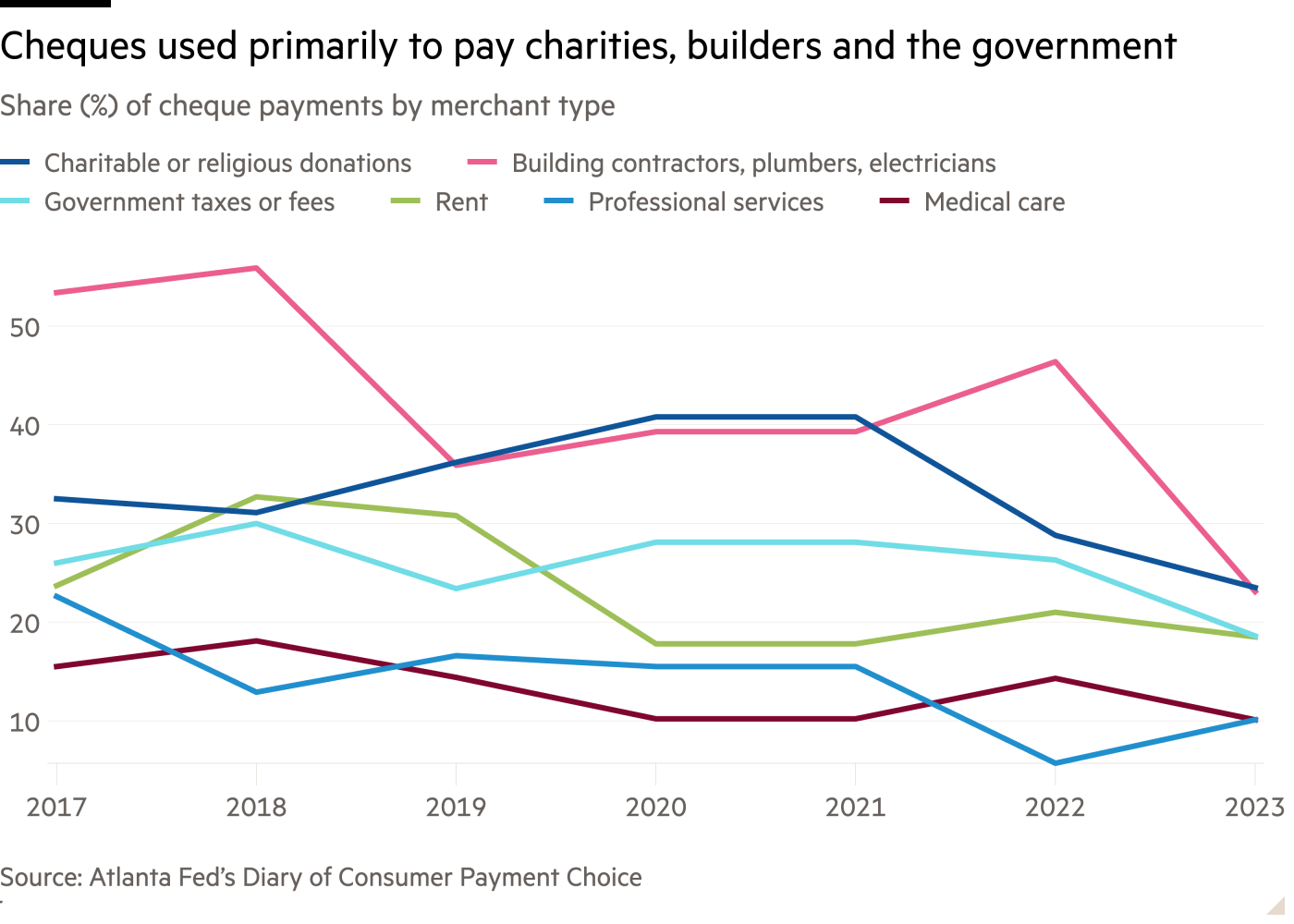
March 2025: The Trump Administration Pushed The Federal Government To Stop Accepting Paper Cheques By The End Of September 2025. According to the Financial Times, “The Trump administration wants to stamp out one of Americans’ enduring financial pastimes: writing cheques. Americans are the global leaders in cheques, writing 10 times that of Britain, Australia, Italy, Germany and France combined, according to estimates by McKinsey. But now, years after the likes of Finland and Denmark abolished them, the US is stepping up efforts to wean the country off of paper cheques. In an executive order last month, the White House mandated the federal government to cease issuing or accepting cheques where it is legal to do so starting from the end of September. The motives behind President Donald Trump’s administration’s war on cheques are clear. Cheques are more expensive to print and post than electronic transfers, more susceptible to fraud and less likely to make it to the intended recipient.” [Financial Times, 2025-04-21]
2023: Almost 20 Percent Of Payments To The Federal Government Was Done As A Paper Cheque. According to the Financial Times, “Despite its drawbacks, the paper cheque has remained stubbornly resilient in the US, particularly for sending money to the government. Almost one in five payments to the government was by cheque in 2023, according to data from the Atlanta branch of the Federal Reserve.” [Financial Times, 2025-04-21]
High Swipe Fees Have Incentives Small Businesses To Push For The Continued Use Of Cheques. According to the Financial Times, “American banks are also reluctant to lose out on credit and debit card fees, which are higher in the US, making them slow to push for direct account to account payments that could rival cheques. In the European Union, interchange rates are capped at 0.2 per cent for debit cards and 0.3 per cent for credit; in the US, the fees charged per swipe typically exceed 1 per cent. Small businesses are among the biggest proponents of cheques to avoid card fees. Contractors like builders and plumbers in the US received about 23 per cent of their payments via cheque, according to the Atlanta Fed data.” [Financial Times, 2025-04-21]
 [Bloomberg,
  [Financial Times,
  [Financial Times,
  [Bloomberg,
  [Financial Times,