April 30, 2025

Macrofinancial Outlook for the Day
Published

April 30, 2025

Summary

The biggest economic news of the day is the decline in real GDP in the first quarter of 2025, which is the first such occurrence since 2022. This contraction coincides with the implementation of President Trump’s trade policies, particularly new tariffs. The report highlights several concerning economic indicators: inflation has reached its highest rate since 2023, employment growth has slowed significantly, manufacturing companies are expressing concerns about tariffs, and financial markets have experienced substantial volatility. New research also sheds light on the long-term economic damage that could result from proposed cuts to federal R&D spending.

In other news common to days ending in Y, more Trump administration corrupt practices seem to be emerging, including meetings between administration officials and major hedge funds, potential conflicts of interest involving the Trump family’s cryptocurrency ventures (World Liberty Financial), and legislative proposals that would consolidate regulatory power within the executive branch.

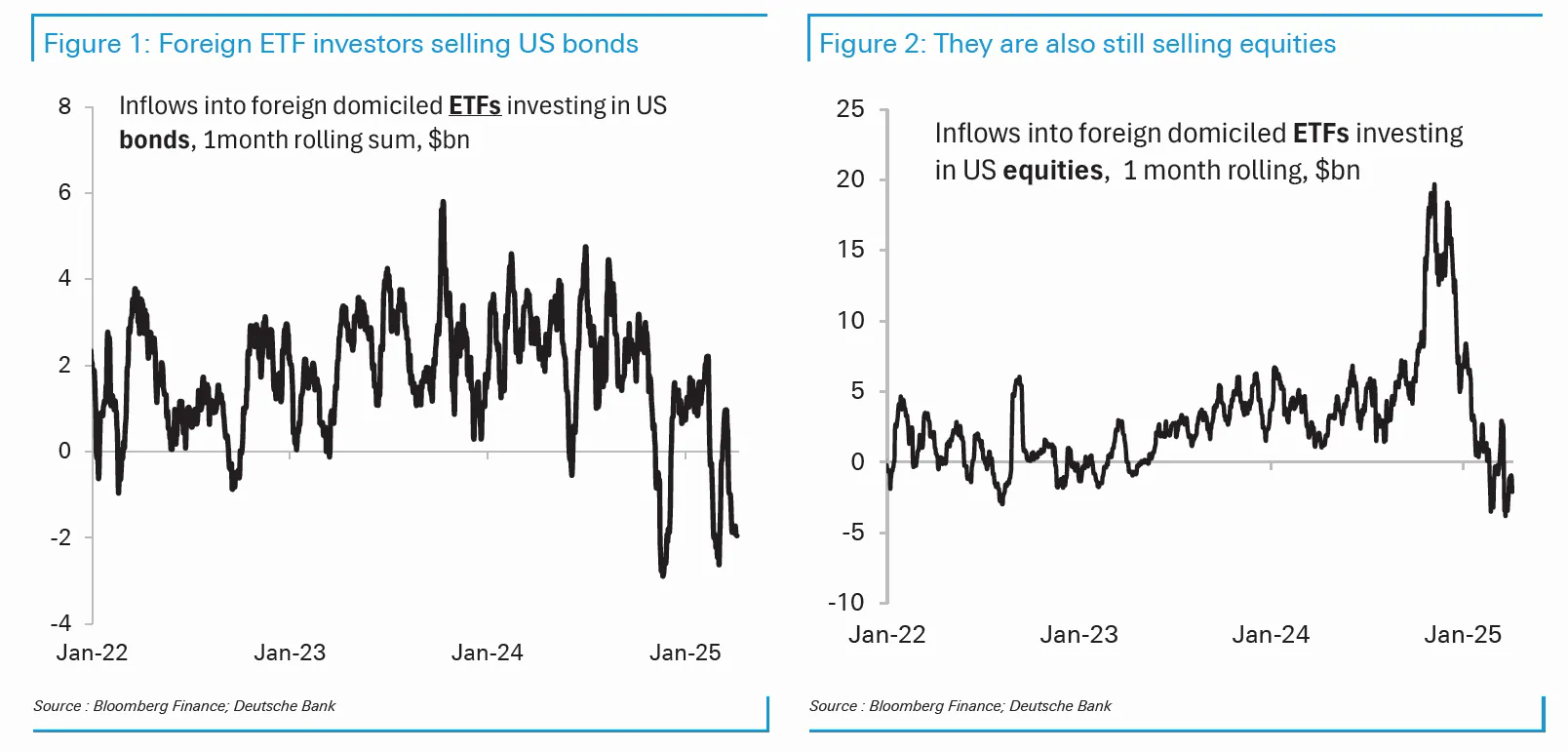
While there doesn’t seem to be another surge in it, capital flight from US markets seems to be continuing, with Deutsche Bank data showing declining foreign investment in US assets through ETFs domiciled outside America.

Shrinking Economy

Income

Q1 2025: The Real Economy Shrank For The First Time Since 2022 As Trump’s Shocks Began To Move Through The Economy. According to Bloomberg, “The US economy contracted at the start of the year for the first time since 2022 on a monumental pre-tariffs import surge and more moderate consumer spending, a first snapshot of the ripple effects from President Donald Trump’s trade policy. Inflation-adjusted gross domestic product decreased an annualized 0.3% in the first quarter, well below average growth of about 3% in the prior two years, according to the government’s initial estimate published Wednesday.” [Bloomberg, 2025-04-30]

Code
include("../scripts/oxocarbon-plot.jl")
theme(:oxocarbon)
using FredData, DataFrames, Dates
key = ENV["FRED_API_KEY"]
f = Fred(key)
per_capita = get_data(f, "A939RX0Q048SBEA"; observation_start="2021-01-01", observation_end="2025-03-01", units="cch").data
national = get_data(f, "GDPC1"; observation_start="2021-01-01", observation_end="2025-03-01", units="cch").data
plot(per_capita.date .+ Month(3), per_capita.value,
title="Q1 2025: National And Per Capita Real Income Fell",
xlabel="Quarter Ending",
ylabel="Annualized Rate of Change, Percent",
label="Per Capita")
plot!(national.date .+ Month(3), national.value, label="National")
hline!([0.0], linestyle=:dash, label="")
Code
deflator = get_data(f, "GDPDEF"; observation_start="2023-01-01", observation_end="2025-03-01", units="pc1").data
plot(deflator.date .+ Month(3), deflator.value, xlabel = "Quarter Ending", ylabel = "Inflation Rate", label = "GDP Deflator", title="Q1 2025: Inflation Hit The Highest Rate Since 2023")
hline!([deflator.value[end]], linestyle=:dash, label="")

Employment

April 2025: “Unease Is The Word Of The Day,” ADP Chief Economist Nela Richardson Noted Uncertainty Weighing On Hiring. According to ADP, “‘Unease is the word of the day. Employers are trying to reconcile policy and consumer uncertainty with a run of mostly positive economic data,’ said Dr. Nela Richardson, chief economist, ADP. ‘It can be difficult to make hiring decisions in such an environment.’” [ADP, 2025-04-30]

Code
adp = get_data(f, "ADPWNUSNERSA"; observation_start = "2024-03-14", observation_end="2025-04-14", units="chg").data
dates = push!(adp.date, Date(2025,4,15))
emp = push!(adp.value, 62000)
plot(dates, emp ./ 1000, xlabel = "Month", ylabel = "Employment Change (Thousands)", title = "APD Employment Growth Slowed in April", label = "ADP Employment Change", legend=:topleft)
hline!([0.0], linestyle=:dash, label="")
vline!([Date(2025,1,20)], linestyle=:dash, label="Inauguration")
vline!([Date(2025,4,2)], linestyle=:dash, label="Tariffs")

A 25 Percent Cut In Federal R&D Spending Could Have A Similar Impact On The Economy To The Great Recession

A 25 Percent Cut In Public Support For Research And Development Could Cause A 3.8 Percent Long-Run Reduction In Output, A Similar Effect To The Great Recession. According to the New York Times, “Cutting federal funding for scientific research could cause long-run economic damage equivalent to a major recession, according to a new study from researchers at American University. In recent months, the Trump administration has sought to cancel or freeze billions of dollars in grants to scientists at Columbia, Harvard and other universities, and has moved to sharply curtail funding for academic medical centers and other institutions. Deeper cuts could be on the way. As soon as this week, the White House is expected to propose sharp reductions in discretionary spending, including on research and development, as part of the annual budget process. Economists have warned that such cuts could undermine American competitiveness in areas like vaccine development, artificial intelligence and quantum computing, and could slow growth in income and productivity in the long term. The private sector can’t fully replace government dollars, they argue, because basic research is too risky and takes too long to pay off to attract sufficient private investment. The study, by a team of economists at American University’s Institute for Macroeconomic and Policy Analysis, is among the first efforts to quantify the risks posed by Mr. Trump’s cuts. Because the full extent of the administration’s plans is not yet clear, the researchers studied a range of scenarios. Even the mildest approach — a 25 percent reduction in public support for research and development — would correlate to a drop in economic output. U.S. gross domestic product, adjusted for inflation, would be 3.8 percent smaller in the long term — a decline similar in magnitude to that in the Great Recession, which ended in 2009. The drop in output would be much more gradual than that downturn, taking place over years rather than months. But it would also be more lasting. Cuts to scientific research would sap innovation, leading to slower productivity growth and, as a result, permanently lower economic output.” [New York Times, 2025-04-30]

  • A 25 Percent Cut To Federal Research And Development Funding Could Lead To An Even Larger Reduction In Tax Revenues. According to the New York Times, “A smaller economy also means less income for the government to tax. As a result, while cutting investment could save money in the short run, it could leave the federal budget in worse shape over the longer term. The researchers estimate that a 25 percent cut to research funding would reduce government revenues 4.3 percent in the long term.” [New York Times, 2025-04-30]

  • A 50 Percent Cut To Federal Research And Development Funding Could Reduce Long Run Output By More Than Any Decline Since The Great Depression. According to the New York Times, “Larger funding cuts would have even greater effects. A 50 percent reduction in funding would lower gross domestic product nearly 7.6 percent, the researchers estimate, and a 75 percent cut would reduce it 11.3 percent — a larger decline than in any recession since the Great Depression.” [New York Times, 2025-04-30]

Trade War

Manufacturing

National Association Of Manufacturers President: “I Think Manufacturers Are Very Concerned” About Trump’s Tariffs. According to Bloomberg, “Speak to managers, and the picture that emerges quickly is that Trump’s tariffs—and the whiplash-inducing trade policies of his first 100 days—are making things more difficult. Companies ranging from giants such as Ford, Ingersoll Rand and Tesla to mom-and-pop outfits have filed more than 1,100 requests to be excluded from the duties of 145% or more that are now in place on Chinese machinery they want to import to set up or expand US factories. “To be very blunt about it, I think manufacturers are very concerned” about tariffs, Jay Timmons, president and chief executive officer of the National Association of Manufacturers, said in an April 17 interview on Bloomberg Radio.” [Bloomberg, 2025-04-29]

Will The Factory Building Boom Continue Under Trump?

Code
inv = get_data(f, "C307RX1Q020SBEA"; observation_start = "2014-06-01", observation_end="2024-12-01").data
prelim_ratio = 210.869 / 213.192
bar(inv.date .+ Month(3), inv.value,
    title = "Will Factory Building Continue To Boom?",
    xlabel = "Quarter Ending",
    ylabel = "\$ Billion, 2017 Chained",
    label="Manufacturing Structure Investment")
bar!([Date(2025,3,1)], [prelim_ratio * inv.value[end]],
    label="2025 Q1 Advanced Estimate",
    color=colorant"#FF6F00",
     bar_width=25)

NOTE: FRED had not updated with the advanced data yet, so I had to make my calculations based on the BEA’s NIPA Tables

Uncertainty And Its Consequences

Uncertainty Driven By Trump’s Trade War Has Led Major Companies Like GM, JetBlue, And Volvo To Pull Their Forward Guidance. According to the Wall Street Journal, “A new wave of major U.S. and European companies, including General Motors, JetBlue, Snap and Volvo, are warning that the trade war’s unknowable course and consequences make it futile to forecast future performance. GM, JetBlue and Volvo all shelved earlier profit guidance for 2025 due to economic uncertainty. The shape-shifting nature of President Trump’s automotive duties have clouded the outlook, GM said, while JetBlue predicted that softer demand would plague the airline into the summer. Snapchat parent company Snap said it wouldn’t issue guidance like it normally does and warned the social-media platform could suffer from an advertising slump. UPS didn’t update its outlook, though it predicted lower shipping volumes and revenue for the second quarter. It also announced 20,000 workers would be laid off.” [Wall Street Journal, 2025-04-29]

A Terrible Starting Stock Market

WSJ Headline: Trump’s First 100 Days Were Worst For Dow, S&P 500 Since Nixon. [Wall Street Journal, 2025-04-29]

For The Smaller Companies In The Russell 2000, Trump’s First 100 Days Were The Worst Start To A Presidency On Record. According to the Wall Street Journal, “The Russell 2000 gauge of smaller stocks is down 13.2%. That was its worst first 100-day period to start a presidency on record.” [Wall Street Journal, 2025-04-29]

Incompetence

Alternative Asset Managers Noted That Trump CEA Chair Miran Was “Out Of His Depth” In An Attempt To Reassure Them About The Administration’s Policies. According to the Financial Times, “Donald Trump’s top economic adviser Stephen Miran struggled to reassure leading bond investors in a meeting last week that followed a bout of intense tumult on Wall Street triggered by the president’s tariffs. Miran, chair of the Council of Economic Advisers, met representatives from top hedge funds and other major investors at the White House’s Eisenhower Executive Office building on Friday, said people with direct knowledge of the matter. Some participants found Friday’s meeting counter-productive, with two people describing Miran’s comments around tariffs and markets as ‘incoherent’ or incomplete, and one of them saying Miran was ‘out of his depth’. ‘[Miran] got questions and that’s when it fell apart,’ said one person familiar with the meeting. ‘When you”re with an audience that knows a lot, the talking points are taken apart pretty quickly.’ Another person familiar with the meeting was more encouraged by the administration’s approach to deregulation and tax cuts. The roughly 15 attendees included representatives of hedge funds Balyasny, Tudor and Citadel, as well as asset managers PGIM and BlackRock. The event, convened by Citigroup, was timed to coincide with the IMF’s spring meeting.” [Financial Times, 2025-04-29]

Alienating Consumers

As The Trump Administration Has Alienated People Around The World From Consuming Coca-Cola. “There Is A Level Of Consumer Boycott Around The US Brands.” According to the Financial Times, “Consumers in Denmark and Mexico, as well as some in the US, are drinking less Coca-Cola as a result of President Donald Trump’s hardline foreign policies and his tough stance on immigration. Danish consumers are boycotting Coca-Cola amid anger at Trump’s threats to take Denmark’s territory of Greenland. Meanwhile, Coca-Cola attributed a slowdown in consumption in Mexico partly to geopolitical tensions, and Hispanic customers in the US bought less as the White House threatens mass deportations of immigrants. Carlsberg, which bottles Coca-Cola in Denmark, on Tuesday said volumes of the American soft drink were ‘slightly down’ in the country. ‘There is a level of consumer boycott around the US brands . . . and it’s the only market where we’re seeing that to a large extent,’ chief executive Jacob Aarup-Andersen said on Tuesday.” [Financial Times, 2025-04-29]

Search For Greater Fools

April 2025: Capital Group And KKR Announced Plans To Launch Funds To Bring Retail Money Into Private Markets. According to the Financial Times, “Capital Group and KKR are set to launch new funds spanning private loans, corporate buyouts, and infrastructure and property deals in the latest tie-up between big traditional asset managers and private capital firms. Los Angeles-based Capital Group — the world’s biggest active asset manager — and private equity giant KKR have agreed to jointly offer a wide range of funds for individual investors that will mix traditional stocks and bonds with unlisted assets such as corporate takeovers. The groups will launch their first two debt funds on Tuesday, and offer strategies combining listed stocks with buyouts as soon as 2026, in addition to other funds dedicated to real estate and infrastructure, top executives from each company told the Financial Times. Alternative firms are racing to manage money for private individuals who have minimal exposure to unlisted assets, compared with pension funds, which have significant private market exposure. Meanwhile, traditional investment houses are keen to push into private markets, which hold the potential for higher returns but often carry greater risks and fees.” [Financial Times, 2025-04-29]

  • While These Funds Will Have A Low Minimum Investment, They Will Have Higher Fees Than Typical Active ETFs, And Restrictions On Selling. According to the Financial Times, “The groups” first two fixed income funds launching this week have a minimum investment of $1,000, opening them to a greater number of investors, fees of 0.84 percentage points for a ‘Core Plus+’ fund and 0.89 percentage points for a ‘Multi-Sector+’ fund. The funds” fees are ‘significantly lower’ than other competing private funds, said Morningstar analyst Karen Zaya. The average adjusted expense ratio for all share classes of similar ‘interval’ funds stood at 2.49 per cent. But they are higher than the 0.58 per cent cost of exchange traded funds, which are broadly focused on public markets. Capital and KKR’s funds will offer investors only a limited ability to sell their shares in full, a trade-off viewed by the industry as a necessary protection given their investments in harder to sell private assets. The funds plan to allocate 40 per cent of the portfolio to private assets, with the remainder invested in more easily sellable publicly traded debt. They offer investors the right to redeem up to 10 per cent quarterly, double most interval funds.” [Financial Times, 2025-04-29]

Context

A few weeks ago, I wrote about the struggles of the Private Equity industry. Retail investors are a new class that has not been able to access their funds typically, and I see vehicles like these as an easy way to use that money to replace the institutional money that those firms have relied on.

Corruption

April 2025: As Financial Markets Have Been Rocked By Instability, Trump CEA Chair Miran Held A Closed Door Meeting With Major Hedge Funds. According to the Financial Times, “Donald Trump’s top economic adviser Stephen Miran struggled to reassure leading bond investors in a meeting last week that followed a bout of intense tumult on Wall Street triggered by the president’s tariffs. Miran, chair of the Council of Economic Advisers, met representatives from top hedge funds and other major investors at the White House’s Eisenhower Executive Office building on Friday, said people with direct knowledge of the matter. Some participants found Friday’s meeting counter-productive, with two people describing Miran’s comments around tariffs and markets as ‘incoherent’ or incomplete, and one of them saying Miran was ‘out of his depth’. ‘[Miran] got questions and that’s when it fell apart,’ said one person familiar with the meeting. ‘When you”re with an audience that knows a lot, the talking points are taken apart pretty quickly.’ Another person familiar with the meeting was more encouraged by the administration’s approach to deregulation and tax cuts. The roughly 15 attendees included representatives of hedge funds Balyasny, Tudor and Citadel, as well as asset managers PGIM and BlackRock. The event, convened by Citigroup, was timed to coincide with the IMF’s spring meeting.” [Financial Times, 2025-04-29]

Crypto Ventures To Profit The Trump Family

While Trump Family Entities Own 60 Percent Of World Liberty Financial, They Are Entitled To 75 Percent Of Some Coin Sale Revenue. According to the New York Times, “Still, the company’s deal-making benefits the president’s family. A Trump business entity owns 60 percent of World Liberty, according to the company’s website, and is entitled to 75 percent of certain revenue from coin sales, which could be converted into cash.” [New York Times, 2025-04-29]

While World Liberty Struggled To Sell Their Tokens Before The Election, After The Result They Were Able To Sell, Espeically To International Buyers. According to the New York Times, “World Liberty, at least according to its marketing pitch, eventually plans to operate as a new type of internet bank that would allow customers to borrow and lend money in various digital currencies. Anyone who bought the $WLFI coins would get to vote on certain bank business decisions like shareholders in a traditional company. Mr. Trump was at the core of the pitch. The company published a 13-page ‘Gold Paper’ that described its mission and leadership team. On the cover was a portrait of Mr. Trump, styled to look as if gold paint had been splashed across the page. He would serve as the company’s ‘Chief Crypto Advocate,’ the paper said. When World Liberty launched, the Trump family and its affiliates were given 22.5 billion units of the crypto coins — a stash now worth at least $1.1 billion on paper, depending on the various prices used in recent sales. Under the company’s rules, the Trumps and other World Liberty investors are not allowed to sell their coins on the open market, though the company has said it might eventually lift that restriction if other buyers of the coin agree. Initially, there were few buyers. By the end of October, World Liberty had sold only $2.7 million worth of the coins, a tiny fraction of its goal. Election Day was a game changer. With polls closed in most of America and Mr. Trump on his way to victory, the World Liberty account on X posted a celebratory message on Nov. 5: ‘Big things on the horizon.’ Soon a surge of investment flowed into World Liberty’s cryptocurrency. Most crypto purchases are recorded on a public ledger called the blockchain, with the buyers and sellers largely anonymized. But World Liberty has said it performs extensive checks on investors in its coin, so it knows who they are. An analysis performed for The Times by the forensics firm Nansen, drawing on crypto industry data, showed that many of the investors were based abroad in places like Singapore, South Korea, Hong Kong and the United Arab Emirates. Federal law prevents foreigners from donating to presidential campaigns or inaugural funds, but World Liberty’s coin sale offered a new, legal way to back Mr. Trump.” [New York Times, 2025-04-29]

  • Buyers Of The Tokens Included People With Business Before The Federal Government. According to the New York Times, “Some investors, domestic and overseas, have managed firms that ran afoul of U.S. regulations. One was Yoni Assia, an Israeli who founded eToro, an online trading platform whose U.S. subsidiary reached a $1.5 million settlement with the S.E.C. last year for crypto-related violations. Troy Murray, a Puerto Rico-based investor, also bought World Liberty’s coin. Before that, he had helped create BarnBridge, which in late 2023 agreed to pay the S.E.C. $1.7 million to settle its own crypto-related accusations. Since Mr. Trump took office, some World Liberty investors have pushed the government for regulatory approvals, or are poised to interact with the administration as they try to build or expand businesses in the United States.” [New York Times, 2025-04-29]

  • Justin Sun, A Chinese Cryptocurrency Billionaire Who Had Been Prosecuted By The SEC, Purchased $75 Million Of The Token Before The Trump SEC Haled Proceedings. According to the New York Times, “Mr. Sun gained global attention late last year, when he spent $6.2 million at an art auction to buy a banana that had been duct taped to a wall. Not long after, Mr. Sun made another headline-grabbing maneuver: He spent $75 million on $WLFI coins. The investment drew widespread criticism given that Mr. Sun had a clear incentive to gain favor with the Trump White House. During the Biden administration, the S.E.C. sued Mr. Sun, arguing that he had fraudulently inflated the price of a Tron cryptocurrency. Mr. Sun has denied the S.E.C.’s charges, and in a text message to The Times last year, he said his World Liberty investment was simply a vote of confidence in the Trump family’s ‘excellent project.’ In late February, the S.E.C. asked a federal judge to halt proceedings in Mr. Sun’s case: The agency said it was exploring ‘a potential resolution.’ The judge granted the stay.” [New York Times, 2025-04-29]

After The Election, World Liberty Pitched Endorsement For Sale, Capitalizing On Its Closeness With Trump. According to the New York Times, “But Mr. Trump’s company wanted more money. Much more. So World Liberty executives soon announced what they called ‘a transformative initiative’ to partner with other crypto outfits and invest in their coins. The strategy, the executives said in February, would leverage World Liberty’s growing clout to help their lesser-known partners. ‘It’s like taking care of your brother in the space,’ Mr. Herro said at a crypto event in New York that month. But World Liberty’s public pronouncements omitted a key aspect of its private pitch to several crypto startups, executives at these companies told The Times. World Liberty wanted to sell its own coin — not just to invest in others”. It was proposing a currency swap. Here is the deal World Liberty offered, according to executives at three crypto firms approached by the company: The startups would spend between $10 million and $30 million on a large chunk of World Liberty’s coins. In return, World Liberty would buy a smaller amount of each startup’s own cryptocurrency. World Liberty would keep the rest of the money for itself — a premium as high as 20 percent. World Liberty’s purchases would signal to the market that Mr. Trump’s firm had deemed the startups worthy of investment. But the market would have no way of knowing that World Liberty had been compensated for that endorsement. Some details of a similar pitch from World Liberty were previously reported by Blockworks, an industry news outlet. ‘They kept telling us, “We’re like, we’re super close to Trump,”’ said Mike Silagadze, the chief executive of Ether.Fi, a crypto startup that World Liberty approached. ‘We immediately rejected,’ said Dominik Schiener, who founded the IOTA Foundation, a Berlin-based group that also received the pitch. ‘It’s a very dishonest approach.’” [New York Times, 2025-04-29]

One Partnership, With Ethena Labs, Predated Trump’s Pardon Of One Of Its Investors Who Violated The Bank Secrecy Act. According to the New York Times, “Other World Liberty partnerships have shown how Mr. Trump is mixing his official role with his business. In December, the company announced that it would use technology designed by a startup based in Lisbon, Ethena Labs. It also bought more than $5 million of Ethena’s cryptocurrency. One of Ethena’s investors is Arthur Hayes, a crypto entrepreneur who pleaded guilty to violating the Bank Secrecy Act in 2022 and was sentenced to six months of home detention. Last month, Mr. Trump granted Mr. Hayes a pardon. (A spokesman who represents both Ethena and Mr. Hayes declined to comment.)” [New York Times, 2025-04-29]

A World Liberty Partner Backed By Peter Thiel Gave $1 Million To Trump’s Inauguration. According to the New York Times, “Another World Liberty partner is Ondo Finance, a New York-based startup backed by Founders Fund, the conservative billionaire Peter Thiel’s venture capital firm. World Liberty made its first purchase of Ondo’s coins in December, buying more than 130,000 of them. The transaction at least briefly helped drive up the price of Ondo’s coin, drawing headlines in crypto news sites celebrating World Liberty’s bet. In January, Ondo donated $1 million to Mr. Trump’s inauguration, securing an invite to a candlelight dinner at the National Building Museum in Washington, where the guest list included several of Mr. Trump’s cabinet nominees. Ondo also helped sponsor an inauguration event called the Crypto Ball. Soon after, Donald Trump Jr. and World Liberty’s management team were headliners at a conference Ondo organized in New York. ‘This is a moment we weren’t sure was gonna happen,’ Ian De Bode, Ondo’s chief strategy officer, said from the stage. ‘But sometimes the stars align.’” [New York Times, 2025-04-29]

February 2025: Trump’s Announcement Of A “Crypto Reserve” Was Predated By A Tweet From Eric And World Liberty’s Purchases

After Trump Announced That Ether Would Be Part Of His “Crypto Reserve,” Its Price Surged 13 Percent. According to the New York Times, “The next month, his father announced the creation of a ‘U.S. Crypto Reserve’ — a Fort Knox-like repository of cryptocurrencies intended to help bolster the industry. Mr. Trump’s announcement included a list of digital currencies to go into the stockpile. Along with Bitcoin, he included Ether, saying it would be ‘at the heart of the Reserve.’ Ether’s price surged more than 13 percent.” [New York Times, 2025-04-29]

  • In The Months Before The Announcement, World Liberty Had Put $240 Million Into Ether. According to the New York Times, “he spike had an immediate beneficiary: World Liberty. Over the previous few months, the company had bought $240 million worth of Ether, according to Arkham, a crypto data firm. The day the president announced the crypto reserve, the value of World Liberty’s Ether stash rose by $33 million, assuming it had not sold any of its holdings.” [New York Times, 2025-04-29]

  • Before The Announcement, Eric Trump Tweeted That It Was A Good Time To Buy Ether. “You Can Thank Me Later.” According to the New York Times, “In February, Eric Trump passed along some investment advice to his followers on Elon Musk’s social media platform, X: ‘In my opinion, it’s a great time to add $ETH.’ It was the ticker symbol for a digital coin called Ether. ‘You can thank me later,’ he added, before deleting that line.” [New York Times, 2025-04-29]

Giving Trump More Regulatory Power

April 2025: House Judiciary Committee Republicans Adopted Legislation Giving The DOJ The FTC’s Antitrust Enforcement Power, Taking It Away From A More Politically Insulated Agency. According to Politico, “It was widely expected that congressional Republicans would use the GOP’s sweeping domestic policy bill to cut taxes, boost border security and slash federal spending. They’re also proposing to hand President Donald Trump a broad new swath of executive power. A legislative draft released by the House Judiciary Committee Monday and set to be adopted at a committee meeting Wednesday would consolidate the federal government’s antitrust enforcement powers at the Justice Department, taking them away from the independent Federal Trade Commission. And it would also supercharge the GOP’s deregulatory agenda, allowing Republicans to potentially overturn reams of government regulations during the remainder of Trump’s term.” [Politico, 2025-04-29]

April 2025: House Judiciary Committee Republicans Adopted Legislation That Would Give The President The Unilateral Authority To Eliminate Older Regulations, Without Any Formal Deregulatory Process. According to Politico, “But the scope of the proposal is hardly modest. It includes a version of the REINS Act — short for ‘Regulations from the Executive in Need of Scrutiny’ — which has percolated inside the GOP for more than a decade. Conservatives have long championed the proposal, which would essentially turn the federal regulatory process on its head: While Congress now has the opportunity to veto most agency rules, REINS would require Congress to affirmatively approve major new regulations. Republicans are selling the measure as a way to check presidential power, not expand it. ‘It’s a reassertion of Article I authority that Congress constitutionally has and has long since forgotten,’ said Rep. Kat Cammack (R-Fla.), a lead co-sponsor of the bill. But a key provision included in the bill would grant Trump sweeping powers to erase existing federal regulations from the books. It would task federal agencies with submitting portions of their rules to Congress for approval over a five-year period. Absent that approval, the rules would cease to have effect — in essence, fast-tracking Trump’s deregulatory agenda.” [Politico, 2025-04-29]
Motivated Policymaking

ProPublica Headline: A DOGE Aide Involved In Dismantling Consumer Bureau Owns Stock In Companies That Could Benefit From The Cuts. [ProPublica, 2025-04-29]

Capital Flight

Deutsche Bank: Inflows Into Foreign ETFs Holding U.S. Assets Have Dropped Off. According to Bloomberg, “Something ominous is happening in US markets. Even as bonds and stocks recover from their massive selloff earlier this months, it looks like foreign investors are continuing to sell American assets. That’s according to Deutsche Bank’s George Saravelos, who’s created a proxy measure to follow the slow run on American assets in real-time (or as near as we can get). He’s looking at flows data for ETFs that invest in US stocks and bonds, but which are domiciled outside of America. And on that basis, things don’t look great.” [Bloomberg, 2025-04-29]